SUBSCRIBE TO OUR FREE NEWSLETTER
Daily news & progressive opinion—funded by the people, not the corporations—delivered straight to your inbox.
5
#000000
#FFFFFF
To donate by check, phone, or other method, see our More Ways to Give page.
Daily news & progressive opinion—funded by the people, not the corporations—delivered straight to your inbox.
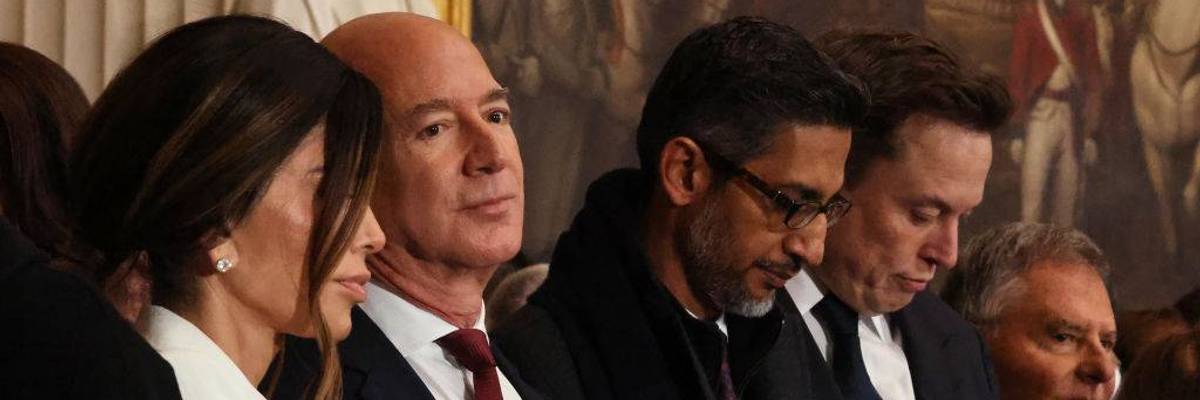
Amazon and Blue Origin founder Jeff Bezos, Google CEO Sundar Pichai and Tesla CEO Elon Musk attend the inauguration of President Donald Trump on January 20, 2025 in Washington, DC.
"Debate about how much tax billionaires pay is likely to grow as America’s fiscal situation deteriorates and its wealth gap widens."
A report published Wednesday by the Rupert Murdoch-owned Wall Street Journal outlined how billionaires' tax evasion schemes are causing problems for the US economy.
The report, written by London-based columnist Carol Ryan, began by noting how completely the US economy has come to depend on the spending habits of its richest households, whose wealth is primarily tied to the fortunes of the stock market, which "could mean the entire economy pays a steep price in the next market correction."
Ryan then walked through some of the plusses and minuses of the wealth tax being debated in the state of California, which has more billionaires than any state in the nation.
Even while personally finding flaws with the California proposal, Ryan said that plans to extract wealth from the super-rich aren't going away, even if the California tax plan is ultimately defeated.
"Debate about how much tax billionaires pay is likely to grow as America’s fiscal situation deteriorates and its wealth gap widens," Ryan wrote. "Data from the Federal Reserve shows that only the richest 1% of households have grown their share of overall US wealth since 1990."
Ryan also broke down how the very richest Americans have tax evasion options that mere multimillionaires don't have.
"A common strategy is to avoid salaries, which are heavily taxed," she wrote. "Billionaires prefer to be paid in shares, which are subject to capital-gains taxes when sold. But they don’t need to sell to fund their lifestyles. Billionaires use borrowed money for living expenses, pledging their shares or other assets as collateral."
Ryan added that "the interest on the debt is much lower than a capital-gains tax bill would be," and billionaires compound this wealth by passing it off to their children as part of a “buy borrow die” tax avoidance plan.
Boston College law professor Ray Madoff told Ryan that the wealth at the very top has grown so concentrated that even "very well-off Americans with high incomes" are now aligned "much more with the middle class" than in the past.
Ryan's report isn't the only one published by the Journal in recent weeks to warn of dangerous levels of US wealth inequality.
Chief Wall Street Journal economics commentator Greg Ip last week posted data showing that corporate profits' share of gross domestic income is now the highest it has been in more than 40 years, while the share of income paid out in workers' wages is at the lowest.
"Profits have soared since the pandemic, and the market value attached to those profits even more," wrote Ip. "The result: Capital, which includes businesses, shareholders, and superstar employees, is triumphant, while the average worker ekes out marginal gains."
Ip also said that this problem could grow worse if artificial intelligence lives up to its creators' hype and starts replacing human workers on a mass scale.
In such a scenario, wrote Ip, the "biggest winners" of the economy would be shareholders who, as Ryan explained in her piece, have ample tools to avoid paying taxes.
Dear Common Dreams reader, It’s been nearly 30 years since I co-founded Common Dreams with my late wife, Lina Newhouser. We had the radical notion that journalism should serve the public good, not corporate profits. It was clear to us from the outset what it would take to build such a project. No paid advertisements. No corporate sponsors. No millionaire publisher telling us what to think or do. Many people said we wouldn't last a year, but we proved those doubters wrong. Together with a tremendous team of journalists and dedicated staff, we built an independent media outlet free from the constraints of profits and corporate control. Our mission has always been simple: To inform. To inspire. To ignite change for the common good. Building Common Dreams was not easy. Our survival was never guaranteed. When you take on the most powerful forces—Wall Street greed, fossil fuel industry destruction, Big Tech lobbyists, and uber-rich oligarchs who have spent billions upon billions rigging the economy and democracy in their favor—the only bulwark you have is supporters who believe in your work. But here’s the urgent message from me today. It's never been this bad out there. And it's never been this hard to keep us going. At the very moment Common Dreams is most needed, the threats we face are intensifying. We need your support now more than ever. We don't accept corporate advertising and never will. We don't have a paywall because we don't think people should be blocked from critical news based on their ability to pay. Everything we do is funded by the donations of readers like you. When everyone does the little they can afford, we are strong. But if that support retreats or dries up, so do we. Will you donate now to make sure Common Dreams not only survives but thrives? —Craig Brown, Co-founder |
A report published Wednesday by the Rupert Murdoch-owned Wall Street Journal outlined how billionaires' tax evasion schemes are causing problems for the US economy.
The report, written by London-based columnist Carol Ryan, began by noting how completely the US economy has come to depend on the spending habits of its richest households, whose wealth is primarily tied to the fortunes of the stock market, which "could mean the entire economy pays a steep price in the next market correction."
Ryan then walked through some of the plusses and minuses of the wealth tax being debated in the state of California, which has more billionaires than any state in the nation.
Even while personally finding flaws with the California proposal, Ryan said that plans to extract wealth from the super-rich aren't going away, even if the California tax plan is ultimately defeated.
"Debate about how much tax billionaires pay is likely to grow as America’s fiscal situation deteriorates and its wealth gap widens," Ryan wrote. "Data from the Federal Reserve shows that only the richest 1% of households have grown their share of overall US wealth since 1990."
Ryan also broke down how the very richest Americans have tax evasion options that mere multimillionaires don't have.
"A common strategy is to avoid salaries, which are heavily taxed," she wrote. "Billionaires prefer to be paid in shares, which are subject to capital-gains taxes when sold. But they don’t need to sell to fund their lifestyles. Billionaires use borrowed money for living expenses, pledging their shares or other assets as collateral."
Ryan added that "the interest on the debt is much lower than a capital-gains tax bill would be," and billionaires compound this wealth by passing it off to their children as part of a “buy borrow die” tax avoidance plan.
Boston College law professor Ray Madoff told Ryan that the wealth at the very top has grown so concentrated that even "very well-off Americans with high incomes" are now aligned "much more with the middle class" than in the past.
Ryan's report isn't the only one published by the Journal in recent weeks to warn of dangerous levels of US wealth inequality.
Chief Wall Street Journal economics commentator Greg Ip last week posted data showing that corporate profits' share of gross domestic income is now the highest it has been in more than 40 years, while the share of income paid out in workers' wages is at the lowest.
"Profits have soared since the pandemic, and the market value attached to those profits even more," wrote Ip. "The result: Capital, which includes businesses, shareholders, and superstar employees, is triumphant, while the average worker ekes out marginal gains."
Ip also said that this problem could grow worse if artificial intelligence lives up to its creators' hype and starts replacing human workers on a mass scale.
In such a scenario, wrote Ip, the "biggest winners" of the economy would be shareholders who, as Ryan explained in her piece, have ample tools to avoid paying taxes.
A report published Wednesday by the Rupert Murdoch-owned Wall Street Journal outlined how billionaires' tax evasion schemes are causing problems for the US economy.
The report, written by London-based columnist Carol Ryan, began by noting how completely the US economy has come to depend on the spending habits of its richest households, whose wealth is primarily tied to the fortunes of the stock market, which "could mean the entire economy pays a steep price in the next market correction."
Ryan then walked through some of the plusses and minuses of the wealth tax being debated in the state of California, which has more billionaires than any state in the nation.
Even while personally finding flaws with the California proposal, Ryan said that plans to extract wealth from the super-rich aren't going away, even if the California tax plan is ultimately defeated.
"Debate about how much tax billionaires pay is likely to grow as America’s fiscal situation deteriorates and its wealth gap widens," Ryan wrote. "Data from the Federal Reserve shows that only the richest 1% of households have grown their share of overall US wealth since 1990."
Ryan also broke down how the very richest Americans have tax evasion options that mere multimillionaires don't have.
"A common strategy is to avoid salaries, which are heavily taxed," she wrote. "Billionaires prefer to be paid in shares, which are subject to capital-gains taxes when sold. But they don’t need to sell to fund their lifestyles. Billionaires use borrowed money for living expenses, pledging their shares or other assets as collateral."
Ryan added that "the interest on the debt is much lower than a capital-gains tax bill would be," and billionaires compound this wealth by passing it off to their children as part of a “buy borrow die” tax avoidance plan.
Boston College law professor Ray Madoff told Ryan that the wealth at the very top has grown so concentrated that even "very well-off Americans with high incomes" are now aligned "much more with the middle class" than in the past.
Ryan's report isn't the only one published by the Journal in recent weeks to warn of dangerous levels of US wealth inequality.
Chief Wall Street Journal economics commentator Greg Ip last week posted data showing that corporate profits' share of gross domestic income is now the highest it has been in more than 40 years, while the share of income paid out in workers' wages is at the lowest.
"Profits have soared since the pandemic, and the market value attached to those profits even more," wrote Ip. "The result: Capital, which includes businesses, shareholders, and superstar employees, is triumphant, while the average worker ekes out marginal gains."
Ip also said that this problem could grow worse if artificial intelligence lives up to its creators' hype and starts replacing human workers on a mass scale.
In such a scenario, wrote Ip, the "biggest winners" of the economy would be shareholders who, as Ryan explained in her piece, have ample tools to avoid paying taxes.