SUBSCRIBE TO OUR FREE NEWSLETTER
Daily news & progressive opinion—funded by the people, not the corporations—delivered straight to your inbox.
5
#000000
#FFFFFF
To donate by check, phone, or other method, see our More Ways to Give page.
Daily news & progressive opinion—funded by the people, not the corporations—delivered straight to your inbox.
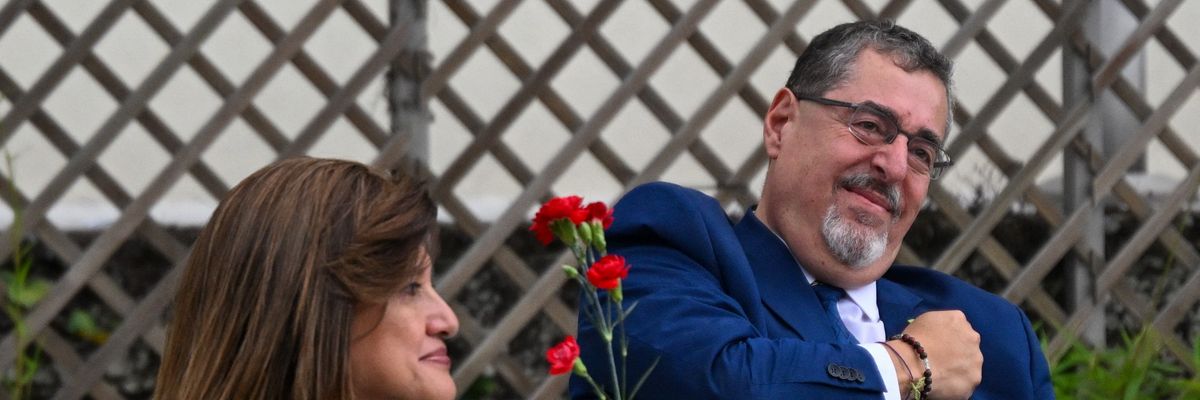
Guatemalan presidential candidate for the Movimiento Semilla party, Bernardo Arevalo, and his running mate, Karin Herrera, greet supporters in Guatemala City on July 13, 2023.
"The force of this victory is going to make it clear that there is no place for the attempts to derail the electoral process," Arévalo said following his win.
In a blow to Guatemala's right-wing political establishment, former diplomat Bernardo Arévalo won the nation's presidential election on Sunday, pledging to fight corruption that has eroded the country's institutions and entrenched massive levels of inequality and poverty.
Voters chose Arévalo over former first lady Sandra Torres in a landslide, putting the anti-corruption advocate on track to become the most progressive Guatemalan leader since Jacobo Árbenz, who was ousted in a U.S.-sponsored coup in 1954.
As The Washington Post noted, "Arévalo's father, Juan José, is widely known as a leader of the 'Guatemalan spring,' a period of democratic rule that began in 1944 when he was elected president." The ouster of Árbenz, Juan José's successor, marked the start of decades of brutal military rule bolstered by U.S. support.
The question now is whether Arévalo will be permitted to take office. Ahead of Sunday's contest, Guatemalan authorities barred several candidates from the ballot, including leftist Indigenous leader Thelma Cabrera.
During his victory speech late Sunday, Arévalo acknowledged possible efforts by Guatemala's political establishment to prevent him from assuming office.
"We know that there is a political persecution underway that is being carried out through the institutions and prosecutor's offices and judges that have been corruptly co-opted," Arévalo said, alluding to the nation's crackdowns on officials, journalists, and activists who have worked to combat graft.
"We want to think that the force of this victory is going to make it clear that there is no place for the attempts to derail the electoral process," said Arévalo. "The Guatemalan people have spoken forcefully."
Arévalo—who is set to be sworn in on January 14, 2024—stunned political observers when he came in second place in the first round of voting in late June. What followed offers a possible preview of coming efforts by political elites to block certification of Arévalo's win.
Rafael Curruchiche, a Guatemalan prosecutor who has himself been accused of corruption, pushed for the suspension of Arévalo's party following the first round of votes, claiming to have uncovered evidence that more than 5,000 signatures for the party's campaign were unlawfully obtained.
While Guatemala's Supreme Electoral Tribunal ultimately rejected Curruchiche's effort, citing laws preventing the suspension of political parties during the election process, the court's ruling could still be appealed to Guatemala's Constitutional Court.
Allan Nairn, an American investigative journalist who has covered Guatemala for decades, wrote before Sunday's election that in the case of an Arévalo victory, Guatemala's conservative elites "have made it clear that they will do what's needed to prevent" him from taking office.
"Merely winning the vote will not be enough; to take office he must first win big, and then many thousands will have to be ready to take to the streets if circumstances demand," Nairn added.
This country and this world are at a monumental crossroads. US voters have an opportunity to beat back the forces of fascism and confront the billionaires who are rigging the economy, our media system, and our democracy, making it increasingly impossible for ordinary people to get by. We’re not just talking about the election. We’re talking about what must be done once these fascist elements are vanquished from power. We need a bolder set of solutions than what either major party has so far been willing to offer and a working-class movement ready to fight like hell for it. Trump didn't emerge from nowhere. The conditions that fueled MAGA authoritarianism were created by decades of radical neoliberal economic policies and a corrupt political system dominated by corporate interests. They slashed taxes on the super-rich, promising that the benefits would trickle down. They said giveaways to the corporate titans would make life more affordable for the rest of us. It was all bullshit. And when a bitter, betrayed populace searches for someone to blame, right-wing demagogues have little trouble finding scapegoats. People know when they're being lied to, but you won't hear any of this from the corporate media. Only independent journalism—powered and funded by people who believe in building a better world—can deliver truly trustworthy daily news. If you share our vision, please contribute whatever you can to sustain our work. |
In a blow to Guatemala's right-wing political establishment, former diplomat Bernardo Arévalo won the nation's presidential election on Sunday, pledging to fight corruption that has eroded the country's institutions and entrenched massive levels of inequality and poverty.
Voters chose Arévalo over former first lady Sandra Torres in a landslide, putting the anti-corruption advocate on track to become the most progressive Guatemalan leader since Jacobo Árbenz, who was ousted in a U.S.-sponsored coup in 1954.
As The Washington Post noted, "Arévalo's father, Juan José, is widely known as a leader of the 'Guatemalan spring,' a period of democratic rule that began in 1944 when he was elected president." The ouster of Árbenz, Juan José's successor, marked the start of decades of brutal military rule bolstered by U.S. support.
The question now is whether Arévalo will be permitted to take office. Ahead of Sunday's contest, Guatemalan authorities barred several candidates from the ballot, including leftist Indigenous leader Thelma Cabrera.
During his victory speech late Sunday, Arévalo acknowledged possible efforts by Guatemala's political establishment to prevent him from assuming office.
"We know that there is a political persecution underway that is being carried out through the institutions and prosecutor's offices and judges that have been corruptly co-opted," Arévalo said, alluding to the nation's crackdowns on officials, journalists, and activists who have worked to combat graft.
"We want to think that the force of this victory is going to make it clear that there is no place for the attempts to derail the electoral process," said Arévalo. "The Guatemalan people have spoken forcefully."
Arévalo—who is set to be sworn in on January 14, 2024—stunned political observers when he came in second place in the first round of voting in late June. What followed offers a possible preview of coming efforts by political elites to block certification of Arévalo's win.
Rafael Curruchiche, a Guatemalan prosecutor who has himself been accused of corruption, pushed for the suspension of Arévalo's party following the first round of votes, claiming to have uncovered evidence that more than 5,000 signatures for the party's campaign were unlawfully obtained.
While Guatemala's Supreme Electoral Tribunal ultimately rejected Curruchiche's effort, citing laws preventing the suspension of political parties during the election process, the court's ruling could still be appealed to Guatemala's Constitutional Court.
Allan Nairn, an American investigative journalist who has covered Guatemala for decades, wrote before Sunday's election that in the case of an Arévalo victory, Guatemala's conservative elites "have made it clear that they will do what's needed to prevent" him from taking office.
"Merely winning the vote will not be enough; to take office he must first win big, and then many thousands will have to be ready to take to the streets if circumstances demand," Nairn added.