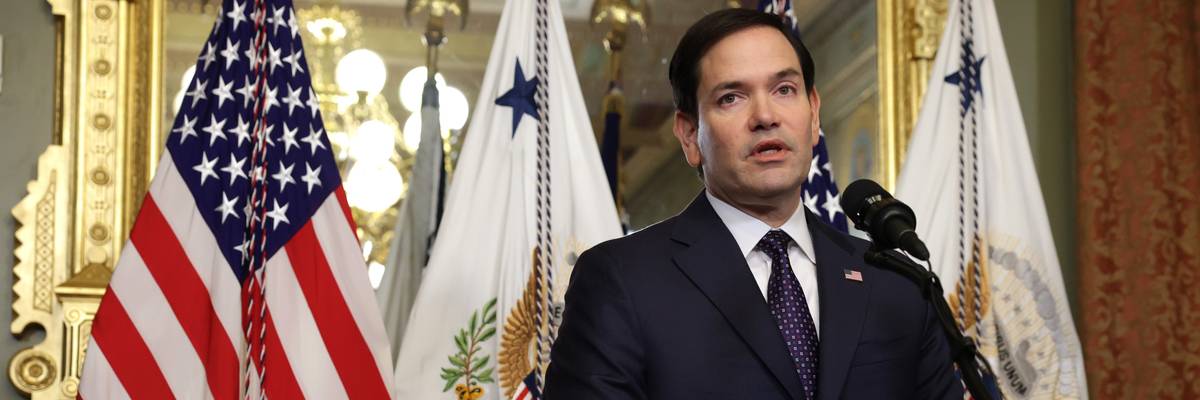
Newly confirmed U.S. Secretary of State Marco Rubio speaks during a swearing-in ceremony at the Vice President's Ceremonial Office at Eisenhower Executive Office Building January 21, 2025 in Washington, DC.
Trump Admin Reportedly Implements Widespread Freeze on Foreign Aid—Except to Israel and Egypt
"Guess which country was exempted…?" wrote the investigative outlet Drop Site News.
The State Department on Friday reportedly issued guidance that it is freezing almost all U.S. foreign assistance—with exceptions for emergency food aid and foreign military financing for two U.S. allies, Israel and Egypt—according to a cable obtained by multiple outlets.
"Guess which country was exempted....?" wrote the investigative outlet Drop Site, in response to the cable, which independent journalist Ken Klippenstein shared on social media.
The aid carve out for Israel follows 15 months of nearly unqualified U.S. support for the Israeli government during its military campaign on the Gaza Strip, which began after Hamas attacked Israel in October 2023, and led to the deaths of tens of thousands of Palestinians, according to the local health officials. A ceasefire between Israel and Hamas went into effect on Sunday, but Israel has since then attacked the city of Jenin in the West Bank.
Other traditional U.S. allies, like Ukraine and Taiwan, are not listed among the waivers to the pause. Trump has been a longtime critic of NATO, which Ukraine hopes to join, and has been critical of the scale of U.S. support for Ukraine as it battles an invasion by Russia.
On Monday, his first day in office, Trump issued an executive order calling for a 90-day pause on U.S. foreign development assistance in order to assess "programmatic efficiencies and consistency with United States foreign policy." But this latest memo, signed by Secretary of State Marco Rubio and sent to embassies worldwide, further fleshes out that directive.
The U.S. "shall not provide foreign assistance funded by or through the department and USAID without the secretary of state's authorization or the authorization of his designee," according to the cable, which was referring to the United States Agency for International Development.
Additionally, "no new obligations shall be made for foreign assistance until such times as the secretary shall determine, following a review" and "for existing foreign assistance awards, contracting officers and grant officers shall immediately issue stop-work orders."
Politico, which also obtained Rubio's memo, reported that "it had not been clear from the president's [Monday] order if it would affect already appropriated funds or Ukraine aid. The new guidance means no further actions will be taken to disperse aid funding to programs already approved by the U.S. government, according to three current and two former officials familiar with the new guidance."
"State just totally went nuclear on foreign assistance," one State Department official told Politico.
In fiscal year 2023, the most recent year with complete government reporting, the U.S. spent $68 billion in foreign aid obligations, on topics ranging from economic development, to health and the environment. Ukraine was the top recipient of foreign aid that year, with $17 billion obligated, and Israel came in second, with $3.3 billion.
According to The Associated Press, which also obtained the cable, the order was particularly disappointing to humanitarian officials who hoped that health clinics and other health programs worldwide would be spared from the funding freeze.
We are at a crossroads
This country and this world are at a monumental crossroads. In a few short weeks, US voters will have an opportunity to beat back the forces of fascism and confront the billionaires who are rigging the economy, our media system, and our democracy, making it increasingly impossible for ordinary people to get by. We’re not just talking about the election. We’re talking about what must be done once these fascist elements are vanquished from power. We need a bolder set of solutions than what either major party has so far been willing to offer and a working-class movement ready to fight like hell for it. Trump didn't emerge from nowhere. The conditions that fueled MAGA authoritarianism were created by decades of radical neoliberal economic policies and a corrupt political system dominated by corporate interests. They slashed taxes on the super-rich, promising that the benefits would trickle down. They said giveaways to the corporate titans would make life more affordable for the rest of us. It was all bullshit. And when a bitter, betrayed populace searches for someone to blame, right-wing demagogues have little trouble finding scapegoats. People know when they're being lied to, but you won't hear any of this from the corporate media. Only independent journalism—powered and funded by people who believe in building a better world—can deliver truly trustworthy daily news. Our Fall Campaign is underway, and we need your help. To power our newsroom through the rest of the year, we need to raise $125,000 by midnight on October 31. So if you share our vision, please contribute whatever you can to sustain our work. |
The State Department on Friday reportedly issued guidance that it is freezing almost all U.S. foreign assistance—with exceptions for emergency food aid and foreign military financing for two U.S. allies, Israel and Egypt—according to a cable obtained by multiple outlets.
"Guess which country was exempted....?" wrote the investigative outlet Drop Site, in response to the cable, which independent journalist Ken Klippenstein shared on social media.
The aid carve out for Israel follows 15 months of nearly unqualified U.S. support for the Israeli government during its military campaign on the Gaza Strip, which began after Hamas attacked Israel in October 2023, and led to the deaths of tens of thousands of Palestinians, according to the local health officials. A ceasefire between Israel and Hamas went into effect on Sunday, but Israel has since then attacked the city of Jenin in the West Bank.
Other traditional U.S. allies, like Ukraine and Taiwan, are not listed among the waivers to the pause. Trump has been a longtime critic of NATO, which Ukraine hopes to join, and has been critical of the scale of U.S. support for Ukraine as it battles an invasion by Russia.
On Monday, his first day in office, Trump issued an executive order calling for a 90-day pause on U.S. foreign development assistance in order to assess "programmatic efficiencies and consistency with United States foreign policy." But this latest memo, signed by Secretary of State Marco Rubio and sent to embassies worldwide, further fleshes out that directive.
The U.S. "shall not provide foreign assistance funded by or through the department and USAID without the secretary of state's authorization or the authorization of his designee," according to the cable, which was referring to the United States Agency for International Development.
Additionally, "no new obligations shall be made for foreign assistance until such times as the secretary shall determine, following a review" and "for existing foreign assistance awards, contracting officers and grant officers shall immediately issue stop-work orders."
Politico, which also obtained Rubio's memo, reported that "it had not been clear from the president's [Monday] order if it would affect already appropriated funds or Ukraine aid. The new guidance means no further actions will be taken to disperse aid funding to programs already approved by the U.S. government, according to three current and two former officials familiar with the new guidance."
"State just totally went nuclear on foreign assistance," one State Department official told Politico.
In fiscal year 2023, the most recent year with complete government reporting, the U.S. spent $68 billion in foreign aid obligations, on topics ranging from economic development, to health and the environment. Ukraine was the top recipient of foreign aid that year, with $17 billion obligated, and Israel came in second, with $3.3 billion.
According to The Associated Press, which also obtained the cable, the order was particularly disappointing to humanitarian officials who hoped that health clinics and other health programs worldwide would be spared from the funding freeze.
- 'We Do Not Consent': Warren Says Senate Must Act to Stop Illegal Trump 'Power Grab' | Common Dreams ›
- Opinion | Trump’s Freeze Was a Brazen, Unlawful Attempt to Steal Our Tax Dollars | Common Dreams ›
- Another Federal Judge Temporarily Blocks Trump's Funding Freeze | Common Dreams ›
- US Judge Delivers Another Blow to 'Harmful' Trump Funding Freeze | Common Dreams ›
- Rubio Touts Trump's Steadfast Support for Israel as it Blocks Aid to Gaza | Common Dreams ›
- 'This Is the Way': Targeted by DOGE, Agency Staffers Refuse Entry in Tense Standoff | Common Dreams ›
The State Department on Friday reportedly issued guidance that it is freezing almost all U.S. foreign assistance—with exceptions for emergency food aid and foreign military financing for two U.S. allies, Israel and Egypt—according to a cable obtained by multiple outlets.
"Guess which country was exempted....?" wrote the investigative outlet Drop Site, in response to the cable, which independent journalist Ken Klippenstein shared on social media.
The aid carve out for Israel follows 15 months of nearly unqualified U.S. support for the Israeli government during its military campaign on the Gaza Strip, which began after Hamas attacked Israel in October 2023, and led to the deaths of tens of thousands of Palestinians, according to the local health officials. A ceasefire between Israel and Hamas went into effect on Sunday, but Israel has since then attacked the city of Jenin in the West Bank.
Other traditional U.S. allies, like Ukraine and Taiwan, are not listed among the waivers to the pause. Trump has been a longtime critic of NATO, which Ukraine hopes to join, and has been critical of the scale of U.S. support for Ukraine as it battles an invasion by Russia.
On Monday, his first day in office, Trump issued an executive order calling for a 90-day pause on U.S. foreign development assistance in order to assess "programmatic efficiencies and consistency with United States foreign policy." But this latest memo, signed by Secretary of State Marco Rubio and sent to embassies worldwide, further fleshes out that directive.
The U.S. "shall not provide foreign assistance funded by or through the department and USAID without the secretary of state's authorization or the authorization of his designee," according to the cable, which was referring to the United States Agency for International Development.
Additionally, "no new obligations shall be made for foreign assistance until such times as the secretary shall determine, following a review" and "for existing foreign assistance awards, contracting officers and grant officers shall immediately issue stop-work orders."
Politico, which also obtained Rubio's memo, reported that "it had not been clear from the president's [Monday] order if it would affect already appropriated funds or Ukraine aid. The new guidance means no further actions will be taken to disperse aid funding to programs already approved by the U.S. government, according to three current and two former officials familiar with the new guidance."
"State just totally went nuclear on foreign assistance," one State Department official told Politico.
In fiscal year 2023, the most recent year with complete government reporting, the U.S. spent $68 billion in foreign aid obligations, on topics ranging from economic development, to health and the environment. Ukraine was the top recipient of foreign aid that year, with $17 billion obligated, and Israel came in second, with $3.3 billion.
According to The Associated Press, which also obtained the cable, the order was particularly disappointing to humanitarian officials who hoped that health clinics and other health programs worldwide would be spared from the funding freeze.
- 'We Do Not Consent': Warren Says Senate Must Act to Stop Illegal Trump 'Power Grab' | Common Dreams ›
- Opinion | Trump’s Freeze Was a Brazen, Unlawful Attempt to Steal Our Tax Dollars | Common Dreams ›
- Another Federal Judge Temporarily Blocks Trump's Funding Freeze | Common Dreams ›
- US Judge Delivers Another Blow to 'Harmful' Trump Funding Freeze | Common Dreams ›
- Rubio Touts Trump's Steadfast Support for Israel as it Blocks Aid to Gaza | Common Dreams ›
- 'This Is the Way': Targeted by DOGE, Agency Staffers Refuse Entry in Tense Standoff | Common Dreams ›