SUBSCRIBE TO OUR FREE NEWSLETTER
Daily news & progressive opinion—funded by the people, not the corporations—delivered straight to your inbox.
5
#000000
#FFFFFF
To donate by check, phone, or other method, see our More Ways to Give page.
Daily news & progressive opinion—funded by the people, not the corporations—delivered straight to your inbox.
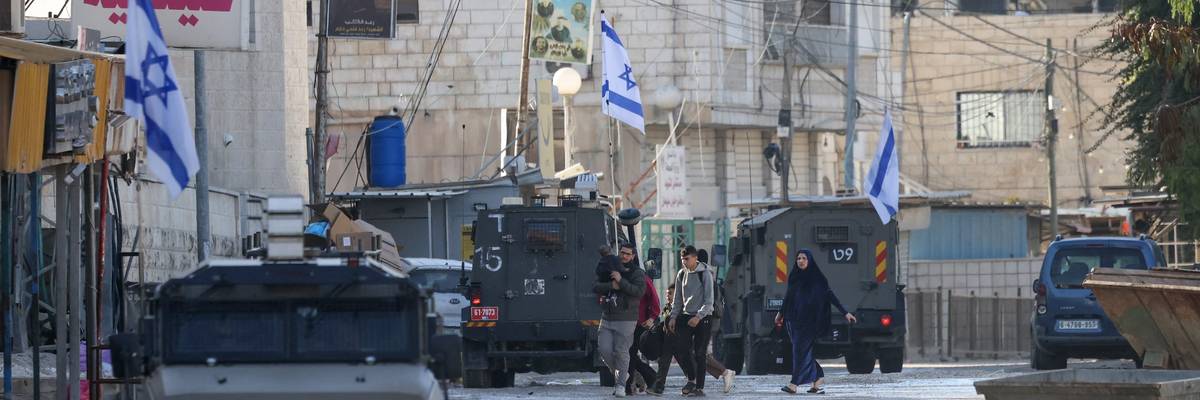
Israeli forces in armored vehicles conduct a raid in Jenin in the occupied West Bank on January 21, 2025.
"There is no cease-fire for Palestinians," said Palestinian writer Yara Hawari.
Israeli security forces on Tuesday launched an attack on the West Bank city of Jenin, just a day after U.S. President Donald Trump rescinded Biden-era sanctions that were levied on extremist Israeli settlers in the West Bank accused of carrying out violence against Palestinians.
Trump moved to overturn the sanctions even after Israeli settlers in the illegally occupied West Bank carried out attacks against Palestinians communities earlier this week. The events highlight the threat of future violence in the West Bank.
A resident of Jenin, Asaad Salim, told the outlet Middle East Eye that the Tuesday attack on Jenin began with Israeli special forces infiltrating a neighborhood in the east of the city. Salim reported Israeli warplanes firing on the city and the Jenin refugee camp and armed clashes took place between Palestinian resistance fighters and the Israeli army, per Middle East Eye.
"There are bodies in the streets, and many people are injured, but no one can reach them. Ambulances can't move due to the intense and sudden assault," Salim told the outlet.
At least eight Palestinians were killed and 35 people were injured, per Reuters, citing Palestinian health services.
"There is no cease-fire for Palestinians," wrote Palestinian writer Yara Hawari, reacting to an Al Jazeera news alert that Israeli forces had attacked the Jenin refugee camp. Her remarks were in reference to a cease-fire deal that went into effect on Sunday, halting hostilities in the war-torn Gaza strip.
The Israeli army and Shin Bet security service announced Tuesday's operation, calling it a counter-terrorism measure codenamed "Iron Wall," according to the Israeli newspaper Haaretz. It will continue "as long as necessary," the outlet reported.
According to Reuters, Israel's far-right Finance Minister Bezalel Smotrich said that the operation was the beginning of a "strong and ongoing campaign" against militant groups "for the protection of settlements and settlers." Smotrich earlier had said he was pleased with Trump's decision to lift sanctions on settlers who are accused of violence against Palestinians, per Reuters.
At multiple points last year, Israel launched attacks on Jenin, and just last week Israeli airstrikes killed three people there, according to Palestinian officials. In December, forces with the Palestinian Authority—which administers parts of the West Bank—stormed the Jenin refugee camp and began a crackdown on armed groups in the camp, which has long been a site of armed struggle and resistance to Israel.
Dear Common Dreams reader, It’s been nearly 30 years since I co-founded Common Dreams with my late wife, Lina Newhouser. We had the radical notion that journalism should serve the public good, not corporate profits. It was clear to us from the outset what it would take to build such a project. No paid advertisements. No corporate sponsors. No millionaire publisher telling us what to think or do. Many people said we wouldn't last a year, but we proved those doubters wrong. Together with a tremendous team of journalists and dedicated staff, we built an independent media outlet free from the constraints of profits and corporate control. Our mission has always been simple: To inform. To inspire. To ignite change for the common good. Building Common Dreams was not easy. Our survival was never guaranteed. When you take on the most powerful forces—Wall Street greed, fossil fuel industry destruction, Big Tech lobbyists, and uber-rich oligarchs who have spent billions upon billions rigging the economy and democracy in their favor—the only bulwark you have is supporters who believe in your work. But here’s the urgent message from me today. It's never been this bad out there. And it's never been this hard to keep us going. At the very moment Common Dreams is most needed, the threats we face are intensifying. We need your support now more than ever. We don't accept corporate advertising and never will. We don't have a paywall because we don't think people should be blocked from critical news based on their ability to pay. Everything we do is funded by the donations of readers like you. When everyone does the little they can afford, we are strong. But if that support retreats or dries up, so do we. Will you donate now to make sure Common Dreams not only survives but thrives? —Craig Brown, Co-founder |
Israeli security forces on Tuesday launched an attack on the West Bank city of Jenin, just a day after U.S. President Donald Trump rescinded Biden-era sanctions that were levied on extremist Israeli settlers in the West Bank accused of carrying out violence against Palestinians.
Trump moved to overturn the sanctions even after Israeli settlers in the illegally occupied West Bank carried out attacks against Palestinians communities earlier this week. The events highlight the threat of future violence in the West Bank.
A resident of Jenin, Asaad Salim, told the outlet Middle East Eye that the Tuesday attack on Jenin began with Israeli special forces infiltrating a neighborhood in the east of the city. Salim reported Israeli warplanes firing on the city and the Jenin refugee camp and armed clashes took place between Palestinian resistance fighters and the Israeli army, per Middle East Eye.
"There are bodies in the streets, and many people are injured, but no one can reach them. Ambulances can't move due to the intense and sudden assault," Salim told the outlet.
At least eight Palestinians were killed and 35 people were injured, per Reuters, citing Palestinian health services.
"There is no cease-fire for Palestinians," wrote Palestinian writer Yara Hawari, reacting to an Al Jazeera news alert that Israeli forces had attacked the Jenin refugee camp. Her remarks were in reference to a cease-fire deal that went into effect on Sunday, halting hostilities in the war-torn Gaza strip.
The Israeli army and Shin Bet security service announced Tuesday's operation, calling it a counter-terrorism measure codenamed "Iron Wall," according to the Israeli newspaper Haaretz. It will continue "as long as necessary," the outlet reported.
According to Reuters, Israel's far-right Finance Minister Bezalel Smotrich said that the operation was the beginning of a "strong and ongoing campaign" against militant groups "for the protection of settlements and settlers." Smotrich earlier had said he was pleased with Trump's decision to lift sanctions on settlers who are accused of violence against Palestinians, per Reuters.
At multiple points last year, Israel launched attacks on Jenin, and just last week Israeli airstrikes killed three people there, according to Palestinian officials. In December, forces with the Palestinian Authority—which administers parts of the West Bank—stormed the Jenin refugee camp and began a crackdown on armed groups in the camp, which has long been a site of armed struggle and resistance to Israel.
Israeli security forces on Tuesday launched an attack on the West Bank city of Jenin, just a day after U.S. President Donald Trump rescinded Biden-era sanctions that were levied on extremist Israeli settlers in the West Bank accused of carrying out violence against Palestinians.
Trump moved to overturn the sanctions even after Israeli settlers in the illegally occupied West Bank carried out attacks against Palestinians communities earlier this week. The events highlight the threat of future violence in the West Bank.
A resident of Jenin, Asaad Salim, told the outlet Middle East Eye that the Tuesday attack on Jenin began with Israeli special forces infiltrating a neighborhood in the east of the city. Salim reported Israeli warplanes firing on the city and the Jenin refugee camp and armed clashes took place between Palestinian resistance fighters and the Israeli army, per Middle East Eye.
"There are bodies in the streets, and many people are injured, but no one can reach them. Ambulances can't move due to the intense and sudden assault," Salim told the outlet.
At least eight Palestinians were killed and 35 people were injured, per Reuters, citing Palestinian health services.
"There is no cease-fire for Palestinians," wrote Palestinian writer Yara Hawari, reacting to an Al Jazeera news alert that Israeli forces had attacked the Jenin refugee camp. Her remarks were in reference to a cease-fire deal that went into effect on Sunday, halting hostilities in the war-torn Gaza strip.
The Israeli army and Shin Bet security service announced Tuesday's operation, calling it a counter-terrorism measure codenamed "Iron Wall," according to the Israeli newspaper Haaretz. It will continue "as long as necessary," the outlet reported.
According to Reuters, Israel's far-right Finance Minister Bezalel Smotrich said that the operation was the beginning of a "strong and ongoing campaign" against militant groups "for the protection of settlements and settlers." Smotrich earlier had said he was pleased with Trump's decision to lift sanctions on settlers who are accused of violence against Palestinians, per Reuters.
At multiple points last year, Israel launched attacks on Jenin, and just last week Israeli airstrikes killed three people there, according to Palestinian officials. In December, forces with the Palestinian Authority—which administers parts of the West Bank—stormed the Jenin refugee camp and began a crackdown on armed groups in the camp, which has long been a site of armed struggle and resistance to Israel.