SUBSCRIBE TO OUR FREE NEWSLETTER
Daily news & progressive opinion—funded by the people, not the corporations—delivered straight to your inbox.
5
#000000
#FFFFFF
To donate by check, phone, or other method, see our More Ways to Give page.
Daily news & progressive opinion—funded by the people, not the corporations—delivered straight to your inbox.
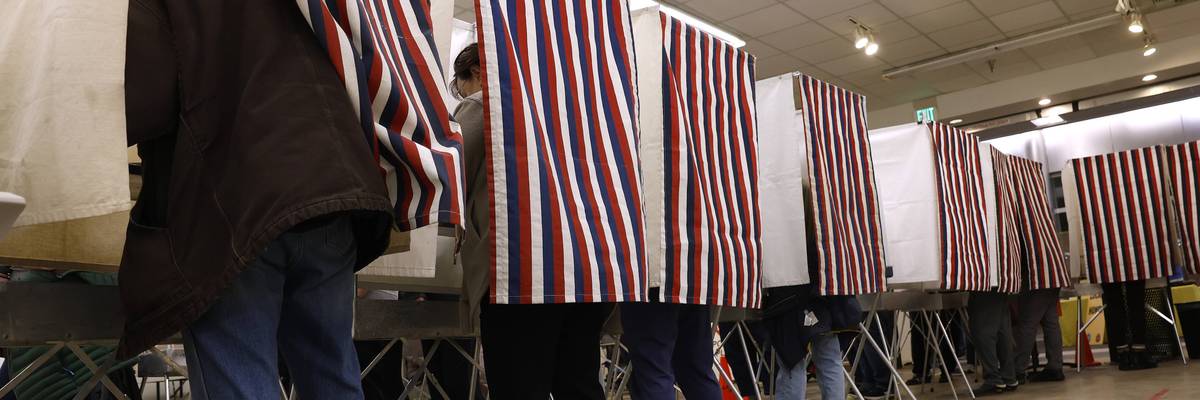
Voters cast their ballots at a polling station at Midtown Mall on October 31, 2026 in Anchorage, Alaska.
The administration quickly appealed the ruling, making it clear that it "still wants to interfere in Alaska's election and pursue an investigation that would violate the right to a secret ballot."
With numerous recent court rulings dismissing the Trump administration's attempts to intimidate election officials and its push to discount tens of thousands of ballots due to the dubious claim they were cast by noncitizens, a key midterm strategy of President Donald Trump—questioning the results of the election before it happens—is falling apart.
The US Department of Justice has focused in recent days on the Alaska US Senate election, with Trump personally calling on the DOJ to file a lawsuit arguing that a federal court must block the certification of the results if Republican Sen. Dan Sullivan narrowly loses his reelection bid—but Chief Judge Sharon Gleason of the US District Court in Alaska threw that effort out on Sunday, as well.
The administration has focused on the election because, along with Sullivan and former Rep. Mary Peltola, the Democratic candidate, another Dan Sullivan appears on the ballots Alaskans have begun casting: Daniel J. Sullivan, a retired teacher.
The DOJ argued in its lawsuit that if Sullivan loses his reelection race but would have won if the votes for Daniel J. Sullivan had gone to him instead, the election results should not be certified.
The Republican senator is clearly marked with his party affiliation and the word "incumbent" on the ballots, and observers have noted that the state's ranked-choice voting system would likely stop Daniel J. Sullivan from acting as a "spoiler."
"Voters are familiar with the system," wrote Anna Griffin at The New York Times Sunday. "Any voter confused by the existence of two Dan Sullivans could simply rank both candidates."
Voters interviewed at the polls in recent days have said the ballot did not cause confusion.
Alaska Voter: I saw that it showed incumbent and Republican for the current incumbent, I wasn't worried about it at all. People are smart enough to see it's labeled clearly. It's already been determined by our Supreme Court in Alaska. I wasn't worried about it https://t.co/003wocOV7N
— Acyn (@Acyn) November 1, 2026
Still, the DOJ in its lawsuit called for an investigation should Sullivan lose narrowly, without explaining how officials would conduct a probe into the secret, anonymous ballots that American voters have a right to.
The administration, said Gleason as she rejected the lawsuit, "offers no rebuttal to the concerns regarding preservation of the secrecy of voting and provides no explanation of how its request for ballot segregation and a court-ordered investigation by law enforcement officers into certain voters’ intent could be implemented while preserving the secrecy of the ballot.”
As the DOJ filed an appeal to the ruling Sunday, a spokesperson for the department complained to the Times that Gleason had not addressed “the argument of the United States that Daniel J. Sullivan (a/k/a Decoy Dan) entered the race as a frivolous candidate to confuse voters.”
Entering an electoral race to act as a "spoiler," while potentially inconvenient and aggravating for another candidate and sometimes denounced as a "dirty trick," is generally not against the law in the US, according to legal experts. Neither is recruiting or encouraging someone to run as a spoiler, as Peltola's campaign has been accused of doing in the Alaska case.
"Regardless of who encouraged him to run, the second Dan Sullivan validly qualified for the ballot. And this is a matter of state law," Joshua Douglas, a law professor at the University of Kentucky, told Reuters this week.
Gleason rejected the DOJ's claim that the administration is not attempting to interfere in "the time, place, and manner of Alaskan elections," which the Constitution stipulates are to be determined by state officials.
"A court order preventing the state from certifying the election if certain circumstances occur; a court order requiring the state to segregate and preserve certain ballots; and a court order permitting the United States to conduct an investigation into the intent of those voters who cast ballots for Daniel J. Sullivan... certainly involve the time, place, and manner of Alaska’s election,” the judge wrote.
Sullivan said Sunday that he would accept the election results regardless of who wins, while also claiming the election could be "stolen."
The DOJ's decision to immediately appeal Gleason's ruling, said journalist Adam Klasfeld, made clear that the administration "still wants to interfere in Alaska's election and pursue an investigation that would violate the right to a secret ballot."
This country and this world are at a monumental crossroads. US voters have an opportunity to beat back the forces of fascism and confront the billionaires who are rigging the economy, our media system, and our democracy, making it increasingly impossible for ordinary people to get by. We’re not just talking about the election. We’re talking about what must be done once these fascist elements are vanquished from power. We need a bolder set of solutions than what either major party has so far been willing to offer and a working-class movement ready to fight like hell for it. Trump didn't emerge from nowhere. The conditions that fueled MAGA authoritarianism were created by decades of radical neoliberal economic policies and a corrupt political system dominated by corporate interests. They slashed taxes on the super-rich, promising that the benefits would trickle down. They said giveaways to the corporate titans would make life more affordable for the rest of us. It was all bullshit. And when a bitter, betrayed populace searches for someone to blame, right-wing demagogues have little trouble finding scapegoats. People know when they're being lied to, but you won't hear any of this from the corporate media. Only independent journalism—powered and funded by people who believe in building a better world—can deliver truly trustworthy daily news. If you share our vision, please contribute whatever you can to sustain our work. |
With numerous recent court rulings dismissing the Trump administration's attempts to intimidate election officials and its push to discount tens of thousands of ballots due to the dubious claim they were cast by noncitizens, a key midterm strategy of President Donald Trump—questioning the results of the election before it happens—is falling apart.
The US Department of Justice has focused in recent days on the Alaska US Senate election, with Trump personally calling on the DOJ to file a lawsuit arguing that a federal court must block the certification of the results if Republican Sen. Dan Sullivan narrowly loses his reelection bid—but Chief Judge Sharon Gleason of the US District Court in Alaska threw that effort out on Sunday, as well.
The administration has focused on the election because, along with Sullivan and former Rep. Mary Peltola, the Democratic candidate, another Dan Sullivan appears on the ballots Alaskans have begun casting: Daniel J. Sullivan, a retired teacher.
The DOJ argued in its lawsuit that if Sullivan loses his reelection race but would have won if the votes for Daniel J. Sullivan had gone to him instead, the election results should not be certified.
The Republican senator is clearly marked with his party affiliation and the word "incumbent" on the ballots, and observers have noted that the state's ranked-choice voting system would likely stop Daniel J. Sullivan from acting as a "spoiler."
"Voters are familiar with the system," wrote Anna Griffin at The New York Times Sunday. "Any voter confused by the existence of two Dan Sullivans could simply rank both candidates."
Voters interviewed at the polls in recent days have said the ballot did not cause confusion.
Alaska Voter: I saw that it showed incumbent and Republican for the current incumbent, I wasn't worried about it at all. People are smart enough to see it's labeled clearly. It's already been determined by our Supreme Court in Alaska. I wasn't worried about it https://t.co/003wocOV7N
— Acyn (@Acyn) November 1, 2026
Still, the DOJ in its lawsuit called for an investigation should Sullivan lose narrowly, without explaining how officials would conduct a probe into the secret, anonymous ballots that American voters have a right to.
The administration, said Gleason as she rejected the lawsuit, "offers no rebuttal to the concerns regarding preservation of the secrecy of voting and provides no explanation of how its request for ballot segregation and a court-ordered investigation by law enforcement officers into certain voters’ intent could be implemented while preserving the secrecy of the ballot.”
As the DOJ filed an appeal to the ruling Sunday, a spokesperson for the department complained to the Times that Gleason had not addressed “the argument of the United States that Daniel J. Sullivan (a/k/a Decoy Dan) entered the race as a frivolous candidate to confuse voters.”
Entering an electoral race to act as a "spoiler," while potentially inconvenient and aggravating for another candidate and sometimes denounced as a "dirty trick," is generally not against the law in the US, according to legal experts. Neither is recruiting or encouraging someone to run as a spoiler, as Peltola's campaign has been accused of doing in the Alaska case.
"Regardless of who encouraged him to run, the second Dan Sullivan validly qualified for the ballot. And this is a matter of state law," Joshua Douglas, a law professor at the University of Kentucky, told Reuters this week.
Gleason rejected the DOJ's claim that the administration is not attempting to interfere in "the time, place, and manner of Alaskan elections," which the Constitution stipulates are to be determined by state officials.
"A court order preventing the state from certifying the election if certain circumstances occur; a court order requiring the state to segregate and preserve certain ballots; and a court order permitting the United States to conduct an investigation into the intent of those voters who cast ballots for Daniel J. Sullivan... certainly involve the time, place, and manner of Alaska’s election,” the judge wrote.
Sullivan said Sunday that he would accept the election results regardless of who wins, while also claiming the election could be "stolen."
The DOJ's decision to immediately appeal Gleason's ruling, said journalist Adam Klasfeld, made clear that the administration "still wants to interfere in Alaska's election and pursue an investigation that would violate the right to a secret ballot."