SUBSCRIBE TO OUR FREE NEWSLETTER
Daily news & progressive opinion—funded by the people, not the corporations—delivered straight to your inbox.
5
#000000
#FFFFFF
To donate by check, phone, or other method, see our More Ways to Give page.
Daily news & progressive opinion—funded by the people, not the corporations—delivered straight to your inbox.
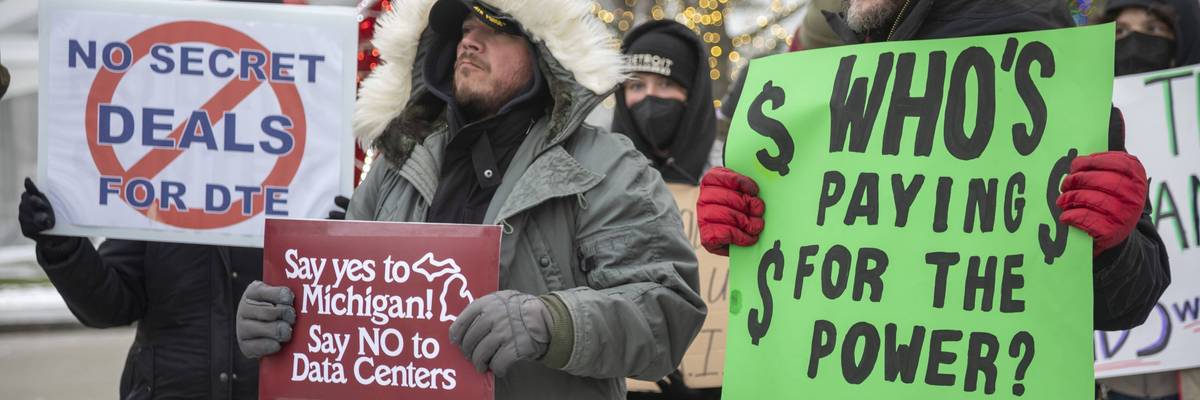
Detroit, Michigan residents picket DTE Energy, opposing the electric utility's plan to provide power for a proposed $7 billion data center in rural Michigan on December 3, 2025.
"These pledges are nothing more than desperate damage control for companies who only now realize that voters see them as the villains of this story," said one progressive advocate.
Climate action advocates and energy experts alike said Wednesday that President Donald Trump's "ratepayer protection pledge," introduced during his State of the Union address Tuesday night, will do little to alleviate rising household electricity costs brought on by the White House's mandated artificial intelligence expansion and the construction of thousands of hulking data centers across the country.
During his address, the president acknowledged that many Americans are "concerned that energy demands from AI data centers could unfairly drive up their electric utility bills," as they already are.
A CNBC analysis published last November found that in addition to average electricity prices rising by more than 6% across the country, according to the Energy Information Administration, households in states with high concentrations of data centers—including Virginia, Illinois, and Ohio—have seen their rates climb by as much as 16% in the past year.
The National Energy Assistance Directors Association also said last year that about 21 million American families were behind on their utility bills, with the average overdue amount about a third higher than it was in 2023.
Trump said Tuesday that he had negotiated a deal with major tech companies, ensuring they "have the obligation to provide for their own power needs and can build their own power plant as part of their factory, so that no one's prices will go up."
Energy industry experts told Politico on Wednesday that if enforced, the pledge—which Trump and the White House offered few details about—would still only partially address rising household costs associated with the AI expansion, which are being caused by the AI industry's rapidly growing demand for power lines, fuel, natural wind turbines, and other energy needs to run massive data centers.
The data centers require energy equivalent to that of 186 large nuclear power plants, according to the data firm Cleanview, and some of them have electricity needs that could power millions of homes.
But Ari Peskoe, director of the Electricity Law Initiative at the Harvard Law School Environmental and Energy Law Program, told Politico that in seeking lower costs for consumers, the White House is "putting this pledge on the wrong entities," as the details of how energy costs are distributed among millions of ratepayers are determined by utilities and state regulators—not tech giants like Microsoft, Google, and Anthropic, which lauded the president's announcement and announced their own pledges to ostensibly protect households from rising costs.
“Most of today’s cost pressure is coming from transmission, distribution, and system readiness, not energy supply,” Brandon Owens, a grid expert and founder of advisory platform AIxEnergy, told Politico ahead of the speech. “Those costs remain even if a data center self-supplies generation.”
With Trump fast-tracking AI data center expansion, utilities are spending far more than they have previously to set up electricity infrastructure. As Politico reported, PJM, which operates the grid for 13 states in the eastern US, has approved $11.8 billion for new transmission projects, with data centers being the largest recipients of new electricity. About 67 million people in the region covered by PJM will split the cost of the new projects, paying roughly double what they did for the company's last two transmission budgets.
Emily Peterson-Casson, policy director for the progressive advocacy group Demand Progress, said in a statement ahead of the State of the Union address that Trump's ratepayer protection pledge amounts "to worthless pinky swears from the multi-billion dollar corporations who are trying to force us to sacrifice our jobs, our children, our privacy, and our communities for an uncertain, AI-powered future that they can control and we won’t."
Rising electricity costs, she said, are just one of many concerns Americans have expressed about AI in numerous recent polls. One taken by YouGov last week found that nearly two-thirds of Americans believe the expansion of AI will reduce the number of jobs available to workers, and another by Bentley University and Gallup found 79% of respondents didn't trust companies to use AI responsibly.
"In addition to providing a dubious balm to skyrocketing electricity bills, these pledges do nothing to address out-of-control AI that caused outages at Amazon Web Services, creates sexualized images of minors, and has led teens in need of help to take their own lives," said Peterson-Casson. "These pledges are nothing more than desperate damage control for companies who only now realize that voters see them as the villains of this story.”
The climate action group 350.org also derided the ratepayer protection pledge as a "theatrical stunt with no enforceable mechanism," and said it would only worsen the ramp up of costly fossil fuel production that Trump has overseen by delaying the closure of expensive, polluting coal plants; blocking solar and wind projects; and approving more liquefied natural gas exports.
Trump said the his address that the US is experiencing a "Golden Age," noted 350.org executive director Anne Jellema, but that's true "only for fossil fuel companies that poured $96 million into the Trump administration."
"For the millions of Americans who cannot afford to pay their energy bills, it is like heading back to the dark ages. The Trump administration cannot claim to stand for American consumers while blocking progress in renewables, the cheapest form of energy available today. It cannot champion affordability while doubling down on a highly volatile gas market and driving conflicts that inevitably increase energy prices everywhere,” said Jellema. “Trump’s bravado cannot disguise the fundamental insecurity at the heart of his administration: Fossil fuels are increasingly unviable, and even businesses want to move on. Around the world, people are demanding and building a clean, affordable energy future, with or without the US government."
350.org also pointed to a recent poll by E3G, Beyond Fossil Fuels, and We Mean Business that showed 97% of nearly 1,500 business executives supported a transition away from fossil fuels to renewable energy sources, citing "competitive edge and long-term energy security."
Journalist Ray Locker added on social media, "The best way to protect ratepayers is to not shackle them to using fossil fuels to generate electricity."
Dear Common Dreams reader, It’s been nearly 30 years since I co-founded Common Dreams with my late wife, Lina Newhouser. We had the radical notion that journalism should serve the public good, not corporate profits. It was clear to us from the outset what it would take to build such a project. No paid advertisements. No corporate sponsors. No millionaire publisher telling us what to think or do. Many people said we wouldn't last a year, but we proved those doubters wrong. Together with a tremendous team of journalists and dedicated staff, we built an independent media outlet free from the constraints of profits and corporate control. Our mission has always been simple: To inform. To inspire. To ignite change for the common good. Building Common Dreams was not easy. Our survival was never guaranteed. When you take on the most powerful forces—Wall Street greed, fossil fuel industry destruction, Big Tech lobbyists, and uber-rich oligarchs who have spent billions upon billions rigging the economy and democracy in their favor—the only bulwark you have is supporters who believe in your work. But here’s the urgent message from me today. It's never been this bad out there. And it's never been this hard to keep us going. At the very moment Common Dreams is most needed, the threats we face are intensifying. We need your support now more than ever. We don't accept corporate advertising and never will. We don't have a paywall because we don't think people should be blocked from critical news based on their ability to pay. Everything we do is funded by the donations of readers like you. When everyone does the little they can afford, we are strong. But if that support retreats or dries up, so do we. Will you donate now to make sure Common Dreams not only survives but thrives? —Craig Brown, Co-founder |
Climate action advocates and energy experts alike said Wednesday that President Donald Trump's "ratepayer protection pledge," introduced during his State of the Union address Tuesday night, will do little to alleviate rising household electricity costs brought on by the White House's mandated artificial intelligence expansion and the construction of thousands of hulking data centers across the country.
During his address, the president acknowledged that many Americans are "concerned that energy demands from AI data centers could unfairly drive up their electric utility bills," as they already are.
A CNBC analysis published last November found that in addition to average electricity prices rising by more than 6% across the country, according to the Energy Information Administration, households in states with high concentrations of data centers—including Virginia, Illinois, and Ohio—have seen their rates climb by as much as 16% in the past year.
The National Energy Assistance Directors Association also said last year that about 21 million American families were behind on their utility bills, with the average overdue amount about a third higher than it was in 2023.
Trump said Tuesday that he had negotiated a deal with major tech companies, ensuring they "have the obligation to provide for their own power needs and can build their own power plant as part of their factory, so that no one's prices will go up."
Energy industry experts told Politico on Wednesday that if enforced, the pledge—which Trump and the White House offered few details about—would still only partially address rising household costs associated with the AI expansion, which are being caused by the AI industry's rapidly growing demand for power lines, fuel, natural wind turbines, and other energy needs to run massive data centers.
The data centers require energy equivalent to that of 186 large nuclear power plants, according to the data firm Cleanview, and some of them have electricity needs that could power millions of homes.
But Ari Peskoe, director of the Electricity Law Initiative at the Harvard Law School Environmental and Energy Law Program, told Politico that in seeking lower costs for consumers, the White House is "putting this pledge on the wrong entities," as the details of how energy costs are distributed among millions of ratepayers are determined by utilities and state regulators—not tech giants like Microsoft, Google, and Anthropic, which lauded the president's announcement and announced their own pledges to ostensibly protect households from rising costs.
“Most of today’s cost pressure is coming from transmission, distribution, and system readiness, not energy supply,” Brandon Owens, a grid expert and founder of advisory platform AIxEnergy, told Politico ahead of the speech. “Those costs remain even if a data center self-supplies generation.”
With Trump fast-tracking AI data center expansion, utilities are spending far more than they have previously to set up electricity infrastructure. As Politico reported, PJM, which operates the grid for 13 states in the eastern US, has approved $11.8 billion for new transmission projects, with data centers being the largest recipients of new electricity. About 67 million people in the region covered by PJM will split the cost of the new projects, paying roughly double what they did for the company's last two transmission budgets.
Emily Peterson-Casson, policy director for the progressive advocacy group Demand Progress, said in a statement ahead of the State of the Union address that Trump's ratepayer protection pledge amounts "to worthless pinky swears from the multi-billion dollar corporations who are trying to force us to sacrifice our jobs, our children, our privacy, and our communities for an uncertain, AI-powered future that they can control and we won’t."
Rising electricity costs, she said, are just one of many concerns Americans have expressed about AI in numerous recent polls. One taken by YouGov last week found that nearly two-thirds of Americans believe the expansion of AI will reduce the number of jobs available to workers, and another by Bentley University and Gallup found 79% of respondents didn't trust companies to use AI responsibly.
"In addition to providing a dubious balm to skyrocketing electricity bills, these pledges do nothing to address out-of-control AI that caused outages at Amazon Web Services, creates sexualized images of minors, and has led teens in need of help to take their own lives," said Peterson-Casson. "These pledges are nothing more than desperate damage control for companies who only now realize that voters see them as the villains of this story.”
The climate action group 350.org also derided the ratepayer protection pledge as a "theatrical stunt with no enforceable mechanism," and said it would only worsen the ramp up of costly fossil fuel production that Trump has overseen by delaying the closure of expensive, polluting coal plants; blocking solar and wind projects; and approving more liquefied natural gas exports.
Trump said the his address that the US is experiencing a "Golden Age," noted 350.org executive director Anne Jellema, but that's true "only for fossil fuel companies that poured $96 million into the Trump administration."
"For the millions of Americans who cannot afford to pay their energy bills, it is like heading back to the dark ages. The Trump administration cannot claim to stand for American consumers while blocking progress in renewables, the cheapest form of energy available today. It cannot champion affordability while doubling down on a highly volatile gas market and driving conflicts that inevitably increase energy prices everywhere,” said Jellema. “Trump’s bravado cannot disguise the fundamental insecurity at the heart of his administration: Fossil fuels are increasingly unviable, and even businesses want to move on. Around the world, people are demanding and building a clean, affordable energy future, with or without the US government."
350.org also pointed to a recent poll by E3G, Beyond Fossil Fuels, and We Mean Business that showed 97% of nearly 1,500 business executives supported a transition away from fossil fuels to renewable energy sources, citing "competitive edge and long-term energy security."
Journalist Ray Locker added on social media, "The best way to protect ratepayers is to not shackle them to using fossil fuels to generate electricity."
Climate action advocates and energy experts alike said Wednesday that President Donald Trump's "ratepayer protection pledge," introduced during his State of the Union address Tuesday night, will do little to alleviate rising household electricity costs brought on by the White House's mandated artificial intelligence expansion and the construction of thousands of hulking data centers across the country.
During his address, the president acknowledged that many Americans are "concerned that energy demands from AI data centers could unfairly drive up their electric utility bills," as they already are.
A CNBC analysis published last November found that in addition to average electricity prices rising by more than 6% across the country, according to the Energy Information Administration, households in states with high concentrations of data centers—including Virginia, Illinois, and Ohio—have seen their rates climb by as much as 16% in the past year.
The National Energy Assistance Directors Association also said last year that about 21 million American families were behind on their utility bills, with the average overdue amount about a third higher than it was in 2023.
Trump said Tuesday that he had negotiated a deal with major tech companies, ensuring they "have the obligation to provide for their own power needs and can build their own power plant as part of their factory, so that no one's prices will go up."
Energy industry experts told Politico on Wednesday that if enforced, the pledge—which Trump and the White House offered few details about—would still only partially address rising household costs associated with the AI expansion, which are being caused by the AI industry's rapidly growing demand for power lines, fuel, natural wind turbines, and other energy needs to run massive data centers.
The data centers require energy equivalent to that of 186 large nuclear power plants, according to the data firm Cleanview, and some of them have electricity needs that could power millions of homes.
But Ari Peskoe, director of the Electricity Law Initiative at the Harvard Law School Environmental and Energy Law Program, told Politico that in seeking lower costs for consumers, the White House is "putting this pledge on the wrong entities," as the details of how energy costs are distributed among millions of ratepayers are determined by utilities and state regulators—not tech giants like Microsoft, Google, and Anthropic, which lauded the president's announcement and announced their own pledges to ostensibly protect households from rising costs.
“Most of today’s cost pressure is coming from transmission, distribution, and system readiness, not energy supply,” Brandon Owens, a grid expert and founder of advisory platform AIxEnergy, told Politico ahead of the speech. “Those costs remain even if a data center self-supplies generation.”
With Trump fast-tracking AI data center expansion, utilities are spending far more than they have previously to set up electricity infrastructure. As Politico reported, PJM, which operates the grid for 13 states in the eastern US, has approved $11.8 billion for new transmission projects, with data centers being the largest recipients of new electricity. About 67 million people in the region covered by PJM will split the cost of the new projects, paying roughly double what they did for the company's last two transmission budgets.
Emily Peterson-Casson, policy director for the progressive advocacy group Demand Progress, said in a statement ahead of the State of the Union address that Trump's ratepayer protection pledge amounts "to worthless pinky swears from the multi-billion dollar corporations who are trying to force us to sacrifice our jobs, our children, our privacy, and our communities for an uncertain, AI-powered future that they can control and we won’t."
Rising electricity costs, she said, are just one of many concerns Americans have expressed about AI in numerous recent polls. One taken by YouGov last week found that nearly two-thirds of Americans believe the expansion of AI will reduce the number of jobs available to workers, and another by Bentley University and Gallup found 79% of respondents didn't trust companies to use AI responsibly.
"In addition to providing a dubious balm to skyrocketing electricity bills, these pledges do nothing to address out-of-control AI that caused outages at Amazon Web Services, creates sexualized images of minors, and has led teens in need of help to take their own lives," said Peterson-Casson. "These pledges are nothing more than desperate damage control for companies who only now realize that voters see them as the villains of this story.”
The climate action group 350.org also derided the ratepayer protection pledge as a "theatrical stunt with no enforceable mechanism," and said it would only worsen the ramp up of costly fossil fuel production that Trump has overseen by delaying the closure of expensive, polluting coal plants; blocking solar and wind projects; and approving more liquefied natural gas exports.
Trump said the his address that the US is experiencing a "Golden Age," noted 350.org executive director Anne Jellema, but that's true "only for fossil fuel companies that poured $96 million into the Trump administration."
"For the millions of Americans who cannot afford to pay their energy bills, it is like heading back to the dark ages. The Trump administration cannot claim to stand for American consumers while blocking progress in renewables, the cheapest form of energy available today. It cannot champion affordability while doubling down on a highly volatile gas market and driving conflicts that inevitably increase energy prices everywhere,” said Jellema. “Trump’s bravado cannot disguise the fundamental insecurity at the heart of his administration: Fossil fuels are increasingly unviable, and even businesses want to move on. Around the world, people are demanding and building a clean, affordable energy future, with or without the US government."
350.org also pointed to a recent poll by E3G, Beyond Fossil Fuels, and We Mean Business that showed 97% of nearly 1,500 business executives supported a transition away from fossil fuels to renewable energy sources, citing "competitive edge and long-term energy security."
Journalist Ray Locker added on social media, "The best way to protect ratepayers is to not shackle them to using fossil fuels to generate electricity."