SUBSCRIBE TO OUR FREE NEWSLETTER
Daily news & progressive opinion—funded by the people, not the corporations—delivered straight to your inbox.
5
#000000
#FFFFFF
To donate by check, phone, or other method, see our More Ways to Give page.
Daily news & progressive opinion—funded by the people, not the corporations—delivered straight to your inbox.
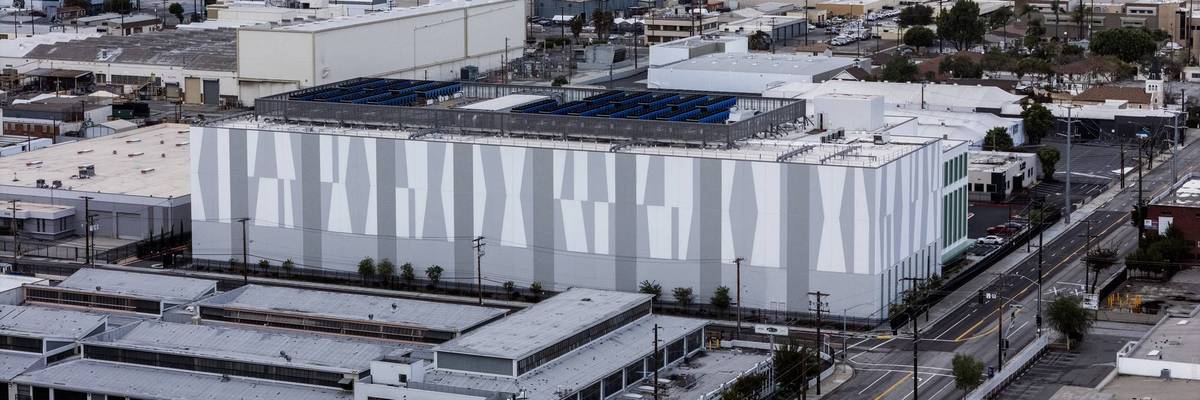
Prime Data Center is seen in Vernon, California on December 25, 2025.
"We need serious public debate and democratic oversight over this enormously consequential issue," said the senator. "The time for action is now."
Although Denver Mayor Mike Johnston is a vocal supporter of artificial intelligence and has pushed to adopt AI-driven products to power the city's infrastructure, he joined City Council members on Monday in announcing a moratorium on the construction of massive AI data centers—the latest sign, said US Sen. Bernie Sanders, that the push to stop corporations from building the energy-guzzling, pollution-causing facilities is not "radical, fringe, and Luddite" as some claim.
Johnston, a Democrat, and other local officials across the country who are pushing to block the construction of data centers "are right," said Sanders (I-Vt.). "Data centers will have a profound impact on land and water use, and will drive up electricity costs."
As grassroots community groups and experts have warned, AI will also "likely have a catastrophic impact on the lives of working-class Americans, eliminating tens of millions of blue- and white-collar jobs in every sector of our economy," said the senator, who proposed a nationwide moratorium on AI data centers in December.
He renewed that call after Johnston and the Denver City Council announced the city would halt any plans for new data centers for at least several months and would require projects that are already permitted or under construction to follow new guidelines once they're finalized by local officials.
"We need a federal moratorium on AI data centers," said Sanders.
Johnston said in a statement that he believes "data centers power the technology we depend upon and strengthen our economy," but stressed that "as this industry evolves, so must our policies."
"This pause allows us to put clear and consistent guardrails in place while protecting our most precious resources and preserving our quality of life," said the mayor.
The city plans to review regulations for data centers that would target “responsible land, energy, and water use as well as zoning and affordability for ratepayers.”
Soaring electricity bills across the country have been linked to the build-out of data centers, which have cropped up as President Donald Trump has pushed to preempt state and local regulations on AI. As CNBC reported last year, residential utility bills rose 6% in August nationwide, but much higher price hikes were reported in states with high concentrations of data centers, like Virginia (13%) and Illinois (16%).
Sanders' office issued a report last October showing that AI, automation, and robotics could replace nearly 100 million jobs over the next decade, including 40% of registered nurses, 47% of truck drivers, 64% of accountants, and 89% of fast food workers.
And a study published in Nature Sustainability last year found that data centers could consume as much water as 10 million Americans and emit as much carbon dioxide as 10 million cars.
At a forum last week at Stanford University, Sanders joined Rep. Ro Khanna (D-Calif.) in warning that the expansion of AI data centers is meant to increase the wealth of billionaire tech moguls with no regard for how working Americans are affected.
“The question that we should be asking day after day… is who is pushing this revolution, who benefits from it, and who gets hurt?” Sanderss said.
In Denver, the moratorium was announced ahead of a planned community meeting scheduled for Tuesday evening at Geotech Environmental, where neighbors are planning to speak out against the 170,000-square foot DE3 data center being built in the Globeville-Elyria-Swansea (GES) area by the Denver-based company CoreSite.
The burden that will be placed on locals if the project is completed "is not accidental," reads a petition by the local grassroots community organization GES Coalition. “It is the outcome of colonial dispossession and extraction, then decades of zoning, redlining, highway construction, and industrial siting that concentrated pollution next to working-class homes alongside the legacy of the Vasquez Boulevard/I-70 Superfund site, a 4.5-square-mile smelting contamination footprint affecting multiple neighborhoods."
Meanwhile, state legislators have introduced at least two bills regarding AI data center development. One, House Bill 1030, would offer sales and use tax exemptions for data center builders—and would slash state general fund revenue while also triggering a $106 million reduction in tax credits for low-income households.
Another, Senate Bill 102, would require data centers to use renewable energy sources and ensure their energy use does not raise rates for consumers.
Grassroots efforts to block the construction of data centers have taken off in places including Saline, Michigan; Port Washington, Wisconsin; and Tucson, Arizona, where community members successfully blocked plans for a new center owned by Amazon.
State lawmakers in Maine, South Dakota, and Oklahoma are also considering moratoriums or limits on new data centers.
"We need serious public debate and democratic oversight over this enormously consequential issue," said Sanders. "The time for action is now."
Dear Common Dreams reader, It’s been nearly 30 years since I co-founded Common Dreams with my late wife, Lina Newhouser. We had the radical notion that journalism should serve the public good, not corporate profits. It was clear to us from the outset what it would take to build such a project. No paid advertisements. No corporate sponsors. No millionaire publisher telling us what to think or do. Many people said we wouldn't last a year, but we proved those doubters wrong. Together with a tremendous team of journalists and dedicated staff, we built an independent media outlet free from the constraints of profits and corporate control. Our mission has always been simple: To inform. To inspire. To ignite change for the common good. Building Common Dreams was not easy. Our survival was never guaranteed. When you take on the most powerful forces—Wall Street greed, fossil fuel industry destruction, Big Tech lobbyists, and uber-rich oligarchs who have spent billions upon billions rigging the economy and democracy in their favor—the only bulwark you have is supporters who believe in your work. But here’s the urgent message from me today. It's never been this bad out there. And it's never been this hard to keep us going. At the very moment Common Dreams is most needed, the threats we face are intensifying. We need your support now more than ever. We don't accept corporate advertising and never will. We don't have a paywall because we don't think people should be blocked from critical news based on their ability to pay. Everything we do is funded by the donations of readers like you. When everyone does the little they can afford, we are strong. But if that support retreats or dries up, so do we. Will you donate now to make sure Common Dreams not only survives but thrives? —Craig Brown, Co-founder |
Although Denver Mayor Mike Johnston is a vocal supporter of artificial intelligence and has pushed to adopt AI-driven products to power the city's infrastructure, he joined City Council members on Monday in announcing a moratorium on the construction of massive AI data centers—the latest sign, said US Sen. Bernie Sanders, that the push to stop corporations from building the energy-guzzling, pollution-causing facilities is not "radical, fringe, and Luddite" as some claim.
Johnston, a Democrat, and other local officials across the country who are pushing to block the construction of data centers "are right," said Sanders (I-Vt.). "Data centers will have a profound impact on land and water use, and will drive up electricity costs."
As grassroots community groups and experts have warned, AI will also "likely have a catastrophic impact on the lives of working-class Americans, eliminating tens of millions of blue- and white-collar jobs in every sector of our economy," said the senator, who proposed a nationwide moratorium on AI data centers in December.
He renewed that call after Johnston and the Denver City Council announced the city would halt any plans for new data centers for at least several months and would require projects that are already permitted or under construction to follow new guidelines once they're finalized by local officials.
"We need a federal moratorium on AI data centers," said Sanders.
Johnston said in a statement that he believes "data centers power the technology we depend upon and strengthen our economy," but stressed that "as this industry evolves, so must our policies."
"This pause allows us to put clear and consistent guardrails in place while protecting our most precious resources and preserving our quality of life," said the mayor.
The city plans to review regulations for data centers that would target “responsible land, energy, and water use as well as zoning and affordability for ratepayers.”
Soaring electricity bills across the country have been linked to the build-out of data centers, which have cropped up as President Donald Trump has pushed to preempt state and local regulations on AI. As CNBC reported last year, residential utility bills rose 6% in August nationwide, but much higher price hikes were reported in states with high concentrations of data centers, like Virginia (13%) and Illinois (16%).
Sanders' office issued a report last October showing that AI, automation, and robotics could replace nearly 100 million jobs over the next decade, including 40% of registered nurses, 47% of truck drivers, 64% of accountants, and 89% of fast food workers.
And a study published in Nature Sustainability last year found that data centers could consume as much water as 10 million Americans and emit as much carbon dioxide as 10 million cars.
At a forum last week at Stanford University, Sanders joined Rep. Ro Khanna (D-Calif.) in warning that the expansion of AI data centers is meant to increase the wealth of billionaire tech moguls with no regard for how working Americans are affected.
“The question that we should be asking day after day… is who is pushing this revolution, who benefits from it, and who gets hurt?” Sanderss said.
In Denver, the moratorium was announced ahead of a planned community meeting scheduled for Tuesday evening at Geotech Environmental, where neighbors are planning to speak out against the 170,000-square foot DE3 data center being built in the Globeville-Elyria-Swansea (GES) area by the Denver-based company CoreSite.
The burden that will be placed on locals if the project is completed "is not accidental," reads a petition by the local grassroots community organization GES Coalition. “It is the outcome of colonial dispossession and extraction, then decades of zoning, redlining, highway construction, and industrial siting that concentrated pollution next to working-class homes alongside the legacy of the Vasquez Boulevard/I-70 Superfund site, a 4.5-square-mile smelting contamination footprint affecting multiple neighborhoods."
Meanwhile, state legislators have introduced at least two bills regarding AI data center development. One, House Bill 1030, would offer sales and use tax exemptions for data center builders—and would slash state general fund revenue while also triggering a $106 million reduction in tax credits for low-income households.
Another, Senate Bill 102, would require data centers to use renewable energy sources and ensure their energy use does not raise rates for consumers.
Grassroots efforts to block the construction of data centers have taken off in places including Saline, Michigan; Port Washington, Wisconsin; and Tucson, Arizona, where community members successfully blocked plans for a new center owned by Amazon.
State lawmakers in Maine, South Dakota, and Oklahoma are also considering moratoriums or limits on new data centers.
"We need serious public debate and democratic oversight over this enormously consequential issue," said Sanders. "The time for action is now."
Although Denver Mayor Mike Johnston is a vocal supporter of artificial intelligence and has pushed to adopt AI-driven products to power the city's infrastructure, he joined City Council members on Monday in announcing a moratorium on the construction of massive AI data centers—the latest sign, said US Sen. Bernie Sanders, that the push to stop corporations from building the energy-guzzling, pollution-causing facilities is not "radical, fringe, and Luddite" as some claim.
Johnston, a Democrat, and other local officials across the country who are pushing to block the construction of data centers "are right," said Sanders (I-Vt.). "Data centers will have a profound impact on land and water use, and will drive up electricity costs."
As grassroots community groups and experts have warned, AI will also "likely have a catastrophic impact on the lives of working-class Americans, eliminating tens of millions of blue- and white-collar jobs in every sector of our economy," said the senator, who proposed a nationwide moratorium on AI data centers in December.
He renewed that call after Johnston and the Denver City Council announced the city would halt any plans for new data centers for at least several months and would require projects that are already permitted or under construction to follow new guidelines once they're finalized by local officials.
"We need a federal moratorium on AI data centers," said Sanders.
Johnston said in a statement that he believes "data centers power the technology we depend upon and strengthen our economy," but stressed that "as this industry evolves, so must our policies."
"This pause allows us to put clear and consistent guardrails in place while protecting our most precious resources and preserving our quality of life," said the mayor.
The city plans to review regulations for data centers that would target “responsible land, energy, and water use as well as zoning and affordability for ratepayers.”
Soaring electricity bills across the country have been linked to the build-out of data centers, which have cropped up as President Donald Trump has pushed to preempt state and local regulations on AI. As CNBC reported last year, residential utility bills rose 6% in August nationwide, but much higher price hikes were reported in states with high concentrations of data centers, like Virginia (13%) and Illinois (16%).
Sanders' office issued a report last October showing that AI, automation, and robotics could replace nearly 100 million jobs over the next decade, including 40% of registered nurses, 47% of truck drivers, 64% of accountants, and 89% of fast food workers.
And a study published in Nature Sustainability last year found that data centers could consume as much water as 10 million Americans and emit as much carbon dioxide as 10 million cars.
At a forum last week at Stanford University, Sanders joined Rep. Ro Khanna (D-Calif.) in warning that the expansion of AI data centers is meant to increase the wealth of billionaire tech moguls with no regard for how working Americans are affected.
“The question that we should be asking day after day… is who is pushing this revolution, who benefits from it, and who gets hurt?” Sanderss said.
In Denver, the moratorium was announced ahead of a planned community meeting scheduled for Tuesday evening at Geotech Environmental, where neighbors are planning to speak out against the 170,000-square foot DE3 data center being built in the Globeville-Elyria-Swansea (GES) area by the Denver-based company CoreSite.
The burden that will be placed on locals if the project is completed "is not accidental," reads a petition by the local grassroots community organization GES Coalition. “It is the outcome of colonial dispossession and extraction, then decades of zoning, redlining, highway construction, and industrial siting that concentrated pollution next to working-class homes alongside the legacy of the Vasquez Boulevard/I-70 Superfund site, a 4.5-square-mile smelting contamination footprint affecting multiple neighborhoods."
Meanwhile, state legislators have introduced at least two bills regarding AI data center development. One, House Bill 1030, would offer sales and use tax exemptions for data center builders—and would slash state general fund revenue while also triggering a $106 million reduction in tax credits for low-income households.
Another, Senate Bill 102, would require data centers to use renewable energy sources and ensure their energy use does not raise rates for consumers.
Grassroots efforts to block the construction of data centers have taken off in places including Saline, Michigan; Port Washington, Wisconsin; and Tucson, Arizona, where community members successfully blocked plans for a new center owned by Amazon.
State lawmakers in Maine, South Dakota, and Oklahoma are also considering moratoriums or limits on new data centers.
"We need serious public debate and democratic oversight over this enormously consequential issue," said Sanders. "The time for action is now."