SUBSCRIBE TO OUR FREE NEWSLETTER
Daily news & progressive opinion—funded by the people, not the corporations—delivered straight to your inbox.
5
#000000
#FFFFFF
To donate by check, phone, or other method, see our More Ways to Give page.
Daily news & progressive opinion—funded by the people, not the corporations—delivered straight to your inbox.
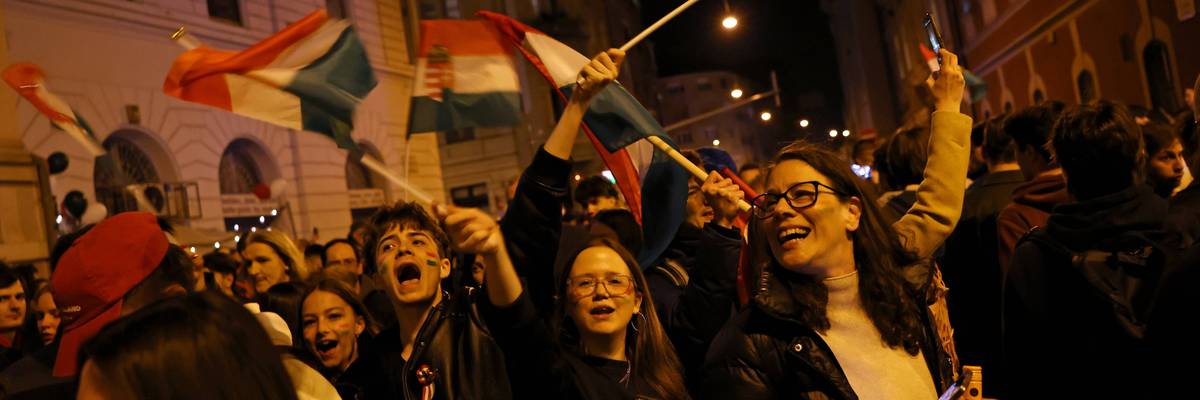
Jubilant Hungarians wave flags to celebrate the resounding Tisza win in parliamentary elections on April 12, 2026 in Budapest.
"Europe has always chosen Hungary," said the head of the European Union. "Together, we are stronger."
Far-right Hungarian Prime Minister Viktor Orbán on Sunday conceded defeat to conservative European lawmaker Peter Magyar in parliamentary elections that ended 16 years of increasingly authoritarian Christian nationalist rule amid overt interference from the Trump administration and alleged covert meddling by Russia.
"The election result is not final yet, but it is understandable and clear," Orbán said. "The election result is painful for us, but clear. The responsibility and possibility of governing was not given to us. I have congratulated the winner."
“We will serve our country and the Hungarian nation from the opposition,” he added.
Magyar, who leads the socially conservative but democratic Tisza Party, said on social media that "just now, Prime Minister Viktor Orbán has congratulated me on our victory in a phone call."
Tisza is projected to win 135 seats in the 199-seat Országgyűlés, or Parliament, with nearly half of all votes counted, according to the national election office. Orbán's Fidesz party is projected to control 57 seats, based on results as of Sunday evening.
Magyar had promised that “step by step, brick by brick, we are taking back our homeland and building a new country, a sovereign, modern, European Hungary."
Domestic and international critics have long accused Orbán of systematically eroding Hungary’s democratic institutions, tightening his grip over the country’s political system, and consolidating control over much of the media to strengthen Fidesz's rule.
After serving a single term as prime minister from 1998-2002, Orbán was elected again in 2010 and served four consecutive terms, thanks to passage by Fidesz-led lawmakers of the so-called "Fundamental Law" and other illiberal measures.
Human rights deteriorated markedly during Orbán’s tenure, especially for LGBTQ+ people, migrants, women, and Roma. The European Union has withheld billions of dollars in funding in response.
EU leaders have condemned Orbán’s rule, calling his government a “hybrid regime of electoral autocracy.” Orbán describes it as “illiberal democracy,” while touting its universal appeal to international conservatives, including US President Donald Trump.
European leaders also bristled at Orban’s warm personal relationship with Russian President Vladimir Putin, although the Hungarian leader did condemn Russia’s invasion of Ukraine and voted along with the rest of the 27-nation EU to impose economic sanctions on Moscow.
Russia is accused of trying to influence the outcome of the election in favor of Fidesz via a coordinated online disinformation campaign. At a massive election eve rally and concert in Budapest, thousands of attendees chanted in unison, "Russians go home!"
Anti-Orban concert in Hungary with the audience chanting “Russians, go home”
[image or embed]
— Olga Nesterova (@onestpress.onestnetwork.com) April 10, 2026 at 7:27 PM
Trump and senior members of his administration had openly backed Orbán, with the president promising "to use the full economic might of the United States to strengthen Hungary’s economy" if the prime minister was reelected.
US Vice President JD Vance traveled to Budapest last week to campaign for Orbán. While decrying what he called "disgraceful" interference by the EU—of which Hungary is a member—Vance added that he wanted to “help as much as I can possibly help” to secure Orbán's reelection.
JD Vance is on a historic roll: He campaigns for AfD in Germany - they lose. Invited the Pope to come to US for Trump’s big event - Pope refuses. Leads peace negotiations with Iran - fails miserably. Campaigns in Hungary for Orbán - who gets smoked.
— Ron Filipkowski (@ronfilipkowski.bsky.social) April 12, 2026 at 1:01 PM
Orbán has also accused Ukraine of election interference, although he has provided no evidence supporting his claim.
Responding to alleged foreign meddling, Magyar said on social media that "this is our country."
"Hungarian history is not written in Washington, Moscow, or Brussels—it is written in Hungary's streets and squares," he insisted.
Numerous world leaders congratulated Magyar.
"Europe’s heart is beating stronger in Hungary tonight," European Commission President Ursula von der Leyen said on social media. "Hungary has chosen Europe. Europe has always chosen Hungary. Together, we are stronger. A country reclaims its European path. The Union grows stronger."
German Chancellor Friedrich Merz said: "The Hungarian people have decided. My heartfelt congratulations on your electoral success. I am looking forward to working with you. Let’s join forces for a strong, secure and, above all, united Europe."
French President Emmanuel Macron wrote on X that "France welcomes what has been a victory in terms of people taking part in the democratic process, and a victory which shows the attachment of the Hungarian people to the values of the European Union and for Hungary's role in Europe."
Swedish Prime Minister Ulf Kristersson cheered "Tisza's historic victory in the Hungarian election!"
"I look forward to working closely with you—as allies and EU Members," Kristersson added. "This marks a new chapter in the history of Hungary.”
This country and this world are at a monumental crossroads. US voters have an opportunity to beat back the forces of fascism and confront the billionaires who are rigging the economy, our media system, and our democracy, making it increasingly impossible for ordinary people to get by. We’re not just talking about the election. We’re talking about what must be done once these fascist elements are vanquished from power. We need a bolder set of solutions than what either major party has so far been willing to offer and a working-class movement ready to fight like hell for it. Trump didn't emerge from nowhere. The conditions that fueled MAGA authoritarianism were created by decades of radical neoliberal economic policies and a corrupt political system dominated by corporate interests. They slashed taxes on the super-rich, promising that the benefits would trickle down. They said giveaways to the corporate titans would make life more affordable for the rest of us. It was all bullshit. And when a bitter, betrayed populace searches for someone to blame, right-wing demagogues have little trouble finding scapegoats. People know when they're being lied to, but you won't hear any of this from the corporate media. Only independent journalism—powered and funded by people who believe in building a better world—can deliver truly trustworthy daily news. If you share our vision, please contribute whatever you can to sustain our work. |
Far-right Hungarian Prime Minister Viktor Orbán on Sunday conceded defeat to conservative European lawmaker Peter Magyar in parliamentary elections that ended 16 years of increasingly authoritarian Christian nationalist rule amid overt interference from the Trump administration and alleged covert meddling by Russia.
"The election result is not final yet, but it is understandable and clear," Orbán said. "The election result is painful for us, but clear. The responsibility and possibility of governing was not given to us. I have congratulated the winner."
“We will serve our country and the Hungarian nation from the opposition,” he added.
Magyar, who leads the socially conservative but democratic Tisza Party, said on social media that "just now, Prime Minister Viktor Orbán has congratulated me on our victory in a phone call."
Tisza is projected to win 135 seats in the 199-seat Országgyűlés, or Parliament, with nearly half of all votes counted, according to the national election office. Orbán's Fidesz party is projected to control 57 seats, based on results as of Sunday evening.
Magyar had promised that “step by step, brick by brick, we are taking back our homeland and building a new country, a sovereign, modern, European Hungary."
Domestic and international critics have long accused Orbán of systematically eroding Hungary’s democratic institutions, tightening his grip over the country’s political system, and consolidating control over much of the media to strengthen Fidesz's rule.
After serving a single term as prime minister from 1998-2002, Orbán was elected again in 2010 and served four consecutive terms, thanks to passage by Fidesz-led lawmakers of the so-called "Fundamental Law" and other illiberal measures.
Human rights deteriorated markedly during Orbán’s tenure, especially for LGBTQ+ people, migrants, women, and Roma. The European Union has withheld billions of dollars in funding in response.
EU leaders have condemned Orbán’s rule, calling his government a “hybrid regime of electoral autocracy.” Orbán describes it as “illiberal democracy,” while touting its universal appeal to international conservatives, including US President Donald Trump.
European leaders also bristled at Orban’s warm personal relationship with Russian President Vladimir Putin, although the Hungarian leader did condemn Russia’s invasion of Ukraine and voted along with the rest of the 27-nation EU to impose economic sanctions on Moscow.
Russia is accused of trying to influence the outcome of the election in favor of Fidesz via a coordinated online disinformation campaign. At a massive election eve rally and concert in Budapest, thousands of attendees chanted in unison, "Russians go home!"
Anti-Orban concert in Hungary with the audience chanting “Russians, go home”
[image or embed]
— Olga Nesterova (@onestpress.onestnetwork.com) April 10, 2026 at 7:27 PM
Trump and senior members of his administration had openly backed Orbán, with the president promising "to use the full economic might of the United States to strengthen Hungary’s economy" if the prime minister was reelected.
US Vice President JD Vance traveled to Budapest last week to campaign for Orbán. While decrying what he called "disgraceful" interference by the EU—of which Hungary is a member—Vance added that he wanted to “help as much as I can possibly help” to secure Orbán's reelection.
JD Vance is on a historic roll: He campaigns for AfD in Germany - they lose. Invited the Pope to come to US for Trump’s big event - Pope refuses. Leads peace negotiations with Iran - fails miserably. Campaigns in Hungary for Orbán - who gets smoked.
— Ron Filipkowski (@ronfilipkowski.bsky.social) April 12, 2026 at 1:01 PM
Orbán has also accused Ukraine of election interference, although he has provided no evidence supporting his claim.
Responding to alleged foreign meddling, Magyar said on social media that "this is our country."
"Hungarian history is not written in Washington, Moscow, or Brussels—it is written in Hungary's streets and squares," he insisted.
Numerous world leaders congratulated Magyar.
"Europe’s heart is beating stronger in Hungary tonight," European Commission President Ursula von der Leyen said on social media. "Hungary has chosen Europe. Europe has always chosen Hungary. Together, we are stronger. A country reclaims its European path. The Union grows stronger."
German Chancellor Friedrich Merz said: "The Hungarian people have decided. My heartfelt congratulations on your electoral success. I am looking forward to working with you. Let’s join forces for a strong, secure and, above all, united Europe."
French President Emmanuel Macron wrote on X that "France welcomes what has been a victory in terms of people taking part in the democratic process, and a victory which shows the attachment of the Hungarian people to the values of the European Union and for Hungary's role in Europe."
Swedish Prime Minister Ulf Kristersson cheered "Tisza's historic victory in the Hungarian election!"
"I look forward to working closely with you—as allies and EU Members," Kristersson added. "This marks a new chapter in the history of Hungary.”