SUBSCRIBE TO OUR FREE NEWSLETTER
Daily news & progressive opinion—funded by the people, not the corporations—delivered straight to your inbox.
5
#000000
#FFFFFF
To donate by check, phone, or other method, see our More Ways to Give page.
Daily news & progressive opinion—funded by the people, not the corporations—delivered straight to your inbox.
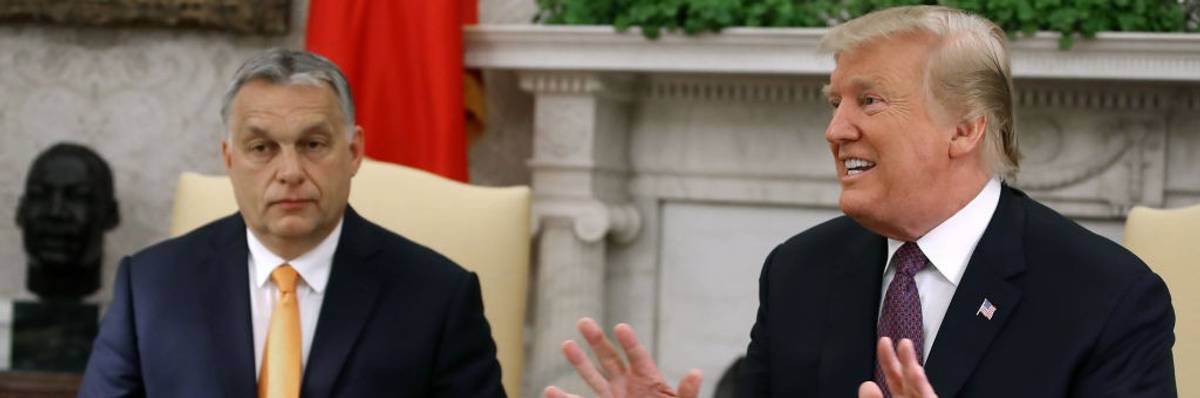
Then-U.S. President Donald Trump speaks to the media during a meeting with Hungarian Prime Minister Viktor Orban, in the Oval Office on May 13, 2019 in Washington, DC.
"How many different ways does Trump need to tell you he's going to rule as a dictator before you believe him?"
Donald Trump, the presumptive Republican nominee for president, praised Hungary Prime Minister Viktor Orbán on Friday night for his authoritarian leadership during an event at Mar-a-Lago in Florida.
"There's nobody that's better, smarter or a better leader than Viktor Orbán, who's fantastic," said Trump from a stage as he introduced his guest to the crowd. "He's a non-controversial figure, because he says, 'This is the way it's gonna be and that's the end of it,' right? He's the boss."
Trump went on to call him a "great leader" and a "fantastic leader."
Trump honors Viktor Orban for being an autocrat: “There’s nobody that’s better, smarter or a better leader than Viktor Orban. He says, ‘This is the way it’s gonna be,’ and that’s the end of it. He’s the boss.” pic.twitter.com/Fz91sbsHi1
— Ron Filipkowski (@RonFilipkowski) March 9, 2024
"How many different ways does Trump need to tell you he's going to rule as a dictator before you believe him?" asked political columnist Will Bunch in response to the remarks. In December, Trump admitted he would act like a dictator if elected in 2024, but only on "day one."
Prior to his trip to down to Florida, Orbán—who has ruled Hungary as an "illiberal state" (his term) since coming to power in 2010—stopped in Washington, D.C. where he met with leaders of the far-right Heritage Foundation, a key ally of Trump's and the architect of Project 2025, a "battle plan" for "authoritarianism" in the United States if the former president is able to win a second term.
President Joe Biden was asked Friday if was concerned that Orbán was meeting with Trump and he responded: "If I'm not, you should be."
Reporter: Are you concerned that Trump is meeting with Orbán?
Biden: If I’m not, you should be pic.twitter.com/Gw4SWXAeVB
— Acyn (@Acyn) March 8, 2024
During a campaign stop later in the day, Biden told attendees, "Do you know who [Trump's] meeting with today down in Mar-a-Lago? Orbán of Hungary, who's stated flatly that he doesn't thinks democracy works, he’s looking for dictatorship."
Biden added that he's fighting for a future "where we defend democracy, not diminish it."
Writing in The Conversation on Thursday, Gábor Scheirin, a former Green party member of the Hungarian Parliament from 2010 to 2014 and now a visiting fellow at Harvard University, described the ascent of Orbán.
Scheirin explains in his piece how Orbán, a "strongman" who benefited greatly from a "nationwide right-wing media network" that could echo his agenda, was able to "subvert democracy from the inside" in ways that have troubling parallels in the United States.
With the help of a pliant judiciary, gerrymandered voting districts, a party stacked with hard-core loyalists, and a right-wing media echo chamber, writes Scheirin, this "authoritarianism from within creates chokepoints, where the opposition isn't crushed" entirely, but "has a hard time breathing."
The biggest threat to a democracy targeted by authoritarians like Orbán and Trump, argues Scheirin, is the neglect of those people susceptible to their inducement due to the economic pain they suffer under neoliberal capitalism and globalization. He writes:
If there is one lesson from Hungary, it is this: Democracy is not sustainable in a divided society where many are left behind economically.
The real power of authoritarian populists like Trump and Orban lies not in the institutions they hijack but in the novel electoral support coalition they create.
They bring together two types of supporters. Some hardcore, authoritarian-right voters are motivated by bigotry and hatred rooted in their fear of globalization’s cultural threats. However, the most successful right-wing populist forces integrate an outer layer of primarily working-class voters hurt by globalization’s economic threats.
"If the liberal center appears uncaring, authoritarian populists can mobilize voters against both the cultural and economic threats posed by globalization," Scheirin continues. "Neglecting this suffering" felt by many voters, he warns, "was the democratic center's politically lethal failure" in Hungary as Orbán rose to power.
As Common Dreams reported earlier this week, the Trump-Orbán get-together was seen broadly by progressive critics as a chance for the Hungarian to school his American friend on "how to destroy democracy" more effectively than he was able to the first time around.
"I mean this sincerely," said Democratic strategist and pundit Cliff Schechter in response to the latest praise of Orbán, Trump would "need to start choosing random people to torture or execute on that stage to make his intentions any more obvious if elected."
Dear Common Dreams reader, It’s been nearly 30 years since I co-founded Common Dreams with my late wife, Lina Newhouser. We had the radical notion that journalism should serve the public good, not corporate profits. It was clear to us from the outset what it would take to build such a project. No paid advertisements. No corporate sponsors. No millionaire publisher telling us what to think or do. Many people said we wouldn't last a year, but we proved those doubters wrong. Together with a tremendous team of journalists and dedicated staff, we built an independent media outlet free from the constraints of profits and corporate control. Our mission has always been simple: To inform. To inspire. To ignite change for the common good. Building Common Dreams was not easy. Our survival was never guaranteed. When you take on the most powerful forces—Wall Street greed, fossil fuel industry destruction, Big Tech lobbyists, and uber-rich oligarchs who have spent billions upon billions rigging the economy and democracy in their favor—the only bulwark you have is supporters who believe in your work. But here’s the urgent message from me today. It's never been this bad out there. And it's never been this hard to keep us going. At the very moment Common Dreams is most needed, the threats we face are intensifying. We need your support now more than ever. We don't accept corporate advertising and never will. We don't have a paywall because we don't think people should be blocked from critical news based on their ability to pay. Everything we do is funded by the donations of readers like you. When everyone does the little they can afford, we are strong. But if that support retreats or dries up, so do we. Will you donate now to make sure Common Dreams not only survives but thrives? —Craig Brown, Co-founder |
Donald Trump, the presumptive Republican nominee for president, praised Hungary Prime Minister Viktor Orbán on Friday night for his authoritarian leadership during an event at Mar-a-Lago in Florida.
"There's nobody that's better, smarter or a better leader than Viktor Orbán, who's fantastic," said Trump from a stage as he introduced his guest to the crowd. "He's a non-controversial figure, because he says, 'This is the way it's gonna be and that's the end of it,' right? He's the boss."
Trump went on to call him a "great leader" and a "fantastic leader."
Trump honors Viktor Orban for being an autocrat: “There’s nobody that’s better, smarter or a better leader than Viktor Orban. He says, ‘This is the way it’s gonna be,’ and that’s the end of it. He’s the boss.” pic.twitter.com/Fz91sbsHi1
— Ron Filipkowski (@RonFilipkowski) March 9, 2024
"How many different ways does Trump need to tell you he's going to rule as a dictator before you believe him?" asked political columnist Will Bunch in response to the remarks. In December, Trump admitted he would act like a dictator if elected in 2024, but only on "day one."
Prior to his trip to down to Florida, Orbán—who has ruled Hungary as an "illiberal state" (his term) since coming to power in 2010—stopped in Washington, D.C. where he met with leaders of the far-right Heritage Foundation, a key ally of Trump's and the architect of Project 2025, a "battle plan" for "authoritarianism" in the United States if the former president is able to win a second term.
President Joe Biden was asked Friday if was concerned that Orbán was meeting with Trump and he responded: "If I'm not, you should be."
Reporter: Are you concerned that Trump is meeting with Orbán?
Biden: If I’m not, you should be pic.twitter.com/Gw4SWXAeVB
— Acyn (@Acyn) March 8, 2024
During a campaign stop later in the day, Biden told attendees, "Do you know who [Trump's] meeting with today down in Mar-a-Lago? Orbán of Hungary, who's stated flatly that he doesn't thinks democracy works, he’s looking for dictatorship."
Biden added that he's fighting for a future "where we defend democracy, not diminish it."
Writing in The Conversation on Thursday, Gábor Scheirin, a former Green party member of the Hungarian Parliament from 2010 to 2014 and now a visiting fellow at Harvard University, described the ascent of Orbán.
Scheirin explains in his piece how Orbán, a "strongman" who benefited greatly from a "nationwide right-wing media network" that could echo his agenda, was able to "subvert democracy from the inside" in ways that have troubling parallels in the United States.
With the help of a pliant judiciary, gerrymandered voting districts, a party stacked with hard-core loyalists, and a right-wing media echo chamber, writes Scheirin, this "authoritarianism from within creates chokepoints, where the opposition isn't crushed" entirely, but "has a hard time breathing."
The biggest threat to a democracy targeted by authoritarians like Orbán and Trump, argues Scheirin, is the neglect of those people susceptible to their inducement due to the economic pain they suffer under neoliberal capitalism and globalization. He writes:
If there is one lesson from Hungary, it is this: Democracy is not sustainable in a divided society where many are left behind economically.
The real power of authoritarian populists like Trump and Orban lies not in the institutions they hijack but in the novel electoral support coalition they create.
They bring together two types of supporters. Some hardcore, authoritarian-right voters are motivated by bigotry and hatred rooted in their fear of globalization’s cultural threats. However, the most successful right-wing populist forces integrate an outer layer of primarily working-class voters hurt by globalization’s economic threats.
"If the liberal center appears uncaring, authoritarian populists can mobilize voters against both the cultural and economic threats posed by globalization," Scheirin continues. "Neglecting this suffering" felt by many voters, he warns, "was the democratic center's politically lethal failure" in Hungary as Orbán rose to power.
As Common Dreams reported earlier this week, the Trump-Orbán get-together was seen broadly by progressive critics as a chance for the Hungarian to school his American friend on "how to destroy democracy" more effectively than he was able to the first time around.
"I mean this sincerely," said Democratic strategist and pundit Cliff Schechter in response to the latest praise of Orbán, Trump would "need to start choosing random people to torture or execute on that stage to make his intentions any more obvious if elected."
Donald Trump, the presumptive Republican nominee for president, praised Hungary Prime Minister Viktor Orbán on Friday night for his authoritarian leadership during an event at Mar-a-Lago in Florida.
"There's nobody that's better, smarter or a better leader than Viktor Orbán, who's fantastic," said Trump from a stage as he introduced his guest to the crowd. "He's a non-controversial figure, because he says, 'This is the way it's gonna be and that's the end of it,' right? He's the boss."
Trump went on to call him a "great leader" and a "fantastic leader."
Trump honors Viktor Orban for being an autocrat: “There’s nobody that’s better, smarter or a better leader than Viktor Orban. He says, ‘This is the way it’s gonna be,’ and that’s the end of it. He’s the boss.” pic.twitter.com/Fz91sbsHi1
— Ron Filipkowski (@RonFilipkowski) March 9, 2024
"How many different ways does Trump need to tell you he's going to rule as a dictator before you believe him?" asked political columnist Will Bunch in response to the remarks. In December, Trump admitted he would act like a dictator if elected in 2024, but only on "day one."
Prior to his trip to down to Florida, Orbán—who has ruled Hungary as an "illiberal state" (his term) since coming to power in 2010—stopped in Washington, D.C. where he met with leaders of the far-right Heritage Foundation, a key ally of Trump's and the architect of Project 2025, a "battle plan" for "authoritarianism" in the United States if the former president is able to win a second term.
President Joe Biden was asked Friday if was concerned that Orbán was meeting with Trump and he responded: "If I'm not, you should be."
Reporter: Are you concerned that Trump is meeting with Orbán?
Biden: If I’m not, you should be pic.twitter.com/Gw4SWXAeVB
— Acyn (@Acyn) March 8, 2024
During a campaign stop later in the day, Biden told attendees, "Do you know who [Trump's] meeting with today down in Mar-a-Lago? Orbán of Hungary, who's stated flatly that he doesn't thinks democracy works, he’s looking for dictatorship."
Biden added that he's fighting for a future "where we defend democracy, not diminish it."
Writing in The Conversation on Thursday, Gábor Scheirin, a former Green party member of the Hungarian Parliament from 2010 to 2014 and now a visiting fellow at Harvard University, described the ascent of Orbán.
Scheirin explains in his piece how Orbán, a "strongman" who benefited greatly from a "nationwide right-wing media network" that could echo his agenda, was able to "subvert democracy from the inside" in ways that have troubling parallels in the United States.
With the help of a pliant judiciary, gerrymandered voting districts, a party stacked with hard-core loyalists, and a right-wing media echo chamber, writes Scheirin, this "authoritarianism from within creates chokepoints, where the opposition isn't crushed" entirely, but "has a hard time breathing."
The biggest threat to a democracy targeted by authoritarians like Orbán and Trump, argues Scheirin, is the neglect of those people susceptible to their inducement due to the economic pain they suffer under neoliberal capitalism and globalization. He writes:
If there is one lesson from Hungary, it is this: Democracy is not sustainable in a divided society where many are left behind economically.
The real power of authoritarian populists like Trump and Orban lies not in the institutions they hijack but in the novel electoral support coalition they create.
They bring together two types of supporters. Some hardcore, authoritarian-right voters are motivated by bigotry and hatred rooted in their fear of globalization’s cultural threats. However, the most successful right-wing populist forces integrate an outer layer of primarily working-class voters hurt by globalization’s economic threats.
"If the liberal center appears uncaring, authoritarian populists can mobilize voters against both the cultural and economic threats posed by globalization," Scheirin continues. "Neglecting this suffering" felt by many voters, he warns, "was the democratic center's politically lethal failure" in Hungary as Orbán rose to power.
As Common Dreams reported earlier this week, the Trump-Orbán get-together was seen broadly by progressive critics as a chance for the Hungarian to school his American friend on "how to destroy democracy" more effectively than he was able to the first time around.
"I mean this sincerely," said Democratic strategist and pundit Cliff Schechter in response to the latest praise of Orbán, Trump would "need to start choosing random people to torture or execute on that stage to make his intentions any more obvious if elected."