SUBSCRIBE TO OUR FREE NEWSLETTER
Daily news & progressive opinion—funded by the people, not the corporations—delivered straight to your inbox.
5
#000000
#FFFFFF
To donate by check, phone, or other method, see our More Ways to Give page.
Daily news & progressive opinion—funded by the people, not the corporations—delivered straight to your inbox.
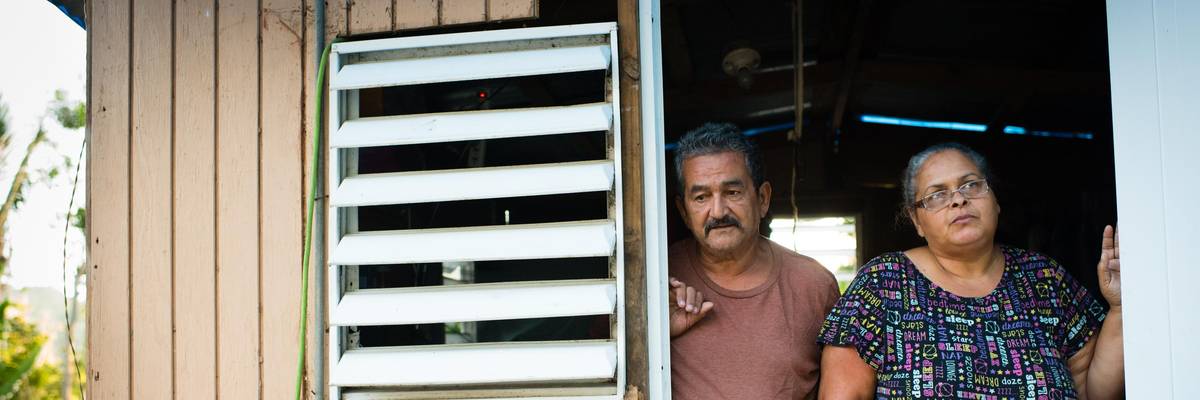
Carlos Fernandez and his wife, Ivette Garcia, stand in the doorway of their temporary house in Villalba, Puerto Rico on August 27, 2018, one year after Hurricane Maria destroyed their home.
A group of 16 Puerto Rican municipalities has sued Chevron, ExxonMobil, Shell, and other fossil fuel giants for alleged violations of the Racketeer Influenced and Corrupt Organizations Act.
The lawsuit, filed last week in federal court and described by plaintiffs as a first-of-its-kind RICO case, accuses Big Oil of colluding to deny the climate-wrecking impacts of their fossil fuel products.
As Reuters reported Tuesday:
The towns say the companies coordinated a multibillion-dollar "fraudulent marketing scheme" to convince consumers that fossil fuel products do not alter the climate. That campaign ran contrary to the companies' own studies showing their products accelerate climate change, resulting in more deadly storms, the lawsuit said.
The municipalities said the companies outlined a plan of deception in a joint memo that took aim at international climate negotiations in the 1990s. The coordinated deception spanning decades violates U.S. racketeering and antitrust laws among others, the suit claims.
The towns argue that roughly a dozen oil, gas, and coal corporations and other actors are financially responsible for and should pay to cover the damages suffered during the catastrophic 2017 hurricane season, which was intensified by planet-heating pollution.
"The 2017 Atlantic hurricane season, featuring six major hurricanes and more than a dozen named storms, caused at least $294 billion worth of damages in the U.S. territory," Reuters reported, citing the lawsuit. "Hurricanes Irma and Maria contributed to an estimated 4,600 deaths and the failure of critical infrastructure in Puerto Rico, the municipalities said."
Marc Grossman, a partner at one of the firms representing the municipalities, called Puerto Rico "the ultimate victim of global warming."
The class action complaint comes just weeks after Puerto Ricans were once again left in the dark for a prolonged period of time after Hurricane Fiona overwhelmed the island's privatized electric grid, sparking protests in several communities as well as a hearing led by local lawmakers.
Fiona made landfall five years after the much stronger Maria triggered an islandwide blackout. In the wake of the 2017 disaster, the island's grid was entirely privatized by LUMA Energy, a joint venture owned by Canadian firm ATCO Ltd. and U.S. contractor Quanta Services Inc.
The United States paved the way for LUMA Energy's corporate takeover of Puerto Rico's grid, and Washington's ongoing domination of the island, which began more than 120 years ago, makes it more vulnerable to the devastating effects of hurricanes such as Maria and Fiona.
In a Jacobin essay published last month, Joe Wilkins wrote:
The commonwealth lost its ability to meaningfully influence structural decisions with a 2016 Barack Obama-era law called the Puerto Rico Oversight, Management, and Economic Stability Act, known as PROMESA or La Junta.
This act allowed the U.S. Congress to infringe on the island's pecuniary autonomy through the appointment of a Financial Oversight and Management Board (FOMB). Since its formation, the FOMB has enacted severe austerity measures on public services in order to help Puerto Rico "achieve fiscal responsibility and ultimately reestablish access to credit markets," according to the text of the legislation. La Junta also gives the FOMB authority to deny unionized utility workers their right to strike.
The FOMB's independence from Puerto Rican lawmakers meant that it could clear the way for Puerto Rico's public electrical company, the Puerto Rico Electric Power Authority (PREPA), to sell commonwealth assets and outsource services related to the generation and transfer of electricity. In 2018, legislation was passed to enable the placement of Puerto Rico's energy grid under private management. That 2018 act revealed La Junta's true purpose: raising the bridge to make way for muck-dredging capitalists who have long lusted after utility contracts in the Global South. From then on it was inevitable that PREPA would seek a public-private partnership in order to improve the public grid. That's where LUMA came in.
The American Prospect's Ryan Cooper argued recently that "there are many proximate factors behind Puerto Rico's continued vulnerability to hurricanes and economic dysfunction. But the root problem is political inequality."
"It is an American colony: controlled by the United States government, but without any political representation for the people living there," wrote Cooper. "Until this inequality is rectified, it's a safe bet that Puerto Rico will never fully recover."
Dozens of states and cities around the U.S. have sued fossil fuel corporations in a bid to make highly deceptive polluters pay for climate change-related damages and adaptation costs, mostly in state court.
Oil and gas giants have tried repeatedly to shift jurisdiction over climate liability lawsuits from state courts to federal court, where they think they will be more likely to avoid accountability.
While federal appeals courts have rejected such attempts on multiple occasions this year, the right-wing-dominated Supreme Court is considering taking up an industry-led challenge to a February ruling with far-reaching implications.
Dear Common Dreams reader, It’s been nearly 30 years since I co-founded Common Dreams with my late wife, Lina Newhouser. We had the radical notion that journalism should serve the public good, not corporate profits. It was clear to us from the outset what it would take to build such a project. No paid advertisements. No corporate sponsors. No millionaire publisher telling us what to think or do. Many people said we wouldn't last a year, but we proved those doubters wrong. Together with a tremendous team of journalists and dedicated staff, we built an independent media outlet free from the constraints of profits and corporate control. Our mission has always been simple: To inform. To inspire. To ignite change for the common good. Building Common Dreams was not easy. Our survival was never guaranteed. When you take on the most powerful forces—Wall Street greed, fossil fuel industry destruction, Big Tech lobbyists, and uber-rich oligarchs who have spent billions upon billions rigging the economy and democracy in their favor—the only bulwark you have is supporters who believe in your work. But here’s the urgent message from me today. It's never been this bad out there. And it's never been this hard to keep us going. At the very moment Common Dreams is most needed, the threats we face are intensifying. We need your support now more than ever. We don't accept corporate advertising and never will. We don't have a paywall because we don't think people should be blocked from critical news based on their ability to pay. Everything we do is funded by the donations of readers like you. When everyone does the little they can afford, we are strong. But if that support retreats or dries up, so do we. Will you donate now to make sure Common Dreams not only survives but thrives? —Craig Brown, Co-founder |
A group of 16 Puerto Rican municipalities has sued Chevron, ExxonMobil, Shell, and other fossil fuel giants for alleged violations of the Racketeer Influenced and Corrupt Organizations Act.
The lawsuit, filed last week in federal court and described by plaintiffs as a first-of-its-kind RICO case, accuses Big Oil of colluding to deny the climate-wrecking impacts of their fossil fuel products.
As Reuters reported Tuesday:
The towns say the companies coordinated a multibillion-dollar "fraudulent marketing scheme" to convince consumers that fossil fuel products do not alter the climate. That campaign ran contrary to the companies' own studies showing their products accelerate climate change, resulting in more deadly storms, the lawsuit said.
The municipalities said the companies outlined a plan of deception in a joint memo that took aim at international climate negotiations in the 1990s. The coordinated deception spanning decades violates U.S. racketeering and antitrust laws among others, the suit claims.
The towns argue that roughly a dozen oil, gas, and coal corporations and other actors are financially responsible for and should pay to cover the damages suffered during the catastrophic 2017 hurricane season, which was intensified by planet-heating pollution.
"The 2017 Atlantic hurricane season, featuring six major hurricanes and more than a dozen named storms, caused at least $294 billion worth of damages in the U.S. territory," Reuters reported, citing the lawsuit. "Hurricanes Irma and Maria contributed to an estimated 4,600 deaths and the failure of critical infrastructure in Puerto Rico, the municipalities said."
Marc Grossman, a partner at one of the firms representing the municipalities, called Puerto Rico "the ultimate victim of global warming."
The class action complaint comes just weeks after Puerto Ricans were once again left in the dark for a prolonged period of time after Hurricane Fiona overwhelmed the island's privatized electric grid, sparking protests in several communities as well as a hearing led by local lawmakers.
Fiona made landfall five years after the much stronger Maria triggered an islandwide blackout. In the wake of the 2017 disaster, the island's grid was entirely privatized by LUMA Energy, a joint venture owned by Canadian firm ATCO Ltd. and U.S. contractor Quanta Services Inc.
The United States paved the way for LUMA Energy's corporate takeover of Puerto Rico's grid, and Washington's ongoing domination of the island, which began more than 120 years ago, makes it more vulnerable to the devastating effects of hurricanes such as Maria and Fiona.
In a Jacobin essay published last month, Joe Wilkins wrote:
The commonwealth lost its ability to meaningfully influence structural decisions with a 2016 Barack Obama-era law called the Puerto Rico Oversight, Management, and Economic Stability Act, known as PROMESA or La Junta.
This act allowed the U.S. Congress to infringe on the island's pecuniary autonomy through the appointment of a Financial Oversight and Management Board (FOMB). Since its formation, the FOMB has enacted severe austerity measures on public services in order to help Puerto Rico "achieve fiscal responsibility and ultimately reestablish access to credit markets," according to the text of the legislation. La Junta also gives the FOMB authority to deny unionized utility workers their right to strike.
The FOMB's independence from Puerto Rican lawmakers meant that it could clear the way for Puerto Rico's public electrical company, the Puerto Rico Electric Power Authority (PREPA), to sell commonwealth assets and outsource services related to the generation and transfer of electricity. In 2018, legislation was passed to enable the placement of Puerto Rico's energy grid under private management. That 2018 act revealed La Junta's true purpose: raising the bridge to make way for muck-dredging capitalists who have long lusted after utility contracts in the Global South. From then on it was inevitable that PREPA would seek a public-private partnership in order to improve the public grid. That's where LUMA came in.
The American Prospect's Ryan Cooper argued recently that "there are many proximate factors behind Puerto Rico's continued vulnerability to hurricanes and economic dysfunction. But the root problem is political inequality."
"It is an American colony: controlled by the United States government, but without any political representation for the people living there," wrote Cooper. "Until this inequality is rectified, it's a safe bet that Puerto Rico will never fully recover."
Dozens of states and cities around the U.S. have sued fossil fuel corporations in a bid to make highly deceptive polluters pay for climate change-related damages and adaptation costs, mostly in state court.
Oil and gas giants have tried repeatedly to shift jurisdiction over climate liability lawsuits from state courts to federal court, where they think they will be more likely to avoid accountability.
While federal appeals courts have rejected such attempts on multiple occasions this year, the right-wing-dominated Supreme Court is considering taking up an industry-led challenge to a February ruling with far-reaching implications.
A group of 16 Puerto Rican municipalities has sued Chevron, ExxonMobil, Shell, and other fossil fuel giants for alleged violations of the Racketeer Influenced and Corrupt Organizations Act.
The lawsuit, filed last week in federal court and described by plaintiffs as a first-of-its-kind RICO case, accuses Big Oil of colluding to deny the climate-wrecking impacts of their fossil fuel products.
As Reuters reported Tuesday:
The towns say the companies coordinated a multibillion-dollar "fraudulent marketing scheme" to convince consumers that fossil fuel products do not alter the climate. That campaign ran contrary to the companies' own studies showing their products accelerate climate change, resulting in more deadly storms, the lawsuit said.
The municipalities said the companies outlined a plan of deception in a joint memo that took aim at international climate negotiations in the 1990s. The coordinated deception spanning decades violates U.S. racketeering and antitrust laws among others, the suit claims.
The towns argue that roughly a dozen oil, gas, and coal corporations and other actors are financially responsible for and should pay to cover the damages suffered during the catastrophic 2017 hurricane season, which was intensified by planet-heating pollution.
"The 2017 Atlantic hurricane season, featuring six major hurricanes and more than a dozen named storms, caused at least $294 billion worth of damages in the U.S. territory," Reuters reported, citing the lawsuit. "Hurricanes Irma and Maria contributed to an estimated 4,600 deaths and the failure of critical infrastructure in Puerto Rico, the municipalities said."
Marc Grossman, a partner at one of the firms representing the municipalities, called Puerto Rico "the ultimate victim of global warming."
The class action complaint comes just weeks after Puerto Ricans were once again left in the dark for a prolonged period of time after Hurricane Fiona overwhelmed the island's privatized electric grid, sparking protests in several communities as well as a hearing led by local lawmakers.
Fiona made landfall five years after the much stronger Maria triggered an islandwide blackout. In the wake of the 2017 disaster, the island's grid was entirely privatized by LUMA Energy, a joint venture owned by Canadian firm ATCO Ltd. and U.S. contractor Quanta Services Inc.
The United States paved the way for LUMA Energy's corporate takeover of Puerto Rico's grid, and Washington's ongoing domination of the island, which began more than 120 years ago, makes it more vulnerable to the devastating effects of hurricanes such as Maria and Fiona.
In a Jacobin essay published last month, Joe Wilkins wrote:
The commonwealth lost its ability to meaningfully influence structural decisions with a 2016 Barack Obama-era law called the Puerto Rico Oversight, Management, and Economic Stability Act, known as PROMESA or La Junta.
This act allowed the U.S. Congress to infringe on the island's pecuniary autonomy through the appointment of a Financial Oversight and Management Board (FOMB). Since its formation, the FOMB has enacted severe austerity measures on public services in order to help Puerto Rico "achieve fiscal responsibility and ultimately reestablish access to credit markets," according to the text of the legislation. La Junta also gives the FOMB authority to deny unionized utility workers their right to strike.
The FOMB's independence from Puerto Rican lawmakers meant that it could clear the way for Puerto Rico's public electrical company, the Puerto Rico Electric Power Authority (PREPA), to sell commonwealth assets and outsource services related to the generation and transfer of electricity. In 2018, legislation was passed to enable the placement of Puerto Rico's energy grid under private management. That 2018 act revealed La Junta's true purpose: raising the bridge to make way for muck-dredging capitalists who have long lusted after utility contracts in the Global South. From then on it was inevitable that PREPA would seek a public-private partnership in order to improve the public grid. That's where LUMA came in.
The American Prospect's Ryan Cooper argued recently that "there are many proximate factors behind Puerto Rico's continued vulnerability to hurricanes and economic dysfunction. But the root problem is political inequality."
"It is an American colony: controlled by the United States government, but without any political representation for the people living there," wrote Cooper. "Until this inequality is rectified, it's a safe bet that Puerto Rico will never fully recover."
Dozens of states and cities around the U.S. have sued fossil fuel corporations in a bid to make highly deceptive polluters pay for climate change-related damages and adaptation costs, mostly in state court.
Oil and gas giants have tried repeatedly to shift jurisdiction over climate liability lawsuits from state courts to federal court, where they think they will be more likely to avoid accountability.
While federal appeals courts have rejected such attempts on multiple occasions this year, the right-wing-dominated Supreme Court is considering taking up an industry-led challenge to a February ruling with far-reaching implications.