SUBSCRIBE TO OUR FREE NEWSLETTER
Daily news & progressive opinion—funded by the people, not the corporations—delivered straight to your inbox.
5
#000000
#FFFFFF
To donate by check, phone, or other method, see our More Ways to Give page.
Daily news & progressive opinion—funded by the people, not the corporations—delivered straight to your inbox.
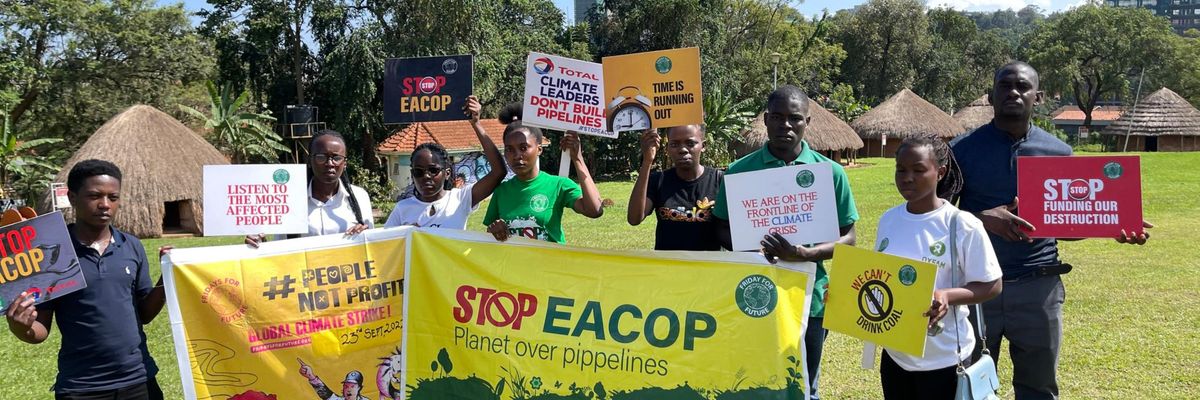
Ugandan climate activists demonstrate in Kampala on September 23, 2022. (Photo: Hilda F. Nakabuye/Twitter)
Thousands of African activists and members of communities on the frontlines of the worsening climate emergency turned out Friday to call on world leaders--who will gather in Egypt in November for the United Nations Climate Summit--to urgently address a crisis that disproportionately impacts their lives.
"The least responsible nations and communities are suffering the most from the impacts of the climate emergency."
Demonstrators took to the streets, public spaces, and even waterways in countries across a continent that's responsible for just 4% of global greenhouse emissions to demand climate justice and an end to fossil fuel exploration and extraction ahead of the U.N.'s COP27 conference, scheduled to start November 6 in Sharm El-Sheikh.
Activists expressed solidarity with global climate strikes--including the youth-led Fridays for Future movement--demanding justice and reparations for the people most affected by a crisis they did the least to cause. Some demonstrations called out individual contributors to the climate emergency, such as the Total-led East African Crude Oil Pipeline.
The protests took place as many parts of Africa are experiencing the worst food crisis in decades. Climate-driven drought and desertification have pushed tens of millions of people to the brink of famine, while shortages and soaring prices of food--fueled by climate change, Russia's invasion of Ukraine, and capitalist predation--adversely affect many millions more.
"The urgency of the climate crisis cannot be understated, particularly here in Africa, which is the region most vulnerable to climate impacts. It is thus concerning that instead of funding a much-needed just transition in Africa, nations in the European Union are turning their gaze to Africa to meet their gas needs," 350Africa.org regional director Landry Ninteretse said in a statement.
"Rather than lock our continent into production of fossils, developed nations should be held accountable for their role in the climate crisis," Ninteretse added. "Ahead of COP27, our expectations are that they should provide compensation in the form of loss and damage suffered by the developing nations as a result of climate impacts, support adaptation measures to allow us to build resilience to these impacts, and inject funding into the just transition to renewable energy in Africa."
Earlier this week, Denmark became the first country to promise to establish a loss and damage fund that aims to compensate developing nations for the destruction caused by climate change.
Edmund Mumbere, a Ugandan activist, said that "as the communities on the frontlines of the climate crisis, we have to hold governments, corporations, financial institutions, and policymakers to account for the harmful practices that are devastating our communities."
"This is why we have been resisting fossil fuel projects, which should not have a place in the future of our continent, or the world," he added. "As climate impacts are projected to worsen, as seen with the recent severe flooding in Uganda, there's a great need for financing to be redirected into renewable energy to support a just transition in Africa."
Friday's protests took place three days before hundreds of young climate activists from across the Global South are set to kick off a weeklong Climate Justice Camp in Tunisia.
"The least responsible nations and communities are suffering the most from the impacts of the climate emergency, which is further deepening historical injustices," Greenpeace Middle East and North Africa regional campaigns manager Ahmed El Droubi said in a statement.
"In November, world leaders will be making decisions in Egypt, which will affect the future of our communities," he added. "We in the Global South need to be at the front of this process to apply pressure for real climate action rather than it being another photo opportunity producing empty words and pledges."
Dear Common Dreams reader, It’s been nearly 30 years since I co-founded Common Dreams with my late wife, Lina Newhouser. We had the radical notion that journalism should serve the public good, not corporate profits. It was clear to us from the outset what it would take to build such a project. No paid advertisements. No corporate sponsors. No millionaire publisher telling us what to think or do. Many people said we wouldn't last a year, but we proved those doubters wrong. Together with a tremendous team of journalists and dedicated staff, we built an independent media outlet free from the constraints of profits and corporate control. Our mission has always been simple: To inform. To inspire. To ignite change for the common good. Building Common Dreams was not easy. Our survival was never guaranteed. When you take on the most powerful forces—Wall Street greed, fossil fuel industry destruction, Big Tech lobbyists, and uber-rich oligarchs who have spent billions upon billions rigging the economy and democracy in their favor—the only bulwark you have is supporters who believe in your work. But here’s the urgent message from me today. It's never been this bad out there. And it's never been this hard to keep us going. At the very moment Common Dreams is most needed, the threats we face are intensifying. We need your support now more than ever. We don't accept corporate advertising and never will. We don't have a paywall because we don't think people should be blocked from critical news based on their ability to pay. Everything we do is funded by the donations of readers like you. When everyone does the little they can afford, we are strong. But if that support retreats or dries up, so do we. Will you donate now to make sure Common Dreams not only survives but thrives? —Craig Brown, Co-founder |
Thousands of African activists and members of communities on the frontlines of the worsening climate emergency turned out Friday to call on world leaders--who will gather in Egypt in November for the United Nations Climate Summit--to urgently address a crisis that disproportionately impacts their lives.
"The least responsible nations and communities are suffering the most from the impacts of the climate emergency."
Demonstrators took to the streets, public spaces, and even waterways in countries across a continent that's responsible for just 4% of global greenhouse emissions to demand climate justice and an end to fossil fuel exploration and extraction ahead of the U.N.'s COP27 conference, scheduled to start November 6 in Sharm El-Sheikh.
Activists expressed solidarity with global climate strikes--including the youth-led Fridays for Future movement--demanding justice and reparations for the people most affected by a crisis they did the least to cause. Some demonstrations called out individual contributors to the climate emergency, such as the Total-led East African Crude Oil Pipeline.
The protests took place as many parts of Africa are experiencing the worst food crisis in decades. Climate-driven drought and desertification have pushed tens of millions of people to the brink of famine, while shortages and soaring prices of food--fueled by climate change, Russia's invasion of Ukraine, and capitalist predation--adversely affect many millions more.
"The urgency of the climate crisis cannot be understated, particularly here in Africa, which is the region most vulnerable to climate impacts. It is thus concerning that instead of funding a much-needed just transition in Africa, nations in the European Union are turning their gaze to Africa to meet their gas needs," 350Africa.org regional director Landry Ninteretse said in a statement.
"Rather than lock our continent into production of fossils, developed nations should be held accountable for their role in the climate crisis," Ninteretse added. "Ahead of COP27, our expectations are that they should provide compensation in the form of loss and damage suffered by the developing nations as a result of climate impacts, support adaptation measures to allow us to build resilience to these impacts, and inject funding into the just transition to renewable energy in Africa."
Earlier this week, Denmark became the first country to promise to establish a loss and damage fund that aims to compensate developing nations for the destruction caused by climate change.
Edmund Mumbere, a Ugandan activist, said that "as the communities on the frontlines of the climate crisis, we have to hold governments, corporations, financial institutions, and policymakers to account for the harmful practices that are devastating our communities."
"This is why we have been resisting fossil fuel projects, which should not have a place in the future of our continent, or the world," he added. "As climate impacts are projected to worsen, as seen with the recent severe flooding in Uganda, there's a great need for financing to be redirected into renewable energy to support a just transition in Africa."
Friday's protests took place three days before hundreds of young climate activists from across the Global South are set to kick off a weeklong Climate Justice Camp in Tunisia.
"The least responsible nations and communities are suffering the most from the impacts of the climate emergency, which is further deepening historical injustices," Greenpeace Middle East and North Africa regional campaigns manager Ahmed El Droubi said in a statement.
"In November, world leaders will be making decisions in Egypt, which will affect the future of our communities," he added. "We in the Global South need to be at the front of this process to apply pressure for real climate action rather than it being another photo opportunity producing empty words and pledges."
Thousands of African activists and members of communities on the frontlines of the worsening climate emergency turned out Friday to call on world leaders--who will gather in Egypt in November for the United Nations Climate Summit--to urgently address a crisis that disproportionately impacts their lives.
"The least responsible nations and communities are suffering the most from the impacts of the climate emergency."
Demonstrators took to the streets, public spaces, and even waterways in countries across a continent that's responsible for just 4% of global greenhouse emissions to demand climate justice and an end to fossil fuel exploration and extraction ahead of the U.N.'s COP27 conference, scheduled to start November 6 in Sharm El-Sheikh.
Activists expressed solidarity with global climate strikes--including the youth-led Fridays for Future movement--demanding justice and reparations for the people most affected by a crisis they did the least to cause. Some demonstrations called out individual contributors to the climate emergency, such as the Total-led East African Crude Oil Pipeline.
The protests took place as many parts of Africa are experiencing the worst food crisis in decades. Climate-driven drought and desertification have pushed tens of millions of people to the brink of famine, while shortages and soaring prices of food--fueled by climate change, Russia's invasion of Ukraine, and capitalist predation--adversely affect many millions more.
"The urgency of the climate crisis cannot be understated, particularly here in Africa, which is the region most vulnerable to climate impacts. It is thus concerning that instead of funding a much-needed just transition in Africa, nations in the European Union are turning their gaze to Africa to meet their gas needs," 350Africa.org regional director Landry Ninteretse said in a statement.
"Rather than lock our continent into production of fossils, developed nations should be held accountable for their role in the climate crisis," Ninteretse added. "Ahead of COP27, our expectations are that they should provide compensation in the form of loss and damage suffered by the developing nations as a result of climate impacts, support adaptation measures to allow us to build resilience to these impacts, and inject funding into the just transition to renewable energy in Africa."
Earlier this week, Denmark became the first country to promise to establish a loss and damage fund that aims to compensate developing nations for the destruction caused by climate change.
Edmund Mumbere, a Ugandan activist, said that "as the communities on the frontlines of the climate crisis, we have to hold governments, corporations, financial institutions, and policymakers to account for the harmful practices that are devastating our communities."
"This is why we have been resisting fossil fuel projects, which should not have a place in the future of our continent, or the world," he added. "As climate impacts are projected to worsen, as seen with the recent severe flooding in Uganda, there's a great need for financing to be redirected into renewable energy to support a just transition in Africa."
Friday's protests took place three days before hundreds of young climate activists from across the Global South are set to kick off a weeklong Climate Justice Camp in Tunisia.
"The least responsible nations and communities are suffering the most from the impacts of the climate emergency, which is further deepening historical injustices," Greenpeace Middle East and North Africa regional campaigns manager Ahmed El Droubi said in a statement.
"In November, world leaders will be making decisions in Egypt, which will affect the future of our communities," he added. "We in the Global South need to be at the front of this process to apply pressure for real climate action rather than it being another photo opportunity producing empty words and pledges."