SUBSCRIBE TO OUR FREE NEWSLETTER
Daily news & progressive opinion—funded by the people, not the corporations—delivered straight to your inbox.
5
#000000
#FFFFFF
To donate by check, phone, or other method, see our More Ways to Give page.
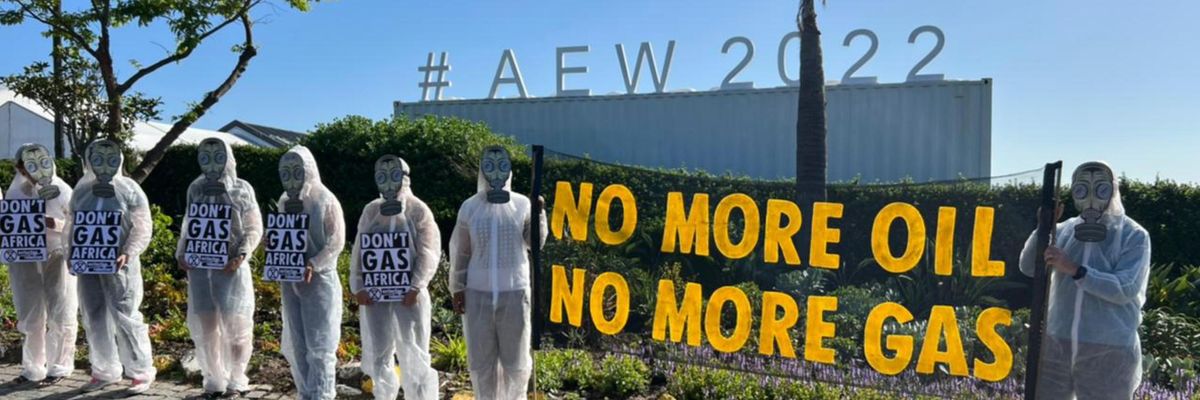
As the fossil fuel industry gathered in Cape Town for Tuesday's start of Africa Energy Week, African climate campaigners took to the streets and social media to reject a ploy to use the continent's development and energy crises as a pretext for accelerating oil and gas extraction.
"The push for investment in fossil fuels is likely to perpetuate the triple injustices of energy, social, and environmental crises."
Activists with Extinction Rebellion Cape Town rallied Tuesday outside one of the conference's venues to demand investment in renewable energy and a transition from a carbon-based economy.
"We reject the fossil fuel industry's drive to expand in Africa when African people are suffering from the climate impacts of the industry," Extinction Rebellion Cape Town spokesperson Judy Scott-Goldman told IOL.
Courtney Morgan, a South African campaigner with the African Climate Reality Project, said in a statement that "the Africa Energy Week program is a systematic plan by the fossil fuel industry for the massive scaling up of oil and gas in Africa."
"It's a declaration of war on Africa's sustainable future and the global climate crisis," she added. "This is not the Africa we want."
It is the Africa that the fossil fuel industry--which is pivoting to the continent as much of the West ditches Russian energy--wants. Kicking off Africa Energy Week with a welcome speech, African Energy Chamber executive chairman N.J. Ayuk waxed bullish on the future of fossil fuels.
"We cannot say this industry is done," the Cameroonian author of Big Barrels: African Oil and Gas and the Quest for Prosperity and other pro-fossil fuel tomes defiantly declared. "We are going to be the drivers of the future and shouldn't have to apologize for wanting to drive growth, create jobs, and create opportunities."
"So, welcome to this city," he added. "Let us go change Africa, make our voices known, and sign deals."
Taking the stage later in the African Energy Week opening session, Yemi Adetunji, general manager of Nigerian National Petroleum Corporation, asserted that "African countries are responsible for just 4% of emissions, and therefore, their priorities are to develop fossil fuels to drive economic prosperity and bring energy to the 600 million people without electricity."
In a bid to push fossil fuels, some African climate ministers have tried to exploit Africans' wariness of Western powers--including some of their former colonizers--dictating a so-called European model of energy transition.
However, African climate campaigners vehemently reject this view.
Related Content

"Collusion by European and African energy elites to continue colonizing the continent with dirty energy infrastructure will saddle Africa with dangerous projects that it doesn't need, entrench the energy apartheid facing millions of Africans, and risk tipping Africa and the world into catastrophic climate disruption," argued Dean Bhekumuzi Bhebhe, campaigns lead for Power Shift Africa.
Landry Ninteretse, regional director at 350Africa.org, said that "the push for investment in fossil fuels is likely to perpetuate the triple injustices of energy, social, and environmental crises hundreds of millions of Africans are confronted with."
"Such plans will not only lock the continent into reliance on climate-wrecking energy sources but also delay the much-needed transition to renewable energy," the Burundian continued.
"It is imperative that officials at Africa Energy Week revise their message," Ninteretse added, "and prioritize sustainable, inclusive, and diversified energy plans that directly benefit Africans and protect their basic rights, livelihoods, environment, and future."
This year's Africa Energy Week comes as drought, desertification, wildfires, and floods--all exacerbated by climate change--ravage much of the continent of 1.2 billion inhabitants. Swaths of southern Nigeria are reeling from catastrophic flooding that has killed at least 600 people while displacing more than 1.3 million in recent weeks.
"The effects of climate change are very real and getting worse," African American writer and activist Ty Ross tweeted in response to the Nigeria floods. "Let's see if the colonizers, robber barons, and oil companies will step up and help a country they environmentally raped for its resources."
As the fossil fuel industry gathered in Cape Town for Tuesday's start of Africa Energy Week, African climate campaigners took to the streets and social media to reject a ploy to use the continent's development and energy crises as a pretext for accelerating oil and gas extraction.
"The push for investment in fossil fuels is likely to perpetuate the triple injustices of energy, social, and environmental crises."
Activists with Extinction Rebellion Cape Town rallied Tuesday outside one of the conference's venues to demand investment in renewable energy and a transition from a carbon-based economy.
"We reject the fossil fuel industry's drive to expand in Africa when African people are suffering from the climate impacts of the industry," Extinction Rebellion Cape Town spokesperson Judy Scott-Goldman told IOL.
Courtney Morgan, a South African campaigner with the African Climate Reality Project, said in a statement that "the Africa Energy Week program is a systematic plan by the fossil fuel industry for the massive scaling up of oil and gas in Africa."
"It's a declaration of war on Africa's sustainable future and the global climate crisis," she added. "This is not the Africa we want."
It is the Africa that the fossil fuel industry--which is pivoting to the continent as much of the West ditches Russian energy--wants. Kicking off Africa Energy Week with a welcome speech, African Energy Chamber executive chairman N.J. Ayuk waxed bullish on the future of fossil fuels.
"We cannot say this industry is done," the Cameroonian author of Big Barrels: African Oil and Gas and the Quest for Prosperity and other pro-fossil fuel tomes defiantly declared. "We are going to be the drivers of the future and shouldn't have to apologize for wanting to drive growth, create jobs, and create opportunities."
"So, welcome to this city," he added. "Let us go change Africa, make our voices known, and sign deals."
Taking the stage later in the African Energy Week opening session, Yemi Adetunji, general manager of Nigerian National Petroleum Corporation, asserted that "African countries are responsible for just 4% of emissions, and therefore, their priorities are to develop fossil fuels to drive economic prosperity and bring energy to the 600 million people without electricity."
In a bid to push fossil fuels, some African climate ministers have tried to exploit Africans' wariness of Western powers--including some of their former colonizers--dictating a so-called European model of energy transition.
However, African climate campaigners vehemently reject this view.
Related Content
"Collusion by European and African energy elites to continue colonizing the continent with dirty energy infrastructure will saddle Africa with dangerous projects that it doesn't need, entrench the energy apartheid facing millions of Africans, and risk tipping Africa and the world into catastrophic climate disruption," argued Dean Bhekumuzi Bhebhe, campaigns lead for Power Shift Africa.
Landry Ninteretse, regional director at 350Africa.org, said that "the push for investment in fossil fuels is likely to perpetuate the triple injustices of energy, social, and environmental crises hundreds of millions of Africans are confronted with."
"Such plans will not only lock the continent into reliance on climate-wrecking energy sources but also delay the much-needed transition to renewable energy," the Burundian continued.
"It is imperative that officials at Africa Energy Week revise their message," Ninteretse added, "and prioritize sustainable, inclusive, and diversified energy plans that directly benefit Africans and protect their basic rights, livelihoods, environment, and future."
This year's Africa Energy Week comes as drought, desertification, wildfires, and floods--all exacerbated by climate change--ravage much of the continent of 1.2 billion inhabitants. Swaths of southern Nigeria are reeling from catastrophic flooding that has killed at least 600 people while displacing more than 1.3 million in recent weeks.
"The effects of climate change are very real and getting worse," African American writer and activist Ty Ross tweeted in response to the Nigeria floods. "Let's see if the colonizers, robber barons, and oil companies will step up and help a country they environmentally raped for its resources."
As the fossil fuel industry gathered in Cape Town for Tuesday's start of Africa Energy Week, African climate campaigners took to the streets and social media to reject a ploy to use the continent's development and energy crises as a pretext for accelerating oil and gas extraction.
"The push for investment in fossil fuels is likely to perpetuate the triple injustices of energy, social, and environmental crises."
Activists with Extinction Rebellion Cape Town rallied Tuesday outside one of the conference's venues to demand investment in renewable energy and a transition from a carbon-based economy.
"We reject the fossil fuel industry's drive to expand in Africa when African people are suffering from the climate impacts of the industry," Extinction Rebellion Cape Town spokesperson Judy Scott-Goldman told IOL.
Courtney Morgan, a South African campaigner with the African Climate Reality Project, said in a statement that "the Africa Energy Week program is a systematic plan by the fossil fuel industry for the massive scaling up of oil and gas in Africa."
"It's a declaration of war on Africa's sustainable future and the global climate crisis," she added. "This is not the Africa we want."
It is the Africa that the fossil fuel industry--which is pivoting to the continent as much of the West ditches Russian energy--wants. Kicking off Africa Energy Week with a welcome speech, African Energy Chamber executive chairman N.J. Ayuk waxed bullish on the future of fossil fuels.
"We cannot say this industry is done," the Cameroonian author of Big Barrels: African Oil and Gas and the Quest for Prosperity and other pro-fossil fuel tomes defiantly declared. "We are going to be the drivers of the future and shouldn't have to apologize for wanting to drive growth, create jobs, and create opportunities."
"So, welcome to this city," he added. "Let us go change Africa, make our voices known, and sign deals."
Taking the stage later in the African Energy Week opening session, Yemi Adetunji, general manager of Nigerian National Petroleum Corporation, asserted that "African countries are responsible for just 4% of emissions, and therefore, their priorities are to develop fossil fuels to drive economic prosperity and bring energy to the 600 million people without electricity."
In a bid to push fossil fuels, some African climate ministers have tried to exploit Africans' wariness of Western powers--including some of their former colonizers--dictating a so-called European model of energy transition.
However, African climate campaigners vehemently reject this view.
Related Content
"Collusion by European and African energy elites to continue colonizing the continent with dirty energy infrastructure will saddle Africa with dangerous projects that it doesn't need, entrench the energy apartheid facing millions of Africans, and risk tipping Africa and the world into catastrophic climate disruption," argued Dean Bhekumuzi Bhebhe, campaigns lead for Power Shift Africa.
Landry Ninteretse, regional director at 350Africa.org, said that "the push for investment in fossil fuels is likely to perpetuate the triple injustices of energy, social, and environmental crises hundreds of millions of Africans are confronted with."
"Such plans will not only lock the continent into reliance on climate-wrecking energy sources but also delay the much-needed transition to renewable energy," the Burundian continued.
"It is imperative that officials at Africa Energy Week revise their message," Ninteretse added, "and prioritize sustainable, inclusive, and diversified energy plans that directly benefit Africans and protect their basic rights, livelihoods, environment, and future."
This year's Africa Energy Week comes as drought, desertification, wildfires, and floods--all exacerbated by climate change--ravage much of the continent of 1.2 billion inhabitants. Swaths of southern Nigeria are reeling from catastrophic flooding that has killed at least 600 people while displacing more than 1.3 million in recent weeks.
"The effects of climate change are very real and getting worse," African American writer and activist Ty Ross tweeted in response to the Nigeria floods. "Let's see if the colonizers, robber barons, and oil companies will step up and help a country they environmentally raped for its resources."