SUBSCRIBE TO OUR FREE NEWSLETTER
Daily news & progressive opinion—funded by the people, not the corporations—delivered straight to your inbox.
5
#000000
#FFFFFF
To donate by check, phone, or other method, see our More Ways to Give page.
Daily news & progressive opinion—funded by the people, not the corporations—delivered straight to your inbox.
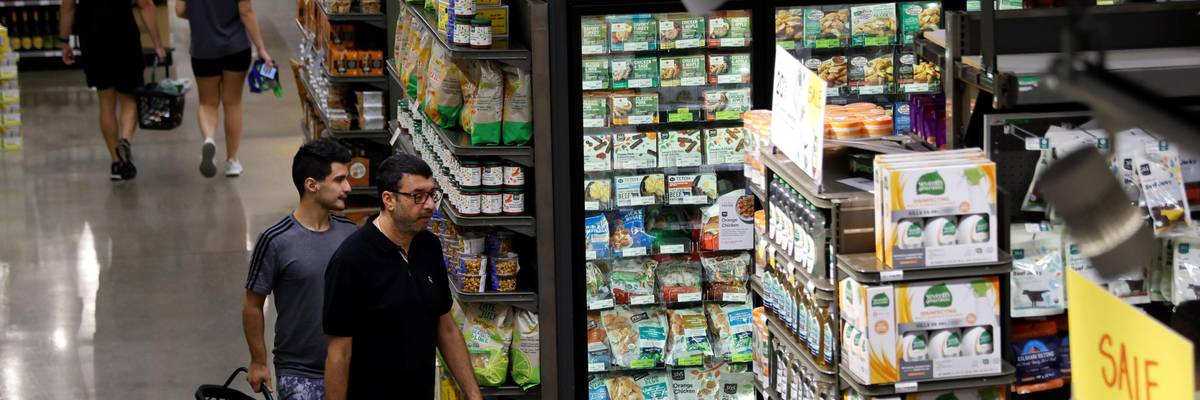
People shop at a local supermarket in Washington, D.C. on September 13, 2022.
One day after the U.S. Federal Reserve imposed yet another interest rate hike, a trio of progressive political economists on Thursday told members of the House Committee on Oversight and Reform that the best way to curb rising prices--without further punishing workers by deliberately plunging the nation into a recession--is to confront the corporate profiteering fueling inflation.
During his opening statement, Rep. Raja Krishnamoorthi (D-Ill.), chair of the Subcommittee on Economic and Consumer Policy, said that "we cannot ignore the reality that American corporations today are reporting higher profit margins than ever, while increasing prices more than necessary to cover costs--all at the expense of the American consumer."
The hearing was titled "Power and Profiteering: How Certain Industries Hiked Prices, Fleeced Consumers, and Drove Inflation."
Rakeen Mabud, chief economist and managing director of policy and research at the Groundwork Collaborative, was among the experts who provided written and oral testimony.
Mabud made three key points in her remarks to lawmakers.
First, "even as input costs come down, corporate executives are gleefully reporting how they plan on keeping prices high," she noted, citing Groundwork's exhaustive research on earnings calls, which reveals how "megacorporations are taking advantage of recent crises to make record profits for themselves and their shareholders." Big companies "are acutely aware of how their market power affords them the ability to keep prices high, even as the costs of expenses go down."
"Interest rate hikes... will not address any of the underlying causes of our supply shortages and do nothing to address profiteering."
Second, price gouging is "hitting the poorest families the hardest because essentials like food and shelter--major drivers of higher costs right now--take up a bigger proportion of their household budgets," Mabud pointed out.
Finally, "the inflation crisis we're facing today is due to decades of deregulation and privatization--resulting in brittle supply chains that can't handle shifts in our economy without supply shortages and bottlenecks," she continued. "A ruthless pursuit of efficiency and short-term profits... left us vulnerable to profiteering and price increases."
"Giant corporations' control over our supply chains has supplanted the functioning, resilient system we could have built through robust public investment and free and fair competition," said Mabud. "Big corporations are getting away with pushing up prices to fatten their profit margins, and families are quite literally paying the price. It's time to rein them in."
Mabud's analysis was echoed by Mike Konczal, director of macroeconomic analysis at the Roosevelt Institute, whose written testimony summarizes his co-authored paper on the positive relationship between concentrated market power and inflation.
In short, Konczal and his colleague Niko Lusiani "found that markups and profits skyrocketed in 2021 to their highest recorded level since the 1950s" and that "firms in the U.S. increased their markups and profits in 2021 at the fastest annual pace since 1955."
When subcommittee member Rep. Katie Porter (D-Calif.) asked Konczal to identify the biggest driver of inflation during the pandemic, he verified that it has been "corporate profits."
Porter also highlighted Konczal and Lusiani's research on the record-breaking surge in price markups in 2021, which underscores how corporations have increased costs for consumers to boost their profits.
"Since corporate profit margins have become so unusually high," said Konczal, "there is room for reversing them with little economic harm and huge societal benefit, including lower prices in the short term."
Like Mabud and Konczal, former U.S. Labor Secretary Robert Reich, now a professor of public policy at the University of California, Berkeley, told lawmakers in writing and over video conference that "the inflation we are now experiencing is not due to wage gains; it is due to increases in corporate profits."
"And it's excessive profits, not wages, that need to be controlled," he added.
Stressing that the Fed's only inflation-fighting tool--interest rate hikes--cannot solve what he calls "profit-price inflation," Reich urged Congress and the Biden administration to address corporate profiteering directly through a windfall profits tax of the sort introduced months ago by Sen. Bernie Sanders (I-Vt.), stronger antitrust enforcement, and temporary price controls.
According to Reich: "The current inflation emerging from the pandemic is analogous to the inflation that occurred right after World War II, when economists argued for temporary price controls on important goods to buy time to overcome supply bottlenecks and prevent corporate profiteering. They should be considered now, for the same reasons."
Reich is far from alone in advocating for robust government intervention in the economy to improve working-class well-being.
In a Chicago Tribune opinion piece, Carl Rosen, general president of the United Electrical, Radio, and Machine Workers of America, wrote earlier this week:
Rather than throwing our country into a recession with interest rate hikes, our federal government should take other measures to alleviate the pain being felt by working people, especially those on fixed incomes. Increasing Social Security payments, reinstituting child tax credit payments, and providing inflation rebates to working people, which can all be paid for by taxing corporate profits and the rich, would put more money in working people's pockets, allowing them to cope with higher prices.
Our government can also take steps to directly control prices, such as those contained in the Emergency Price Stabilization Act introduced by U.S. Rep. Jamaal Bowman (D-N.Y.) in August. This legislation would allow the government to investigate corporate profiteering and issue appropriate controls and regulations to stabilize prices. It would also engage and mobilize the public in a manner modeled on the successful and popular Office of Price Administration that kept basic goods affordable during World War II.
Furthermore, Congress should strengthen workers' ability to negotiate higher wages by immediately passing the Protecting the Right to Organize, or PRO, Act, which would make it easier for workers to form unions, and by fully funding the National Labor Relations Board to make sure it has the resources to enforce the existing labor law.
Economic Policy Institute research director Josh Bivens did not participate in Thursday's hearing but wrote in a blog post that "protecting low-wage workers from inflation means raising the minimum wage."
During her testimony, Mabud also provided lawmakers with a roadmap to overcome the cost-of-living crisis:
"Importantly," she added, "interest rate hikes, which slow inflation by tamping down demand and making people poorer, will not address any of the underlying causes of our supply shortages and do nothing to address profiteering."
Dear Common Dreams reader, It’s been nearly 30 years since I co-founded Common Dreams with my late wife, Lina Newhouser. We had the radical notion that journalism should serve the public good, not corporate profits. It was clear to us from the outset what it would take to build such a project. No paid advertisements. No corporate sponsors. No millionaire publisher telling us what to think or do. Many people said we wouldn't last a year, but we proved those doubters wrong. Together with a tremendous team of journalists and dedicated staff, we built an independent media outlet free from the constraints of profits and corporate control. Our mission has always been simple: To inform. To inspire. To ignite change for the common good. Building Common Dreams was not easy. Our survival was never guaranteed. When you take on the most powerful forces—Wall Street greed, fossil fuel industry destruction, Big Tech lobbyists, and uber-rich oligarchs who have spent billions upon billions rigging the economy and democracy in their favor—the only bulwark you have is supporters who believe in your work. But here’s the urgent message from me today. It's never been this bad out there. And it's never been this hard to keep us going. At the very moment Common Dreams is most needed, the threats we face are intensifying. We need your support now more than ever. We don't accept corporate advertising and never will. We don't have a paywall because we don't think people should be blocked from critical news based on their ability to pay. Everything we do is funded by the donations of readers like you. When everyone does the little they can afford, we are strong. But if that support retreats or dries up, so do we. Will you donate now to make sure Common Dreams not only survives but thrives? —Craig Brown, Co-founder |
One day after the U.S. Federal Reserve imposed yet another interest rate hike, a trio of progressive political economists on Thursday told members of the House Committee on Oversight and Reform that the best way to curb rising prices--without further punishing workers by deliberately plunging the nation into a recession--is to confront the corporate profiteering fueling inflation.
During his opening statement, Rep. Raja Krishnamoorthi (D-Ill.), chair of the Subcommittee on Economic and Consumer Policy, said that "we cannot ignore the reality that American corporations today are reporting higher profit margins than ever, while increasing prices more than necessary to cover costs--all at the expense of the American consumer."
The hearing was titled "Power and Profiteering: How Certain Industries Hiked Prices, Fleeced Consumers, and Drove Inflation."
Rakeen Mabud, chief economist and managing director of policy and research at the Groundwork Collaborative, was among the experts who provided written and oral testimony.
Mabud made three key points in her remarks to lawmakers.
First, "even as input costs come down, corporate executives are gleefully reporting how they plan on keeping prices high," she noted, citing Groundwork's exhaustive research on earnings calls, which reveals how "megacorporations are taking advantage of recent crises to make record profits for themselves and their shareholders." Big companies "are acutely aware of how their market power affords them the ability to keep prices high, even as the costs of expenses go down."
"Interest rate hikes... will not address any of the underlying causes of our supply shortages and do nothing to address profiteering."
Second, price gouging is "hitting the poorest families the hardest because essentials like food and shelter--major drivers of higher costs right now--take up a bigger proportion of their household budgets," Mabud pointed out.
Finally, "the inflation crisis we're facing today is due to decades of deregulation and privatization--resulting in brittle supply chains that can't handle shifts in our economy without supply shortages and bottlenecks," she continued. "A ruthless pursuit of efficiency and short-term profits... left us vulnerable to profiteering and price increases."
"Giant corporations' control over our supply chains has supplanted the functioning, resilient system we could have built through robust public investment and free and fair competition," said Mabud. "Big corporations are getting away with pushing up prices to fatten their profit margins, and families are quite literally paying the price. It's time to rein them in."
Mabud's analysis was echoed by Mike Konczal, director of macroeconomic analysis at the Roosevelt Institute, whose written testimony summarizes his co-authored paper on the positive relationship between concentrated market power and inflation.
In short, Konczal and his colleague Niko Lusiani "found that markups and profits skyrocketed in 2021 to their highest recorded level since the 1950s" and that "firms in the U.S. increased their markups and profits in 2021 at the fastest annual pace since 1955."
When subcommittee member Rep. Katie Porter (D-Calif.) asked Konczal to identify the biggest driver of inflation during the pandemic, he verified that it has been "corporate profits."
Porter also highlighted Konczal and Lusiani's research on the record-breaking surge in price markups in 2021, which underscores how corporations have increased costs for consumers to boost their profits.
"Since corporate profit margins have become so unusually high," said Konczal, "there is room for reversing them with little economic harm and huge societal benefit, including lower prices in the short term."
Like Mabud and Konczal, former U.S. Labor Secretary Robert Reich, now a professor of public policy at the University of California, Berkeley, told lawmakers in writing and over video conference that "the inflation we are now experiencing is not due to wage gains; it is due to increases in corporate profits."
"And it's excessive profits, not wages, that need to be controlled," he added.
Stressing that the Fed's only inflation-fighting tool--interest rate hikes--cannot solve what he calls "profit-price inflation," Reich urged Congress and the Biden administration to address corporate profiteering directly through a windfall profits tax of the sort introduced months ago by Sen. Bernie Sanders (I-Vt.), stronger antitrust enforcement, and temporary price controls.
According to Reich: "The current inflation emerging from the pandemic is analogous to the inflation that occurred right after World War II, when economists argued for temporary price controls on important goods to buy time to overcome supply bottlenecks and prevent corporate profiteering. They should be considered now, for the same reasons."
Reich is far from alone in advocating for robust government intervention in the economy to improve working-class well-being.
In a Chicago Tribune opinion piece, Carl Rosen, general president of the United Electrical, Radio, and Machine Workers of America, wrote earlier this week:
Rather than throwing our country into a recession with interest rate hikes, our federal government should take other measures to alleviate the pain being felt by working people, especially those on fixed incomes. Increasing Social Security payments, reinstituting child tax credit payments, and providing inflation rebates to working people, which can all be paid for by taxing corporate profits and the rich, would put more money in working people's pockets, allowing them to cope with higher prices.
Our government can also take steps to directly control prices, such as those contained in the Emergency Price Stabilization Act introduced by U.S. Rep. Jamaal Bowman (D-N.Y.) in August. This legislation would allow the government to investigate corporate profiteering and issue appropriate controls and regulations to stabilize prices. It would also engage and mobilize the public in a manner modeled on the successful and popular Office of Price Administration that kept basic goods affordable during World War II.
Furthermore, Congress should strengthen workers' ability to negotiate higher wages by immediately passing the Protecting the Right to Organize, or PRO, Act, which would make it easier for workers to form unions, and by fully funding the National Labor Relations Board to make sure it has the resources to enforce the existing labor law.
Economic Policy Institute research director Josh Bivens did not participate in Thursday's hearing but wrote in a blog post that "protecting low-wage workers from inflation means raising the minimum wage."
During her testimony, Mabud also provided lawmakers with a roadmap to overcome the cost-of-living crisis:
"Importantly," she added, "interest rate hikes, which slow inflation by tamping down demand and making people poorer, will not address any of the underlying causes of our supply shortages and do nothing to address profiteering."
One day after the U.S. Federal Reserve imposed yet another interest rate hike, a trio of progressive political economists on Thursday told members of the House Committee on Oversight and Reform that the best way to curb rising prices--without further punishing workers by deliberately plunging the nation into a recession--is to confront the corporate profiteering fueling inflation.
During his opening statement, Rep. Raja Krishnamoorthi (D-Ill.), chair of the Subcommittee on Economic and Consumer Policy, said that "we cannot ignore the reality that American corporations today are reporting higher profit margins than ever, while increasing prices more than necessary to cover costs--all at the expense of the American consumer."
The hearing was titled "Power and Profiteering: How Certain Industries Hiked Prices, Fleeced Consumers, and Drove Inflation."
Rakeen Mabud, chief economist and managing director of policy and research at the Groundwork Collaborative, was among the experts who provided written and oral testimony.
Mabud made three key points in her remarks to lawmakers.
First, "even as input costs come down, corporate executives are gleefully reporting how they plan on keeping prices high," she noted, citing Groundwork's exhaustive research on earnings calls, which reveals how "megacorporations are taking advantage of recent crises to make record profits for themselves and their shareholders." Big companies "are acutely aware of how their market power affords them the ability to keep prices high, even as the costs of expenses go down."
"Interest rate hikes... will not address any of the underlying causes of our supply shortages and do nothing to address profiteering."
Second, price gouging is "hitting the poorest families the hardest because essentials like food and shelter--major drivers of higher costs right now--take up a bigger proportion of their household budgets," Mabud pointed out.
Finally, "the inflation crisis we're facing today is due to decades of deregulation and privatization--resulting in brittle supply chains that can't handle shifts in our economy without supply shortages and bottlenecks," she continued. "A ruthless pursuit of efficiency and short-term profits... left us vulnerable to profiteering and price increases."
"Giant corporations' control over our supply chains has supplanted the functioning, resilient system we could have built through robust public investment and free and fair competition," said Mabud. "Big corporations are getting away with pushing up prices to fatten their profit margins, and families are quite literally paying the price. It's time to rein them in."
Mabud's analysis was echoed by Mike Konczal, director of macroeconomic analysis at the Roosevelt Institute, whose written testimony summarizes his co-authored paper on the positive relationship between concentrated market power and inflation.
In short, Konczal and his colleague Niko Lusiani "found that markups and profits skyrocketed in 2021 to their highest recorded level since the 1950s" and that "firms in the U.S. increased their markups and profits in 2021 at the fastest annual pace since 1955."
When subcommittee member Rep. Katie Porter (D-Calif.) asked Konczal to identify the biggest driver of inflation during the pandemic, he verified that it has been "corporate profits."
Porter also highlighted Konczal and Lusiani's research on the record-breaking surge in price markups in 2021, which underscores how corporations have increased costs for consumers to boost their profits.
"Since corporate profit margins have become so unusually high," said Konczal, "there is room for reversing them with little economic harm and huge societal benefit, including lower prices in the short term."
Like Mabud and Konczal, former U.S. Labor Secretary Robert Reich, now a professor of public policy at the University of California, Berkeley, told lawmakers in writing and over video conference that "the inflation we are now experiencing is not due to wage gains; it is due to increases in corporate profits."
"And it's excessive profits, not wages, that need to be controlled," he added.
Stressing that the Fed's only inflation-fighting tool--interest rate hikes--cannot solve what he calls "profit-price inflation," Reich urged Congress and the Biden administration to address corporate profiteering directly through a windfall profits tax of the sort introduced months ago by Sen. Bernie Sanders (I-Vt.), stronger antitrust enforcement, and temporary price controls.
According to Reich: "The current inflation emerging from the pandemic is analogous to the inflation that occurred right after World War II, when economists argued for temporary price controls on important goods to buy time to overcome supply bottlenecks and prevent corporate profiteering. They should be considered now, for the same reasons."
Reich is far from alone in advocating for robust government intervention in the economy to improve working-class well-being.
In a Chicago Tribune opinion piece, Carl Rosen, general president of the United Electrical, Radio, and Machine Workers of America, wrote earlier this week:
Rather than throwing our country into a recession with interest rate hikes, our federal government should take other measures to alleviate the pain being felt by working people, especially those on fixed incomes. Increasing Social Security payments, reinstituting child tax credit payments, and providing inflation rebates to working people, which can all be paid for by taxing corporate profits and the rich, would put more money in working people's pockets, allowing them to cope with higher prices.
Our government can also take steps to directly control prices, such as those contained in the Emergency Price Stabilization Act introduced by U.S. Rep. Jamaal Bowman (D-N.Y.) in August. This legislation would allow the government to investigate corporate profiteering and issue appropriate controls and regulations to stabilize prices. It would also engage and mobilize the public in a manner modeled on the successful and popular Office of Price Administration that kept basic goods affordable during World War II.
Furthermore, Congress should strengthen workers' ability to negotiate higher wages by immediately passing the Protecting the Right to Organize, or PRO, Act, which would make it easier for workers to form unions, and by fully funding the National Labor Relations Board to make sure it has the resources to enforce the existing labor law.
Economic Policy Institute research director Josh Bivens did not participate in Thursday's hearing but wrote in a blog post that "protecting low-wage workers from inflation means raising the minimum wage."
During her testimony, Mabud also provided lawmakers with a roadmap to overcome the cost-of-living crisis:
"Importantly," she added, "interest rate hikes, which slow inflation by tamping down demand and making people poorer, will not address any of the underlying causes of our supply shortages and do nothing to address profiteering."