SUBSCRIBE TO OUR FREE NEWSLETTER
Daily news & progressive opinion—funded by the people, not the corporations—delivered straight to your inbox.
5
#000000
#FFFFFF
To donate by check, phone, or other method, see our More Ways to Give page.
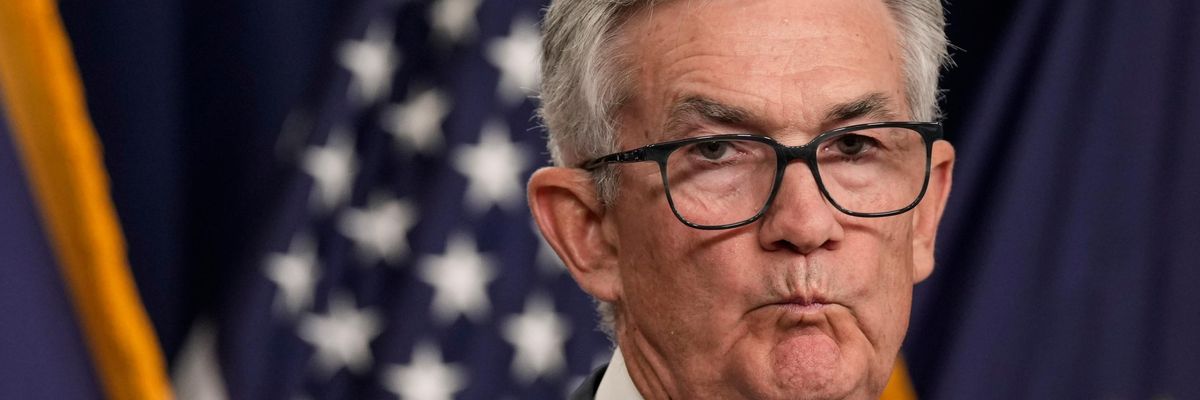
A United Nations organization on Monday joined critics of the U.S. Federal Reserve and other central banks across the globe hiking interest rates with the goal of reining in inflation.
"We have the tools to calm inflation and support all vulnerable groups. This is a matter of policy choices and political will."
With the world economy "in the midst of cascading and multiplying crises," a new U.N. Conference on Trade and Development (UNCTAD) report explains, "the attention of policymakers has become much too focused on dampening inflationary pressures through restrictive monetary policies, with the hope that central banks can pilot the economy to a soft landing, avoiding a full-blown recession."
"Not only is there a real danger that the policy remedy could prove worse than the economic disease, in terms of declining wages, employment, and government revenues, but the road taken would reverse the pandemic pledges to build a more sustainable, resilient, and inclusive world," the document warns.
The warning comes after the Fed late last month announced another widely anticipated 75-basis-point interest rate increase--a move that led some experts to accuse the U.S. institution of not only disregarding the negative impacts that such a policy has on the nation's poor but also ignoring a key driver of inflation: corporate greed.
Related Content

As the UNCTAD document details, "Today, inflation is caused by a mixture of disruptions in global supply chains, high (container) shipping costs, the impact of war on key sectors, higher mark-ups, commodity-market speculators, and the ongoing uncertainty of an evolving pandemic."
"In this situation, central banks cannot bring inflation down at a socially acceptable cost," it continues. "Instead, supply-chain disruptions and labor shortages require appropriate industrial policies to increase the supply of key items in the medium term; this must be accompanied by sustained global policy coordination and (liquidity) support to help countries fund and manage these changes."
The report adds that "in the meantime, policymakers should seriously consider alternative paths of action to lower inflation in socially desirable ways, including strategic price controls, better regulation to reduce speculative trades in key markets, targeted income support for vulnerable groups, and debt relief."
"If monetary tightening in the advanced economies continues over the coming year, however, a global recession is more likely, and, even if it is looser than the 1980s, it will almost unavoidably harm potential growth rate in the developing economies," the document states. "The permanent damage to economic development in these countries will not only be substantial but will also leave the ambition to achieve a better world by 2030 dangling by the most precarious of threads."
The report's recommendations include windfall profits taxes targeting industries that are cashing in on the current economic conditions. Fossil fuel giants, for example, have been repeatedly accused of price gouging throughout this year.
Related Content

"Do you try to solve a supply-side problem with a demand-side solution?" asked Richard Kozul-Wright, who led the team in charge of the report, in an interview with The Wall Street Journal. "We think that's a very dangerous approach."
UNCTAD noted in a Monday statement that the U.S. interest rate hikes "are set to cut an estimated $360 billion of future income for developing countries (excluding China) and signal even more trouble ahead."
The Journal highlighted that the Fed is not alone in hiking interest rates.
"The European Central Bank and the Bank of England are also raising their key interest rates more rapidly than during recent decades," the newspaper reported. "According to the World Bank, more central banks raised borrowing costs in July than at any time since records began in the early 1970s."
UNCTAD Secretary-General Rebeca Grynspan stressed Monday that "there's still time to step back from the edge of recession."
"We have the tools to calm inflation and support all vulnerable groups. This is a matter of policy choices and political will," she said. "But the current course of action is hurting the most vulnerable, especially in developing countries, and risks tipping the world into a global recession."
A United Nations organization on Monday joined critics of the U.S. Federal Reserve and other central banks across the globe hiking interest rates with the goal of reining in inflation.
"We have the tools to calm inflation and support all vulnerable groups. This is a matter of policy choices and political will."
With the world economy "in the midst of cascading and multiplying crises," a new U.N. Conference on Trade and Development (UNCTAD) report explains, "the attention of policymakers has become much too focused on dampening inflationary pressures through restrictive monetary policies, with the hope that central banks can pilot the economy to a soft landing, avoiding a full-blown recession."
"Not only is there a real danger that the policy remedy could prove worse than the economic disease, in terms of declining wages, employment, and government revenues, but the road taken would reverse the pandemic pledges to build a more sustainable, resilient, and inclusive world," the document warns.
The warning comes after the Fed late last month announced another widely anticipated 75-basis-point interest rate increase--a move that led some experts to accuse the U.S. institution of not only disregarding the negative impacts that such a policy has on the nation's poor but also ignoring a key driver of inflation: corporate greed.
Related Content
As the UNCTAD document details, "Today, inflation is caused by a mixture of disruptions in global supply chains, high (container) shipping costs, the impact of war on key sectors, higher mark-ups, commodity-market speculators, and the ongoing uncertainty of an evolving pandemic."
"In this situation, central banks cannot bring inflation down at a socially acceptable cost," it continues. "Instead, supply-chain disruptions and labor shortages require appropriate industrial policies to increase the supply of key items in the medium term; this must be accompanied by sustained global policy coordination and (liquidity) support to help countries fund and manage these changes."
The report adds that "in the meantime, policymakers should seriously consider alternative paths of action to lower inflation in socially desirable ways, including strategic price controls, better regulation to reduce speculative trades in key markets, targeted income support for vulnerable groups, and debt relief."
"If monetary tightening in the advanced economies continues over the coming year, however, a global recession is more likely, and, even if it is looser than the 1980s, it will almost unavoidably harm potential growth rate in the developing economies," the document states. "The permanent damage to economic development in these countries will not only be substantial but will also leave the ambition to achieve a better world by 2030 dangling by the most precarious of threads."
The report's recommendations include windfall profits taxes targeting industries that are cashing in on the current economic conditions. Fossil fuel giants, for example, have been repeatedly accused of price gouging throughout this year.
Related Content
"Do you try to solve a supply-side problem with a demand-side solution?" asked Richard Kozul-Wright, who led the team in charge of the report, in an interview with The Wall Street Journal. "We think that's a very dangerous approach."
UNCTAD noted in a Monday statement that the U.S. interest rate hikes "are set to cut an estimated $360 billion of future income for developing countries (excluding China) and signal even more trouble ahead."
The Journal highlighted that the Fed is not alone in hiking interest rates.
"The European Central Bank and the Bank of England are also raising their key interest rates more rapidly than during recent decades," the newspaper reported. "According to the World Bank, more central banks raised borrowing costs in July than at any time since records began in the early 1970s."
UNCTAD Secretary-General Rebeca Grynspan stressed Monday that "there's still time to step back from the edge of recession."
"We have the tools to calm inflation and support all vulnerable groups. This is a matter of policy choices and political will," she said. "But the current course of action is hurting the most vulnerable, especially in developing countries, and risks tipping the world into a global recession."
A United Nations organization on Monday joined critics of the U.S. Federal Reserve and other central banks across the globe hiking interest rates with the goal of reining in inflation.
"We have the tools to calm inflation and support all vulnerable groups. This is a matter of policy choices and political will."
With the world economy "in the midst of cascading and multiplying crises," a new U.N. Conference on Trade and Development (UNCTAD) report explains, "the attention of policymakers has become much too focused on dampening inflationary pressures through restrictive monetary policies, with the hope that central banks can pilot the economy to a soft landing, avoiding a full-blown recession."
"Not only is there a real danger that the policy remedy could prove worse than the economic disease, in terms of declining wages, employment, and government revenues, but the road taken would reverse the pandemic pledges to build a more sustainable, resilient, and inclusive world," the document warns.
The warning comes after the Fed late last month announced another widely anticipated 75-basis-point interest rate increase--a move that led some experts to accuse the U.S. institution of not only disregarding the negative impacts that such a policy has on the nation's poor but also ignoring a key driver of inflation: corporate greed.
Related Content
As the UNCTAD document details, "Today, inflation is caused by a mixture of disruptions in global supply chains, high (container) shipping costs, the impact of war on key sectors, higher mark-ups, commodity-market speculators, and the ongoing uncertainty of an evolving pandemic."
"In this situation, central banks cannot bring inflation down at a socially acceptable cost," it continues. "Instead, supply-chain disruptions and labor shortages require appropriate industrial policies to increase the supply of key items in the medium term; this must be accompanied by sustained global policy coordination and (liquidity) support to help countries fund and manage these changes."
The report adds that "in the meantime, policymakers should seriously consider alternative paths of action to lower inflation in socially desirable ways, including strategic price controls, better regulation to reduce speculative trades in key markets, targeted income support for vulnerable groups, and debt relief."
"If monetary tightening in the advanced economies continues over the coming year, however, a global recession is more likely, and, even if it is looser than the 1980s, it will almost unavoidably harm potential growth rate in the developing economies," the document states. "The permanent damage to economic development in these countries will not only be substantial but will also leave the ambition to achieve a better world by 2030 dangling by the most precarious of threads."
The report's recommendations include windfall profits taxes targeting industries that are cashing in on the current economic conditions. Fossil fuel giants, for example, have been repeatedly accused of price gouging throughout this year.
Related Content
"Do you try to solve a supply-side problem with a demand-side solution?" asked Richard Kozul-Wright, who led the team in charge of the report, in an interview with The Wall Street Journal. "We think that's a very dangerous approach."
UNCTAD noted in a Monday statement that the U.S. interest rate hikes "are set to cut an estimated $360 billion of future income for developing countries (excluding China) and signal even more trouble ahead."
The Journal highlighted that the Fed is not alone in hiking interest rates.
"The European Central Bank and the Bank of England are also raising their key interest rates more rapidly than during recent decades," the newspaper reported. "According to the World Bank, more central banks raised borrowing costs in July than at any time since records began in the early 1970s."
UNCTAD Secretary-General Rebeca Grynspan stressed Monday that "there's still time to step back from the edge of recession."
"We have the tools to calm inflation and support all vulnerable groups. This is a matter of policy choices and political will," she said. "But the current course of action is hurting the most vulnerable, especially in developing countries, and risks tipping the world into a global recession."