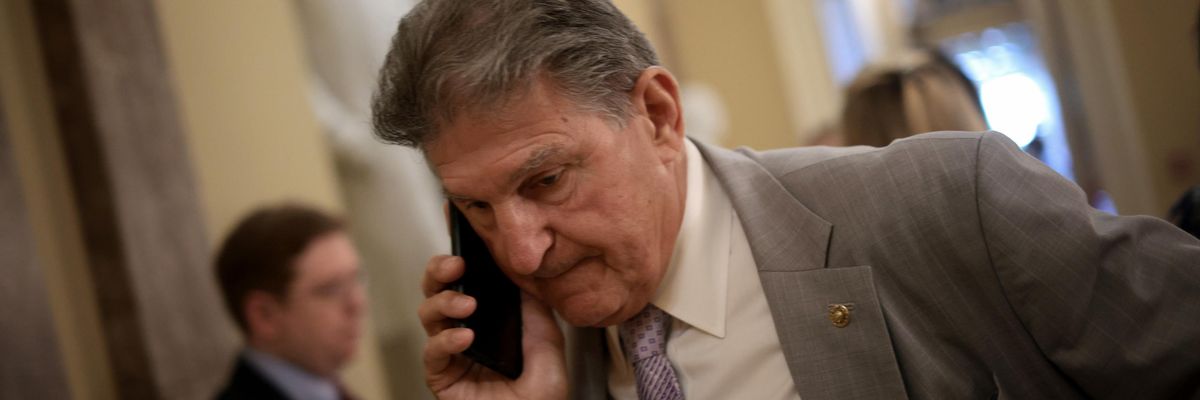
Sen. Joe Manchin (D-W.Va.) arrives for a bipartisan meeting on infrastructure legislation at the U.S. Capitol on July 13, 2021 in Washington, D.C. (Photo: Win McNamee via Getty Images)
Manchin Admits Getting His Bill Passed and Then Tanking Progressive Package Was Always the Plan
"Thank god," said one observer, that the Congressional Progressive Caucus is "holding the line on the original deal otherwise we'd be toast on child care, climate, housing, prescription drugs, and everything else."
Sen. Joe Manchin admitted Thursday, ahead of a scheduled House vote on the Senate-passed bipartisan infrastructure bill, that it had been corporate Democrats' plan all along to first secure passage of their fossil fuel-friendly legislation and then undermine the party's more ambitious reconciliation package that proposes investing up to $3.5 trillion over a decade in clean energy and the social safety net.
The conservative West Virginia Democrat told reporters Thursday that on July 28, he secured a signed agreement (pdf) from Senate Majority Leader Chuck Schumer (D-N.Y.) outlining his conditions for voting on the final reconciliation bill.
A spokesperson for Schumer, meanwhile, told Politico that "Schumer never agreed to any of the conditions Sen. Manchin laid out; he merely acknowledged where Sen. Manchin was on the subject at the time."
In addition to demanding a topline figure no higher than $1.5 trillion, something he reiterated on Thursday, Manchin said in July that he wanted to delay debate on the reconciliation package until October 1.
Meanwhile, a small group of corporate-funded House Democrats--led by Rep. Josh Gottheimer (N.J.) and supported by Manchin and fellow right-wing Democratic Sen. Kyrsten Sinema (Ariz.)--in August pressured Speaker Nancy Pelosi (D-Calif.) to bring the Bipartisan Infrastructure Framework (BIF) to the floor by September 27 in exchange for their votes on the $3.5 trillion budget resolution that enabled lawmakers to draft the Build Back Better Act, as the reconciliation package has since been named.
Related Content

'It's Sickening': Sinema Draws Progressive Ire for Obstructing Biden Agenda
Critics were quick to point out the significance of Manchin's revelation.
"It sure feeds the idea that their goal is to pass BIF then bail on reconciliation," noted former Senate staffer Adam Jentleson, now executive director of the Battle Born Collective, a progressive messaging firm.
Ezra Levin, co-founder and co-executive director of Indivisible, a progressive advocacy group, expressed gratitude for the Congressional Progressive Caucus, which has vowed to secure President Joe Biden's entire domestic policy agenda by voting down the bipartisan physical infrastructure bill until Congress passes the popular Build Back Better Act--a broader social infrastructure package that would fund climate action and anti-poverty measures by raising taxes on corporations and the rich--through the filibuster-proof budget reconciliation process.
It remains unclear whether Pelosi still plans to bring the BIF to a vote on Thursday, but progressives' pledge to block the bipartisan bill until it is relinked with the reconciliation package is consistent with the deal that Democratic Party leaders outlined months ago to keep both pieces of legislation connected and advance them together.
In June, Pelosi said that the House would not take up either piece of legislation until the Senate passed both. Last month, she successfully got Gottheimer and the other holdouts to vote for the $3.5 trillion budget blueprint. In order to secure their support, however, Pelosi agreed to hold a late-September vote on the Senate-passed Infrastructure Investment and Jobs Act, as the BIF is also known.
Pelosi's decision on Monday to schedule a vote on the bipartisan bill even though the reconciliation package is not yet ready, let alone approved--a reversal of her earlier promise to not decouple the two pieces of legislation--has been sharply rebuked by progressives in the House as well as Sens. Bernie Sanders (I-Vt.) and Elizabeth Warren (D-Mass.).
As Sanders said Tuesday, "If the bipartisan infrastructure bill is passed on its own on Thursday, this will be in violation of an agreement that was reached within the Democratic Caucus in Congress."
"More importantly," Sanders warned, "it will end all leverage that we have to pass a major reconciliation bill."
"That means there will be no serious effort to address the long-neglected crises facing the working families of our country, the children, the elderly, the sick, and the poor," he added. "It also means that Congress will continue to ignore the existential threat to our country and planet with regard to climate change."

FINAL DAY! This is urgent.
Dear Common Dreams reader, It’s been nearly 30 years since I co-founded Common Dreams with my late wife, Lina Newhouser. We had the radical notion that journalism should serve the public good, not corporate profits. It was clear to us from the outset what it would take to build such a project. No paid advertisements. No corporate sponsors. No millionaire publisher telling us what to think or do. Many people said we wouldn't last a year, but we proved those doubters wrong. Together with a tremendous team of journalists and dedicated staff, we built an independent media outlet free from the constraints of profits and corporate control. Our mission from the outset was simple. To inform. To inspire. To ignite change for the common good. Building Common Dreams was not easy. Our survival was never guaranteed. When you take on the most powerful forces—Wall Street greed, fossil fuel industry destruction, Big Tech lobbyists, and uber-rich oligarchs who have spent billions upon billions rigging the economy and democracy in their favor—the only bulwark you have is supporters who believe in your work. But here’s the urgent message from me today. It’s never been this bad out there. And it’s never been this hard to keep us going. At the very moment Common Dreams is most needed and doing some of its best and most important work, the threats we face are intensifying. Right now, with just hours left in our Spring Campaign, we're still falling short of our make-or-break goal. When everyone does the little they can afford, we are strong. But if that support retreats or dries up, so do we. Can you make a gift right now to make sure Common Dreams not only survives but thrives? There is no backup plan or rainy day fund. There is only you. —Craig Brown, Co-founder |
Sen. Joe Manchin admitted Thursday, ahead of a scheduled House vote on the Senate-passed bipartisan infrastructure bill, that it had been corporate Democrats' plan all along to first secure passage of their fossil fuel-friendly legislation and then undermine the party's more ambitious reconciliation package that proposes investing up to $3.5 trillion over a decade in clean energy and the social safety net.
The conservative West Virginia Democrat told reporters Thursday that on July 28, he secured a signed agreement (pdf) from Senate Majority Leader Chuck Schumer (D-N.Y.) outlining his conditions for voting on the final reconciliation bill.
A spokesperson for Schumer, meanwhile, told Politico that "Schumer never agreed to any of the conditions Sen. Manchin laid out; he merely acknowledged where Sen. Manchin was on the subject at the time."
In addition to demanding a topline figure no higher than $1.5 trillion, something he reiterated on Thursday, Manchin said in July that he wanted to delay debate on the reconciliation package until October 1.
Meanwhile, a small group of corporate-funded House Democrats--led by Rep. Josh Gottheimer (N.J.) and supported by Manchin and fellow right-wing Democratic Sen. Kyrsten Sinema (Ariz.)--in August pressured Speaker Nancy Pelosi (D-Calif.) to bring the Bipartisan Infrastructure Framework (BIF) to the floor by September 27 in exchange for their votes on the $3.5 trillion budget resolution that enabled lawmakers to draft the Build Back Better Act, as the reconciliation package has since been named.
Related Content

'It's Sickening': Sinema Draws Progressive Ire for Obstructing Biden Agenda
Critics were quick to point out the significance of Manchin's revelation.
"It sure feeds the idea that their goal is to pass BIF then bail on reconciliation," noted former Senate staffer Adam Jentleson, now executive director of the Battle Born Collective, a progressive messaging firm.
Ezra Levin, co-founder and co-executive director of Indivisible, a progressive advocacy group, expressed gratitude for the Congressional Progressive Caucus, which has vowed to secure President Joe Biden's entire domestic policy agenda by voting down the bipartisan physical infrastructure bill until Congress passes the popular Build Back Better Act--a broader social infrastructure package that would fund climate action and anti-poverty measures by raising taxes on corporations and the rich--through the filibuster-proof budget reconciliation process.
It remains unclear whether Pelosi still plans to bring the BIF to a vote on Thursday, but progressives' pledge to block the bipartisan bill until it is relinked with the reconciliation package is consistent with the deal that Democratic Party leaders outlined months ago to keep both pieces of legislation connected and advance them together.
In June, Pelosi said that the House would not take up either piece of legislation until the Senate passed both. Last month, she successfully got Gottheimer and the other holdouts to vote for the $3.5 trillion budget blueprint. In order to secure their support, however, Pelosi agreed to hold a late-September vote on the Senate-passed Infrastructure Investment and Jobs Act, as the BIF is also known.
Pelosi's decision on Monday to schedule a vote on the bipartisan bill even though the reconciliation package is not yet ready, let alone approved--a reversal of her earlier promise to not decouple the two pieces of legislation--has been sharply rebuked by progressives in the House as well as Sens. Bernie Sanders (I-Vt.) and Elizabeth Warren (D-Mass.).
As Sanders said Tuesday, "If the bipartisan infrastructure bill is passed on its own on Thursday, this will be in violation of an agreement that was reached within the Democratic Caucus in Congress."
"More importantly," Sanders warned, "it will end all leverage that we have to pass a major reconciliation bill."
"That means there will be no serious effort to address the long-neglected crises facing the working families of our country, the children, the elderly, the sick, and the poor," he added. "It also means that Congress will continue to ignore the existential threat to our country and planet with regard to climate change."
Sen. Joe Manchin admitted Thursday, ahead of a scheduled House vote on the Senate-passed bipartisan infrastructure bill, that it had been corporate Democrats' plan all along to first secure passage of their fossil fuel-friendly legislation and then undermine the party's more ambitious reconciliation package that proposes investing up to $3.5 trillion over a decade in clean energy and the social safety net.
The conservative West Virginia Democrat told reporters Thursday that on July 28, he secured a signed agreement (pdf) from Senate Majority Leader Chuck Schumer (D-N.Y.) outlining his conditions for voting on the final reconciliation bill.
A spokesperson for Schumer, meanwhile, told Politico that "Schumer never agreed to any of the conditions Sen. Manchin laid out; he merely acknowledged where Sen. Manchin was on the subject at the time."
In addition to demanding a topline figure no higher than $1.5 trillion, something he reiterated on Thursday, Manchin said in July that he wanted to delay debate on the reconciliation package until October 1.
Meanwhile, a small group of corporate-funded House Democrats--led by Rep. Josh Gottheimer (N.J.) and supported by Manchin and fellow right-wing Democratic Sen. Kyrsten Sinema (Ariz.)--in August pressured Speaker Nancy Pelosi (D-Calif.) to bring the Bipartisan Infrastructure Framework (BIF) to the floor by September 27 in exchange for their votes on the $3.5 trillion budget resolution that enabled lawmakers to draft the Build Back Better Act, as the reconciliation package has since been named.
Related Content

'It's Sickening': Sinema Draws Progressive Ire for Obstructing Biden Agenda
Critics were quick to point out the significance of Manchin's revelation.
"It sure feeds the idea that their goal is to pass BIF then bail on reconciliation," noted former Senate staffer Adam Jentleson, now executive director of the Battle Born Collective, a progressive messaging firm.
Ezra Levin, co-founder and co-executive director of Indivisible, a progressive advocacy group, expressed gratitude for the Congressional Progressive Caucus, which has vowed to secure President Joe Biden's entire domestic policy agenda by voting down the bipartisan physical infrastructure bill until Congress passes the popular Build Back Better Act--a broader social infrastructure package that would fund climate action and anti-poverty measures by raising taxes on corporations and the rich--through the filibuster-proof budget reconciliation process.
It remains unclear whether Pelosi still plans to bring the BIF to a vote on Thursday, but progressives' pledge to block the bipartisan bill until it is relinked with the reconciliation package is consistent with the deal that Democratic Party leaders outlined months ago to keep both pieces of legislation connected and advance them together.
In June, Pelosi said that the House would not take up either piece of legislation until the Senate passed both. Last month, she successfully got Gottheimer and the other holdouts to vote for the $3.5 trillion budget blueprint. In order to secure their support, however, Pelosi agreed to hold a late-September vote on the Senate-passed Infrastructure Investment and Jobs Act, as the BIF is also known.
Pelosi's decision on Monday to schedule a vote on the bipartisan bill even though the reconciliation package is not yet ready, let alone approved--a reversal of her earlier promise to not decouple the two pieces of legislation--has been sharply rebuked by progressives in the House as well as Sens. Bernie Sanders (I-Vt.) and Elizabeth Warren (D-Mass.).
As Sanders said Tuesday, "If the bipartisan infrastructure bill is passed on its own on Thursday, this will be in violation of an agreement that was reached within the Democratic Caucus in Congress."
"More importantly," Sanders warned, "it will end all leverage that we have to pass a major reconciliation bill."
"That means there will be no serious effort to address the long-neglected crises facing the working families of our country, the children, the elderly, the sick, and the poor," he added. "It also means that Congress will continue to ignore the existential threat to our country and planet with regard to climate change."