

SUBSCRIBE TO OUR FREE NEWSLETTER
Daily news & progressive opinion—funded by the people, not the corporations—delivered straight to your inbox.
5
#000000
#FFFFFF
To donate by check, phone, or other method, see our More Ways to Give page.
Daily news & progressive opinion—funded by the people, not the corporations—delivered straight to your inbox.
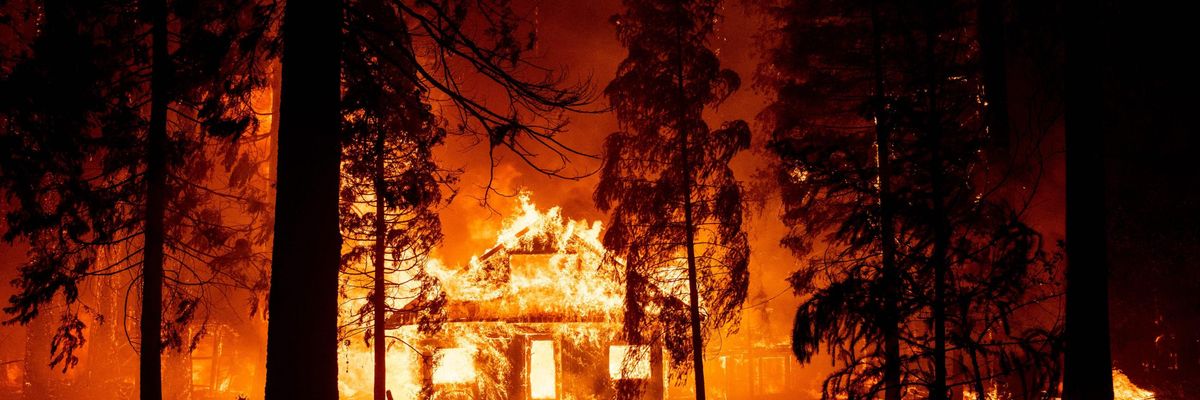
A home burns as flames from the Dixie Fire tear through the Indian Falls neighborhood of unincorporated Plumas County, California on July 24, 2021. (Photo: Josh Edelson/AFP via Getty Images)
With the massive Bootleg Fire less than half contained and having burned nearly 409,000 acres in Oregon, Democratic Gov. Kate Brown appeared on CNN Sunday to discuss current conditions in her state, the climate emergency, and what the future may look like across the U.S. West.
"The harsh reality is that we're going to see more of these wildfires," Brown told host Jake Tapper on "State of the Union."
"They're hotter, they're more fierce, and obviously much more challenging to tackle," Brown continued. "And they are a sign of the changing climate impacts."
The governor acknowledged other crises her state has endured over this past year--the Covid-19 pandemic, a regional heatwave tied to over 100 deaths in Oregon alone, ice storms in February, and historic wildfires last year for which recovery is ongoing.
" Climate change is here, it's real, and it's like a hammer hitting us in the head, and we have to take action," declared the governor, who noted her state's efforts on renewable energy and electric vehicles.
As for shorter-term action to address raging fires, Brown told Tapper she appreciates the "strong partnership with the Biden-Harris administration," pointing to forest management efforts that not only put Oregonians to work on federal lands but also reduce the impacts of wildfires.
Her comments come as U.S. senators are working to finalize a bipartisan infrastructure deal as early as Monday and House Speaker Nancy Pelosi (D-Calif.) reiterated Sunday that she won't put the bipartisan plan up for a vote "until we have the rest of the initiative," referring to the reconciliation package that Democrats intend to pass without GOP support.
"We are rooting for the infrastructure bill to pass," Pelosi told ABC's George Stephanopoulos on "This Week," referencing the bipartisan deal, "but we all know that more needs to be done if we're going to build back better."
A key provision that progressive climate campaigners and lawmakers want to include in the reconciliation package is a fully funded Civilian Climate Corps (CCC). Inspired by a New Deal-era program, the new initiative would put millions of Americans to work in green jobs.
Earlier this week, 84 Democrats--including Sen. Ed Markey (D-Mass.) and Rep. Alexandria Ocasio-Cortez, who proposed CCC legislation in April--sent a letter (pdf) to Pelosi and Senate Majority Leader Chuck Schumer (D-N.Y.) outlining what they want the program to look like.
Meanwhile, Pelosi's state is also enduring intense wildfires. The Dixie Fire, California's largest, destroyed multiple homes and properties on Saturday. By Sunday morning it was only 21% contained and had consumed over 190,000 acres.
There are 86 active large fires that have collectively burned 1,498,205 acres across 12 Western states, according to the National Interagency Fire Center.
Experts and policymakers continue to point to the fires as proof of the necessity of ambitious policies and actions that meet the scale of the climate emergency.
"The climate crisis is here. We're living it," Sen. Ron Wyden (D-Ore.) tweeted earlier this week, as the Bootleg Fire burned through his state. "And without immediate, meaningful action, it will get so much worse than we ever could have imagined."
In about three months, world leaders will come together for a United Nations climate summit in Glasgow to discuss governments' commitments to cutting planet-heating emissions in line with the Paris agreement goals--keeping global temperature rise this century below 2degC, and preferably limiting it to 1.5degC.
The Biden-Harris administration rejoined the Paris agreement and pledged to halve U.S. emissions by 2030, relative to 2005--but critics say that falls short of what science and justice demand, especially considering that the United States is the world's biggest historical emitter and wealthiest country.
Other rich countries are also under fire for inadequate climate commitments.
The Guardian reported Sunday that an analysis by the peer-reviewed group Paris Equity Check found that Australia, Brazil, China, and Russia all have energy policies associated with 5degC rises in atmospheric temperatures.
"The research underlines what many of us fear," said Yann Robiou du Pont, the lead researcher for the analysis. "Major economies are simply not doing enough to tackle the climate crisis and, in many cases, G20 countries are leaving us on track [for] a world of more heatwaves, flooding, and extreme weather events."
Dear Common Dreams reader, It’s been nearly 30 years since I co-founded Common Dreams with my late wife, Lina Newhouser. We had the radical notion that journalism should serve the public good, not corporate profits. It was clear to us from the outset what it would take to build such a project. No paid advertisements. No corporate sponsors. No millionaire publisher telling us what to think or do. Many people said we wouldn't last a year, but we proved those doubters wrong. Together with a tremendous team of journalists and dedicated staff, we built an independent media outlet free from the constraints of profits and corporate control. Our mission has always been simple: To inform. To inspire. To ignite change for the common good. Building Common Dreams was not easy. Our survival was never guaranteed. When you take on the most powerful forces—Wall Street greed, fossil fuel industry destruction, Big Tech lobbyists, and uber-rich oligarchs who have spent billions upon billions rigging the economy and democracy in their favor—the only bulwark you have is supporters who believe in your work. But here’s the urgent message from me today. It's never been this bad out there. And it's never been this hard to keep us going. At the very moment Common Dreams is most needed, the threats we face are intensifying. We need your support now more than ever. We don't accept corporate advertising and never will. We don't have a paywall because we don't think people should be blocked from critical news based on their ability to pay. Everything we do is funded by the donations of readers like you. When everyone does the little they can afford, we are strong. But if that support retreats or dries up, so do we. Will you donate now to make sure Common Dreams not only survives but thrives? —Craig Brown, Co-founder |
With the massive Bootleg Fire less than half contained and having burned nearly 409,000 acres in Oregon, Democratic Gov. Kate Brown appeared on CNN Sunday to discuss current conditions in her state, the climate emergency, and what the future may look like across the U.S. West.
"The harsh reality is that we're going to see more of these wildfires," Brown told host Jake Tapper on "State of the Union."
"They're hotter, they're more fierce, and obviously much more challenging to tackle," Brown continued. "And they are a sign of the changing climate impacts."
The governor acknowledged other crises her state has endured over this past year--the Covid-19 pandemic, a regional heatwave tied to over 100 deaths in Oregon alone, ice storms in February, and historic wildfires last year for which recovery is ongoing.
" Climate change is here, it's real, and it's like a hammer hitting us in the head, and we have to take action," declared the governor, who noted her state's efforts on renewable energy and electric vehicles.
As for shorter-term action to address raging fires, Brown told Tapper she appreciates the "strong partnership with the Biden-Harris administration," pointing to forest management efforts that not only put Oregonians to work on federal lands but also reduce the impacts of wildfires.
Her comments come as U.S. senators are working to finalize a bipartisan infrastructure deal as early as Monday and House Speaker Nancy Pelosi (D-Calif.) reiterated Sunday that she won't put the bipartisan plan up for a vote "until we have the rest of the initiative," referring to the reconciliation package that Democrats intend to pass without GOP support.
"We are rooting for the infrastructure bill to pass," Pelosi told ABC's George Stephanopoulos on "This Week," referencing the bipartisan deal, "but we all know that more needs to be done if we're going to build back better."
A key provision that progressive climate campaigners and lawmakers want to include in the reconciliation package is a fully funded Civilian Climate Corps (CCC). Inspired by a New Deal-era program, the new initiative would put millions of Americans to work in green jobs.
Earlier this week, 84 Democrats--including Sen. Ed Markey (D-Mass.) and Rep. Alexandria Ocasio-Cortez, who proposed CCC legislation in April--sent a letter (pdf) to Pelosi and Senate Majority Leader Chuck Schumer (D-N.Y.) outlining what they want the program to look like.
Meanwhile, Pelosi's state is also enduring intense wildfires. The Dixie Fire, California's largest, destroyed multiple homes and properties on Saturday. By Sunday morning it was only 21% contained and had consumed over 190,000 acres.
There are 86 active large fires that have collectively burned 1,498,205 acres across 12 Western states, according to the National Interagency Fire Center.
Experts and policymakers continue to point to the fires as proof of the necessity of ambitious policies and actions that meet the scale of the climate emergency.
"The climate crisis is here. We're living it," Sen. Ron Wyden (D-Ore.) tweeted earlier this week, as the Bootleg Fire burned through his state. "And without immediate, meaningful action, it will get so much worse than we ever could have imagined."
In about three months, world leaders will come together for a United Nations climate summit in Glasgow to discuss governments' commitments to cutting planet-heating emissions in line with the Paris agreement goals--keeping global temperature rise this century below 2degC, and preferably limiting it to 1.5degC.
The Biden-Harris administration rejoined the Paris agreement and pledged to halve U.S. emissions by 2030, relative to 2005--but critics say that falls short of what science and justice demand, especially considering that the United States is the world's biggest historical emitter and wealthiest country.
Other rich countries are also under fire for inadequate climate commitments.
The Guardian reported Sunday that an analysis by the peer-reviewed group Paris Equity Check found that Australia, Brazil, China, and Russia all have energy policies associated with 5degC rises in atmospheric temperatures.
"The research underlines what many of us fear," said Yann Robiou du Pont, the lead researcher for the analysis. "Major economies are simply not doing enough to tackle the climate crisis and, in many cases, G20 countries are leaving us on track [for] a world of more heatwaves, flooding, and extreme weather events."
With the massive Bootleg Fire less than half contained and having burned nearly 409,000 acres in Oregon, Democratic Gov. Kate Brown appeared on CNN Sunday to discuss current conditions in her state, the climate emergency, and what the future may look like across the U.S. West.
"The harsh reality is that we're going to see more of these wildfires," Brown told host Jake Tapper on "State of the Union."
"They're hotter, they're more fierce, and obviously much more challenging to tackle," Brown continued. "And they are a sign of the changing climate impacts."
The governor acknowledged other crises her state has endured over this past year--the Covid-19 pandemic, a regional heatwave tied to over 100 deaths in Oregon alone, ice storms in February, and historic wildfires last year for which recovery is ongoing.
" Climate change is here, it's real, and it's like a hammer hitting us in the head, and we have to take action," declared the governor, who noted her state's efforts on renewable energy and electric vehicles.
As for shorter-term action to address raging fires, Brown told Tapper she appreciates the "strong partnership with the Biden-Harris administration," pointing to forest management efforts that not only put Oregonians to work on federal lands but also reduce the impacts of wildfires.
Her comments come as U.S. senators are working to finalize a bipartisan infrastructure deal as early as Monday and House Speaker Nancy Pelosi (D-Calif.) reiterated Sunday that she won't put the bipartisan plan up for a vote "until we have the rest of the initiative," referring to the reconciliation package that Democrats intend to pass without GOP support.
"We are rooting for the infrastructure bill to pass," Pelosi told ABC's George Stephanopoulos on "This Week," referencing the bipartisan deal, "but we all know that more needs to be done if we're going to build back better."
A key provision that progressive climate campaigners and lawmakers want to include in the reconciliation package is a fully funded Civilian Climate Corps (CCC). Inspired by a New Deal-era program, the new initiative would put millions of Americans to work in green jobs.
Earlier this week, 84 Democrats--including Sen. Ed Markey (D-Mass.) and Rep. Alexandria Ocasio-Cortez, who proposed CCC legislation in April--sent a letter (pdf) to Pelosi and Senate Majority Leader Chuck Schumer (D-N.Y.) outlining what they want the program to look like.
Meanwhile, Pelosi's state is also enduring intense wildfires. The Dixie Fire, California's largest, destroyed multiple homes and properties on Saturday. By Sunday morning it was only 21% contained and had consumed over 190,000 acres.
There are 86 active large fires that have collectively burned 1,498,205 acres across 12 Western states, according to the National Interagency Fire Center.
Experts and policymakers continue to point to the fires as proof of the necessity of ambitious policies and actions that meet the scale of the climate emergency.
"The climate crisis is here. We're living it," Sen. Ron Wyden (D-Ore.) tweeted earlier this week, as the Bootleg Fire burned through his state. "And without immediate, meaningful action, it will get so much worse than we ever could have imagined."
In about three months, world leaders will come together for a United Nations climate summit in Glasgow to discuss governments' commitments to cutting planet-heating emissions in line with the Paris agreement goals--keeping global temperature rise this century below 2degC, and preferably limiting it to 1.5degC.
The Biden-Harris administration rejoined the Paris agreement and pledged to halve U.S. emissions by 2030, relative to 2005--but critics say that falls short of what science and justice demand, especially considering that the United States is the world's biggest historical emitter and wealthiest country.
Other rich countries are also under fire for inadequate climate commitments.
The Guardian reported Sunday that an analysis by the peer-reviewed group Paris Equity Check found that Australia, Brazil, China, and Russia all have energy policies associated with 5degC rises in atmospheric temperatures.
"The research underlines what many of us fear," said Yann Robiou du Pont, the lead researcher for the analysis. "Major economies are simply not doing enough to tackle the climate crisis and, in many cases, G20 countries are leaving us on track [for] a world of more heatwaves, flooding, and extreme weather events."

