SUBSCRIBE TO OUR FREE NEWSLETTER
Daily news & progressive opinion—funded by the people, not the corporations—delivered straight to your inbox.
5
#000000
#FFFFFF
To donate by check, phone, or other method, see our More Ways to Give page.
Daily news & progressive opinion—funded by the people, not the corporations—delivered straight to your inbox.
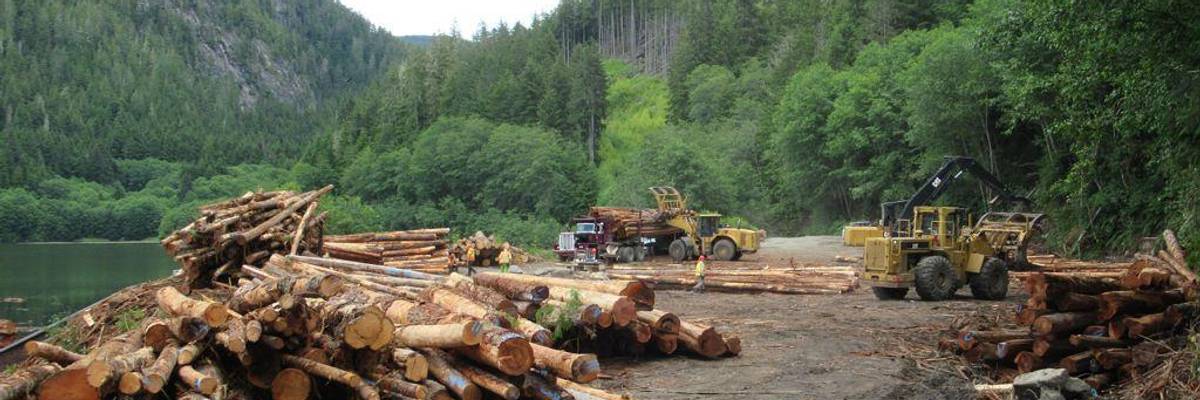
An active logging camp operates at Shoal Harbour on Gilford Island in the Broughton Archipelago, British Columbia, Canada. (Photo: David Stanley/Flickr/CC)
As opposition to logging in British Columbia's endangered old-growth forests continues to gain steam, more than 270 people have been arrested while resisting deforestation, The Guardian reported Thursday.
The Guardian described recent protests against the ongoing destruction of ancient and enormous trees in Canada's westernmost province--some of which are over 1,000 years old and stand 250 feet tall--as one of the country's "largest logging blockades since the 1993 'war in the woods,' when roughly 1,000 people were arrested for blocking logging roads to stop clear-cutting in nearby Clayoquot Sound."
With logging still underway in many areas despite the fact that less than 3% of large-tree old-growth forests remain in B.C., "hundreds of activists have been chaining themselves to giant tripods made from the trunks of felled trees, suspending themselves in trees for days or more at a time, and even securing their arms inside devices called 'sleeping dragons' cemented into the roadway," the newspaper reported.
The movement's goal is to push the government in B.C. to permanently protect the region's vital ecosystems by putting away the chainsaws for good.
According to The Guardian:
The arrests, which involve police removing protesters from the intricate and sometimes precarious contraptions blocking logging roads on southern Vancouver Island, are continuing despite recent promises by the B.C. government to defer logging for two years in two of the five areas that blockaders are trying to protect: the untouched Fairy Creek watershed and the nearby Central Walbran Valley.
Saul Arbess, a spokesperson with the blockade movement calling itself the Rainforest Flying Squad, said while the deferrals were a step in the right direction, they were not enough to ensure that rare and ancient old-growth ecosystems were permanently protected.
Earlier in June, people throughout B.C. held protests outside of legislative offices to urge New Democratic Party lawmakers to honor their campaign promises to halt the clear-cutting of the region's ancient forests, according to Stand.Earth, an environmental justice organization that is advocating for a province-wide ban on deforestation.
While B.C. Premier John Horgan's administration did announce two weeks ago that "it would honor deferral requests from Pacheedaht, Ditidaht, and Huu-ay-aht First Nations, it only addresses a fraction of at-risk old-growth forests in B.C. and leaves calls by other First Nations for immediate logging deferrals unanswered," Stand.Earth pointed out.
Pacheedaht elder Bill Jones, meanwhile, is among those saying the blockades should continue until permanent protections of old-growth forests are in place.
"We must not stand down," Jones told The Guardian.
Last week, as Common Dreams reported, over 100 prominent individuals throughout Canadian society, along with a handful of international supporters, called on Horgan to fulfill his campaign pledge to immediately protect the province's old-growth forests, which scientists have argued is essential.
"The world watches in horror as British Columbia's government allows the destruction of remaining old-growth forest," said environmentalist Bill McKibben, the co-founder of 350.org. "Time for John Horgan to do the right thing."
Dear Common Dreams reader, It’s been nearly 30 years since I co-founded Common Dreams with my late wife, Lina Newhouser. We had the radical notion that journalism should serve the public good, not corporate profits. It was clear to us from the outset what it would take to build such a project. No paid advertisements. No corporate sponsors. No millionaire publisher telling us what to think or do. Many people said we wouldn't last a year, but we proved those doubters wrong. Together with a tremendous team of journalists and dedicated staff, we built an independent media outlet free from the constraints of profits and corporate control. Our mission has always been simple: To inform. To inspire. To ignite change for the common good. Building Common Dreams was not easy. Our survival was never guaranteed. When you take on the most powerful forces—Wall Street greed, fossil fuel industry destruction, Big Tech lobbyists, and uber-rich oligarchs who have spent billions upon billions rigging the economy and democracy in their favor—the only bulwark you have is supporters who believe in your work. But here’s the urgent message from me today. It's never been this bad out there. And it's never been this hard to keep us going. At the very moment Common Dreams is most needed, the threats we face are intensifying. We need your support now more than ever. We don't accept corporate advertising and never will. We don't have a paywall because we don't think people should be blocked from critical news based on their ability to pay. Everything we do is funded by the donations of readers like you. When everyone does the little they can afford, we are strong. But if that support retreats or dries up, so do we. Will you donate now to make sure Common Dreams not only survives but thrives? —Craig Brown, Co-founder |
As opposition to logging in British Columbia's endangered old-growth forests continues to gain steam, more than 270 people have been arrested while resisting deforestation, The Guardian reported Thursday.
The Guardian described recent protests against the ongoing destruction of ancient and enormous trees in Canada's westernmost province--some of which are over 1,000 years old and stand 250 feet tall--as one of the country's "largest logging blockades since the 1993 'war in the woods,' when roughly 1,000 people were arrested for blocking logging roads to stop clear-cutting in nearby Clayoquot Sound."
With logging still underway in many areas despite the fact that less than 3% of large-tree old-growth forests remain in B.C., "hundreds of activists have been chaining themselves to giant tripods made from the trunks of felled trees, suspending themselves in trees for days or more at a time, and even securing their arms inside devices called 'sleeping dragons' cemented into the roadway," the newspaper reported.
The movement's goal is to push the government in B.C. to permanently protect the region's vital ecosystems by putting away the chainsaws for good.
According to The Guardian:
The arrests, which involve police removing protesters from the intricate and sometimes precarious contraptions blocking logging roads on southern Vancouver Island, are continuing despite recent promises by the B.C. government to defer logging for two years in two of the five areas that blockaders are trying to protect: the untouched Fairy Creek watershed and the nearby Central Walbran Valley.
Saul Arbess, a spokesperson with the blockade movement calling itself the Rainforest Flying Squad, said while the deferrals were a step in the right direction, they were not enough to ensure that rare and ancient old-growth ecosystems were permanently protected.
Earlier in June, people throughout B.C. held protests outside of legislative offices to urge New Democratic Party lawmakers to honor their campaign promises to halt the clear-cutting of the region's ancient forests, according to Stand.Earth, an environmental justice organization that is advocating for a province-wide ban on deforestation.
While B.C. Premier John Horgan's administration did announce two weeks ago that "it would honor deferral requests from Pacheedaht, Ditidaht, and Huu-ay-aht First Nations, it only addresses a fraction of at-risk old-growth forests in B.C. and leaves calls by other First Nations for immediate logging deferrals unanswered," Stand.Earth pointed out.
Pacheedaht elder Bill Jones, meanwhile, is among those saying the blockades should continue until permanent protections of old-growth forests are in place.
"We must not stand down," Jones told The Guardian.
Last week, as Common Dreams reported, over 100 prominent individuals throughout Canadian society, along with a handful of international supporters, called on Horgan to fulfill his campaign pledge to immediately protect the province's old-growth forests, which scientists have argued is essential.
"The world watches in horror as British Columbia's government allows the destruction of remaining old-growth forest," said environmentalist Bill McKibben, the co-founder of 350.org. "Time for John Horgan to do the right thing."
As opposition to logging in British Columbia's endangered old-growth forests continues to gain steam, more than 270 people have been arrested while resisting deforestation, The Guardian reported Thursday.
The Guardian described recent protests against the ongoing destruction of ancient and enormous trees in Canada's westernmost province--some of which are over 1,000 years old and stand 250 feet tall--as one of the country's "largest logging blockades since the 1993 'war in the woods,' when roughly 1,000 people were arrested for blocking logging roads to stop clear-cutting in nearby Clayoquot Sound."
With logging still underway in many areas despite the fact that less than 3% of large-tree old-growth forests remain in B.C., "hundreds of activists have been chaining themselves to giant tripods made from the trunks of felled trees, suspending themselves in trees for days or more at a time, and even securing their arms inside devices called 'sleeping dragons' cemented into the roadway," the newspaper reported.
The movement's goal is to push the government in B.C. to permanently protect the region's vital ecosystems by putting away the chainsaws for good.
According to The Guardian:
The arrests, which involve police removing protesters from the intricate and sometimes precarious contraptions blocking logging roads on southern Vancouver Island, are continuing despite recent promises by the B.C. government to defer logging for two years in two of the five areas that blockaders are trying to protect: the untouched Fairy Creek watershed and the nearby Central Walbran Valley.
Saul Arbess, a spokesperson with the blockade movement calling itself the Rainforest Flying Squad, said while the deferrals were a step in the right direction, they were not enough to ensure that rare and ancient old-growth ecosystems were permanently protected.
Earlier in June, people throughout B.C. held protests outside of legislative offices to urge New Democratic Party lawmakers to honor their campaign promises to halt the clear-cutting of the region's ancient forests, according to Stand.Earth, an environmental justice organization that is advocating for a province-wide ban on deforestation.
While B.C. Premier John Horgan's administration did announce two weeks ago that "it would honor deferral requests from Pacheedaht, Ditidaht, and Huu-ay-aht First Nations, it only addresses a fraction of at-risk old-growth forests in B.C. and leaves calls by other First Nations for immediate logging deferrals unanswered," Stand.Earth pointed out.
Pacheedaht elder Bill Jones, meanwhile, is among those saying the blockades should continue until permanent protections of old-growth forests are in place.
"We must not stand down," Jones told The Guardian.
Last week, as Common Dreams reported, over 100 prominent individuals throughout Canadian society, along with a handful of international supporters, called on Horgan to fulfill his campaign pledge to immediately protect the province's old-growth forests, which scientists have argued is essential.
"The world watches in horror as British Columbia's government allows the destruction of remaining old-growth forest," said environmentalist Bill McKibben, the co-founder of 350.org. "Time for John Horgan to do the right thing."