

SUBSCRIBE TO OUR FREE NEWSLETTER
Daily news & progressive opinion—funded by the people, not the corporations—delivered straight to your inbox.
5
#000000
#FFFFFF
To donate by check, phone, or other method, see our More Ways to Give page.
Daily news & progressive opinion—funded by the people, not the corporations—delivered straight to your inbox.
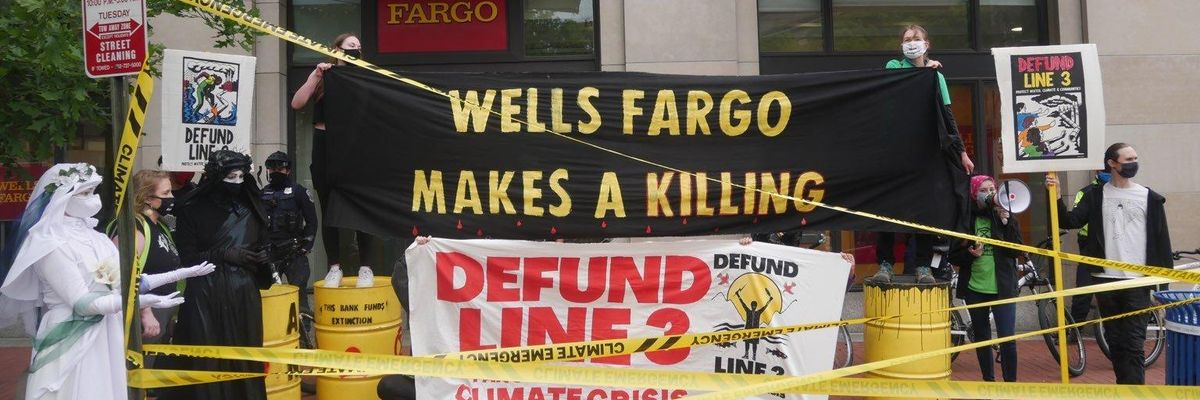
Activists across four continents held protests on Friday calling on banks to stop backing the Line 3 tar sands pipeline. (Photo: Stop the Money Pipeline)
From fake oil spills in Washington, D.C. and New York City to a "people mural" in Seattle spelling out "Defund Line 3," climate and Indigenous protesters in 50 U.S. cities and across seven other countries spanning four continents took to the streets on Friday for a day of action pushing 20 banks to ditch the controversial tar sands pipeline.
"Against the backdrop of rising climate chaos, the continued bankrolling of Line 3 and similar oil and gas infrastructure worldwide is fueling gross and systemic violations of human rights and Indigenous peoples' rights at a global scale," said Carroll Muffett, president of the Center for International Environmental Law.
"It's time for the big banks to recognize that they can and will be held accountable for their complicity in those violations," Muffett added. His organization is part of the Stop the Money Pipeline coalition, over 150 groups that urge asset managers, banks, and insurers to stop funding climate destruction.
The global protests on Friday follow on-the-ground actions that have, at times, successfully halted construction of Canada-based Enbridge's Line 3 project, which is intended to replace an old pipeline that runs from Alberta, through North Dakota and Minnesota, to Wisconsin. The new pipeline's route crosses Anishinaabe treaty lands.
Simone Senogles, a Red Lake Anishinaabe citizen and organizer for Indigenous Environmental Network, declared that "no amount of greenwashing and PR can absolve these banks from violating Indigenous rights and the desolation of Mother Earth."
"By giving credit lines to Enbridge, these institutions are giving the oil company a blank check to attack Anishinaabe people, steal our lands, and further guide this planet into climate chaos," Senogles said. "Those who financially back Enbridge are directly implicated in its crimes. To put it bluntly, blood is on their hands."
The Stop the Money Pipeline coalition launched the #DefundLine3 campaign in February. At the time, Tara Houska--a citizen of Couchiching First Nation, tribal attorney, and founder of the Giniw Collective--wrote for Common Dreams:
It is my duty as an Anishinaabe woman that compels me to support people in taking direct action to stop the construction of Line 3. Direct action, like when Water Protectors recently locked themselves inside a section of pipe, blockaded the entrances to construction sites, and locked themselves to trucks being used to carry Line 3 pipeline materials.
It is from this sense of duty that I am asking you to join us in this campaign. Together, I know that we can do this. Throughout history people-powered movements have changed the world. And they sure as hell can stop Line 3.
Appearing on Democracy Now! Friday, Jackie Fielder of Stop the Money Pipeline noted that "Line 3 would result in an additional 193 million tons of greenhouse gases every single year, and it violates Indigenous rights of the Anishinaabe people and their right to free, prior, and informed consent."
While critics of Line 3 continue to call on U.S. President Joe Biden to intervene and block the pipeline, activists also hope that increasing pressure on banks could quash not only this project but others like it.
" Wall Street may think it can keep profiting off disrespect for Indigenous rights and desecration of the natural world, but it needs to think again," said Moira Birss, climate and finance director at Amazon Watch. "From the Kichwa in the Amazon to the Anishinaabe in Minnesota, Indigenous peoples and their allies are ramping up resistance, and we will hold accountable the financial enablers of this destruction."
As 350.org co-founder Bill McKibben explained: "Let's just say it straight. These banks are trying to profit off the end of the world, and the ongoing desecration of Indigenous land. History will judge them for it, but we're trying to speed up the process."
Activists and supporters shared updates from the protests on social media:
"Nearly every major U.S. bank has now promised that they will align their business with the Paris agreement," noted Alec Connon, Stop the Money Pipeline coalition co-coordinator. "But the fact that those exact same banks are continuing to bankroll a tar sands oil pipeline that is completely incompatible with the Paris agreement and curtailing climate chaos shows just how hollow their promises are."
The 2015 Paris agreement's more ambitious goal is to limit global temperature rise to 1.5@C by the end of the century. However, based on nations' current plans to cut planet-heating emissions, the world is on track to hit 2.4@C of warming by 2100, according to a projection published earlier this week by the Climate Action Tracker.
Osprey Orielle Lake, executive director of Women's Earth and Climate Action Network, asserted that "financial institutions must be held accountable for their role in financing the destruction of the climate, the violation of Indigenous rights, escalating harms to public health during a pandemic, and increased rates of violence toward Indigenous women living near 'man camps' associated with pipeline construction."
"In solidarity with Indigenous leaders, we are calling for fossil fuel divestment to protect the water and climate, and the health and survival of Indigenous communities," she said. "As multiple crises in 2021 proliferate, business as usual must not and cannot continue."
"Now is the time for financial institutions to align with the Paris agreement, respect human rights, divest from Line 3 and planet-wrecking companies, and instead invest in our communities, renewable energy, and a regenerative economy," she added. "There is no time to lose!"
Dear Common Dreams reader, It’s been nearly 30 years since I co-founded Common Dreams with my late wife, Lina Newhouser. We had the radical notion that journalism should serve the public good, not corporate profits. It was clear to us from the outset what it would take to build such a project. No paid advertisements. No corporate sponsors. No millionaire publisher telling us what to think or do. Many people said we wouldn't last a year, but we proved those doubters wrong. Together with a tremendous team of journalists and dedicated staff, we built an independent media outlet free from the constraints of profits and corporate control. Our mission has always been simple: To inform. To inspire. To ignite change for the common good. Building Common Dreams was not easy. Our survival was never guaranteed. When you take on the most powerful forces—Wall Street greed, fossil fuel industry destruction, Big Tech lobbyists, and uber-rich oligarchs who have spent billions upon billions rigging the economy and democracy in their favor—the only bulwark you have is supporters who believe in your work. But here’s the urgent message from me today. It's never been this bad out there. And it's never been this hard to keep us going. At the very moment Common Dreams is most needed, the threats we face are intensifying. We need your support now more than ever. We don't accept corporate advertising and never will. We don't have a paywall because we don't think people should be blocked from critical news based on their ability to pay. Everything we do is funded by the donations of readers like you. When everyone does the little they can afford, we are strong. But if that support retreats or dries up, so do we. Will you donate now to make sure Common Dreams not only survives but thrives? —Craig Brown, Co-founder |
From fake oil spills in Washington, D.C. and New York City to a "people mural" in Seattle spelling out "Defund Line 3," climate and Indigenous protesters in 50 U.S. cities and across seven other countries spanning four continents took to the streets on Friday for a day of action pushing 20 banks to ditch the controversial tar sands pipeline.
"Against the backdrop of rising climate chaos, the continued bankrolling of Line 3 and similar oil and gas infrastructure worldwide is fueling gross and systemic violations of human rights and Indigenous peoples' rights at a global scale," said Carroll Muffett, president of the Center for International Environmental Law.
"It's time for the big banks to recognize that they can and will be held accountable for their complicity in those violations," Muffett added. His organization is part of the Stop the Money Pipeline coalition, over 150 groups that urge asset managers, banks, and insurers to stop funding climate destruction.
The global protests on Friday follow on-the-ground actions that have, at times, successfully halted construction of Canada-based Enbridge's Line 3 project, which is intended to replace an old pipeline that runs from Alberta, through North Dakota and Minnesota, to Wisconsin. The new pipeline's route crosses Anishinaabe treaty lands.
Simone Senogles, a Red Lake Anishinaabe citizen and organizer for Indigenous Environmental Network, declared that "no amount of greenwashing and PR can absolve these banks from violating Indigenous rights and the desolation of Mother Earth."
"By giving credit lines to Enbridge, these institutions are giving the oil company a blank check to attack Anishinaabe people, steal our lands, and further guide this planet into climate chaos," Senogles said. "Those who financially back Enbridge are directly implicated in its crimes. To put it bluntly, blood is on their hands."
The Stop the Money Pipeline coalition launched the #DefundLine3 campaign in February. At the time, Tara Houska--a citizen of Couchiching First Nation, tribal attorney, and founder of the Giniw Collective--wrote for Common Dreams:
It is my duty as an Anishinaabe woman that compels me to support people in taking direct action to stop the construction of Line 3. Direct action, like when Water Protectors recently locked themselves inside a section of pipe, blockaded the entrances to construction sites, and locked themselves to trucks being used to carry Line 3 pipeline materials.
It is from this sense of duty that I am asking you to join us in this campaign. Together, I know that we can do this. Throughout history people-powered movements have changed the world. And they sure as hell can stop Line 3.
Appearing on Democracy Now! Friday, Jackie Fielder of Stop the Money Pipeline noted that "Line 3 would result in an additional 193 million tons of greenhouse gases every single year, and it violates Indigenous rights of the Anishinaabe people and their right to free, prior, and informed consent."
While critics of Line 3 continue to call on U.S. President Joe Biden to intervene and block the pipeline, activists also hope that increasing pressure on banks could quash not only this project but others like it.
" Wall Street may think it can keep profiting off disrespect for Indigenous rights and desecration of the natural world, but it needs to think again," said Moira Birss, climate and finance director at Amazon Watch. "From the Kichwa in the Amazon to the Anishinaabe in Minnesota, Indigenous peoples and their allies are ramping up resistance, and we will hold accountable the financial enablers of this destruction."
As 350.org co-founder Bill McKibben explained: "Let's just say it straight. These banks are trying to profit off the end of the world, and the ongoing desecration of Indigenous land. History will judge them for it, but we're trying to speed up the process."
Activists and supporters shared updates from the protests on social media:
"Nearly every major U.S. bank has now promised that they will align their business with the Paris agreement," noted Alec Connon, Stop the Money Pipeline coalition co-coordinator. "But the fact that those exact same banks are continuing to bankroll a tar sands oil pipeline that is completely incompatible with the Paris agreement and curtailing climate chaos shows just how hollow their promises are."
The 2015 Paris agreement's more ambitious goal is to limit global temperature rise to 1.5@C by the end of the century. However, based on nations' current plans to cut planet-heating emissions, the world is on track to hit 2.4@C of warming by 2100, according to a projection published earlier this week by the Climate Action Tracker.
Osprey Orielle Lake, executive director of Women's Earth and Climate Action Network, asserted that "financial institutions must be held accountable for their role in financing the destruction of the climate, the violation of Indigenous rights, escalating harms to public health during a pandemic, and increased rates of violence toward Indigenous women living near 'man camps' associated with pipeline construction."
"In solidarity with Indigenous leaders, we are calling for fossil fuel divestment to protect the water and climate, and the health and survival of Indigenous communities," she said. "As multiple crises in 2021 proliferate, business as usual must not and cannot continue."
"Now is the time for financial institutions to align with the Paris agreement, respect human rights, divest from Line 3 and planet-wrecking companies, and instead invest in our communities, renewable energy, and a regenerative economy," she added. "There is no time to lose!"
From fake oil spills in Washington, D.C. and New York City to a "people mural" in Seattle spelling out "Defund Line 3," climate and Indigenous protesters in 50 U.S. cities and across seven other countries spanning four continents took to the streets on Friday for a day of action pushing 20 banks to ditch the controversial tar sands pipeline.
"Against the backdrop of rising climate chaos, the continued bankrolling of Line 3 and similar oil and gas infrastructure worldwide is fueling gross and systemic violations of human rights and Indigenous peoples' rights at a global scale," said Carroll Muffett, president of the Center for International Environmental Law.
"It's time for the big banks to recognize that they can and will be held accountable for their complicity in those violations," Muffett added. His organization is part of the Stop the Money Pipeline coalition, over 150 groups that urge asset managers, banks, and insurers to stop funding climate destruction.
The global protests on Friday follow on-the-ground actions that have, at times, successfully halted construction of Canada-based Enbridge's Line 3 project, which is intended to replace an old pipeline that runs from Alberta, through North Dakota and Minnesota, to Wisconsin. The new pipeline's route crosses Anishinaabe treaty lands.
Simone Senogles, a Red Lake Anishinaabe citizen and organizer for Indigenous Environmental Network, declared that "no amount of greenwashing and PR can absolve these banks from violating Indigenous rights and the desolation of Mother Earth."
"By giving credit lines to Enbridge, these institutions are giving the oil company a blank check to attack Anishinaabe people, steal our lands, and further guide this planet into climate chaos," Senogles said. "Those who financially back Enbridge are directly implicated in its crimes. To put it bluntly, blood is on their hands."
The Stop the Money Pipeline coalition launched the #DefundLine3 campaign in February. At the time, Tara Houska--a citizen of Couchiching First Nation, tribal attorney, and founder of the Giniw Collective--wrote for Common Dreams:
It is my duty as an Anishinaabe woman that compels me to support people in taking direct action to stop the construction of Line 3. Direct action, like when Water Protectors recently locked themselves inside a section of pipe, blockaded the entrances to construction sites, and locked themselves to trucks being used to carry Line 3 pipeline materials.
It is from this sense of duty that I am asking you to join us in this campaign. Together, I know that we can do this. Throughout history people-powered movements have changed the world. And they sure as hell can stop Line 3.
Appearing on Democracy Now! Friday, Jackie Fielder of Stop the Money Pipeline noted that "Line 3 would result in an additional 193 million tons of greenhouse gases every single year, and it violates Indigenous rights of the Anishinaabe people and their right to free, prior, and informed consent."
While critics of Line 3 continue to call on U.S. President Joe Biden to intervene and block the pipeline, activists also hope that increasing pressure on banks could quash not only this project but others like it.
" Wall Street may think it can keep profiting off disrespect for Indigenous rights and desecration of the natural world, but it needs to think again," said Moira Birss, climate and finance director at Amazon Watch. "From the Kichwa in the Amazon to the Anishinaabe in Minnesota, Indigenous peoples and their allies are ramping up resistance, and we will hold accountable the financial enablers of this destruction."
As 350.org co-founder Bill McKibben explained: "Let's just say it straight. These banks are trying to profit off the end of the world, and the ongoing desecration of Indigenous land. History will judge them for it, but we're trying to speed up the process."
Activists and supporters shared updates from the protests on social media:
"Nearly every major U.S. bank has now promised that they will align their business with the Paris agreement," noted Alec Connon, Stop the Money Pipeline coalition co-coordinator. "But the fact that those exact same banks are continuing to bankroll a tar sands oil pipeline that is completely incompatible with the Paris agreement and curtailing climate chaos shows just how hollow their promises are."
The 2015 Paris agreement's more ambitious goal is to limit global temperature rise to 1.5@C by the end of the century. However, based on nations' current plans to cut planet-heating emissions, the world is on track to hit 2.4@C of warming by 2100, according to a projection published earlier this week by the Climate Action Tracker.
Osprey Orielle Lake, executive director of Women's Earth and Climate Action Network, asserted that "financial institutions must be held accountable for their role in financing the destruction of the climate, the violation of Indigenous rights, escalating harms to public health during a pandemic, and increased rates of violence toward Indigenous women living near 'man camps' associated with pipeline construction."
"In solidarity with Indigenous leaders, we are calling for fossil fuel divestment to protect the water and climate, and the health and survival of Indigenous communities," she said. "As multiple crises in 2021 proliferate, business as usual must not and cannot continue."
"Now is the time for financial institutions to align with the Paris agreement, respect human rights, divest from Line 3 and planet-wrecking companies, and instead invest in our communities, renewable energy, and a regenerative economy," she added. "There is no time to lose!"

