

SUBSCRIBE TO OUR FREE NEWSLETTER
Daily news & progressive opinion—funded by the people, not the corporations—delivered straight to your inbox.
5
#000000
#FFFFFF
To donate by check, phone, or other method, see our More Ways to Give page.
Daily news & progressive opinion—funded by the people, not the corporations—delivered straight to your inbox.
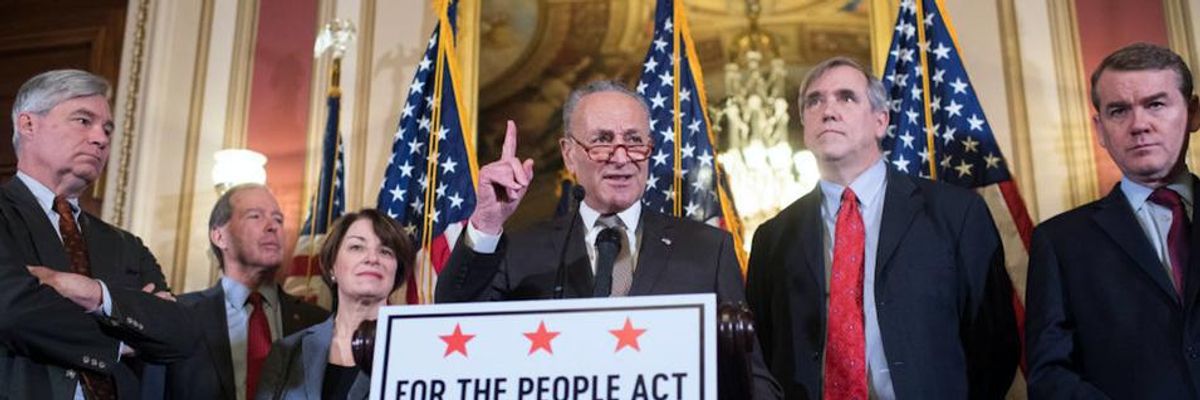
Then-Senate Minority Leader Chuck Schumer (D-N.Y., center) stands flanked by Sens. Amy Klobuchar (D-Minn.) and Jeff Merkley (D-Ore.) at the original Senate introduction of the For the People Act on March 27, 2019. (Photo: Tom Williams/CQ Roll Call)
After decades of erosion by corporate and plutocratic interests and the battering ram that was the Donald Trump presidency, a new poll Friday suggests the democratic ideals enshrined in the landmark For the People Act enjoy broad support across the political spectrum.
"The most important parts give candidates a realistic chance to fund campaigns with small contributions only. That could liberate Congress from special interest funding."
--Lawrence Lessig,
Harvard Law School
Originally passed by the House of Representatives in 2019 but torpedoed by the Republican-controlled Senate, the For the People Act (pdf) would expand voting rights including for former felons, curtail partisan gerrymandering, strengthen ethics rules, limit money in politics and implement the DISCLOSE Act, and make Washington, D.C. a state--among other reforms.
The new survey, conducted by the left-leaning think tank Data for Progress and the advocacy group Equal Citizens, found a majority of self-described Democrats, Republicans, and independents support the For the People Act. Respondents were given the following information:
The For the People Act has been introduced in Congress. Supporters of the bill say it would limit the influence of big money in politics by empowering small donors, make voting easier and more secure, end gerrymandering, and give the public more information about who is lobbying our government. Opponents say it would be an overreach by the federal government and that states should control their own elections. Do you support or oppose the For The People Act?
Two-thirds, or 67%, of respondents answered affirmatively, including 77% of Democratic voters, 56% of Republicans, and 68% of independents. More than one-third (35%) of Democratic voters and 25% of Republicans "strongly support" the bill, while only 4% of Democrats and 11% of Republicans said they "strongly oppose" it.
The original For the People Act was written by the late Rep. John Lewis (D-Ga.) and Rep. John Sarbanes (D-Md.). Senate Majority Leader Chuck Schumer (D-N.Y.), Sen. Amy Klobuchar (D-Minn.), and Sen. Jeff Merkley (D-Ore.) said it will be the very first bill they introduce in the current congressional session.
"From a violent insurrection at the Capitol to the countless attempts to silence the vote of millions of Americans, attacks on our democracy have come in many forms," said Schumer on Tuesday. "Senate Democrats are committed to advancing real solutions and fighting to uphold the core tenets of our constitution, which is why we are announcing today that the first bill of the new Congress will be the For the People Act."
Despite controlling both chambers of Congress, based on current rules at least 10 Senate Republicans will need to support holding a vote for the bill in order to avoid a filibuster. A flood of progressive voices and groups, including Justice Democrats and the Sunrise Movement, have recently urged Senate Democrats to eliminate the filibuster, which could be accomplished by a simple majority vote.
Lawrence Lessig, a professor at Harvard Law School and expert on campaign finance, calls the For the People Act "an incredibly important piece of comprehensive democracy reform."
"In my view, the most important parts give candidates a realistic chance to fund campaigns with small contributions only," Lessig told OpenSecrets. "That could liberate Congress from special interest funding."
In addition to broad popular support, the For the People Act is backed by some 180 progressive groups who have formed the Declaration for American Democracy coalition.
Members of the coalition include: the American Federation of Teachers, CodePink, Color of Change, Common Cause, Demand Progress, Greenpeace, Indivisible, the League of Conservation Voters, March for Our Lives, Planned Parenthood Action Fund, Progressive Democrats of America, Public Citizen, the Service Employees International Union, and the Southern Poverty Law Center.
Dear Common Dreams reader, It’s been nearly 30 years since I co-founded Common Dreams with my late wife, Lina Newhouser. We had the radical notion that journalism should serve the public good, not corporate profits. It was clear to us from the outset what it would take to build such a project. No paid advertisements. No corporate sponsors. No millionaire publisher telling us what to think or do. Many people said we wouldn't last a year, but we proved those doubters wrong. Together with a tremendous team of journalists and dedicated staff, we built an independent media outlet free from the constraints of profits and corporate control. Our mission has always been simple: To inform. To inspire. To ignite change for the common good. Building Common Dreams was not easy. Our survival was never guaranteed. When you take on the most powerful forces—Wall Street greed, fossil fuel industry destruction, Big Tech lobbyists, and uber-rich oligarchs who have spent billions upon billions rigging the economy and democracy in their favor—the only bulwark you have is supporters who believe in your work. But here’s the urgent message from me today. It's never been this bad out there. And it's never been this hard to keep us going. At the very moment Common Dreams is most needed, the threats we face are intensifying. We need your support now more than ever. We don't accept corporate advertising and never will. We don't have a paywall because we don't think people should be blocked from critical news based on their ability to pay. Everything we do is funded by the donations of readers like you. When everyone does the little they can afford, we are strong. But if that support retreats or dries up, so do we. Will you donate now to make sure Common Dreams not only survives but thrives? —Craig Brown, Co-founder |
After decades of erosion by corporate and plutocratic interests and the battering ram that was the Donald Trump presidency, a new poll Friday suggests the democratic ideals enshrined in the landmark For the People Act enjoy broad support across the political spectrum.
"The most important parts give candidates a realistic chance to fund campaigns with small contributions only. That could liberate Congress from special interest funding."
--Lawrence Lessig,
Harvard Law School
Originally passed by the House of Representatives in 2019 but torpedoed by the Republican-controlled Senate, the For the People Act (pdf) would expand voting rights including for former felons, curtail partisan gerrymandering, strengthen ethics rules, limit money in politics and implement the DISCLOSE Act, and make Washington, D.C. a state--among other reforms.
The new survey, conducted by the left-leaning think tank Data for Progress and the advocacy group Equal Citizens, found a majority of self-described Democrats, Republicans, and independents support the For the People Act. Respondents were given the following information:
The For the People Act has been introduced in Congress. Supporters of the bill say it would limit the influence of big money in politics by empowering small donors, make voting easier and more secure, end gerrymandering, and give the public more information about who is lobbying our government. Opponents say it would be an overreach by the federal government and that states should control their own elections. Do you support or oppose the For The People Act?
Two-thirds, or 67%, of respondents answered affirmatively, including 77% of Democratic voters, 56% of Republicans, and 68% of independents. More than one-third (35%) of Democratic voters and 25% of Republicans "strongly support" the bill, while only 4% of Democrats and 11% of Republicans said they "strongly oppose" it.
The original For the People Act was written by the late Rep. John Lewis (D-Ga.) and Rep. John Sarbanes (D-Md.). Senate Majority Leader Chuck Schumer (D-N.Y.), Sen. Amy Klobuchar (D-Minn.), and Sen. Jeff Merkley (D-Ore.) said it will be the very first bill they introduce in the current congressional session.
"From a violent insurrection at the Capitol to the countless attempts to silence the vote of millions of Americans, attacks on our democracy have come in many forms," said Schumer on Tuesday. "Senate Democrats are committed to advancing real solutions and fighting to uphold the core tenets of our constitution, which is why we are announcing today that the first bill of the new Congress will be the For the People Act."
Despite controlling both chambers of Congress, based on current rules at least 10 Senate Republicans will need to support holding a vote for the bill in order to avoid a filibuster. A flood of progressive voices and groups, including Justice Democrats and the Sunrise Movement, have recently urged Senate Democrats to eliminate the filibuster, which could be accomplished by a simple majority vote.
Lawrence Lessig, a professor at Harvard Law School and expert on campaign finance, calls the For the People Act "an incredibly important piece of comprehensive democracy reform."
"In my view, the most important parts give candidates a realistic chance to fund campaigns with small contributions only," Lessig told OpenSecrets. "That could liberate Congress from special interest funding."
In addition to broad popular support, the For the People Act is backed by some 180 progressive groups who have formed the Declaration for American Democracy coalition.
Members of the coalition include: the American Federation of Teachers, CodePink, Color of Change, Common Cause, Demand Progress, Greenpeace, Indivisible, the League of Conservation Voters, March for Our Lives, Planned Parenthood Action Fund, Progressive Democrats of America, Public Citizen, the Service Employees International Union, and the Southern Poverty Law Center.
After decades of erosion by corporate and plutocratic interests and the battering ram that was the Donald Trump presidency, a new poll Friday suggests the democratic ideals enshrined in the landmark For the People Act enjoy broad support across the political spectrum.
"The most important parts give candidates a realistic chance to fund campaigns with small contributions only. That could liberate Congress from special interest funding."
--Lawrence Lessig,
Harvard Law School
Originally passed by the House of Representatives in 2019 but torpedoed by the Republican-controlled Senate, the For the People Act (pdf) would expand voting rights including for former felons, curtail partisan gerrymandering, strengthen ethics rules, limit money in politics and implement the DISCLOSE Act, and make Washington, D.C. a state--among other reforms.
The new survey, conducted by the left-leaning think tank Data for Progress and the advocacy group Equal Citizens, found a majority of self-described Democrats, Republicans, and independents support the For the People Act. Respondents were given the following information:
The For the People Act has been introduced in Congress. Supporters of the bill say it would limit the influence of big money in politics by empowering small donors, make voting easier and more secure, end gerrymandering, and give the public more information about who is lobbying our government. Opponents say it would be an overreach by the federal government and that states should control their own elections. Do you support or oppose the For The People Act?
Two-thirds, or 67%, of respondents answered affirmatively, including 77% of Democratic voters, 56% of Republicans, and 68% of independents. More than one-third (35%) of Democratic voters and 25% of Republicans "strongly support" the bill, while only 4% of Democrats and 11% of Republicans said they "strongly oppose" it.
The original For the People Act was written by the late Rep. John Lewis (D-Ga.) and Rep. John Sarbanes (D-Md.). Senate Majority Leader Chuck Schumer (D-N.Y.), Sen. Amy Klobuchar (D-Minn.), and Sen. Jeff Merkley (D-Ore.) said it will be the very first bill they introduce in the current congressional session.
"From a violent insurrection at the Capitol to the countless attempts to silence the vote of millions of Americans, attacks on our democracy have come in many forms," said Schumer on Tuesday. "Senate Democrats are committed to advancing real solutions and fighting to uphold the core tenets of our constitution, which is why we are announcing today that the first bill of the new Congress will be the For the People Act."
Despite controlling both chambers of Congress, based on current rules at least 10 Senate Republicans will need to support holding a vote for the bill in order to avoid a filibuster. A flood of progressive voices and groups, including Justice Democrats and the Sunrise Movement, have recently urged Senate Democrats to eliminate the filibuster, which could be accomplished by a simple majority vote.
Lawrence Lessig, a professor at Harvard Law School and expert on campaign finance, calls the For the People Act "an incredibly important piece of comprehensive democracy reform."
"In my view, the most important parts give candidates a realistic chance to fund campaigns with small contributions only," Lessig told OpenSecrets. "That could liberate Congress from special interest funding."
In addition to broad popular support, the For the People Act is backed by some 180 progressive groups who have formed the Declaration for American Democracy coalition.
Members of the coalition include: the American Federation of Teachers, CodePink, Color of Change, Common Cause, Demand Progress, Greenpeace, Indivisible, the League of Conservation Voters, March for Our Lives, Planned Parenthood Action Fund, Progressive Democrats of America, Public Citizen, the Service Employees International Union, and the Southern Poverty Law Center.

