
SUBSCRIBE TO OUR FREE NEWSLETTER
Daily news & progressive opinion—funded by the people, not the corporations—delivered straight to your inbox.
5
#000000
#FFFFFF
To donate by check, phone, or other method, see our More Ways to Give page.


Daily news & progressive opinion—funded by the people, not the corporations—delivered straight to your inbox.
"Bigotry has been his brand since day 1," said Congresswoman Yvette Clarke.
As President Donald Trump refuses to apologize for a now-deleted social media post in which former President Barack Obama and his wife Michelle Obama are portrayed as apes, the head of the Congressional Black Caucus on Friday blasted what she called the "bigoted and racist regime" in the White House.
“It’s very clear that there was an intent to harm people, to hurt people, with this video,” Congressional Black Caucus Chair Yvette Clarke (D-NY) said in an interview with the Associated Press. "Every week we are, as the American people, put in a position where we have to respond to something very cruel or something extremely off-putting that this administration does. It’s a part of their M.O. at this point."
After dismissing the widespread revulsion—including by some Republican lawmakers—over Trump's sharing of the racist election conspiracy video on his Truth Social network as "fake outrage," the White House subsequently claimed that an aide "erroneously made the post," which was deleted after nearly 12 hours online.
The president told reporters aboard Air Force one Friday evening, "I didn't make a mistake" and that he is the "least racist president you've had in a long time."
Trump launched his political career by amplifying the conspiracy theory that Barack Obama was not born in the United States and his 2016 presidential campaign by calling Mexicans "rapists." Since then, he has made numerous bigoted statements about racial minorities, immigrants, Muslims, women, and others.
Brushing off the administration's explanation for Trump's post, Clarke said that "they don’t tell the truth."
"If there wasn’t a climate, a toxic and racist climate within the White House, we wouldn’t see this type of behavior regardless of who it’s coming from," she contended.
"Here we are, in the year 2026, celebrating the 250th anniversary of the United States of America, the 100th anniversary of the commemoration of Black history, and this is what comes out of the White House on a Friday morning," the congresswoman added. "It’s beneath all of us."
Asked what it means that Trump—who rarely retracts anything—deleted the post, Clarke said, "I think it’s more of a political expediency than it is any moral compass."
"As my mother would say," she added, "'Too late. Mercy’s gone.'"
Civil rights groups also condemned Trump, with Color of Change posting on Facebook that "this is white supremacy expressed from the Oval Office."
"Trump resents what the Obamas represent: A Black family that is accomplished, respected, and widely admired," the group continued. "Their success contradicts the worldview he has spent years promoting. His attacks follow a clear trajectory—from birther conspiracies questioning Obama's legitimacy, to false accusations of treason, to now circulating imagery rooted in centuries of racial dehumanization used to justify slavery, lynching, and violence."
"Republican leadership has been silent," Color of Change added. "Elected officials who refuse to condemn this behavior are choosing to normalize it."
NAACP president Derrick Johnson said in a statement that "Donald Trump's video is blatantly racist, disgusting, and utterly despicable."
Johnson asserted that Trump is attempting to distract from the cost of living crisis and Jeffrey Epstein scandal.
"You know who isn't in the Epstein files? Barack Obama," he said. "You know who actually improved the economy as president? Barack Obama."
If Trump wins and this far-right agenda is to put into motion, it will wreak havoc on Black communities in a way we haven’t seen since Jim Crow.
We are one day away from the election, and too much is at stake for Black people. The questioning around Vice President Kamala Harris' Blackness and misconceptions about her plans for Black people continue to distract voters from the far-right, destructive manifesto fueling Donald Trump’s agenda, Project 2025: a dangerous declaration of oppression that risks civil rights and the democratic fabric of our nation.
Project 2025 details a disturbing vision for the future of Black people in this country: One where we have no rights, no control of our bodies, none where we can’t afford groceries, we can’t afford housing, where our children can’t even learn their own history because it is erased and whitewashed, and where politicians can spread dangerous lies about Black people without recourse. This manifesto seeks to erode the authority of vital government agencies, giving unprecedented power to the executive branch, leaving so many Black communities devastated. By threatening discrimination laws and targeting initiatives promoting diversity, equity, and inclusion, Project 2025 will unravel decades of hard-fought civil rights progress.And with little to no federal oversight historical patterns of discrimination against Black communities will also worsen.
Black communities know what it’s like to be at the hands of a government without checks and balances and no accountability.
One of the key civil rights standards Project 2025 seeks to eliminate critical safeguard that addresses unintentional discriminatory practices, is a backbone of civil rights protections. This is the disparate impact standard in discrimination cases. In 2013, in one of the largest fair lending cases in the DOJ’s history, Black customers in the Chicago area brought a large lawsuit against Wells Fargo after they paid $2,937 more in broker fees for their homes than similarly situated white customers. Without the disparate impact standard, the federal government would have been unable to demonstrate that Black communities had suffered disproportionate harm at the hands of Wells Fargo. At a time when the nation is grappling with a housing crisis, eliminating the disparate impact standard would exacerbate existing disparities and leave Black communities vulnerable to discriminatory housing and lending practices.
Project 2025 also seeks to eliminate diversity, equity, and inclusion efforts in our schools and businesses. In June, a U.S. federal court of appeals court deemed an Atlanta private equity fund unconstitutional for providing grants to women-owned and Black-owned companies, ignoring the systemic barriers that have historically excluded Black women from investment funding. And following the Supreme Court’s decision on affirmative action, conservatives attacked critical programs designed to increase the number of Black medical doctors. In a world where Black mothers are dying more than anyone in childbirth, the need for Black doctors is needed more than ever. The Project 2025 manifesto seeks to take this further and delete all references to diversity, equity, and inclusion from in our federal regulations and legislation. But let’s be very clear about what this will mean: these efforts will sabotage contracts, harm Black-owned businesses, and perpetuate historical injustices within Black communities.
Project 2025's agenda will wreak havoc on Black communities in a way we haven’t seen since Jim Crow. Black communities know what it’s like to be at the hands of a government without checks and balances and no accountability. As we are one day out from the election, Black people must vote in mass. We must recognize the urgency of this threat to our democracy and lean on tangible solutions to defend our rights for many generations. It’s time to take back our power, and let our voices be heard. Vote like your life depends on it because it does. We need all hands on deck to protect our future.
"The spread of misinformation and targeted intimidation of Black voters will continue without the proper safeguards," said Color of Change.
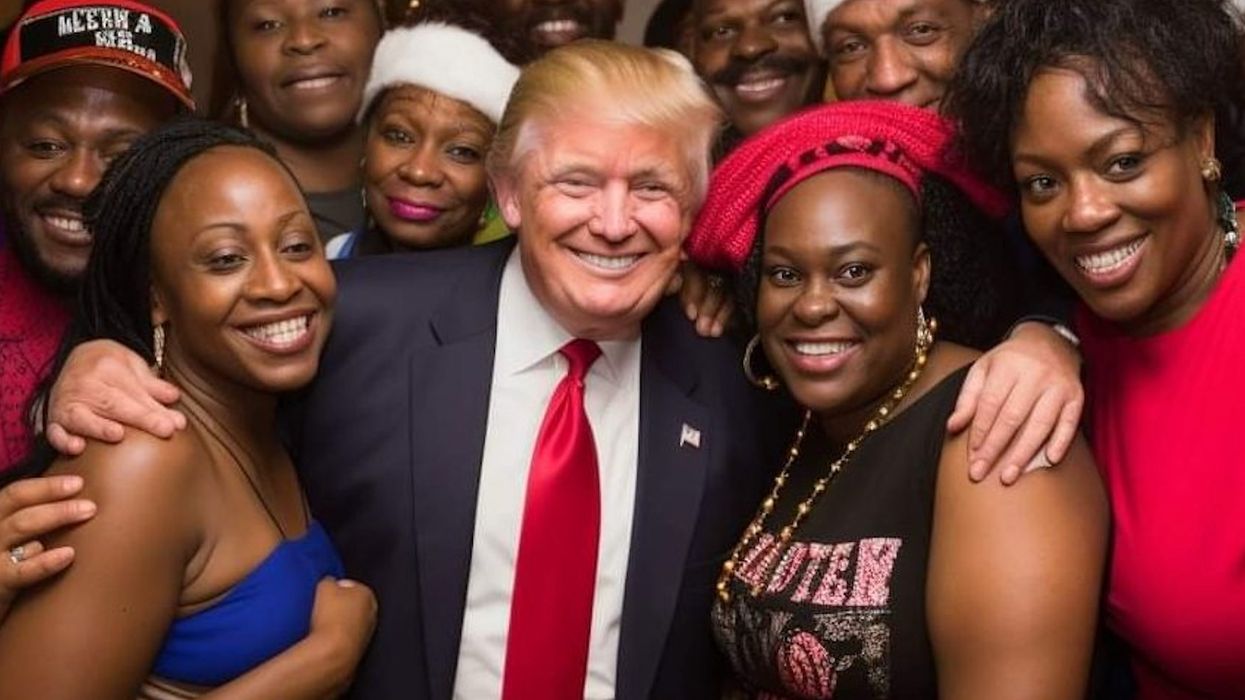
Racial justice defenders on Monday renewed calls for banning artificial intelligence in political advertisements after backers of former U.S. President Donald Trump published fake AI-generated images of the presumptive Republican nominee with Black "supporters."
BBC highlighted numerous deepfakes, including one created by right-wing Florida radio host Mark Kaye showing a smiling Trump embracing happy Black women. On closer inspection, missing or misformed fingers and unintelligible lettering on attire expose the images as fake.
"I'm not claiming it's accurate," Kaye told the BBC. "I'm not a photojournalist. "I'm not out there taking pictures of what's really happening. I'm a storyteller."
"If anybody's voting one way or another because of one photo they see on a Facebook page, that's a problem with that person, not with the post itself," Kaye added.
Another deepfake shows Trump on a porch surrounded by young Black men. The image earned a "community note" on X, the Elon Musk-owned social media platform formerly known as Twitter, identifying it as AI-generated. The owner of the account that published the image—which has been viewed more than 1.4 million times according to X—included the deceptive caption, "What do you think about Trump stopping his motorcade to take pictures with young men that waved him down?"
When asked about his image by the BBC, @MAGAShaggy1958 said his posts "have attracted thousands of wonderful kind-hearted Christian followers."
Responding to the new reporting, the racial justice group Color of Change led calls to ban AI in political ads.
"The spread of misinformation and targeted intimidation of Black voters will continue without the proper safeguards," the group said on social media, while calling for:
"As the 2024 election approaches, Big Tech companies like Google and Meta are poised to once again play a pivotal role in the spread of misinformation meant to disenfranchise Black voters and justify violence in the name of right-wing candidates," Color of Change said in a petition urging Big Tech to "stop amplifying election lies."
"During the 2016 and 2020 presidential election cycles, social media platforms such as Twitter, Facebook, YouTube, and others consistently ignored the warning signs that they were helping to undermine our democracy," the group continued. "This dangerous trend doesn't seem to be changing."
"Despite their claims that they've learned their lesson and are shoring up protections against misinformation ahead of the 2024 election cycle, large tech companies are cutting key staff that moderate content and removing election protections from their policies that are supposed to safeguard platform users from misinformation," the petition warns.
Last September, Sens. Amy Klobuchar (D-Minn.), Chris Coons (D-Del.), Josh Hawley (R-Mo.), and Susan Collins (R-Maine) introduced bipartisan legislation to prohibit the use of AI-generated content that falsely depicts candidates in political ads.
In February, the Federal Communications Commission responded to AI-generated robocalls featuring President Joe Biden's fake voice telling New Hampshire voters to not vote in their state's primary election by prohibiting the use of voice cloning technology to create automated calls.
The Federal Election Commission, however, has been accused by advocacy groups including Public Citizen of foot-dragging in response to public demands to regulate deepfakes. Earlier this year, FEC Chair Sean Cooksey said the agency would "resolve the AI rulemaking by early summer"—after many state primaries are over.
At least 13 states have passed laws governing the use of AI in political ads, while tech companies have responded in various ways to the rise of deepfakes. Last September, Google announced that it would require the prominent disclosure of political ads using AI. Meta, the parent company of Facebook and Instagram, has banned political campaigns from using its generative AI tools. OpenAI, which makes the popular ChatGPT chatbot, said earlier this year that it won't let users create content for political campaigns and will embed watermarks on art made with its DALL-E image generator.
Cliff Albright, co-founder of the Black Voters Matter campaign, told the BBC that "there have been documented attempts to target disinformation to Black communities again, especially younger Black voters."
Albright said the deepfakes serve a "very strategic narrative" being pushed by a wide range of right-wing voices from the Trump campaign to social media accounts in a bid to woo African Americans.
Trump's support among Black voters increased from just 8% in 2016 to a still-meager 12% in 2020. Conversely, a recent New York Times/Siena College survey of voters in six key swing states found that Biden's support among African American voters has plummeted from 92% during the last election cycle to 71% today, while 22% of Black respondents said they would vote for Trump this year.
Trump's attempts to win Black votes have ranged from awkward to cringeworthy, including hawking $400 golden sneakers and suggesting his mugshot and 91 criminal indictments appeal to African Americans.