SUBSCRIBE TO OUR FREE NEWSLETTER
Daily news & progressive opinion—funded by the people, not the corporations—delivered straight to your inbox.
5
#000000
#FFFFFF
To donate by check, phone, or other method, see our More Ways to Give page.
Daily news & progressive opinion—funded by the people, not the corporations—delivered straight to your inbox.
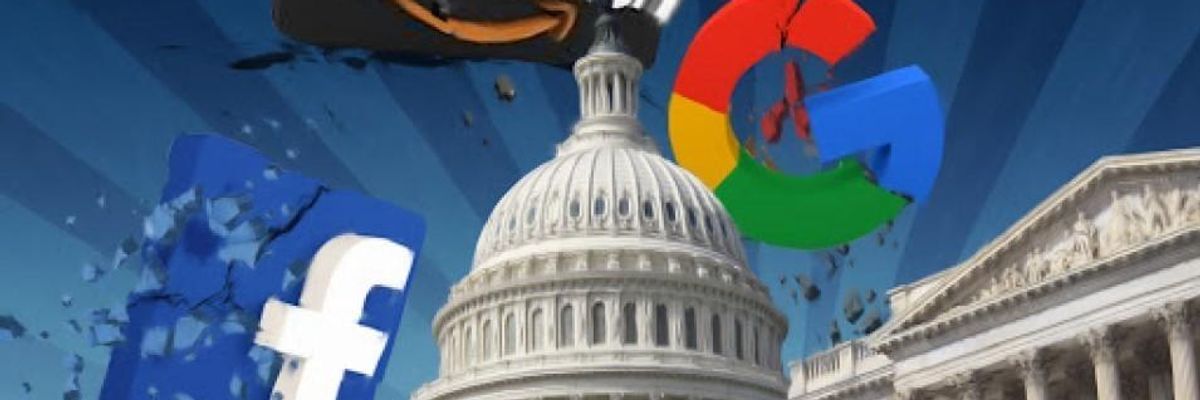
A growing number of lawmakers and advocates are calling for the breaking up of Big Tech monopolies like Facebook and Google. (Image: Peter Macdiarmid/Getty Images)
Seeing President Donald Trump banned from social media might feel good, and it might even thwart some criminal acts inspired by the president's inflammatory rhetoric. But kicking Trump off Facebook, Twitter, and other platforms sets a perilous precedent and won't change the companies' business models and the decades of government deregulation that enabled their monopolistic hegemony, numerous experts argued this week.
"As a short-term measure, the social media crackdown on Trump might be welcome. But Trump will soon be gone. Facebook, Twitter, and the other internet leviathans will remain. They should be the target of far-reaching reform."
--Jeet Heer, The Nation
"Whatever one thinks of stopping Trump fomenting violence by limiting his ability to communicate, the ability of democratically unaccountable monopolies with extraordinary control over communications infrastructure, like Facebook and Google, YouTube's parent company, to silence political speech is exceptionally dangerous," wrote Matt Stoller and Sarah Miller in a Guardian editorial published Monday. "It also sidesteps the underlying problem--that it's their dominance and business model that promotes conspiratorial, fake, and violent content to millions."
Stoller and Miller, both of American Economic Liberties Project, note that companies including Facebook and Google make billions of dollars by fostering the "ecosystem of disinformation, extremism, rage, and bigotry" that "won't go away by banning Trump or his supporters."
"Policymakers must recognize the choices that enabled the rise of these toxic but wildly lucrative business models," the authors write. The culprit, in a word, is deregulation:
Beginning in the 1970s, policymakers changed their philosophy to encourage consolidation. They altered rules around advertising, publishing, and information distribution markets, weakening antitrust laws, killing important protections like the Fairness Doctrine, and passing the Telecommunications Act of 1996, which lifted local media ownership caps and unleashed a wave of mergers and acquisitions.
They also enacted Section 230 of the Communications Decency Act, a provision that today allows tech platforms to escape liability for illegal content they help shape and monetize. And over the last 20 years, policymakers enabled Google and Facebook to roll up the entire digital advertising and communication space by permitting hundreds of mergers, without a single challenge.
The net effect is that two giant corporations, Facebook and Google, dominate online communications, profiting by selling advertising against cheaply produced, addictive clickbait and conspiratorial content.
"Making matters worse, in seeking ad money and quick profits, Facebook and Google, as well as private equity, have killed the pro-social institutions on which we rely, such as local newspapers, by redirecting advertising revenue to themselves," the authors add. "Filling their place are conspiracy theories like QAnon, which these platforms amplify to turn a handsome profit. Survey results show Google provided ad services to 86% of sites carrying coronavirus conspiracies."
Jeet Heer, a contributor at The Nation, calls social media companies' decisions to ban Trump a "purely arbitrary... assertion of raw corporate power" while agreeing with Stoller and Miller that "beyond the special quandary of incendiary speech, there is the larger problem that the social media giants are now de facto monopolies."
"If these firms are so powerful that they can be the primary gatekeepers between a president and the public, then they have outgrown democratic control," asserts Heer. "As a short-term measure, the social media crackdown on Trump might be welcome. But Trump will soon be gone. Facebook, Twitter, and the other internet leviathans will remain. They should be the target of far-reaching reform."
So what can the administration of President-elect Joe Biden do to remedy a problem that won't go away just because Trump exits the White House next week? Stoller and Miller argue that the incoming administration and Congress "can fix these twin problems of monopoly power and profit motive by returning to a traditional policy framework of fair competition, neutral communication networks, and business models that finance local news and a diversity of voices."
"Breaking up these goliaths and prohibiting mergers by dominant firms would force them to compete over users based on data privacy and safety, as Facebook once had to do when it was in a competitive social networking world in the early 2000s," they write. "And imposing neutrality, like nondiscrimination rules and interoperability requirements, would end the tyranny of algorithms that push us towards incendiary content."
In a separate statement published on Wednesday, Open Markets Institute executive director Barry Lynn laid out a three-step action plan to rein in Big Tech's concentrated control while safeguarding free online expression:
First, Congress must enact clear rules that protect free speech while also barring incitements to violence, libel, and other restricted speech on all public debate forums hosted by any corporation providing essential communications services...
Second, the [Federal Trade Commission] should use its rule-making authority to ban the deceptive data collection and the hyper-targeted ads that allow these corporations to manipulate and exploit their users.
Third, Congress and law enforcers must act to clearly separate advertising-supported publishing from the business of providing essential public platforms and communications services.
"The good news is Republican and Democratic attorneys general in 48 states have filed historic antitrust suits against Google and Facebook, seeking to break them up," write Stoller and Miller, "and the Biden administration and many in Congress seem wide awake to the pernicious role of social media platforms... But until political leaders recognize that these tech barons make their billions by selling tickets to the end of American democracy, it will continue to creep ever closer."
"Until political leaders recognize that these tech barons make their billions by selling tickets to the end of American democracy, it will continue to creep ever closer."
--Matt Stoller and Sarah Miller
"Seeing Trump booted off Facebook may be emotionally satisfying and even potentially prevent dangerous behavior in the short term," they conclude. "But only a wholesale restructuring of our online communications infrastructure can preserve democracy."
A growing number of lawmakers and advocates support dismantling Big Tech monopolies like Facebook and Google. In October 2020, the House Judiciary Subcommittee on Antitrust, following a 16-month investigation, released a 450-page report (pdf) that found four tech giants--Amazon, Apple, Facebook, and Google--wield abusive monopoly power and suggested that lawmakers take steps to break them up.
"The totality of the evidence produced during this investigation demonstrates the pressing need for legislative action and reform," the report states. "These firms have too much power, and that power must be reined in and subject to appropriate oversight and enforcement."
Dear Common Dreams reader, It’s been nearly 30 years since I co-founded Common Dreams with my late wife, Lina Newhouser. We had the radical notion that journalism should serve the public good, not corporate profits. It was clear to us from the outset what it would take to build such a project. No paid advertisements. No corporate sponsors. No millionaire publisher telling us what to think or do. Many people said we wouldn't last a year, but we proved those doubters wrong. Together with a tremendous team of journalists and dedicated staff, we built an independent media outlet free from the constraints of profits and corporate control. Our mission has always been simple: To inform. To inspire. To ignite change for the common good. Building Common Dreams was not easy. Our survival was never guaranteed. When you take on the most powerful forces—Wall Street greed, fossil fuel industry destruction, Big Tech lobbyists, and uber-rich oligarchs who have spent billions upon billions rigging the economy and democracy in their favor—the only bulwark you have is supporters who believe in your work. But here’s the urgent message from me today. It's never been this bad out there. And it's never been this hard to keep us going. At the very moment Common Dreams is most needed, the threats we face are intensifying. We need your support now more than ever. We don't accept corporate advertising and never will. We don't have a paywall because we don't think people should be blocked from critical news based on their ability to pay. Everything we do is funded by the donations of readers like you. When everyone does the little they can afford, we are strong. But if that support retreats or dries up, so do we. Will you donate now to make sure Common Dreams not only survives but thrives? —Craig Brown, Co-founder |
Seeing President Donald Trump banned from social media might feel good, and it might even thwart some criminal acts inspired by the president's inflammatory rhetoric. But kicking Trump off Facebook, Twitter, and other platforms sets a perilous precedent and won't change the companies' business models and the decades of government deregulation that enabled their monopolistic hegemony, numerous experts argued this week.
"As a short-term measure, the social media crackdown on Trump might be welcome. But Trump will soon be gone. Facebook, Twitter, and the other internet leviathans will remain. They should be the target of far-reaching reform."
--Jeet Heer, The Nation
"Whatever one thinks of stopping Trump fomenting violence by limiting his ability to communicate, the ability of democratically unaccountable monopolies with extraordinary control over communications infrastructure, like Facebook and Google, YouTube's parent company, to silence political speech is exceptionally dangerous," wrote Matt Stoller and Sarah Miller in a Guardian editorial published Monday. "It also sidesteps the underlying problem--that it's their dominance and business model that promotes conspiratorial, fake, and violent content to millions."
Stoller and Miller, both of American Economic Liberties Project, note that companies including Facebook and Google make billions of dollars by fostering the "ecosystem of disinformation, extremism, rage, and bigotry" that "won't go away by banning Trump or his supporters."
"Policymakers must recognize the choices that enabled the rise of these toxic but wildly lucrative business models," the authors write. The culprit, in a word, is deregulation:
Beginning in the 1970s, policymakers changed their philosophy to encourage consolidation. They altered rules around advertising, publishing, and information distribution markets, weakening antitrust laws, killing important protections like the Fairness Doctrine, and passing the Telecommunications Act of 1996, which lifted local media ownership caps and unleashed a wave of mergers and acquisitions.
They also enacted Section 230 of the Communications Decency Act, a provision that today allows tech platforms to escape liability for illegal content they help shape and monetize. And over the last 20 years, policymakers enabled Google and Facebook to roll up the entire digital advertising and communication space by permitting hundreds of mergers, without a single challenge.
The net effect is that two giant corporations, Facebook and Google, dominate online communications, profiting by selling advertising against cheaply produced, addictive clickbait and conspiratorial content.
"Making matters worse, in seeking ad money and quick profits, Facebook and Google, as well as private equity, have killed the pro-social institutions on which we rely, such as local newspapers, by redirecting advertising revenue to themselves," the authors add. "Filling their place are conspiracy theories like QAnon, which these platforms amplify to turn a handsome profit. Survey results show Google provided ad services to 86% of sites carrying coronavirus conspiracies."
Jeet Heer, a contributor at The Nation, calls social media companies' decisions to ban Trump a "purely arbitrary... assertion of raw corporate power" while agreeing with Stoller and Miller that "beyond the special quandary of incendiary speech, there is the larger problem that the social media giants are now de facto monopolies."
"If these firms are so powerful that they can be the primary gatekeepers between a president and the public, then they have outgrown democratic control," asserts Heer. "As a short-term measure, the social media crackdown on Trump might be welcome. But Trump will soon be gone. Facebook, Twitter, and the other internet leviathans will remain. They should be the target of far-reaching reform."
So what can the administration of President-elect Joe Biden do to remedy a problem that won't go away just because Trump exits the White House next week? Stoller and Miller argue that the incoming administration and Congress "can fix these twin problems of monopoly power and profit motive by returning to a traditional policy framework of fair competition, neutral communication networks, and business models that finance local news and a diversity of voices."
"Breaking up these goliaths and prohibiting mergers by dominant firms would force them to compete over users based on data privacy and safety, as Facebook once had to do when it was in a competitive social networking world in the early 2000s," they write. "And imposing neutrality, like nondiscrimination rules and interoperability requirements, would end the tyranny of algorithms that push us towards incendiary content."
In a separate statement published on Wednesday, Open Markets Institute executive director Barry Lynn laid out a three-step action plan to rein in Big Tech's concentrated control while safeguarding free online expression:
First, Congress must enact clear rules that protect free speech while also barring incitements to violence, libel, and other restricted speech on all public debate forums hosted by any corporation providing essential communications services...
Second, the [Federal Trade Commission] should use its rule-making authority to ban the deceptive data collection and the hyper-targeted ads that allow these corporations to manipulate and exploit their users.
Third, Congress and law enforcers must act to clearly separate advertising-supported publishing from the business of providing essential public platforms and communications services.
"The good news is Republican and Democratic attorneys general in 48 states have filed historic antitrust suits against Google and Facebook, seeking to break them up," write Stoller and Miller, "and the Biden administration and many in Congress seem wide awake to the pernicious role of social media platforms... But until political leaders recognize that these tech barons make their billions by selling tickets to the end of American democracy, it will continue to creep ever closer."
"Until political leaders recognize that these tech barons make their billions by selling tickets to the end of American democracy, it will continue to creep ever closer."
--Matt Stoller and Sarah Miller
"Seeing Trump booted off Facebook may be emotionally satisfying and even potentially prevent dangerous behavior in the short term," they conclude. "But only a wholesale restructuring of our online communications infrastructure can preserve democracy."
A growing number of lawmakers and advocates support dismantling Big Tech monopolies like Facebook and Google. In October 2020, the House Judiciary Subcommittee on Antitrust, following a 16-month investigation, released a 450-page report (pdf) that found four tech giants--Amazon, Apple, Facebook, and Google--wield abusive monopoly power and suggested that lawmakers take steps to break them up.
"The totality of the evidence produced during this investigation demonstrates the pressing need for legislative action and reform," the report states. "These firms have too much power, and that power must be reined in and subject to appropriate oversight and enforcement."
Seeing President Donald Trump banned from social media might feel good, and it might even thwart some criminal acts inspired by the president's inflammatory rhetoric. But kicking Trump off Facebook, Twitter, and other platforms sets a perilous precedent and won't change the companies' business models and the decades of government deregulation that enabled their monopolistic hegemony, numerous experts argued this week.
"As a short-term measure, the social media crackdown on Trump might be welcome. But Trump will soon be gone. Facebook, Twitter, and the other internet leviathans will remain. They should be the target of far-reaching reform."
--Jeet Heer, The Nation
"Whatever one thinks of stopping Trump fomenting violence by limiting his ability to communicate, the ability of democratically unaccountable monopolies with extraordinary control over communications infrastructure, like Facebook and Google, YouTube's parent company, to silence political speech is exceptionally dangerous," wrote Matt Stoller and Sarah Miller in a Guardian editorial published Monday. "It also sidesteps the underlying problem--that it's their dominance and business model that promotes conspiratorial, fake, and violent content to millions."
Stoller and Miller, both of American Economic Liberties Project, note that companies including Facebook and Google make billions of dollars by fostering the "ecosystem of disinformation, extremism, rage, and bigotry" that "won't go away by banning Trump or his supporters."
"Policymakers must recognize the choices that enabled the rise of these toxic but wildly lucrative business models," the authors write. The culprit, in a word, is deregulation:
Beginning in the 1970s, policymakers changed their philosophy to encourage consolidation. They altered rules around advertising, publishing, and information distribution markets, weakening antitrust laws, killing important protections like the Fairness Doctrine, and passing the Telecommunications Act of 1996, which lifted local media ownership caps and unleashed a wave of mergers and acquisitions.
They also enacted Section 230 of the Communications Decency Act, a provision that today allows tech platforms to escape liability for illegal content they help shape and monetize. And over the last 20 years, policymakers enabled Google and Facebook to roll up the entire digital advertising and communication space by permitting hundreds of mergers, without a single challenge.
The net effect is that two giant corporations, Facebook and Google, dominate online communications, profiting by selling advertising against cheaply produced, addictive clickbait and conspiratorial content.
"Making matters worse, in seeking ad money and quick profits, Facebook and Google, as well as private equity, have killed the pro-social institutions on which we rely, such as local newspapers, by redirecting advertising revenue to themselves," the authors add. "Filling their place are conspiracy theories like QAnon, which these platforms amplify to turn a handsome profit. Survey results show Google provided ad services to 86% of sites carrying coronavirus conspiracies."
Jeet Heer, a contributor at The Nation, calls social media companies' decisions to ban Trump a "purely arbitrary... assertion of raw corporate power" while agreeing with Stoller and Miller that "beyond the special quandary of incendiary speech, there is the larger problem that the social media giants are now de facto monopolies."
"If these firms are so powerful that they can be the primary gatekeepers between a president and the public, then they have outgrown democratic control," asserts Heer. "As a short-term measure, the social media crackdown on Trump might be welcome. But Trump will soon be gone. Facebook, Twitter, and the other internet leviathans will remain. They should be the target of far-reaching reform."
So what can the administration of President-elect Joe Biden do to remedy a problem that won't go away just because Trump exits the White House next week? Stoller and Miller argue that the incoming administration and Congress "can fix these twin problems of monopoly power and profit motive by returning to a traditional policy framework of fair competition, neutral communication networks, and business models that finance local news and a diversity of voices."
"Breaking up these goliaths and prohibiting mergers by dominant firms would force them to compete over users based on data privacy and safety, as Facebook once had to do when it was in a competitive social networking world in the early 2000s," they write. "And imposing neutrality, like nondiscrimination rules and interoperability requirements, would end the tyranny of algorithms that push us towards incendiary content."
In a separate statement published on Wednesday, Open Markets Institute executive director Barry Lynn laid out a three-step action plan to rein in Big Tech's concentrated control while safeguarding free online expression:
First, Congress must enact clear rules that protect free speech while also barring incitements to violence, libel, and other restricted speech on all public debate forums hosted by any corporation providing essential communications services...
Second, the [Federal Trade Commission] should use its rule-making authority to ban the deceptive data collection and the hyper-targeted ads that allow these corporations to manipulate and exploit their users.
Third, Congress and law enforcers must act to clearly separate advertising-supported publishing from the business of providing essential public platforms and communications services.
"The good news is Republican and Democratic attorneys general in 48 states have filed historic antitrust suits against Google and Facebook, seeking to break them up," write Stoller and Miller, "and the Biden administration and many in Congress seem wide awake to the pernicious role of social media platforms... But until political leaders recognize that these tech barons make their billions by selling tickets to the end of American democracy, it will continue to creep ever closer."
"Until political leaders recognize that these tech barons make their billions by selling tickets to the end of American democracy, it will continue to creep ever closer."
--Matt Stoller and Sarah Miller
"Seeing Trump booted off Facebook may be emotionally satisfying and even potentially prevent dangerous behavior in the short term," they conclude. "But only a wholesale restructuring of our online communications infrastructure can preserve democracy."
A growing number of lawmakers and advocates support dismantling Big Tech monopolies like Facebook and Google. In October 2020, the House Judiciary Subcommittee on Antitrust, following a 16-month investigation, released a 450-page report (pdf) that found four tech giants--Amazon, Apple, Facebook, and Google--wield abusive monopoly power and suggested that lawmakers take steps to break them up.
"The totality of the evidence produced during this investigation demonstrates the pressing need for legislative action and reform," the report states. "These firms have too much power, and that power must be reined in and subject to appropriate oversight and enforcement."