SUBSCRIBE TO OUR FREE NEWSLETTER
Daily news & progressive opinion—funded by the people, not the corporations—delivered straight to your inbox.
5
#000000
#FFFFFF
To donate by check, phone, or other method, see our More Ways to Give page.
Daily news & progressive opinion—funded by the people, not the corporations—delivered straight to your inbox.
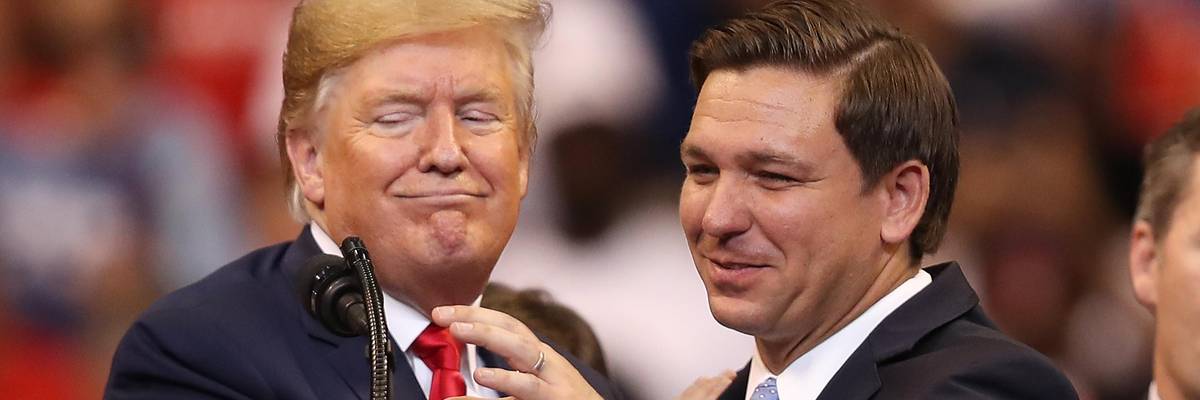
Former U.S. President Donald Trump introduces Florida Governor Ron DeSantis during a homecoming campaign rally at the BB&T Center on November 26, 2019 in Sunrise, Florida.
Is it possible to turn the tide toward truthful exchange? Yes, if we take immediate responsibility as well as carefully embrace long-term strategies
So, Donald Trump is back on social media. What a perfect moment to grapple with our nation's crisis of trust.
A 2022 Gallup poll found that less than 30 percent of us have "a great deal (or quite a lot) of confidence in U.S. institutions," and that's "as low as it has ever been." Among 16 institutions tested, 11 registered decline. And the steepest drop? Trust in the presidency "fell off a cliff," reported CNN. Eight in 10 of us believe our democracy is threatened.
On trust in government, we now rank 26th worldwide between Greece and Hungary.
Such findings are ominous, for the very bedrock of democracy is trust—including trust that political and economic rules are fair so that our voices are heard. And it's hard to imagine many of us feel heard when wealth and income continue gushing to the top, generating economic inequality roughly on par with Haiti's and more extreme than in 121 countries. Plus, most of us express reluctance to share our views for fear of offending others.
How many among us would choose this path?
At the same time we experience concentrated private power undermining our wellbeing, as, for example, fossil fuel giants use their vast profits to thwart action on our climate emergency.
All the above is made more threatening by the spreading disinformation disease. It pits citizens against each other and distracts us from focusing on underlying economic unfairness and undemocratic rules, including those suppressing the vote.
"Fake news" has been harming people for centuries, scholars tell us. But in today's instant-info world, disinformation—a nice word for "lies"—is literally killing us. Four in ten Americans still believe the 2020 "stolen election" lie that triggered an unprecedented insurrection attempt and death.
If you are among this 40 percent, check out reporting by the Heritage Foundation. Considered a conservative center, it has long tracked voter fraud, and our analysis of its data reveals no significant problem.
Our legal system typically limits "freedom of speech" only in cases of libel and defamation—regardless of potential for wider social harm. If this interpretation holds, it is frightening: In November, for example, California lawyers defending doctors "spreading false information about Covid-19 vaccines and treatments" argued their clients' free speech rights were being violated.
Around the world, however, a range of democratic nations are taking a nuanced, citizen-driven approach to combat disinformation.
To guard their citizens' free speech rights as well as protect against dangerous lies, some are creating transparent public processes, which evolve in response to experience. In Crisis of Trust: How Can Democracies Protect Against Dangerous Lies, a report just released by Cambridge-based Small Planet Institute, we share highlights of five national efforts—New Zealand, Australia, Germany, France, and Sweden.
New Zealand's approach seems especially useful, as it has been evolving over decades. Note that in the quality of its democracy the country ranks fourth worldwide, according to Freedom House, founded by Eleanor Roosevelt and colleagues in 1941. And the US? We come in a sad 62nd.
Since 1989 the New Zealand Broadcast Standards Authority (BSA) has offered a transparent, public platform in which citizens can flag what they believe to be dangerous disinformation. Hate speech is also covered, as the country strives to protect the interests of its Māori people. An independent board then investigates. If it deems the material both false and harmful, the offending media must be removed or corrected. Complaints and decisions are visible to all on the BSA website.
Overall, the agency appears to exercise caution, requiring removal or correction in response to about 7 percent of complaints. An example of the BSA's action? A daytime entertainment program airing false Covid information was required to provide correct information in the same program at a similar time of day.
Initiatives of several highly ranked democracies to counter disinformation reflect alarm not primarily about a single lie that could cause great harm—although our own "stolen election" lie certainly qualifies. Rather, they focus on the drip, drip, drip of false messages in our media-saturated lives.
So, is it possible to turn the tide toward truthful exchange? Yes, if we take immediate responsibility as well as carefully embrace long-term strategies.
We can each resist directly; and in taking on this challenge the Global Disinformation Index is a helpful tool. As a society we can learn from specific strategies of nations, such as those mentioned above, protecting freedom-of-speech while creating guardrails against disinformation's poison. Long-term solutions, however, require our building a more accountable democracy generating greater economic and political equity so that Americans feel trust in government is warranted and are less susceptible to lies.
May the shock of registering our true standing, as well as inspiration and practical lessons from highly regarded democracies, motivate courageous action here.
Dear Common Dreams reader, It’s been nearly 30 years since I co-founded Common Dreams with my late wife, Lina Newhouser. We had the radical notion that journalism should serve the public good, not corporate profits. It was clear to us from the outset what it would take to build such a project. No paid advertisements. No corporate sponsors. No millionaire publisher telling us what to think or do. Many people said we wouldn't last a year, but we proved those doubters wrong. Together with a tremendous team of journalists and dedicated staff, we built an independent media outlet free from the constraints of profits and corporate control. Our mission has always been simple: To inform. To inspire. To ignite change for the common good. Building Common Dreams was not easy. Our survival was never guaranteed. When you take on the most powerful forces—Wall Street greed, fossil fuel industry destruction, Big Tech lobbyists, and uber-rich oligarchs who have spent billions upon billions rigging the economy and democracy in their favor—the only bulwark you have is supporters who believe in your work. But here’s the urgent message from me today. It's never been this bad out there. And it's never been this hard to keep us going. At the very moment Common Dreams is most needed, the threats we face are intensifying. We need your support now more than ever. We don't accept corporate advertising and never will. We don't have a paywall because we don't think people should be blocked from critical news based on their ability to pay. Everything we do is funded by the donations of readers like you. When everyone does the little they can afford, we are strong. But if that support retreats or dries up, so do we. Will you donate now to make sure Common Dreams not only survives but thrives? —Craig Brown, Co-founder |
So, Donald Trump is back on social media. What a perfect moment to grapple with our nation's crisis of trust.
A 2022 Gallup poll found that less than 30 percent of us have "a great deal (or quite a lot) of confidence in U.S. institutions," and that's "as low as it has ever been." Among 16 institutions tested, 11 registered decline. And the steepest drop? Trust in the presidency "fell off a cliff," reported CNN. Eight in 10 of us believe our democracy is threatened.
On trust in government, we now rank 26th worldwide between Greece and Hungary.
Such findings are ominous, for the very bedrock of democracy is trust—including trust that political and economic rules are fair so that our voices are heard. And it's hard to imagine many of us feel heard when wealth and income continue gushing to the top, generating economic inequality roughly on par with Haiti's and more extreme than in 121 countries. Plus, most of us express reluctance to share our views for fear of offending others.
How many among us would choose this path?
At the same time we experience concentrated private power undermining our wellbeing, as, for example, fossil fuel giants use their vast profits to thwart action on our climate emergency.
All the above is made more threatening by the spreading disinformation disease. It pits citizens against each other and distracts us from focusing on underlying economic unfairness and undemocratic rules, including those suppressing the vote.
"Fake news" has been harming people for centuries, scholars tell us. But in today's instant-info world, disinformation—a nice word for "lies"—is literally killing us. Four in ten Americans still believe the 2020 "stolen election" lie that triggered an unprecedented insurrection attempt and death.
If you are among this 40 percent, check out reporting by the Heritage Foundation. Considered a conservative center, it has long tracked voter fraud, and our analysis of its data reveals no significant problem.
Our legal system typically limits "freedom of speech" only in cases of libel and defamation—regardless of potential for wider social harm. If this interpretation holds, it is frightening: In November, for example, California lawyers defending doctors "spreading false information about Covid-19 vaccines and treatments" argued their clients' free speech rights were being violated.
Around the world, however, a range of democratic nations are taking a nuanced, citizen-driven approach to combat disinformation.
To guard their citizens' free speech rights as well as protect against dangerous lies, some are creating transparent public processes, which evolve in response to experience. In Crisis of Trust: How Can Democracies Protect Against Dangerous Lies, a report just released by Cambridge-based Small Planet Institute, we share highlights of five national efforts—New Zealand, Australia, Germany, France, and Sweden.
New Zealand's approach seems especially useful, as it has been evolving over decades. Note that in the quality of its democracy the country ranks fourth worldwide, according to Freedom House, founded by Eleanor Roosevelt and colleagues in 1941. And the US? We come in a sad 62nd.
Since 1989 the New Zealand Broadcast Standards Authority (BSA) has offered a transparent, public platform in which citizens can flag what they believe to be dangerous disinformation. Hate speech is also covered, as the country strives to protect the interests of its Māori people. An independent board then investigates. If it deems the material both false and harmful, the offending media must be removed or corrected. Complaints and decisions are visible to all on the BSA website.
Overall, the agency appears to exercise caution, requiring removal or correction in response to about 7 percent of complaints. An example of the BSA's action? A daytime entertainment program airing false Covid information was required to provide correct information in the same program at a similar time of day.
Initiatives of several highly ranked democracies to counter disinformation reflect alarm not primarily about a single lie that could cause great harm—although our own "stolen election" lie certainly qualifies. Rather, they focus on the drip, drip, drip of false messages in our media-saturated lives.
So, is it possible to turn the tide toward truthful exchange? Yes, if we take immediate responsibility as well as carefully embrace long-term strategies.
We can each resist directly; and in taking on this challenge the Global Disinformation Index is a helpful tool. As a society we can learn from specific strategies of nations, such as those mentioned above, protecting freedom-of-speech while creating guardrails against disinformation's poison. Long-term solutions, however, require our building a more accountable democracy generating greater economic and political equity so that Americans feel trust in government is warranted and are less susceptible to lies.
May the shock of registering our true standing, as well as inspiration and practical lessons from highly regarded democracies, motivate courageous action here.
So, Donald Trump is back on social media. What a perfect moment to grapple with our nation's crisis of trust.
A 2022 Gallup poll found that less than 30 percent of us have "a great deal (or quite a lot) of confidence in U.S. institutions," and that's "as low as it has ever been." Among 16 institutions tested, 11 registered decline. And the steepest drop? Trust in the presidency "fell off a cliff," reported CNN. Eight in 10 of us believe our democracy is threatened.
On trust in government, we now rank 26th worldwide between Greece and Hungary.
Such findings are ominous, for the very bedrock of democracy is trust—including trust that political and economic rules are fair so that our voices are heard. And it's hard to imagine many of us feel heard when wealth and income continue gushing to the top, generating economic inequality roughly on par with Haiti's and more extreme than in 121 countries. Plus, most of us express reluctance to share our views for fear of offending others.
How many among us would choose this path?
At the same time we experience concentrated private power undermining our wellbeing, as, for example, fossil fuel giants use their vast profits to thwart action on our climate emergency.
All the above is made more threatening by the spreading disinformation disease. It pits citizens against each other and distracts us from focusing on underlying economic unfairness and undemocratic rules, including those suppressing the vote.
"Fake news" has been harming people for centuries, scholars tell us. But in today's instant-info world, disinformation—a nice word for "lies"—is literally killing us. Four in ten Americans still believe the 2020 "stolen election" lie that triggered an unprecedented insurrection attempt and death.
If you are among this 40 percent, check out reporting by the Heritage Foundation. Considered a conservative center, it has long tracked voter fraud, and our analysis of its data reveals no significant problem.
Our legal system typically limits "freedom of speech" only in cases of libel and defamation—regardless of potential for wider social harm. If this interpretation holds, it is frightening: In November, for example, California lawyers defending doctors "spreading false information about Covid-19 vaccines and treatments" argued their clients' free speech rights were being violated.
Around the world, however, a range of democratic nations are taking a nuanced, citizen-driven approach to combat disinformation.
To guard their citizens' free speech rights as well as protect against dangerous lies, some are creating transparent public processes, which evolve in response to experience. In Crisis of Trust: How Can Democracies Protect Against Dangerous Lies, a report just released by Cambridge-based Small Planet Institute, we share highlights of five national efforts—New Zealand, Australia, Germany, France, and Sweden.
New Zealand's approach seems especially useful, as it has been evolving over decades. Note that in the quality of its democracy the country ranks fourth worldwide, according to Freedom House, founded by Eleanor Roosevelt and colleagues in 1941. And the US? We come in a sad 62nd.
Since 1989 the New Zealand Broadcast Standards Authority (BSA) has offered a transparent, public platform in which citizens can flag what they believe to be dangerous disinformation. Hate speech is also covered, as the country strives to protect the interests of its Māori people. An independent board then investigates. If it deems the material both false and harmful, the offending media must be removed or corrected. Complaints and decisions are visible to all on the BSA website.
Overall, the agency appears to exercise caution, requiring removal or correction in response to about 7 percent of complaints. An example of the BSA's action? A daytime entertainment program airing false Covid information was required to provide correct information in the same program at a similar time of day.
Initiatives of several highly ranked democracies to counter disinformation reflect alarm not primarily about a single lie that could cause great harm—although our own "stolen election" lie certainly qualifies. Rather, they focus on the drip, drip, drip of false messages in our media-saturated lives.
So, is it possible to turn the tide toward truthful exchange? Yes, if we take immediate responsibility as well as carefully embrace long-term strategies.
We can each resist directly; and in taking on this challenge the Global Disinformation Index is a helpful tool. As a society we can learn from specific strategies of nations, such as those mentioned above, protecting freedom-of-speech while creating guardrails against disinformation's poison. Long-term solutions, however, require our building a more accountable democracy generating greater economic and political equity so that Americans feel trust in government is warranted and are less susceptible to lies.
May the shock of registering our true standing, as well as inspiration and practical lessons from highly regarded democracies, motivate courageous action here.