SUBSCRIBE TO OUR FREE NEWSLETTER
Daily news & progressive opinion—funded by the people, not the corporations—delivered straight to your inbox.
5
#000000
#FFFFFF
To donate by check, phone, or other method, see our More Ways to Give page.
Daily news & progressive opinion—funded by the people, not the corporations—delivered straight to your inbox.
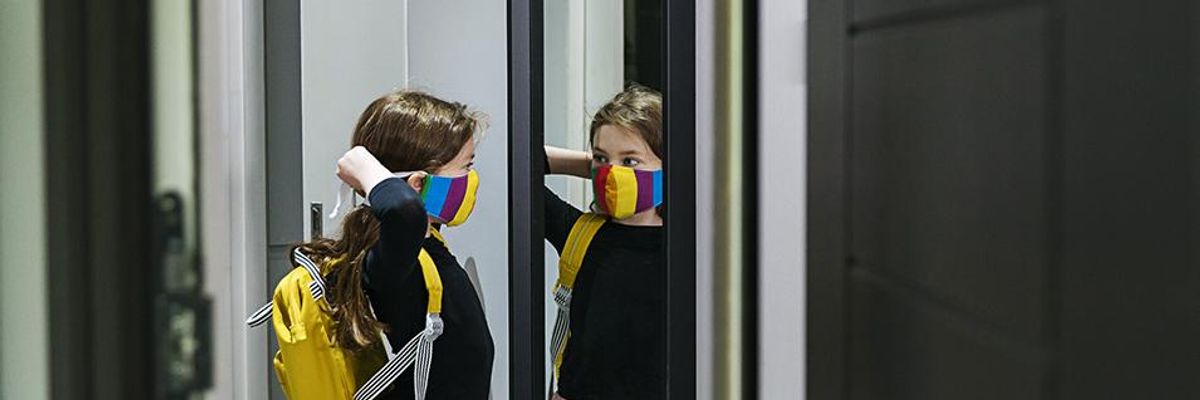
More than 97,000 children tested postive for Covid-19 in the final two weeks of July, according to a report released by the American Academy of Pediatrics and the Children's Hospital Association. (Photo: Justin Paget, Getty Images)
An estimated 338,000 children in the United States have been infected with Covid-19, and 97,000 of those were reported in the final two weeks of July, according to a report released by the American Academy of Pediatrics and the Children's Hospital Association.
School districts across the country are considering how to safely reopen amid climbing Covid-19 cases nationwide, and medical experts are increasingly worried about the consequences of in-person school openings.
"Historically, my response up to this last couple of weeks has been typically much more neutral and just trying to implore people to do the right thing, to lay the information out in front," Dr. Michael Saag, director of UAB Medicine's Division of Infectious Disease, told Yahoo! Finance last week. "Now we're seeing schools that seem to shrug their shoulders ... It's impossible to stay quiet."
Parents and educators have expressed concern over the push to reopen, and some have protested moves to put kids in physical classrooms. Schools that have resumed in-person learning are reporting rapid spreads of Covid-19 infections among students and staff, prompting digital learning alternatives.
But politicians--Democrat and Republican--continue to tie the health of the nation's economy to reopening schools, and newly released studies refute the idea floated earlier in the pandemic that children "almost immune" to getting and spreading Covid-19, but do indicate children may be at lower risk than adults. In addition, a new report from the Centers for Disease Control and Prevention (CDC) indicates African American and Hispanic children who contract Covid-19 are five and eight times more likely to be hospitalized than their white counterparts.
"It has been hypothesized that Hispanic adults might be at increased risk for SARS-CoV-2 infection because they are overrepresented in frontline (e.g., essential and direct-service) occupations with decreased opportunities for social distancing, which might also affect children living in those households," the CDC researchers wrote.
Additionally, a report released by the journal Pediatrics showed racial and economic disparities for positive Covid-19 test rates.
"Racial/ethnic and socioeconomically disadvantaged groups have less access to primary care physicians," the study's authors wrote. "In addition, referral to the testing site by clinicians may have been differentially provided, and advertisement of the testing site may not have been uniformly distributed among all potential referring clinicians. Furthermore, the testing site was available a few days per week and during the hours of 10 a.m. and 2 p.m. which may not have been convenient for all."
The United States' top infectious disease specialist Dr. Anthony Fauci said last week that with proper precautions--social distancing, mask wearing, lower class sizes, etc.--schools could reopen for in-person learning.
"The primary consideration should always be the safety, the health [and] the welfare of the children, as well as the teachers and the secondary effects for spreading [to] the parents and other family members," Fauci told CNN Friday.
Many school districts in the U.S. have opted to go digital. Education Week reports that as of Aug. 6, 17 of the 20 largest school districts are choosing remote learning only as their back-to-school instructional model, affecting over four million students.
"As the parent of a school-aged daughter, I understand the gravity of this decision and the challenges posed by remote learning for our students and their families," Congresswoman Ayanna Pressley (D-Mass.), said in a press release urging officials implement digital learning in the Bay State schools. "But rushing to reopen our schools will directly jeopardize the lives of our students and educators, and that is a risk we cannot take."
Dear Common Dreams reader, It’s been nearly 30 years since I co-founded Common Dreams with my late wife, Lina Newhouser. We had the radical notion that journalism should serve the public good, not corporate profits. It was clear to us from the outset what it would take to build such a project. No paid advertisements. No corporate sponsors. No millionaire publisher telling us what to think or do. Many people said we wouldn't last a year, but we proved those doubters wrong. Together with a tremendous team of journalists and dedicated staff, we built an independent media outlet free from the constraints of profits and corporate control. Our mission has always been simple: To inform. To inspire. To ignite change for the common good. Building Common Dreams was not easy. Our survival was never guaranteed. When you take on the most powerful forces—Wall Street greed, fossil fuel industry destruction, Big Tech lobbyists, and uber-rich oligarchs who have spent billions upon billions rigging the economy and democracy in their favor—the only bulwark you have is supporters who believe in your work. But here’s the urgent message from me today. It's never been this bad out there. And it's never been this hard to keep us going. At the very moment Common Dreams is most needed, the threats we face are intensifying. We need your support now more than ever. We don't accept corporate advertising and never will. We don't have a paywall because we don't think people should be blocked from critical news based on their ability to pay. Everything we do is funded by the donations of readers like you. When everyone does the little they can afford, we are strong. But if that support retreats or dries up, so do we. Will you donate now to make sure Common Dreams not only survives but thrives? —Craig Brown, Co-founder |
An estimated 338,000 children in the United States have been infected with Covid-19, and 97,000 of those were reported in the final two weeks of July, according to a report released by the American Academy of Pediatrics and the Children's Hospital Association.
School districts across the country are considering how to safely reopen amid climbing Covid-19 cases nationwide, and medical experts are increasingly worried about the consequences of in-person school openings.
"Historically, my response up to this last couple of weeks has been typically much more neutral and just trying to implore people to do the right thing, to lay the information out in front," Dr. Michael Saag, director of UAB Medicine's Division of Infectious Disease, told Yahoo! Finance last week. "Now we're seeing schools that seem to shrug their shoulders ... It's impossible to stay quiet."
Parents and educators have expressed concern over the push to reopen, and some have protested moves to put kids in physical classrooms. Schools that have resumed in-person learning are reporting rapid spreads of Covid-19 infections among students and staff, prompting digital learning alternatives.
But politicians--Democrat and Republican--continue to tie the health of the nation's economy to reopening schools, and newly released studies refute the idea floated earlier in the pandemic that children "almost immune" to getting and spreading Covid-19, but do indicate children may be at lower risk than adults. In addition, a new report from the Centers for Disease Control and Prevention (CDC) indicates African American and Hispanic children who contract Covid-19 are five and eight times more likely to be hospitalized than their white counterparts.
"It has been hypothesized that Hispanic adults might be at increased risk for SARS-CoV-2 infection because they are overrepresented in frontline (e.g., essential and direct-service) occupations with decreased opportunities for social distancing, which might also affect children living in those households," the CDC researchers wrote.
Additionally, a report released by the journal Pediatrics showed racial and economic disparities for positive Covid-19 test rates.
"Racial/ethnic and socioeconomically disadvantaged groups have less access to primary care physicians," the study's authors wrote. "In addition, referral to the testing site by clinicians may have been differentially provided, and advertisement of the testing site may not have been uniformly distributed among all potential referring clinicians. Furthermore, the testing site was available a few days per week and during the hours of 10 a.m. and 2 p.m. which may not have been convenient for all."
The United States' top infectious disease specialist Dr. Anthony Fauci said last week that with proper precautions--social distancing, mask wearing, lower class sizes, etc.--schools could reopen for in-person learning.
"The primary consideration should always be the safety, the health [and] the welfare of the children, as well as the teachers and the secondary effects for spreading [to] the parents and other family members," Fauci told CNN Friday.
Many school districts in the U.S. have opted to go digital. Education Week reports that as of Aug. 6, 17 of the 20 largest school districts are choosing remote learning only as their back-to-school instructional model, affecting over four million students.
"As the parent of a school-aged daughter, I understand the gravity of this decision and the challenges posed by remote learning for our students and their families," Congresswoman Ayanna Pressley (D-Mass.), said in a press release urging officials implement digital learning in the Bay State schools. "But rushing to reopen our schools will directly jeopardize the lives of our students and educators, and that is a risk we cannot take."
An estimated 338,000 children in the United States have been infected with Covid-19, and 97,000 of those were reported in the final two weeks of July, according to a report released by the American Academy of Pediatrics and the Children's Hospital Association.
School districts across the country are considering how to safely reopen amid climbing Covid-19 cases nationwide, and medical experts are increasingly worried about the consequences of in-person school openings.
"Historically, my response up to this last couple of weeks has been typically much more neutral and just trying to implore people to do the right thing, to lay the information out in front," Dr. Michael Saag, director of UAB Medicine's Division of Infectious Disease, told Yahoo! Finance last week. "Now we're seeing schools that seem to shrug their shoulders ... It's impossible to stay quiet."
Parents and educators have expressed concern over the push to reopen, and some have protested moves to put kids in physical classrooms. Schools that have resumed in-person learning are reporting rapid spreads of Covid-19 infections among students and staff, prompting digital learning alternatives.
But politicians--Democrat and Republican--continue to tie the health of the nation's economy to reopening schools, and newly released studies refute the idea floated earlier in the pandemic that children "almost immune" to getting and spreading Covid-19, but do indicate children may be at lower risk than adults. In addition, a new report from the Centers for Disease Control and Prevention (CDC) indicates African American and Hispanic children who contract Covid-19 are five and eight times more likely to be hospitalized than their white counterparts.
"It has been hypothesized that Hispanic adults might be at increased risk for SARS-CoV-2 infection because they are overrepresented in frontline (e.g., essential and direct-service) occupations with decreased opportunities for social distancing, which might also affect children living in those households," the CDC researchers wrote.
Additionally, a report released by the journal Pediatrics showed racial and economic disparities for positive Covid-19 test rates.
"Racial/ethnic and socioeconomically disadvantaged groups have less access to primary care physicians," the study's authors wrote. "In addition, referral to the testing site by clinicians may have been differentially provided, and advertisement of the testing site may not have been uniformly distributed among all potential referring clinicians. Furthermore, the testing site was available a few days per week and during the hours of 10 a.m. and 2 p.m. which may not have been convenient for all."
The United States' top infectious disease specialist Dr. Anthony Fauci said last week that with proper precautions--social distancing, mask wearing, lower class sizes, etc.--schools could reopen for in-person learning.
"The primary consideration should always be the safety, the health [and] the welfare of the children, as well as the teachers and the secondary effects for spreading [to] the parents and other family members," Fauci told CNN Friday.
Many school districts in the U.S. have opted to go digital. Education Week reports that as of Aug. 6, 17 of the 20 largest school districts are choosing remote learning only as their back-to-school instructional model, affecting over four million students.
"As the parent of a school-aged daughter, I understand the gravity of this decision and the challenges posed by remote learning for our students and their families," Congresswoman Ayanna Pressley (D-Mass.), said in a press release urging officials implement digital learning in the Bay State schools. "But rushing to reopen our schools will directly jeopardize the lives of our students and educators, and that is a risk we cannot take."