SUBSCRIBE TO OUR FREE NEWSLETTER
Daily news & progressive opinion—funded by the people, not the corporations—delivered straight to your inbox.
5
#000000
#FFFFFF
To donate by check, phone, or other method, see our More Ways to Give page.
Daily news & progressive opinion—funded by the people, not the corporations—delivered straight to your inbox.
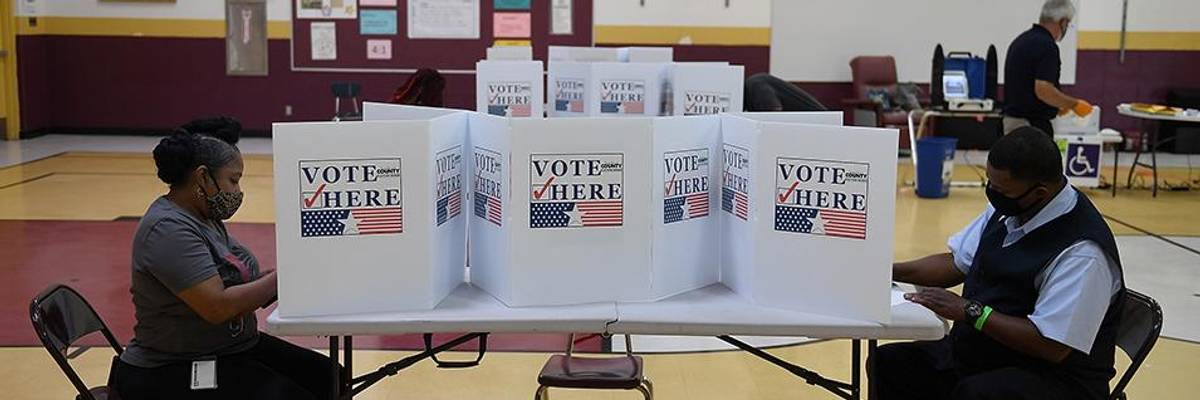
Voters cast their ballots at Keevan Elementary School August 4, 2020 in North St. Louis, Missouri. (Photo: Michael B. Thomas/Getty Images)
An estimated 230,000 low-income residents of Missouri will soon be eligible for Medicaid after 53% of the state's voters passed a ballot measure expanding the program in Tuesday's election. The popular approval comes after nearly ten years of obstruction by Republican lawmakers in the state forbid expansion of the program made possible by the 2010 Affordable Care Act.
"It's a huge day for Missouri," Traci Gleason, vice president with the advocacy group Missouri Budget Project, told KCUR. "It's something we have long needed in order to strengthen our state. This is something that will improve the health of our communities."
Per the initiative language, Medicaid expansion in the state is slated to take effect in July of 2021. According to the Fairness Project, similar citizen-led expansion efforts around the country have opened up eligibility for 830,000 low-income people.
The Missouri vote comes in the midst of the ongoing Covid-19 pandemic, which has caused unemployment to spike, and tens of millions of Americans to lose their employer-sponsored insurance due to job loss.
Missouri became 39th state to expand Medicaid under the ACA, and the sixth state to expand Medicaid via ballot initiative. Successful efforts in Maine, Idaho, Nebraska, Utah and Oklahoma--where GOP-led state legislatures and/or GOP governors refused to enact expansion on their own--have helped close the coverage gap that emerged when ACA was enacted.
"Voters are rejecting the idea that health care has to be a partisan issue and they are hungry for change," Jonathan Schleifer, executive director of The Fairness Project, which assisted the initiative efforts in Missouri and other states, said in a statement. "We won't stop fighting until Americans in every state are afforded the same access to affordable health care, regardless of their zip code and income level."
Citizen-led efforts to expand Medicaid have been met with GOP opposition, and some Republican state legislatures and conservative advocacy groups have resisted implementation even after voter approval.
Still, advocates are celebrating the Missouri initiative's victory.
"Amendment 2 won today," Caitlyn Adams, executive director for Missouri Jobs with Justice Voter Action told the Kansas City Star Tuesday, "because no matter what we look like, where we live, or how much money we make, most of us want the same things--the ability to keep our families safe and well. Expanding Medicaid is a big step toward this goal."
Dear Common Dreams reader, It’s been nearly 30 years since I co-founded Common Dreams with my late wife, Lina Newhouser. We had the radical notion that journalism should serve the public good, not corporate profits. It was clear to us from the outset what it would take to build such a project. No paid advertisements. No corporate sponsors. No millionaire publisher telling us what to think or do. Many people said we wouldn't last a year, but we proved those doubters wrong. Together with a tremendous team of journalists and dedicated staff, we built an independent media outlet free from the constraints of profits and corporate control. Our mission has always been simple: To inform. To inspire. To ignite change for the common good. Building Common Dreams was not easy. Our survival was never guaranteed. When you take on the most powerful forces—Wall Street greed, fossil fuel industry destruction, Big Tech lobbyists, and uber-rich oligarchs who have spent billions upon billions rigging the economy and democracy in their favor—the only bulwark you have is supporters who believe in your work. But here’s the urgent message from me today. It's never been this bad out there. And it's never been this hard to keep us going. At the very moment Common Dreams is most needed, the threats we face are intensifying. We need your support now more than ever. We don't accept corporate advertising and never will. We don't have a paywall because we don't think people should be blocked from critical news based on their ability to pay. Everything we do is funded by the donations of readers like you. When everyone does the little they can afford, we are strong. But if that support retreats or dries up, so do we. Will you donate now to make sure Common Dreams not only survives but thrives? —Craig Brown, Co-founder |
An estimated 230,000 low-income residents of Missouri will soon be eligible for Medicaid after 53% of the state's voters passed a ballot measure expanding the program in Tuesday's election. The popular approval comes after nearly ten years of obstruction by Republican lawmakers in the state forbid expansion of the program made possible by the 2010 Affordable Care Act.
"It's a huge day for Missouri," Traci Gleason, vice president with the advocacy group Missouri Budget Project, told KCUR. "It's something we have long needed in order to strengthen our state. This is something that will improve the health of our communities."
Per the initiative language, Medicaid expansion in the state is slated to take effect in July of 2021. According to the Fairness Project, similar citizen-led expansion efforts around the country have opened up eligibility for 830,000 low-income people.
The Missouri vote comes in the midst of the ongoing Covid-19 pandemic, which has caused unemployment to spike, and tens of millions of Americans to lose their employer-sponsored insurance due to job loss.
Missouri became 39th state to expand Medicaid under the ACA, and the sixth state to expand Medicaid via ballot initiative. Successful efforts in Maine, Idaho, Nebraska, Utah and Oklahoma--where GOP-led state legislatures and/or GOP governors refused to enact expansion on their own--have helped close the coverage gap that emerged when ACA was enacted.
"Voters are rejecting the idea that health care has to be a partisan issue and they are hungry for change," Jonathan Schleifer, executive director of The Fairness Project, which assisted the initiative efforts in Missouri and other states, said in a statement. "We won't stop fighting until Americans in every state are afforded the same access to affordable health care, regardless of their zip code and income level."
Citizen-led efforts to expand Medicaid have been met with GOP opposition, and some Republican state legislatures and conservative advocacy groups have resisted implementation even after voter approval.
Still, advocates are celebrating the Missouri initiative's victory.
"Amendment 2 won today," Caitlyn Adams, executive director for Missouri Jobs with Justice Voter Action told the Kansas City Star Tuesday, "because no matter what we look like, where we live, or how much money we make, most of us want the same things--the ability to keep our families safe and well. Expanding Medicaid is a big step toward this goal."
An estimated 230,000 low-income residents of Missouri will soon be eligible for Medicaid after 53% of the state's voters passed a ballot measure expanding the program in Tuesday's election. The popular approval comes after nearly ten years of obstruction by Republican lawmakers in the state forbid expansion of the program made possible by the 2010 Affordable Care Act.
"It's a huge day for Missouri," Traci Gleason, vice president with the advocacy group Missouri Budget Project, told KCUR. "It's something we have long needed in order to strengthen our state. This is something that will improve the health of our communities."
Per the initiative language, Medicaid expansion in the state is slated to take effect in July of 2021. According to the Fairness Project, similar citizen-led expansion efforts around the country have opened up eligibility for 830,000 low-income people.
The Missouri vote comes in the midst of the ongoing Covid-19 pandemic, which has caused unemployment to spike, and tens of millions of Americans to lose their employer-sponsored insurance due to job loss.
Missouri became 39th state to expand Medicaid under the ACA, and the sixth state to expand Medicaid via ballot initiative. Successful efforts in Maine, Idaho, Nebraska, Utah and Oklahoma--where GOP-led state legislatures and/or GOP governors refused to enact expansion on their own--have helped close the coverage gap that emerged when ACA was enacted.
"Voters are rejecting the idea that health care has to be a partisan issue and they are hungry for change," Jonathan Schleifer, executive director of The Fairness Project, which assisted the initiative efforts in Missouri and other states, said in a statement. "We won't stop fighting until Americans in every state are afforded the same access to affordable health care, regardless of their zip code and income level."
Citizen-led efforts to expand Medicaid have been met with GOP opposition, and some Republican state legislatures and conservative advocacy groups have resisted implementation even after voter approval.
Still, advocates are celebrating the Missouri initiative's victory.
"Amendment 2 won today," Caitlyn Adams, executive director for Missouri Jobs with Justice Voter Action told the Kansas City Star Tuesday, "because no matter what we look like, where we live, or how much money we make, most of us want the same things--the ability to keep our families safe and well. Expanding Medicaid is a big step toward this goal."