SUBSCRIBE TO OUR FREE NEWSLETTER
Daily news & progressive opinion—funded by the people, not the corporations—delivered straight to your inbox.
5
#000000
#FFFFFF
To donate by check, phone, or other method, see our More Ways to Give page.
Daily news & progressive opinion—funded by the people, not the corporations—delivered straight to your inbox.
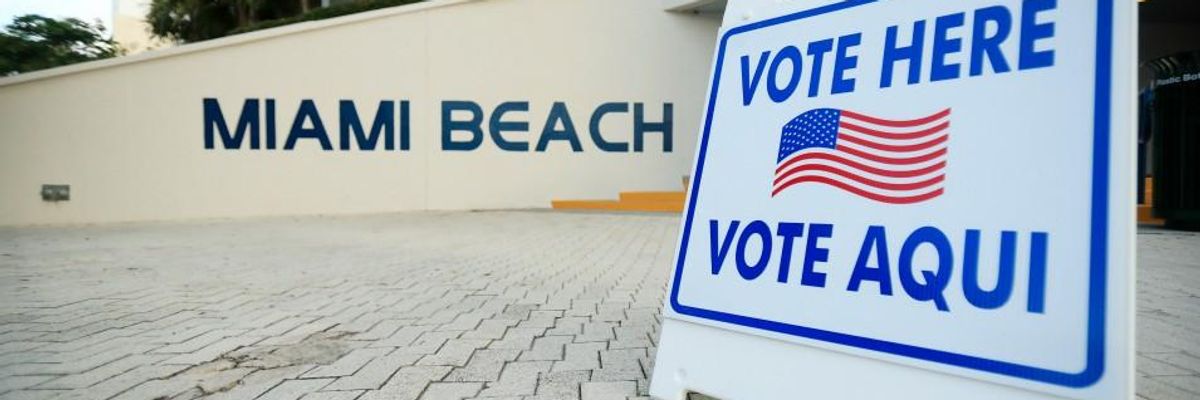
A sign directed voters to a polling location during the Florida presidential primary on March 17, 2020 at Miami Beach City Hall in Miami Beach, Florida. (Photo: Cliff Hawkins/Getty Images)
The voting rights of hundreds of thousands of former felons in Florida were called into question Thursday after the U.S. Supreme Court allowed a lower court ruling to stand, permitting the state to bar former inmates from voting if they owe court fees or fines.
The decision relates to Amendment 4, a law that overwhelmingly passed in November 2018 via a referendum. Sixty-five percent of Florida voters approved of the amendment, which said former felons can vote in the state after they have completed "all terms of [their] sentence."
"Florida's voters spoke loud and clear when nearly two-thirds of them supported rights restoration at the ballot box in 2018. The Supreme Court stood by as the Eleventh Circuit prevented hundreds of thousands of otherwise eligible voters from participating in Florida's primary election simply because they can't afford to pay fines and fees."
--Paul Smith, Campaign Legal Center
After Republican Gov. Ron DeSantis entered office in 2019, however, he and state GOP lawmakers passed a bill retroactively stating that sentence terms apply to the payment of all fees, in addition to the completion of probation and prison time.
The U.S. Court of Appeals for the 11th Circuit recently halted a judge's order that would have allowed ex-felons to register to vote regardless of outstanding fees, and the Supreme Court declined to overturn that decision.
Justices Sonia Sotomayor, Elena Kagan, and Ruth Bader Ginsburg dissented, with Sotomayor denouncing the unsigned majority opinion.
"This Court's inaction continues a trend of condoning [disenfranchisement]," the judge wrote.
Calling the law a "pay-to-vote scheme," the Campaign Legal Center (CLC), which joined the ACLU and other voting rights groups earlier this month in asking the Supreme Court to rule on the case, called the decision "deeply disappointing."
"Florida's voters spoke loud and clear when nearly two-thirds of them supported rights restoration at the ballot box in 2018," said Paul Smith, vice president of the CLC. "The Supreme Court stood by as the Eleventh Circuit prevented hundreds of thousands of otherwise eligible voters from participating in Florida's primary election simply because they can't afford to pay fines and fees. We look forward to continuing to fight for Florida voters so they can participate in the General Election in November."
The Fines and Fees Justice Center told CNN that fees owed by recently-released former felons are frequently insurmountable, especially as many struggle to find well-paying employment.
The fines and fees "can range from a couple hundred to tens of thousands of dollars," CNN reported. "And in Florida, all the court charges that are unpaid after 90 days are referred to private debt collectors, who are allowed to add up to a 40% surcharge on the unpaid court debt."
On social media, advocates for voting rights condemned the high court's decision, which comes just days before Florida's Monday voter registration deadline ahead of the primary election in August.
"This ruling means if you're a poor person with a felony conviction you're disenfranchised," tweeted Joyce Vance, a U.S. Attorney under the Obama administration. "If you can afford to pay fines you can vote. Setting aside that there's no reason to keep people who've served their sentence from voting forever, this is a poll tax."
This country and this world are at a monumental crossroads. US voters have an opportunity to beat back the forces of fascism and confront the billionaires who are rigging the economy, our media system, and our democracy, making it increasingly impossible for ordinary people to get by. We’re not just talking about the election. We’re talking about what must be done once these fascist elements are vanquished from power. We need a bolder set of solutions than what either major party has so far been willing to offer and a working-class movement ready to fight like hell for it. Trump didn't emerge from nowhere. The conditions that fueled MAGA authoritarianism were created by decades of radical neoliberal economic policies and a corrupt political system dominated by corporate interests. They slashed taxes on the super-rich, promising that the benefits would trickle down. They said giveaways to the corporate titans would make life more affordable for the rest of us. It was all bullshit. And when a bitter, betrayed populace searches for someone to blame, right-wing demagogues have little trouble finding scapegoats. People know when they're being lied to, but you won't hear any of this from the corporate media. Only independent journalism—powered and funded by people who believe in building a better world—can deliver truly trustworthy daily news. If you share our vision, please contribute whatever you can to sustain our work. |
The voting rights of hundreds of thousands of former felons in Florida were called into question Thursday after the U.S. Supreme Court allowed a lower court ruling to stand, permitting the state to bar former inmates from voting if they owe court fees or fines.
The decision relates to Amendment 4, a law that overwhelmingly passed in November 2018 via a referendum. Sixty-five percent of Florida voters approved of the amendment, which said former felons can vote in the state after they have completed "all terms of [their] sentence."
"Florida's voters spoke loud and clear when nearly two-thirds of them supported rights restoration at the ballot box in 2018. The Supreme Court stood by as the Eleventh Circuit prevented hundreds of thousands of otherwise eligible voters from participating in Florida's primary election simply because they can't afford to pay fines and fees."
--Paul Smith, Campaign Legal Center
After Republican Gov. Ron DeSantis entered office in 2019, however, he and state GOP lawmakers passed a bill retroactively stating that sentence terms apply to the payment of all fees, in addition to the completion of probation and prison time.
The U.S. Court of Appeals for the 11th Circuit recently halted a judge's order that would have allowed ex-felons to register to vote regardless of outstanding fees, and the Supreme Court declined to overturn that decision.
Justices Sonia Sotomayor, Elena Kagan, and Ruth Bader Ginsburg dissented, with Sotomayor denouncing the unsigned majority opinion.
"This Court's inaction continues a trend of condoning [disenfranchisement]," the judge wrote.
Calling the law a "pay-to-vote scheme," the Campaign Legal Center (CLC), which joined the ACLU and other voting rights groups earlier this month in asking the Supreme Court to rule on the case, called the decision "deeply disappointing."
"Florida's voters spoke loud and clear when nearly two-thirds of them supported rights restoration at the ballot box in 2018," said Paul Smith, vice president of the CLC. "The Supreme Court stood by as the Eleventh Circuit prevented hundreds of thousands of otherwise eligible voters from participating in Florida's primary election simply because they can't afford to pay fines and fees. We look forward to continuing to fight for Florida voters so they can participate in the General Election in November."
The Fines and Fees Justice Center told CNN that fees owed by recently-released former felons are frequently insurmountable, especially as many struggle to find well-paying employment.
The fines and fees "can range from a couple hundred to tens of thousands of dollars," CNN reported. "And in Florida, all the court charges that are unpaid after 90 days are referred to private debt collectors, who are allowed to add up to a 40% surcharge on the unpaid court debt."
On social media, advocates for voting rights condemned the high court's decision, which comes just days before Florida's Monday voter registration deadline ahead of the primary election in August.
"This ruling means if you're a poor person with a felony conviction you're disenfranchised," tweeted Joyce Vance, a U.S. Attorney under the Obama administration. "If you can afford to pay fines you can vote. Setting aside that there's no reason to keep people who've served their sentence from voting forever, this is a poll tax."