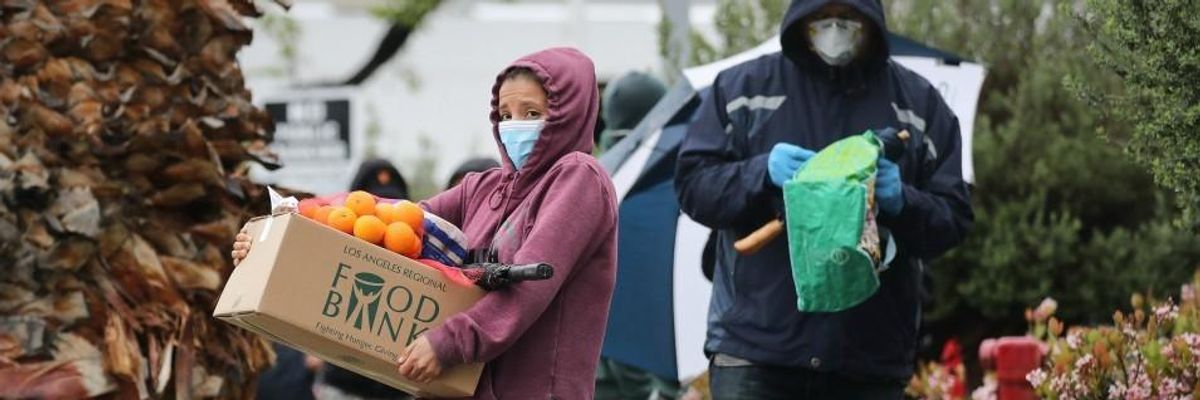
A recipient carries a box of food as others wait in line at a Food Bank distribution for those in need as the coronavirus pandemic continues on April 9, 2020 in Van Nuys, California. (Photo: Mario Tama/Getty Images)
'Poverty Is a Policy Choice': Studies Detail How Poorest Saved by Covid-19 Stimulus--and Why More Is Needed
"When you look at the size of the government response, it makes sense."
Two separate studies released Sunday show that U.S. government economic stimulus efforts aimed at offsetting the financial pain of the coronavirus pandemic lockdowns helped alleviate poverty in the country, sparking calls for further federal rescue programs to continue the relief.
"Poverty is a policy choice," tweeted progressive advocacy group People for Bernie.
The studies--one from Columbia University researchers and the other from the University of Chicago and the University of Notre Dame--both specifically citing the one time $1,200 payments sent out to most Americans and the federally provided $600 weekly bonus to unemployment benefits for those out of work due to the pandemic.
While the two groups used different methodologies and had slightly different findings--the Columbia study found that poverty rose, but only slightly, while the Chicago group saw a reduction in poverty--the overall result that federal stimulus led to better outcomes for the country's poor was not in question.
As the New York Times reported:
The Columbia group's midrange forecast has poverty rising only slightly this year to 12.7%, from 12.5% before the coronavirus. Without the Coronavirus Aid, Relief and Economic Security Act--the March law that provided one-time checks to most Americans and weekly bonuses to the unemployed--it would have reached 16.3%, the researchers found. That would have pushed nearly 12 million more people into poverty.
"Right now, the safety net is doing what it's supposed to do for most families--helping them secure a minimally decent life," Columbia's Zachary Parolin told the Times. "Given the magnitude of the employment loss, this is really remarkable."
Meanwhile, the Times reported, University of Chicago and Notre Dame researchers "estimate that poverty in April and May fell to 8.6 percent for the previous 12 months, from 10.9 percent in January and February."
Notre Dame economics professor and study co-author James Sullivan said in an interview with the Times that the huge economic shock of the pandemic led researchers to expect a spike in poverty, not a reduction.
"When we initially saw our results, we thought, 'How could this be true?'" said Sullivan. "But when you look at the size of the government response, it makes sense."
With payments and bonuses set to expire at the end of July, Atlantic staff writer Annie Lowrey on Twitter opined that the results of the stimulus make a compelling argument for more aggressive and continued government programs to reduce poverty across the nation.
"If we can prevent recessions from increasing poverty by just giving people money, maybe we could end, say, deep poverty among kids by just... giving people money," Lowrey tweeted.
"Maybe just all poverty," she added. "Even during recessions."
We are at a crossroads
This country and this world are at a monumental crossroads. US voters have an opportunity to beat back the forces of fascism and confront the billionaires who are rigging the economy, our media system, and our democracy, making it increasingly impossible for ordinary people to get by. We’re not just talking about the election. We’re talking about what must be done once these fascist elements are vanquished from power. We need a bolder set of solutions than what either major party has so far been willing to offer and a working-class movement ready to fight like hell for it. Trump didn't emerge from nowhere. The conditions that fueled MAGA authoritarianism were created by decades of radical neoliberal economic policies and a corrupt political system dominated by corporate interests. They slashed taxes on the super-rich, promising that the benefits would trickle down. They said giveaways to the corporate titans would make life more affordable for the rest of us. It was all bullshit. And when a bitter, betrayed populace searches for someone to blame, right-wing demagogues have little trouble finding scapegoats. People know when they're being lied to, but you won't hear any of this from the corporate media. Only independent journalism—powered and funded by people who believe in building a better world—can deliver truly trustworthy daily news. Our Fall Campaign is underway, and we need your help. To power our newsroom through the rest of the year, we need to raise $125,000 by midnight on October 31. So if you share our vision, please contribute whatever you can to sustain our work. |
Two separate studies released Sunday show that U.S. government economic stimulus efforts aimed at offsetting the financial pain of the coronavirus pandemic lockdowns helped alleviate poverty in the country, sparking calls for further federal rescue programs to continue the relief.
"Poverty is a policy choice," tweeted progressive advocacy group People for Bernie.
The studies--one from Columbia University researchers and the other from the University of Chicago and the University of Notre Dame--both specifically citing the one time $1,200 payments sent out to most Americans and the federally provided $600 weekly bonus to unemployment benefits for those out of work due to the pandemic.
While the two groups used different methodologies and had slightly different findings--the Columbia study found that poverty rose, but only slightly, while the Chicago group saw a reduction in poverty--the overall result that federal stimulus led to better outcomes for the country's poor was not in question.
As the New York Times reported:
The Columbia group's midrange forecast has poverty rising only slightly this year to 12.7%, from 12.5% before the coronavirus. Without the Coronavirus Aid, Relief and Economic Security Act--the March law that provided one-time checks to most Americans and weekly bonuses to the unemployed--it would have reached 16.3%, the researchers found. That would have pushed nearly 12 million more people into poverty.
"Right now, the safety net is doing what it's supposed to do for most families--helping them secure a minimally decent life," Columbia's Zachary Parolin told the Times. "Given the magnitude of the employment loss, this is really remarkable."
Meanwhile, the Times reported, University of Chicago and Notre Dame researchers "estimate that poverty in April and May fell to 8.6 percent for the previous 12 months, from 10.9 percent in January and February."
Notre Dame economics professor and study co-author James Sullivan said in an interview with the Times that the huge economic shock of the pandemic led researchers to expect a spike in poverty, not a reduction.
"When we initially saw our results, we thought, 'How could this be true?'" said Sullivan. "But when you look at the size of the government response, it makes sense."
With payments and bonuses set to expire at the end of July, Atlantic staff writer Annie Lowrey on Twitter opined that the results of the stimulus make a compelling argument for more aggressive and continued government programs to reduce poverty across the nation.
"If we can prevent recessions from increasing poverty by just giving people money, maybe we could end, say, deep poverty among kids by just... giving people money," Lowrey tweeted.
"Maybe just all poverty," she added. "Even during recessions."