

SUBSCRIBE TO OUR FREE NEWSLETTER
Daily news & progressive opinion—funded by the people, not the corporations—delivered straight to your inbox.
5
#000000
#FFFFFF
To donate by check, phone, or other method, see our More Ways to Give page.
Daily news & progressive opinion—funded by the people, not the corporations—delivered straight to your inbox.
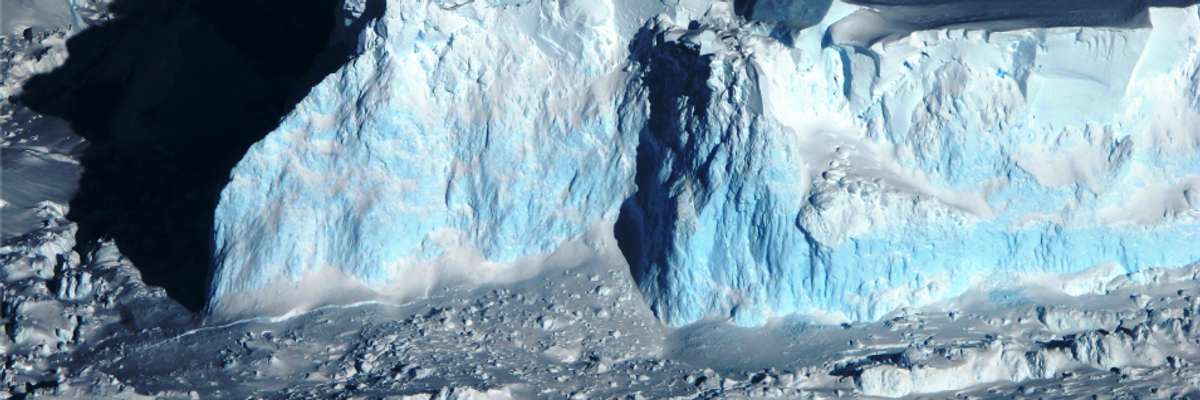
The melt rate of West Antarctica's Thwaites Glacier is an important concern for climate scientists, because this glacier alone is currently responsible for about 1% of global sea level rise. (Photo: Stuart Rankin/Flickr/cc)
A study by British and American scientists revealed that a massive sheet of ice known as the "doomsday glacier" is melting faster than experts previously believed--edging the world closer to a possible sea level rise of more than 10 feet.
Researchers at New York University and the British Antarctic Survey drilled through nearly 2,000 feet of ice in the Thwaites glacier in West Antarctica, to measure temperatures at the 75-mile wide ice sheet's "grounding line," where the ice meets the ocean.
The water just beneath the ice was found to be 32o Fahrenheit--more than 2o above freezing temperature in the Antarctic region.
The findings have "huge implications for global sea level rise," NYU scientist David Holland said in a statement.
350.org co-founder and author Bill McKibben was among the climate action campaigners who expressed alarm over the new study.
"Oh, damn," McKibben wrote on social media.
The researchers expressed concern that the water beneath the glacier could be even warmer in other areas.
Scientists refer to Thwaites as the "doomsday glacier" due to the dire implications its rapid melting could have for the planet. Though a 10-foot sea level rise would likely take years, the melting of the glacier could eventually mean the U.S. would lose 28,800 square miles of coastal land--pushing 12.3 million people currently living in those areas out of their homes.
"Warm waters in this part of the world, as remote as they may seem, should serve as a warning to all of us about the potential dire changes to the planet brought about by climate change," Holland said.
The Thwaites glacier has lost 600 billion tons of ice over the past several decades, accelerating to as many as 50 billion tons per year in recent years.
"There is very warm water there, and clearly, it could not have been there forever, or the glacier could not be there," Holland told the Washington Post of the recent findings, suggesting the water has gotten warmer recently.
Scientists are especially concerned about the Thwaites because its configuration is an example of "marine ice sheet instability."
As Chris Mooney wrote at the Post:
Thwaites gets deeper and thicker from its oceanfront region back into its interior in the heart of West Antarctica. This is known to be an unstable configuration for a glacier, because as the ocean continues to eat away at its base, the glacier becomes thicker, so more ice is exposed to the ocean. In turn, that ice flows outward faster.
BBC released a short video detailing the scientists' journey to the Thwaites glacier and their findings.
"The ice rises almost a mile from the sea bed and it's collapsing into the sea at two miles a year," the narration explains. "If Thwaites melts, it will increase sea levels worldwide by half a meter. But it sits in the middle of the Antarctic ice sheet and there's three meters more of sea level rise locked up in there."
Dear Common Dreams reader, It’s been nearly 30 years since I co-founded Common Dreams with my late wife, Lina Newhouser. We had the radical notion that journalism should serve the public good, not corporate profits. It was clear to us from the outset what it would take to build such a project. No paid advertisements. No corporate sponsors. No millionaire publisher telling us what to think or do. Many people said we wouldn't last a year, but we proved those doubters wrong. Together with a tremendous team of journalists and dedicated staff, we built an independent media outlet free from the constraints of profits and corporate control. Our mission has always been simple: To inform. To inspire. To ignite change for the common good. Building Common Dreams was not easy. Our survival was never guaranteed. When you take on the most powerful forces—Wall Street greed, fossil fuel industry destruction, Big Tech lobbyists, and uber-rich oligarchs who have spent billions upon billions rigging the economy and democracy in their favor—the only bulwark you have is supporters who believe in your work. But here’s the urgent message from me today. It's never been this bad out there. And it's never been this hard to keep us going. At the very moment Common Dreams is most needed, the threats we face are intensifying. We need your support now more than ever. We don't accept corporate advertising and never will. We don't have a paywall because we don't think people should be blocked from critical news based on their ability to pay. Everything we do is funded by the donations of readers like you. When everyone does the little they can afford, we are strong. But if that support retreats or dries up, so do we. Will you donate now to make sure Common Dreams not only survives but thrives? —Craig Brown, Co-founder |
A study by British and American scientists revealed that a massive sheet of ice known as the "doomsday glacier" is melting faster than experts previously believed--edging the world closer to a possible sea level rise of more than 10 feet.
Researchers at New York University and the British Antarctic Survey drilled through nearly 2,000 feet of ice in the Thwaites glacier in West Antarctica, to measure temperatures at the 75-mile wide ice sheet's "grounding line," where the ice meets the ocean.
The water just beneath the ice was found to be 32o Fahrenheit--more than 2o above freezing temperature in the Antarctic region.
The findings have "huge implications for global sea level rise," NYU scientist David Holland said in a statement.
350.org co-founder and author Bill McKibben was among the climate action campaigners who expressed alarm over the new study.
"Oh, damn," McKibben wrote on social media.
The researchers expressed concern that the water beneath the glacier could be even warmer in other areas.
Scientists refer to Thwaites as the "doomsday glacier" due to the dire implications its rapid melting could have for the planet. Though a 10-foot sea level rise would likely take years, the melting of the glacier could eventually mean the U.S. would lose 28,800 square miles of coastal land--pushing 12.3 million people currently living in those areas out of their homes.
"Warm waters in this part of the world, as remote as they may seem, should serve as a warning to all of us about the potential dire changes to the planet brought about by climate change," Holland said.
The Thwaites glacier has lost 600 billion tons of ice over the past several decades, accelerating to as many as 50 billion tons per year in recent years.
"There is very warm water there, and clearly, it could not have been there forever, or the glacier could not be there," Holland told the Washington Post of the recent findings, suggesting the water has gotten warmer recently.
Scientists are especially concerned about the Thwaites because its configuration is an example of "marine ice sheet instability."
As Chris Mooney wrote at the Post:
Thwaites gets deeper and thicker from its oceanfront region back into its interior in the heart of West Antarctica. This is known to be an unstable configuration for a glacier, because as the ocean continues to eat away at its base, the glacier becomes thicker, so more ice is exposed to the ocean. In turn, that ice flows outward faster.
BBC released a short video detailing the scientists' journey to the Thwaites glacier and their findings.
"The ice rises almost a mile from the sea bed and it's collapsing into the sea at two miles a year," the narration explains. "If Thwaites melts, it will increase sea levels worldwide by half a meter. But it sits in the middle of the Antarctic ice sheet and there's three meters more of sea level rise locked up in there."
A study by British and American scientists revealed that a massive sheet of ice known as the "doomsday glacier" is melting faster than experts previously believed--edging the world closer to a possible sea level rise of more than 10 feet.
Researchers at New York University and the British Antarctic Survey drilled through nearly 2,000 feet of ice in the Thwaites glacier in West Antarctica, to measure temperatures at the 75-mile wide ice sheet's "grounding line," where the ice meets the ocean.
The water just beneath the ice was found to be 32o Fahrenheit--more than 2o above freezing temperature in the Antarctic region.
The findings have "huge implications for global sea level rise," NYU scientist David Holland said in a statement.
350.org co-founder and author Bill McKibben was among the climate action campaigners who expressed alarm over the new study.
"Oh, damn," McKibben wrote on social media.
The researchers expressed concern that the water beneath the glacier could be even warmer in other areas.
Scientists refer to Thwaites as the "doomsday glacier" due to the dire implications its rapid melting could have for the planet. Though a 10-foot sea level rise would likely take years, the melting of the glacier could eventually mean the U.S. would lose 28,800 square miles of coastal land--pushing 12.3 million people currently living in those areas out of their homes.
"Warm waters in this part of the world, as remote as they may seem, should serve as a warning to all of us about the potential dire changes to the planet brought about by climate change," Holland said.
The Thwaites glacier has lost 600 billion tons of ice over the past several decades, accelerating to as many as 50 billion tons per year in recent years.
"There is very warm water there, and clearly, it could not have been there forever, or the glacier could not be there," Holland told the Washington Post of the recent findings, suggesting the water has gotten warmer recently.
Scientists are especially concerned about the Thwaites because its configuration is an example of "marine ice sheet instability."
As Chris Mooney wrote at the Post:
Thwaites gets deeper and thicker from its oceanfront region back into its interior in the heart of West Antarctica. This is known to be an unstable configuration for a glacier, because as the ocean continues to eat away at its base, the glacier becomes thicker, so more ice is exposed to the ocean. In turn, that ice flows outward faster.
BBC released a short video detailing the scientists' journey to the Thwaites glacier and their findings.
"The ice rises almost a mile from the sea bed and it's collapsing into the sea at two miles a year," the narration explains. "If Thwaites melts, it will increase sea levels worldwide by half a meter. But it sits in the middle of the Antarctic ice sheet and there's three meters more of sea level rise locked up in there."

