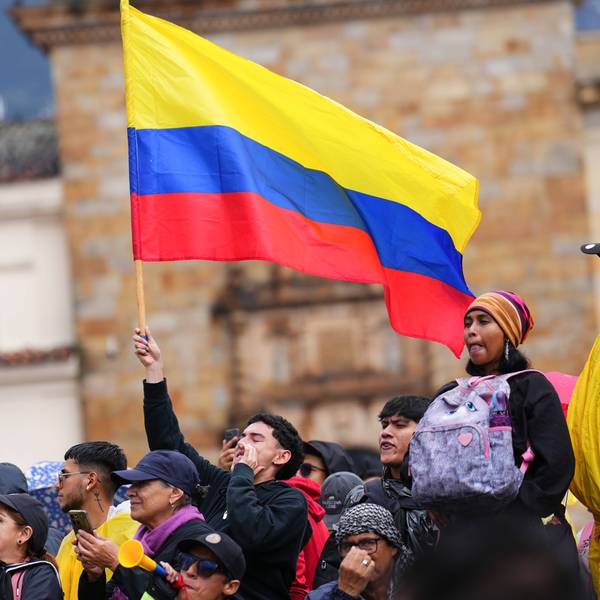
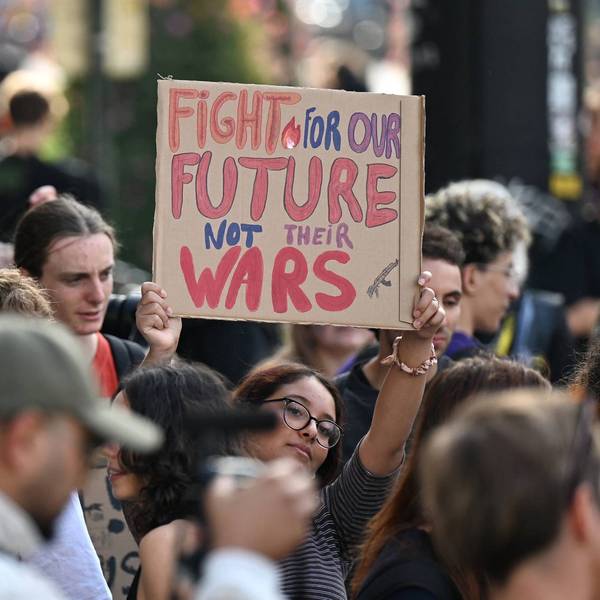
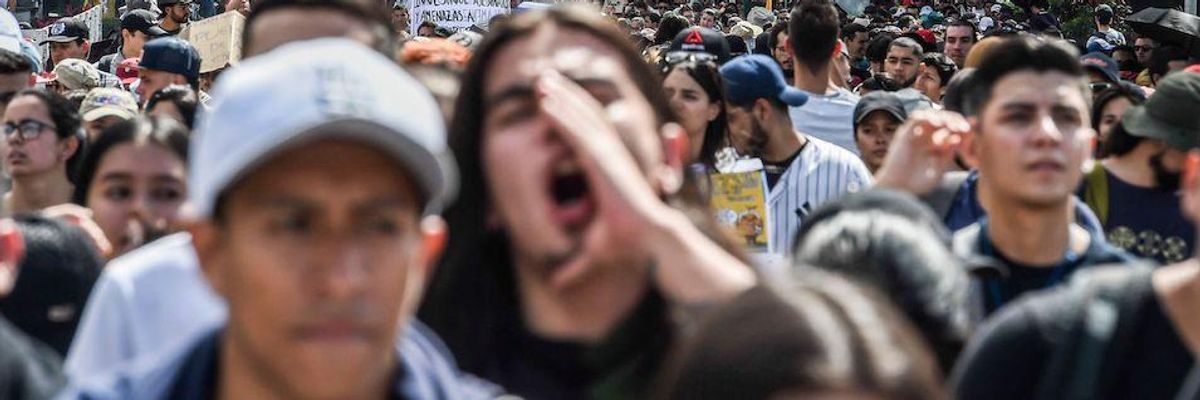
People march during a nationwide strike called by students, unions and indigenous groups to protest against the government of Colombia's President Ivan Duque in Medellin, Colombia, on November 21, 2019. (Photo: Joaquin Sarmiento/AFP/Getty Images)
'We Cannot Continue to Live Like This': Mass Protests in Colombia Latest in Latin American Uprisings
"What happened in Chile sent a forceful message."
An estimated over 207,000 protesters across Colombia upset at decades of right-wing rule took to the streets Thursday in the latest progressive people's movement in Latin America to explode into the streets, following movements in Chile, post-coup Bolivia, and Ecuador.
Demonstrators clashed with security forces in the capital, Bogota, and elsewhere across the country.
"We are standing up to protest and tell all humanity that we need to demand change," protester and actress Aida Prado told The Associated Press.
The demonstrations, which had been planned, began with a general strike against the policies of President Ivan Duque. Protesters, many carrying the Indigenous wiphala flag in solidarity with the people of Bolivia, expressed their anger over Duque's plan to cut pensions in the country and the lack of real forward movement in peace talks with the rebel group Revolutionary Armed Forces of Colombia, or FARC.
"We live in a country that kills children, that kills social leaders, with a government that is against peace," businesswoman Alexandra Guzman said. "That is why we have to change something. We cannot continue to live like this."
According to The Guardian, the protests led to clashes with police forces:
In the capital, Bogota, police helicopters whirred overhead, while riot police fired teargas at protesters who had blocked bus routes before dawn. Despite torrential rain, thousands of people thronged the city's historic Plaza de Simon Bolivar, singing the national anthem.
The marches began in Bogota largely without incident, although a few clashes broke out near Bogota airport between protesters and riot police around midday. As the rain cleared, more confrontations broke out across the city in the early evening. Explosions could be heard across the city. Teargas was fired in the Plaza de Simon Bolivar and at the campus of the National University, where protesters battled with security forces.
The economic and social pressures on Colombian society that led to the demonstrations likely won't lead to the kind of sustained movement that's been seen in other parts of Latin America, Bogota Rosario University professor Yann Basset told DW.
"We're not in a pre-insurrectional climate," said Basset. "I'm not sure there's a general rejection of the political system."
Bolivian demonstrators opposed to the right-wing regime that seized power in the country after a coup on November 10 that resulted in the forced resignation of democratically elected President Evo Morales have protested in cities and across the central South American nation for weeks. A Chilean protest movement that began in October has resulted in the country's neoliberal leadership promising to rewrite the constitution; also in October, protests against austerity erupted across Ecuador.
Student leader Jose Cardenas told AP that the marches in Colombia were inspired by the other movements on the continent.
"What happened in Chile sent a forceful message," he said.
We are at a crossroads
This country and this world are at a monumental crossroads. US voters have an opportunity to beat back the forces of fascism and confront the billionaires who are rigging the economy, our media system, and our democracy, making it increasingly impossible for ordinary people to get by. We’re not just talking about the election. We’re talking about what must be done once these fascist elements are vanquished from power. We need a bolder set of solutions than what either major party has so far been willing to offer and a working-class movement ready to fight like hell for it. Trump didn't emerge from nowhere. The conditions that fueled MAGA authoritarianism were created by decades of radical neoliberal economic policies and a corrupt political system dominated by corporate interests. They slashed taxes on the super-rich, promising that the benefits would trickle down. They said giveaways to the corporate titans would make life more affordable for the rest of us. It was all bullshit. And when a bitter, betrayed populace searches for someone to blame, right-wing demagogues have little trouble finding scapegoats. People know when they're being lied to, but you won't hear any of this from the corporate media. Only independent journalism—powered and funded by people who believe in building a better world—can deliver truly trustworthy daily news. Our Fall Campaign is underway, and we need your help. To power our newsroom through the rest of the year, we need to raise $125,000 by midnight on October 31. So if you share our vision, please contribute whatever you can to sustain our work. |
An estimated over 207,000 protesters across Colombia upset at decades of right-wing rule took to the streets Thursday in the latest progressive people's movement in Latin America to explode into the streets, following movements in Chile, post-coup Bolivia, and Ecuador.
Demonstrators clashed with security forces in the capital, Bogota, and elsewhere across the country.
"We are standing up to protest and tell all humanity that we need to demand change," protester and actress Aida Prado told The Associated Press.
The demonstrations, which had been planned, began with a general strike against the policies of President Ivan Duque. Protesters, many carrying the Indigenous wiphala flag in solidarity with the people of Bolivia, expressed their anger over Duque's plan to cut pensions in the country and the lack of real forward movement in peace talks with the rebel group Revolutionary Armed Forces of Colombia, or FARC.
"We live in a country that kills children, that kills social leaders, with a government that is against peace," businesswoman Alexandra Guzman said. "That is why we have to change something. We cannot continue to live like this."
According to The Guardian, the protests led to clashes with police forces:
In the capital, Bogota, police helicopters whirred overhead, while riot police fired teargas at protesters who had blocked bus routes before dawn. Despite torrential rain, thousands of people thronged the city's historic Plaza de Simon Bolivar, singing the national anthem.
The marches began in Bogota largely without incident, although a few clashes broke out near Bogota airport between protesters and riot police around midday. As the rain cleared, more confrontations broke out across the city in the early evening. Explosions could be heard across the city. Teargas was fired in the Plaza de Simon Bolivar and at the campus of the National University, where protesters battled with security forces.
The economic and social pressures on Colombian society that led to the demonstrations likely won't lead to the kind of sustained movement that's been seen in other parts of Latin America, Bogota Rosario University professor Yann Basset told DW.
"We're not in a pre-insurrectional climate," said Basset. "I'm not sure there's a general rejection of the political system."
Bolivian demonstrators opposed to the right-wing regime that seized power in the country after a coup on November 10 that resulted in the forced resignation of democratically elected President Evo Morales have protested in cities and across the central South American nation for weeks. A Chilean protest movement that began in October has resulted in the country's neoliberal leadership promising to rewrite the constitution; also in October, protests against austerity erupted across Ecuador.
Student leader Jose Cardenas told AP that the marches in Colombia were inspired by the other movements on the continent.
"What happened in Chile sent a forceful message," he said.