

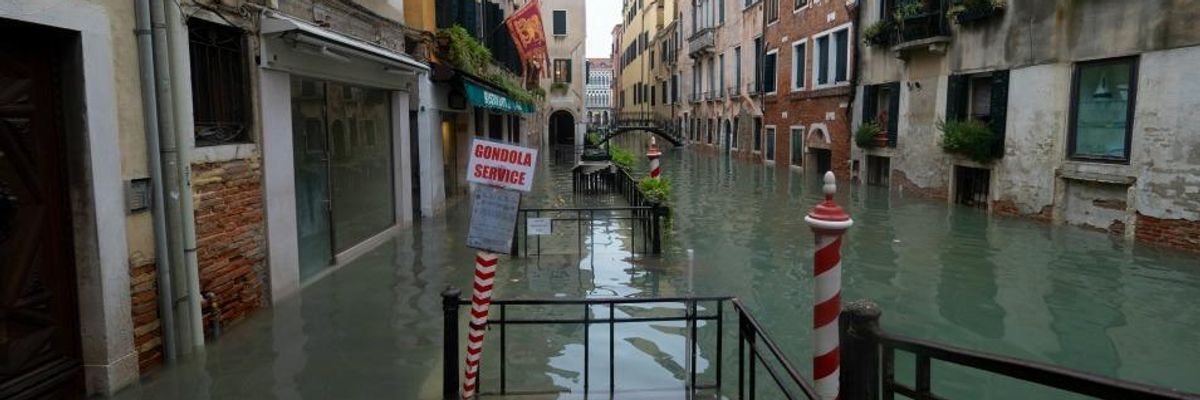
Venice suffered its worst flooding in 50 years on Tuesday. (Photo: Anna Henly/Barcroft Media via Getty Images)
Declaring State of Emergency, Venice Mayor Blames Climate Crisis for Historic Flooding
"This is not just 'bad weather,' this is a climate emergency."
After six feet of water inundated the city of Venice Tuesday, Mayor Luigi Brugnaro declared that the flooding should not be considered normal but rather the result of the climate crisis.
The highest water level in 50 years led Brugnaro to ask Italy's government for assistance and to declare a state of emergency in the city after at least two people were reported dead in the flooding.
"These are the effects of climate change," the mayor tweeted in Italian on Tuesday night.
This week's flooding marked the second-highest water level recorded in Venice since city officials began keeping flood records in 1923. In 1966, the city was overwhelmed by six feet, three inches of rain water flooding the streets.
The ancient cathedral St. Mark's Basilica flooded Tuesday for only the sixth time in 1,200 years, according to the BBC--but church officials said four of those times have been in the last two decades as fossil fuel emissions and sea levels have both gone up.
"I usually associate climate change with dramatic catastrophe like hurricanes and forest fires but this is silent and creeping," one local observer wrote. "Residents are adapting by scheduling meetings earlier or later, shops place wooden barriers to block water and there are ramps in low elevation spaces but it is clear that it is getting worse every winter."
Greenpeace cautioned against dismissing the flooding as the result of Venice's location in the Venetian Lagoon.
"From north to south, Italy has been impacted by a series of extreme climate events," Greenpeace Italy tweeted. "What's happening in Venice is a powerful example. This is not just 'bad weather,' this is a climate emergency."
Climate experts Katharine Hayhoe, Eric Holthaus, and Bill McKibben added that the climate crisis is worsening weather events' effects on the low-lying city.
Climate experts--including Katharine Hayhoe, Eric Holthaus, and Bill McKibben--noted that low-lying cities like Venice are becoming increasingly vulnerable to extreme weather and rising seas caused by rising global temperatures.
The Italian government announced earlier this month that school children would be required starting in 2020 to study the climate crisis as part of their curriculum, in an initiative pushed by Education Minister Lorenzo Fioramonti. But the government is still influenced by the far-right opposition party Lega, led by climate change denier Matteo Salvini, who remains the country's most popular politician.
"Now the government must listen," Brugnaro said.
We are at a crossroads
This country and this world are at a monumental crossroads. In a few short weeks, US voters will have an opportunity to beat back the forces of fascism and confront the billionaires who are rigging the economy, our media system, and our democracy, making it increasingly impossible for ordinary people to get by. We’re not just talking about the election. We’re talking about what must be done once these fascist elements are vanquished from power. We need a bolder set of solutions than what either major party has so far been willing to offer and a working-class movement ready to fight like hell for it. Trump didn't emerge from nowhere. The conditions that fueled MAGA authoritarianism were created by decades of radical neoliberal economic policies and a corrupt political system dominated by corporate interests. They slashed taxes on the super-rich, promising that the benefits would trickle down. They said giveaways to the corporate titans would make life more affordable for the rest of us. It was all bullshit. And when a bitter, betrayed populace searches for someone to blame, right-wing demagogues have little trouble finding scapegoats. People know when they're being lied to, but you won't hear any of this from the corporate media. Only independent journalism—powered and funded by people who believe in building a better world—can deliver truly trustworthy daily news. Our Fall Campaign is underway, and we need your help. To power our newsroom through the rest of the year, we need to raise $125,000 by midnight on October 31. So if you share our vision, please contribute whatever you can to sustain our work. |
After six feet of water inundated the city of Venice Tuesday, Mayor Luigi Brugnaro declared that the flooding should not be considered normal but rather the result of the climate crisis.
The highest water level in 50 years led Brugnaro to ask Italy's government for assistance and to declare a state of emergency in the city after at least two people were reported dead in the flooding.
"These are the effects of climate change," the mayor tweeted in Italian on Tuesday night.
This week's flooding marked the second-highest water level recorded in Venice since city officials began keeping flood records in 1923. In 1966, the city was overwhelmed by six feet, three inches of rain water flooding the streets.
The ancient cathedral St. Mark's Basilica flooded Tuesday for only the sixth time in 1,200 years, according to the BBC--but church officials said four of those times have been in the last two decades as fossil fuel emissions and sea levels have both gone up.
"I usually associate climate change with dramatic catastrophe like hurricanes and forest fires but this is silent and creeping," one local observer wrote. "Residents are adapting by scheduling meetings earlier or later, shops place wooden barriers to block water and there are ramps in low elevation spaces but it is clear that it is getting worse every winter."
Greenpeace cautioned against dismissing the flooding as the result of Venice's location in the Venetian Lagoon.
"From north to south, Italy has been impacted by a series of extreme climate events," Greenpeace Italy tweeted. "What's happening in Venice is a powerful example. This is not just 'bad weather,' this is a climate emergency."
Climate experts Katharine Hayhoe, Eric Holthaus, and Bill McKibben added that the climate crisis is worsening weather events' effects on the low-lying city.
Climate experts--including Katharine Hayhoe, Eric Holthaus, and Bill McKibben--noted that low-lying cities like Venice are becoming increasingly vulnerable to extreme weather and rising seas caused by rising global temperatures.
The Italian government announced earlier this month that school children would be required starting in 2020 to study the climate crisis as part of their curriculum, in an initiative pushed by Education Minister Lorenzo Fioramonti. But the government is still influenced by the far-right opposition party Lega, led by climate change denier Matteo Salvini, who remains the country's most popular politician.
"Now the government must listen," Brugnaro said.