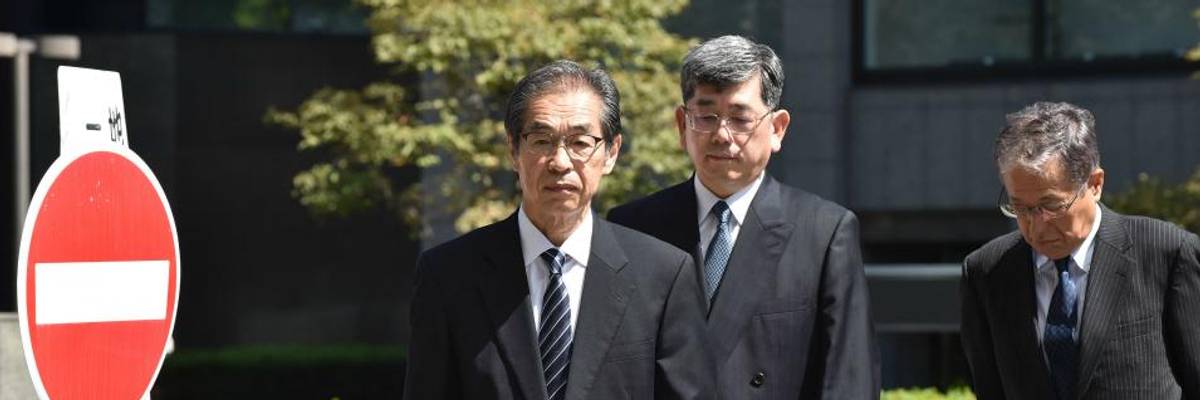
Ichiro Takekuro, former vice president of Tokyo Electric Power Company (TEPCO), arrives at the Tokyo District Court on September 19, 2019. (Photo: Kazuhiro Nogi/AFP/Getty Images)
'What Corporate Impunity Looks Like': Court Acquits Tepco Executives for Role in Fukushima Nuclear Disaster
"I had braced myself that we might not get a clean victory, but this is too awful."
A Japanese court sparked widespread outrage Thursday by acquitting three former Tepco executives accused of criminal negligence for their failure to take adequate safety measures ahead of the Fukushima nuclear disaster.
In 2011, a powerful earthquake off the coast of Japan caused a tsunami that severely damaged Tepco's Fukushima Daiichi power plant, unleashing tons of radioactive material and forcing hundreds of thousands of people to flee their homes.
Prosecutors said Tsunehisa Katsumata, Sakae Muto, and Ichiro Takekuro knew of the severe risk posed to the facility by a tsunami as early as 2008 but refused to act.
"The executives were charged with contributing to the deaths of 44 people who had been living in a hospital and nursing home near the plant and died during the hasty evacuation or soon after," the Wall Street Journal reported.
Yuichi Kaido, lawyer and anti-nuclear activist, told the New York Times that the executives "themselves had done the calculations" on the risk of a tsunami "and hid them for three years."
"The only way to see this is the court has issued an unfair verdict," Kaido said following the acquittal.
The court's decision provoked a furious response from the dozens of people who rallied outside Tokyo District Court hoping the executives would be held accountable.
"I couldn't be more angry," a man who was forced to evacuate due to the Fukushima disaster told supporters at a rally following the verdict. "We can't go back to our normal lives. Those who were at the top of the company at the time must be prosecuted!"
Akihiro Yoshidome, an 81-year-old anti-nuclear campaigner from Tokyo, told AFP he was shocked by the court's decision.
"I had braced myself that we might not get a clean victory, but this is too awful," Yoshidome said. "This shows Japanese courts don't stand for people's interest. This can't be true."
We are at a crossroads
This country and this world are at a monumental crossroads. In a few short weeks, US voters will have an opportunity to beat back the forces of fascism and confront the billionaires who are rigging the economy, our media system, and our democracy, making it increasingly impossible for ordinary people to get by. We’re not just talking about the election. We’re talking about what must be done once these fascist elements are vanquished from power. We need a bolder set of solutions than what either major party has so far been willing to offer and a working-class movement ready to fight like hell for it. Trump didn't emerge from nowhere. The conditions that fueled MAGA authoritarianism were created by decades of radical neoliberal economic policies and a corrupt political system dominated by corporate interests. They slashed taxes on the super-rich, promising that the benefits would trickle down. They said giveaways to the corporate titans would make life more affordable for the rest of us. It was all bullshit. And when a bitter, betrayed populace searches for someone to blame, right-wing demagogues have little trouble finding scapegoats. People know when they're being lied to, but you won't hear any of this from the corporate media. Only independent journalism—powered and funded by people who believe in building a better world—can deliver truly trustworthy daily news. Our Fall Campaign is underway, and we need your help. To power our newsroom through the rest of the year, we need to raise $125,000 by midnight on October 31. So if you share our vision, please contribute whatever you can to sustain our work. |
A Japanese court sparked widespread outrage Thursday by acquitting three former Tepco executives accused of criminal negligence for their failure to take adequate safety measures ahead of the Fukushima nuclear disaster.
In 2011, a powerful earthquake off the coast of Japan caused a tsunami that severely damaged Tepco's Fukushima Daiichi power plant, unleashing tons of radioactive material and forcing hundreds of thousands of people to flee their homes.
Prosecutors said Tsunehisa Katsumata, Sakae Muto, and Ichiro Takekuro knew of the severe risk posed to the facility by a tsunami as early as 2008 but refused to act.
"The executives were charged with contributing to the deaths of 44 people who had been living in a hospital and nursing home near the plant and died during the hasty evacuation or soon after," the Wall Street Journal reported.
Yuichi Kaido, lawyer and anti-nuclear activist, told the New York Times that the executives "themselves had done the calculations" on the risk of a tsunami "and hid them for three years."
"The only way to see this is the court has issued an unfair verdict," Kaido said following the acquittal.
The court's decision provoked a furious response from the dozens of people who rallied outside Tokyo District Court hoping the executives would be held accountable.
"I couldn't be more angry," a man who was forced to evacuate due to the Fukushima disaster told supporters at a rally following the verdict. "We can't go back to our normal lives. Those who were at the top of the company at the time must be prosecuted!"
Akihiro Yoshidome, an 81-year-old anti-nuclear campaigner from Tokyo, told AFP he was shocked by the court's decision.
"I had braced myself that we might not get a clean victory, but this is too awful," Yoshidome said. "This shows Japanese courts don't stand for people's interest. This can't be true."