SUBSCRIBE TO OUR FREE NEWSLETTER
Daily news & progressive opinion—funded by the people, not the corporations—delivered straight to your inbox.
5
#000000
#FFFFFF
To donate by check, phone, or other method, see our More Ways to Give page.
Daily news & progressive opinion—funded by the people, not the corporations—delivered straight to your inbox.
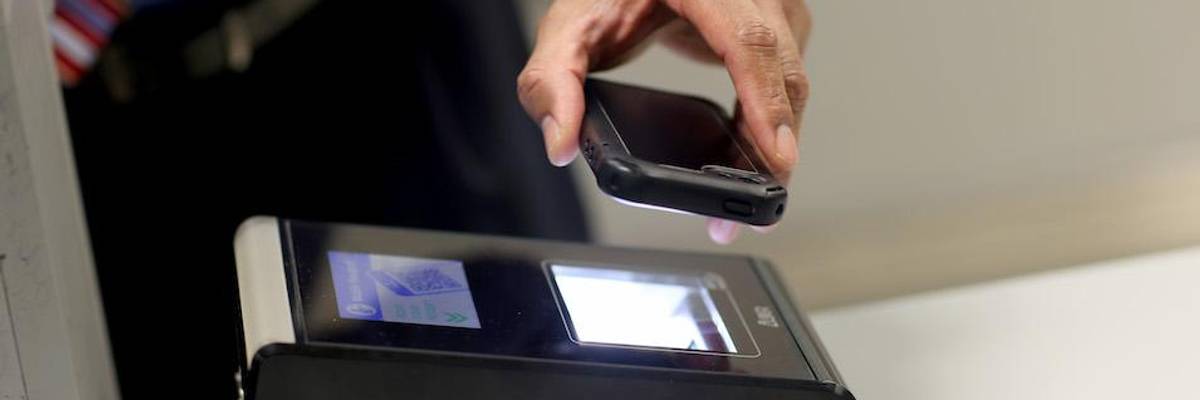
A phone is passed over a scanner during a demonstration at Miami International Airport on March 4, 2015. (Photo: Joe Raedle/Getty Images)
The State Department Friday put new regulations in place for visa applicants, requiring disclosure of social media accounts, a move that critics worry could lead to an easier path for deportations.
Applicants for visas will be required to provide a list of their social media account usernames, email addresses, and phone numbers upon applying. These restrictions, which AP reported will affect up to 15 million people a year, were previously only used for applicants who were flagged by the department.
In an interview with Common Dreams, Dan Feidt, a reporter with Unicorn Riot and privacy advocate, speculated that the new rules could be used to expedite deportation proceedings.
"They can falsely attribute some social media activity to you and claim you lied about it," said Feidt.
Feidt added that he believes the new rules could provide a bigger "attack surface" for the government to target applicants with--giving more of a chance that the government could find inconsistencies to then use as the justification for deportation.
"It's a much larger set of info they can claim you potentially lied about and get at you with," said Feidt. "Before, you had to provide less info to United States Citizenship and Immigration Services, so there was less to get attacked about."
Saagar Enjeti of The Hill first reported the new policy's implementation Friday, and the State Department subsequently confirmed the news to multiple other news organizations. The new regulations are part of "extreme vetting" policies announced in an executive order by President Donald Trump in March 2017. The new regulations around social media accounts were first announced in March 2018.
Quoting an unnamed State Department official, Enjeti said that the administration claims it will use social media vetting to go after threats to the U.S.
"As we've seen around the world in recent years, social media can be a major forum for terrorist sentiment and activity," the official said. "This will be a vital tool to screen out terrorists, public safety threats, and other dangerous individuals from gaining immigration benefits and setting foot on U.S. soil."
The news follows reports, including from Common Dreams, that the administration is holding migrants in overcrowded facilities that are so cramped people can hardly move or breathe.
This country and this world are at a monumental crossroads. US voters have an opportunity to beat back the forces of fascism and confront the billionaires who are rigging the economy, our media system, and our democracy, making it increasingly impossible for ordinary people to get by. We’re not just talking about the election. We’re talking about what must be done once these fascist elements are vanquished from power. We need a bolder set of solutions than what either major party has so far been willing to offer and a working-class movement ready to fight like hell for it. Trump didn't emerge from nowhere. The conditions that fueled MAGA authoritarianism were created by decades of radical neoliberal economic policies and a corrupt political system dominated by corporate interests. They slashed taxes on the super-rich, promising that the benefits would trickle down. They said giveaways to the corporate titans would make life more affordable for the rest of us. It was all bullshit. And when a bitter, betrayed populace searches for someone to blame, right-wing demagogues have little trouble finding scapegoats. People know when they're being lied to, but you won't hear any of this from the corporate media. Only independent journalism—powered and funded by people who believe in building a better world—can deliver truly trustworthy daily news. If you share our vision, please contribute whatever you can to sustain our work. |
The State Department Friday put new regulations in place for visa applicants, requiring disclosure of social media accounts, a move that critics worry could lead to an easier path for deportations.
Applicants for visas will be required to provide a list of their social media account usernames, email addresses, and phone numbers upon applying. These restrictions, which AP reported will affect up to 15 million people a year, were previously only used for applicants who were flagged by the department.
In an interview with Common Dreams, Dan Feidt, a reporter with Unicorn Riot and privacy advocate, speculated that the new rules could be used to expedite deportation proceedings.
"They can falsely attribute some social media activity to you and claim you lied about it," said Feidt.
Feidt added that he believes the new rules could provide a bigger "attack surface" for the government to target applicants with--giving more of a chance that the government could find inconsistencies to then use as the justification for deportation.
"It's a much larger set of info they can claim you potentially lied about and get at you with," said Feidt. "Before, you had to provide less info to United States Citizenship and Immigration Services, so there was less to get attacked about."
Saagar Enjeti of The Hill first reported the new policy's implementation Friday, and the State Department subsequently confirmed the news to multiple other news organizations. The new regulations are part of "extreme vetting" policies announced in an executive order by President Donald Trump in March 2017. The new regulations around social media accounts were first announced in March 2018.
Quoting an unnamed State Department official, Enjeti said that the administration claims it will use social media vetting to go after threats to the U.S.
"As we've seen around the world in recent years, social media can be a major forum for terrorist sentiment and activity," the official said. "This will be a vital tool to screen out terrorists, public safety threats, and other dangerous individuals from gaining immigration benefits and setting foot on U.S. soil."
The news follows reports, including from Common Dreams, that the administration is holding migrants in overcrowded facilities that are so cramped people can hardly move or breathe.