SUBSCRIBE TO OUR FREE NEWSLETTER
Daily news & progressive opinion—funded by the people, not the corporations—delivered straight to your inbox.
5
#000000
#FFFFFF
To donate by check, phone, or other method, see our More Ways to Give page.
Daily news & progressive opinion—funded by the people, not the corporations—delivered straight to your inbox.
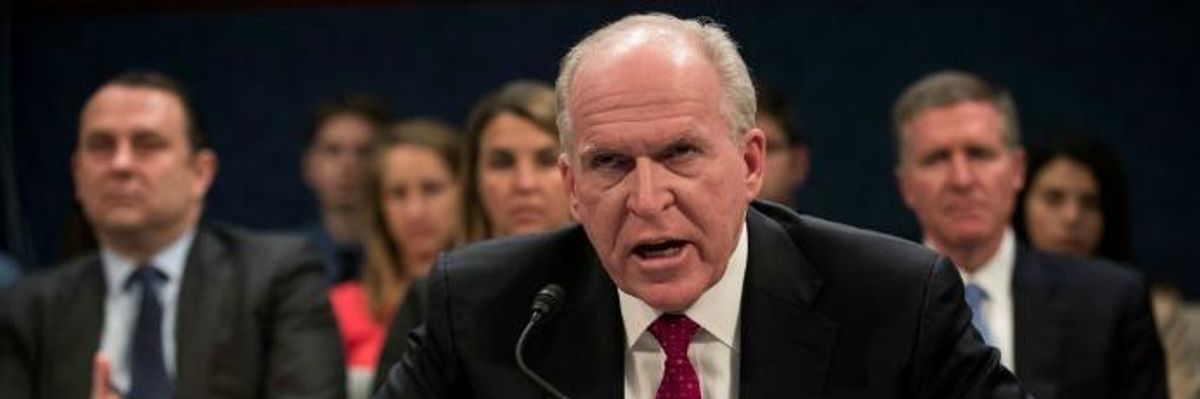
Former Director of the U.S. Central Intelligence Agency (CIA) John Brennan testifies before the House Permanent Select Committee on Intelligence on Capitol Hill. (Photo: Drew Angerer/Getty Images)
While Democratic senators, corporate talking heads, former national security officials, and Twitter pundits issued dire proclamations about the "dangerous precendent" President Donald Trump set on Wednesday by revoking former CIA Director John Brennan's security clearance for obviously vindictive and political reasons, critics of America's far-too-powerful intelligence apparatus were quick to express how little sympathy they feel for Brennan, given his utterly horrendous track record of defending torture and masterminding the Obama administration's deadly drone program.
"John Brennan is being punished by not being able to find out who got droned yesterday, I hope he's ok," joked Splinter's Libby Watson.
But while well-established critics of the American national security state refused to shed a single tear for Brennan--or, for that matter, any of the other former intelligence officials on Trump's so-called enemies list--the very fact that Trump has such a list and is using the power of the presidency to punish the individuals on it sparked alarm among journalists and civil libertarians.
"Trump's action is unconstitutional because he's punishing political speech, and unethical because he is lying to cover it up."
--Norm Eisen, Citizens for Responsibility and Ethics in Washington
"The First Amendment does not permit the president to revoke security clearances to punish his critics," Ben Wizner, director of the American Civil Liberties Union's Speech, Privacy, and Technology Project, argued in a statement on Wednesday, referring to the fact that the officials on Trump's list have frequently denounced the president on television.
"Brennan's record is full of grave missteps, and we have been unsparing in our criticism of his defense of the CIA torture program and his role in unlawful lethal strikes abroad," Wizner added. "But Trump's revocation of Brennan's clearance, and his threats to revoke the clearances of other former officials for the sole reason that they have criticized his conduct and policies, amount to unconstitutional retaliation. They are also part of a broader pattern of seeking to silence or marginalize critics, which includes forcing staff to sign unconstitutional non-disclosure agreements."
The Intercept's Glenn Greenwald--who has been similarly unsparing in his assessment of Brennan's record and dismissive of those who reflexively "revere anyone who occupies high positions in the U.S. national security state"--echoed the ACLU in a series of tweets on Wednesday, noting that while Brennan is a "war criminal" and a "pathological liar," it is nonetheless "dangerous to allow a president to impose punishments for criticisms."
Medhi Hasan, Greenwald's colleague at The Intercept, captured the absurdity of Trump's standard for who should and shouldn't have access to classified information by noting that the president's son-in-law, Jared Kushner, still has a security clearance--a fact that clearly shows Trump's decision to revoke Brennan's clearance was based on a petty grudge, not any reasonable "national security" concerns.
As the New York Times reported on Wednesday, the White House's statement announcing that Brennan's security clearance has been revoked was dated July 26--an indication that the decision to punish Brennan was actually made weeks ago, fueling speculation that the Trump administration timed the announcement to control the news cycle and distract from other controversies, such as former White House official Omarosa Manigault Newman's insistence that Trump is in a state of "mental decline" and that she has a tape of the president using the n-word.
Intended as a distraction or not, former White House ethics chief and chair of Citizens for Responsibility and Ethics in Washington (CREW) chair Norm Eisen argued in a tweet on Wednesday that Trump's revocation of Brennan's security clearance was a flagrant violation of the Constitution.
"Trump's action is unconstitutional because he's punishing political speech, and unethical because he is lying to cover it up," Eisen concluded.
This country and this world are at a monumental crossroads. US voters have an opportunity to beat back the forces of fascism and confront the billionaires who are rigging the economy, our media system, and our democracy, making it increasingly impossible for ordinary people to get by. We’re not just talking about the election. We’re talking about what must be done once these fascist elements are vanquished from power. We need a bolder set of solutions than what either major party has so far been willing to offer and a working-class movement ready to fight like hell for it. Trump didn't emerge from nowhere. The conditions that fueled MAGA authoritarianism were created by decades of radical neoliberal economic policies and a corrupt political system dominated by corporate interests. They slashed taxes on the super-rich, promising that the benefits would trickle down. They said giveaways to the corporate titans would make life more affordable for the rest of us. It was all bullshit. And when a bitter, betrayed populace searches for someone to blame, right-wing demagogues have little trouble finding scapegoats. People know when they're being lied to, but you won't hear any of this from the corporate media. Only independent journalism—powered and funded by people who believe in building a better world—can deliver truly trustworthy daily news. If you share our vision, please contribute whatever you can to sustain our work. |
While Democratic senators, corporate talking heads, former national security officials, and Twitter pundits issued dire proclamations about the "dangerous precendent" President Donald Trump set on Wednesday by revoking former CIA Director John Brennan's security clearance for obviously vindictive and political reasons, critics of America's far-too-powerful intelligence apparatus were quick to express how little sympathy they feel for Brennan, given his utterly horrendous track record of defending torture and masterminding the Obama administration's deadly drone program.
"John Brennan is being punished by not being able to find out who got droned yesterday, I hope he's ok," joked Splinter's Libby Watson.
But while well-established critics of the American national security state refused to shed a single tear for Brennan--or, for that matter, any of the other former intelligence officials on Trump's so-called enemies list--the very fact that Trump has such a list and is using the power of the presidency to punish the individuals on it sparked alarm among journalists and civil libertarians.
"Trump's action is unconstitutional because he's punishing political speech, and unethical because he is lying to cover it up."
--Norm Eisen, Citizens for Responsibility and Ethics in Washington
"The First Amendment does not permit the president to revoke security clearances to punish his critics," Ben Wizner, director of the American Civil Liberties Union's Speech, Privacy, and Technology Project, argued in a statement on Wednesday, referring to the fact that the officials on Trump's list have frequently denounced the president on television.
"Brennan's record is full of grave missteps, and we have been unsparing in our criticism of his defense of the CIA torture program and his role in unlawful lethal strikes abroad," Wizner added. "But Trump's revocation of Brennan's clearance, and his threats to revoke the clearances of other former officials for the sole reason that they have criticized his conduct and policies, amount to unconstitutional retaliation. They are also part of a broader pattern of seeking to silence or marginalize critics, which includes forcing staff to sign unconstitutional non-disclosure agreements."
The Intercept's Glenn Greenwald--who has been similarly unsparing in his assessment of Brennan's record and dismissive of those who reflexively "revere anyone who occupies high positions in the U.S. national security state"--echoed the ACLU in a series of tweets on Wednesday, noting that while Brennan is a "war criminal" and a "pathological liar," it is nonetheless "dangerous to allow a president to impose punishments for criticisms."
Medhi Hasan, Greenwald's colleague at The Intercept, captured the absurdity of Trump's standard for who should and shouldn't have access to classified information by noting that the president's son-in-law, Jared Kushner, still has a security clearance--a fact that clearly shows Trump's decision to revoke Brennan's clearance was based on a petty grudge, not any reasonable "national security" concerns.
As the New York Times reported on Wednesday, the White House's statement announcing that Brennan's security clearance has been revoked was dated July 26--an indication that the decision to punish Brennan was actually made weeks ago, fueling speculation that the Trump administration timed the announcement to control the news cycle and distract from other controversies, such as former White House official Omarosa Manigault Newman's insistence that Trump is in a state of "mental decline" and that she has a tape of the president using the n-word.
Intended as a distraction or not, former White House ethics chief and chair of Citizens for Responsibility and Ethics in Washington (CREW) chair Norm Eisen argued in a tweet on Wednesday that Trump's revocation of Brennan's security clearance was a flagrant violation of the Constitution.
"Trump's action is unconstitutional because he's punishing political speech, and unethical because he is lying to cover it up," Eisen concluded.