

Residents of a small city in coastal Maine are pushing to formally ban Big Oil's plans to pump tar sands through their community, and they're pretty sure they're going to win.
Over 200 people wearing matching sky-blue tee-shirts flooded a city council meeting in South Portland on Wednesday night to cheer a presentation on a proposed ordinance that would prohibit the bulk loading of crude oil--including tar sands--as well as new infrastructure for such purposes within city limits.
Backers of the legislation, known as the Clear Skies Ordinance, say tar sands transport through their city would devastate their waterfront, unleash toxic air pollution, and risk dangerous spills.
And they have reason to worry.
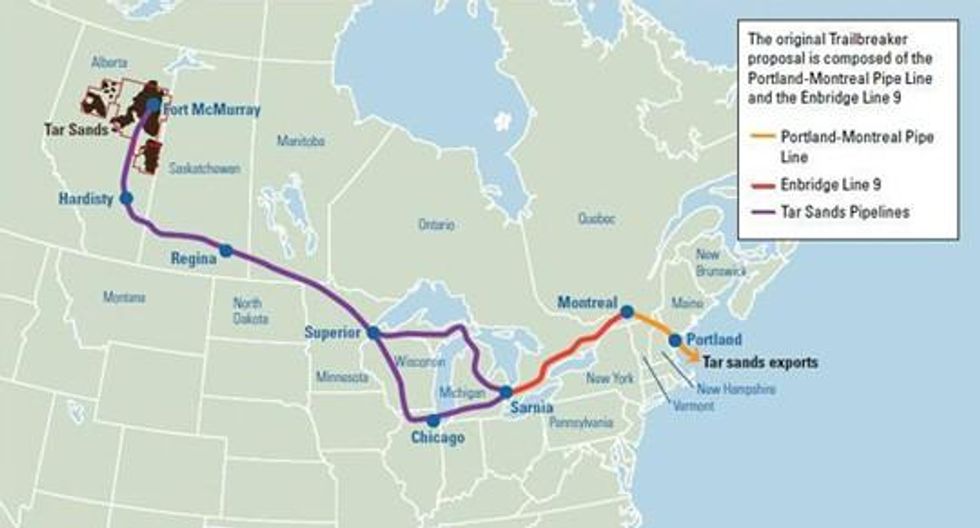
South Portland is the starting point for the 236-mile long "Portland-Montreal Pipeline" which is majority-owned by Exxon-Mobil. The pipeline is critical to move Canadian tar sands to a major port for loading on oil tankers for export. Canadian pipeline company Enbridge appears to be moving forward with plans to pump tar sands, via their Canadian Line 9 pipeline, through New England to South Portland's Casco Bay, where the oil would then be exported to global markets.
According to Environment Maine, the Portland-Montreal Pipeline is also central to the Energy East pipeline, proposed by Canadian company Transcanada, that would pump 1.1 million barrels of tar sands daily from Quebec to New Brunswick,
"The threat is not abstract," said Taryn Hallweaver of Environment Maine in an interview with Common Dreams. "Tar sands oil will flow to Montreal as early as this summer for the first time ever, right at New England's doorstep."
Oil extracted from tar sands, also referred to as bitumen, is one of the world's dirtiest fossil fuels, producing up to five times more carbon than conventional crude oil. The extraction process is extremely energy-intensive and destructive to ecosystems and creates large reservoirs of dangerous waste.
The Clear Skies Ordinance to block tar sands emerged from a six-month-long public process launched by South Portland's City Council. It was drafted by a committee of appointed land-use experts and is slated for further consideration by the city council and planning board, with a vote slated for late-July.
It follows the narrow defeat last year of a South Portland effort to block a future tar sands terminal after the oil industry poured hundreds of thousands of dollars into a campaign to squash the protective measure.
Robert Selling of Protect South Portland told Common Dreams that he is "extremely hopeful" that this ordinance. He emphasized that the draft ordinance was met with "enthusiastic response" and "standing ovations" at Wednesday's meeting.
"I think it's going to be a model for other communities," he said.
_____________________
Residents of a small city in coastal Maine are pushing to formally ban Big Oil's plans to pump tar sands through their community, and they're pretty sure they're going to win.
Over 200 people wearing matching sky-blue tee-shirts flooded a city council meeting in South Portland on Wednesday night to cheer a presentation on a proposed ordinance that would prohibit the bulk loading of crude oil--including tar sands--as well as new infrastructure for such purposes within city limits.
Backers of the legislation, known as the Clear Skies Ordinance, say tar sands transport through their city would devastate their waterfront, unleash toxic air pollution, and risk dangerous spills.
And they have reason to worry.
South Portland is the starting point for the 236-mile long "Portland-Montreal Pipeline" which is majority-owned by Exxon-Mobil. The pipeline is critical to move Canadian tar sands to a major port for loading on oil tankers for export. Canadian pipeline company Enbridge appears to be moving forward with plans to pump tar sands, via their Canadian Line 9 pipeline, through New England to South Portland's Casco Bay, where the oil would then be exported to global markets.
According to Environment Maine, the Portland-Montreal Pipeline is also central to the Energy East pipeline, proposed by Canadian company Transcanada, that would pump 1.1 million barrels of tar sands daily from Quebec to New Brunswick,
"The threat is not abstract," said Taryn Hallweaver of Environment Maine in an interview with Common Dreams. "Tar sands oil will flow to Montreal as early as this summer for the first time ever, right at New England's doorstep."
Oil extracted from tar sands, also referred to as bitumen, is one of the world's dirtiest fossil fuels, producing up to five times more carbon than conventional crude oil. The extraction process is extremely energy-intensive and destructive to ecosystems and creates large reservoirs of dangerous waste.
The Clear Skies Ordinance to block tar sands emerged from a six-month-long public process launched by South Portland's City Council. It was drafted by a committee of appointed land-use experts and is slated for further consideration by the city council and planning board, with a vote slated for late-July.
It follows the narrow defeat last year of a South Portland effort to block a future tar sands terminal after the oil industry poured hundreds of thousands of dollars into a campaign to squash the protective measure.
Robert Selling of Protect South Portland told Common Dreams that he is "extremely hopeful" that this ordinance. He emphasized that the draft ordinance was met with "enthusiastic response" and "standing ovations" at Wednesday's meeting.
"I think it's going to be a model for other communities," he said.
_____________________