

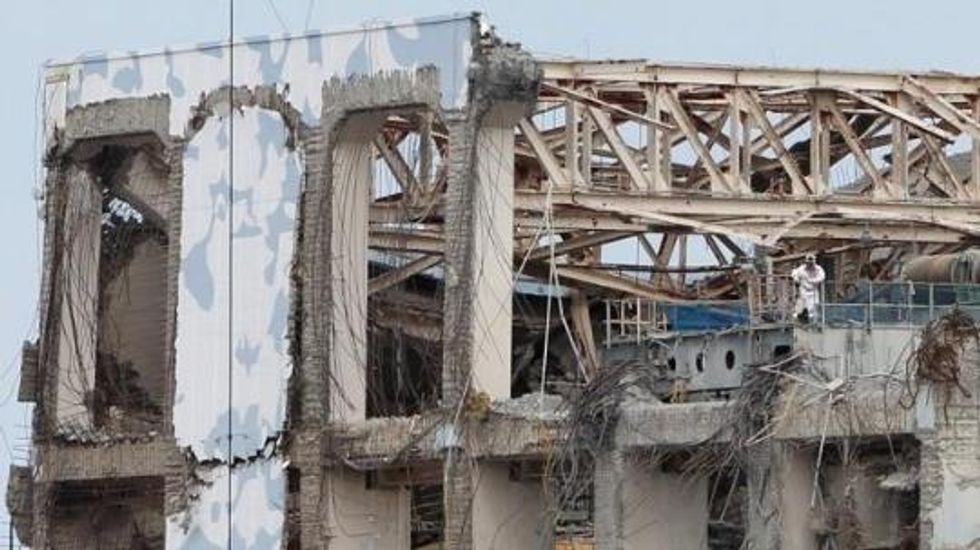
According to Associated Press, the NRA announced that the proposal to manually remove the radioactive rods put forth by the plant operator, Tokyo Electric Power Co. or TEPCO, was "appropriate" and that the removal "can start in November as planned, following an on-site inspection by regulators."
TEPCO estimates that the complete decommissioning process will last decades. Detailing the process, AP reports:
TEPCO has prepared a massive steel structure that comes with a remote-controlled crane to remove the fuel rods, which will be placed into a protective cask and transferred to a joint cooling pool inside a nearby building. To make room for the Unit 4 fuel rods, the company has been moving those already in the joint pool to safer storage in dry casks at a separate plant location.
The utility plans to empty the Unit 4 pool by end of 2014, and remove fuel rods from other pools at three other wrecked reactors over several years before digging into their melted cores around 2020.
However, according to nuclear engineer Arnie Gundersen, the spent fuel rods in the Unit 4 core are "bent, damaged and embrittled to the point of crumbling." And NRA chairman Shunichi Tanaka warned that removing the rods would be difficult because of the risk posed by debris that fell into the pool during the explosions triggered by the 2011 earthquake, tsunami and subsequent three reactor meltdowns at the plant.
"It's a totally different operation than removing normal fuel rods from a spent fuel pool," Tanaka said during the news conference Wednesday. "They need to be handled extremely carefully and closely monitored. You should never rush or force them out, or they may break."
Wasserman warns that there are "some 400 tons of fuel in that pool [that] could spew out more than 15,000 times as much radiation as was released at Hiroshima."
Wasserman, Gundersen and other nuclear watchdogs have warned that neither TEPCO nor the Japanese government has the "scientific, engineering or financial resources to handle" the job and that the situation instead demands a "coordinated worldwide effort of the best scientists and engineers our species can muster."
Over 100,000 people have thus far signed a petition echoing that call. "[T]he impending removal of hugely radioactive spent fuel rods from a pool 100 feet in the air presents unparalleled scientific and engineering challenges," caution the signees, who are calling on President Obama and UN Secretary General Ban Ki-Moon to intercept the Japanese authority's process. "We ask the world community [...] to take control of this uniquely perilous task."
_____________________
According to Associated Press, the NRA announced that the proposal to manually remove the radioactive rods put forth by the plant operator, Tokyo Electric Power Co. or TEPCO, was "appropriate" and that the removal "can start in November as planned, following an on-site inspection by regulators."
TEPCO estimates that the complete decommissioning process will last decades. Detailing the process, AP reports:
TEPCO has prepared a massive steel structure that comes with a remote-controlled crane to remove the fuel rods, which will be placed into a protective cask and transferred to a joint cooling pool inside a nearby building. To make room for the Unit 4 fuel rods, the company has been moving those already in the joint pool to safer storage in dry casks at a separate plant location.
The utility plans to empty the Unit 4 pool by end of 2014, and remove fuel rods from other pools at three other wrecked reactors over several years before digging into their melted cores around 2020.
However, according to nuclear engineer Arnie Gundersen, the spent fuel rods in the Unit 4 core are "bent, damaged and embrittled to the point of crumbling." And NRA chairman Shunichi Tanaka warned that removing the rods would be difficult because of the risk posed by debris that fell into the pool during the explosions triggered by the 2011 earthquake, tsunami and subsequent three reactor meltdowns at the plant.
"It's a totally different operation than removing normal fuel rods from a spent fuel pool," Tanaka said during the news conference Wednesday. "They need to be handled extremely carefully and closely monitored. You should never rush or force them out, or they may break."
Wasserman warns that there are "some 400 tons of fuel in that pool [that] could spew out more than 15,000 times as much radiation as was released at Hiroshima."
Wasserman, Gundersen and other nuclear watchdogs have warned that neither TEPCO nor the Japanese government has the "scientific, engineering or financial resources to handle" the job and that the situation instead demands a "coordinated worldwide effort of the best scientists and engineers our species can muster."
Over 100,000 people have thus far signed a petition echoing that call. "[T]he impending removal of hugely radioactive spent fuel rods from a pool 100 feet in the air presents unparalleled scientific and engineering challenges," caution the signees, who are calling on President Obama and UN Secretary General Ban Ki-Moon to intercept the Japanese authority's process. "We ask the world community [...] to take control of this uniquely perilous task."
_____________________
According to Associated Press, the NRA announced that the proposal to manually remove the radioactive rods put forth by the plant operator, Tokyo Electric Power Co. or TEPCO, was "appropriate" and that the removal "can start in November as planned, following an on-site inspection by regulators."
TEPCO estimates that the complete decommissioning process will last decades. Detailing the process, AP reports:
TEPCO has prepared a massive steel structure that comes with a remote-controlled crane to remove the fuel rods, which will be placed into a protective cask and transferred to a joint cooling pool inside a nearby building. To make room for the Unit 4 fuel rods, the company has been moving those already in the joint pool to safer storage in dry casks at a separate plant location.
The utility plans to empty the Unit 4 pool by end of 2014, and remove fuel rods from other pools at three other wrecked reactors over several years before digging into their melted cores around 2020.
However, according to nuclear engineer Arnie Gundersen, the spent fuel rods in the Unit 4 core are "bent, damaged and embrittled to the point of crumbling." And NRA chairman Shunichi Tanaka warned that removing the rods would be difficult because of the risk posed by debris that fell into the pool during the explosions triggered by the 2011 earthquake, tsunami and subsequent three reactor meltdowns at the plant.
"It's a totally different operation than removing normal fuel rods from a spent fuel pool," Tanaka said during the news conference Wednesday. "They need to be handled extremely carefully and closely monitored. You should never rush or force them out, or they may break."
Wasserman warns that there are "some 400 tons of fuel in that pool [that] could spew out more than 15,000 times as much radiation as was released at Hiroshima."
Wasserman, Gundersen and other nuclear watchdogs have warned that neither TEPCO nor the Japanese government has the "scientific, engineering or financial resources to handle" the job and that the situation instead demands a "coordinated worldwide effort of the best scientists and engineers our species can muster."
Over 100,000 people have thus far signed a petition echoing that call. "[T]he impending removal of hugely radioactive spent fuel rods from a pool 100 feet in the air presents unparalleled scientific and engineering challenges," caution the signees, who are calling on President Obama and UN Secretary General Ban Ki-Moon to intercept the Japanese authority's process. "We ask the world community [...] to take control of this uniquely perilous task."
_____________________