SUBSCRIBE TO OUR FREE NEWSLETTER
Daily news & progressive opinion—funded by the people, not the corporations—delivered straight to your inbox.
5
#000000
#FFFFFF
To donate by check, phone, or other method, see our More Ways to Give page.
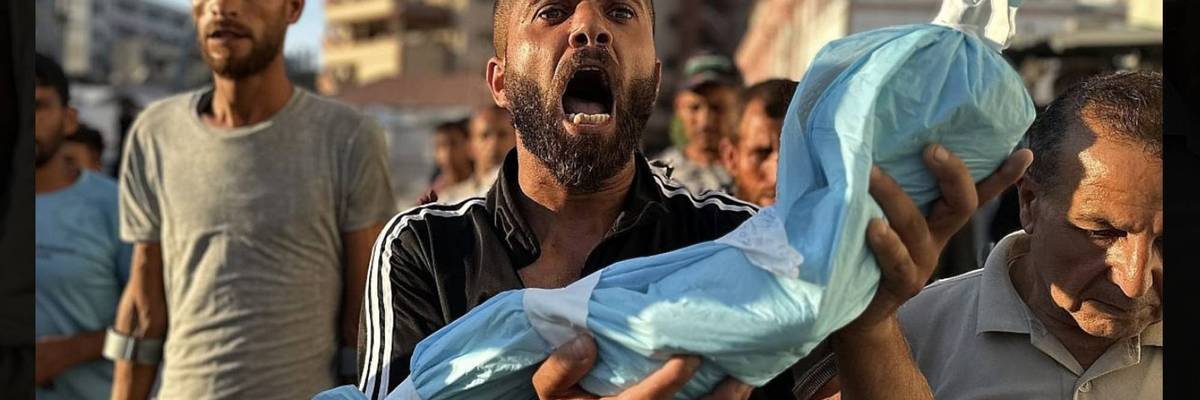
The anniversary of the Oct. 7 Hamas attack and the three-year, U.S-funded Gazan genocide it ignited marks the birth of a dark new world where "the unthinkable has become banal," where many thousands of damaged Palestinian children - homeless, toy-less, traumatized, unschooled, with mournful questions about a lost world - have been given only "tents, hunger, and rubble as answers." Zohran Mamdani on the arduous, unfulfilled task before us: "There must be room to mourn every single life."
Precisely one year into what over 100 human rights organizations around the world call "a ceasefire in name only," Gaza remains "Ground Zero" in the ethnic cleansing of Palestinians. In the last three years, Israeli strikes have killed at least 74,254 people, including over 21,500 children, and wounded 175,000 more, killing or wounding more than 1 in 10 of Gaza's pre-war population; health officials estimate tens of thousands more dead remain buried beneath Gaza's 61 million tons of rubble. Since the start of the so-called ceasefire on Oct.10 of last year, at least 1,470 more Palestinians have been killed, including nearly one child a day. No hospital is fully functional, over 1.4 million Palestinians face crisis-level hunger and most Gazan families remain trapped in a devastating cycle of loss, grief, deprivation and uncertainty.
Reports seeping out from a still-mostly-blockaded Gaza describe "entire worlds wiped out" - extended families, neighborhoods, over 80% of all buildings, resulting in nearly 1.9 million Palestinians displaced. Gaza's missing, or last seen detained, handcuffed, tortured, naked, haunt those who survive: "We don't know whether to mourn them or wait for them." During occasional prisoner swaps, Israel hands over images or remains of decomposing bodies of detainees, many handcuffed, blindfolded, missing limbs, clearly tortured. Parents scroll or search through them, all that's left of a long-missing son: "How did I become a mother who hopes to find her child among mutilated corpses? My dream was to hug him. Now I pray simply to bury him."
Others relive the brutality they survived: fires, bombings, multiple evacuations, sights, smells, sounds of phosphorous bombs, drones, tanks; the terror of running to an outhouse fast enough not to "be sniped," the uneasy sleep under shelling close enough to outside walls that if bombs fall their neighbors can dig them out or at least bury them; the first up-close sight of Israeli soldiers, every inch covered in armor to "look invincible." The orders to strip to underwear, blindfolded, handcuffed behind backs, kneeling on ground strewn with glass and rubble, the insults, beatings, cold relieved only when their own warm blood from beatings runs over them. Trying to pray or sleep, hallucinating "between life and death," when blankets, speaking, changing position was forbidden: "Everything was forbidden except breathing and swift death."
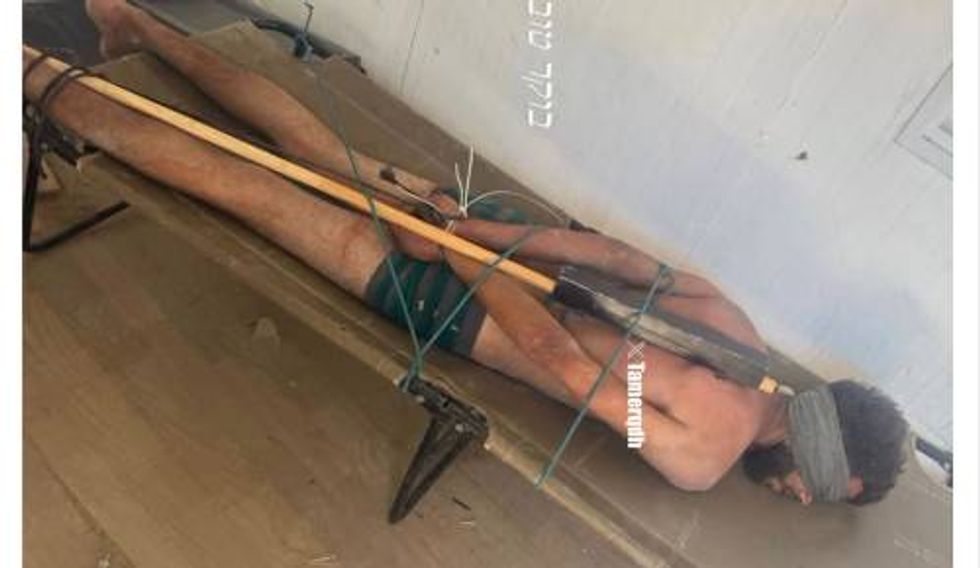 Palestinian detaineePhoto by Activestills
And always there are the children, Gaza's "lost generation," roughly 700,000 students left behind by three years of war and deliberate “scholasticide" that have destroyed 95% of their schools, turned the rest into shelters for the displaced, killed over 20,000 students and 1,000 teachers, seen books burned for fuel for warmth or cooking. At the start of a new school year, the UN and its partners have set up over 500 tent sites - no desks, chairs, books, water, ovens in summer, freezing in winter - to serve up to 100,000 hungry, shell-shocked students struggling to focus in an attempted return to a "normal life" they can't imagine, who've grown up falling asleep to the sound of bombs, "their entire existence one of life amid rubble, tents, stones and sand," writes Tareq Hajjaj of kids often too young to remember what a home or school was.
Hajjaj fled for Cairo in 2024 so his only child wouldn't "grow up believing the whole world looked like Gaza." He left behind 15 nieces and nephews whose "expectations for ordinary life" he's seen shrink; on one video call, a six-year-old nephew saw him sitting on a sofa and asked how he fit it in his tent, and they dream only of a bigger, dryer tent. In the occupied West Bank, residents likewise endure new Israeli gates that turn villages into "an effective cage," Bedouin families expelled, settlers stealing land, livestock, homes, olive groves harvested by Palestinian generations past. This is not a Palestinian "superhuman capacity" for resilience, he argues, but "the ordinary human behavior of people who have no other choice, who are left alone to their fate." To cope, they dismiss the hardship with “aadi,” Arabic for normal, "it is what it is," but "there is nothing normal about it."
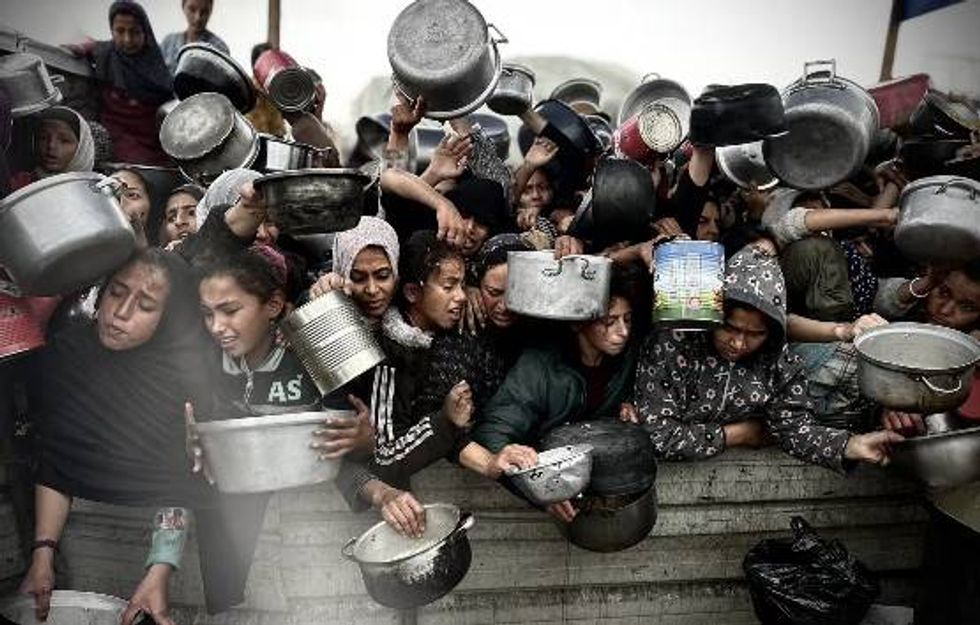 Many Gazans are still surviving on a fraction of the food aid they need.Getty Image
In a deeply complicit America that contributed over $30 billion to Gaza's genocide, the truth of what our blood money has wrought slowly seeps out. Last month, the New York Film Festival premiered NAZA, the Guardian-produced documentary by two Israeli filmmakers that offers a grim "Window Into Systems of Mass Killings" in a Gaza where rabid Zionists argued there are "no innocent people." NAZA, the Hebrew acronym for civilian deaths as high as 500 for one legit target, presents damning testimony from 24 Israeli soldiers, faces obscured, who veer from naming their genocidal acts to rationalizing them through performative nods toward their guilt - a longtime form of Israeli sort-of-moral-reckoning with state violence known as "shooting and crying" that critics dub "addiction to the mediated obscene." The film will stream for free in November on The Guardian website.
New York Mayor Zohran Mamdani proffered a more heartfelt, equitable reckoning with horror this week by attending a peace vigil and press conference to commemorate the three year anniversary. As expected, he caught flak from both sides when he called out both Hamas' “horrific war crimes” - he's a Muslim "traitor" - and Israel's “devastating, ongoing genocide” - he's an "anti-Semite." Calmly, he noted, he "signed up for this," and will continue to insist on it, citing the need to mourn and extend human rights to the more than 1,100 Israelis killed, and the over 74,000 Palestinians subsequently killed. "This is part of what it means to believe in a sense of humanity, " he said. "We need not choose between which death we will mourn and which we will ignore, and we must reckon with the fact that all of it is to be opposed.”
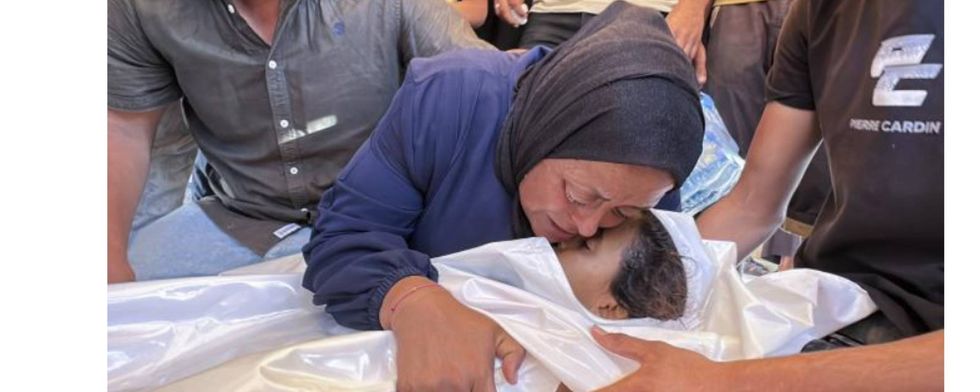 A ceasefire in name only: The mother of 8-year-old Amal al-Mughayir mourns her death in an Israeli strike on Khan Younis last month.Photo by Doaa Albaz
Further glad proof of that reckoning was the awarding of the 2026 Nobel Peace Prize to “Navi” Pillay, 85, South African jurist, former U.N. human rights chief and member of the ICC who has led decades-long fights seeking accountability for apartheid, wartime rape and most recently the Gaza genocide. The Nobel committee cited Pillay's “exceptional courage”; noting her last report naming Gaza a genocide, she responded, "Why would you need courage to speak the truth?" Fittingly, Pillay learned of the award while at Germany's Nuremberg Forum, where Nazis went on trial in 1945: "I was sitting here minding my own business, listening to the panel present their research, because you’re always learning.” After colleagues applauded her, Pillay also won the Internet by joking,"Thank you so much. If you clap a little more, I may share this prize with President Trump."
Last year, Pillay was also awarded the Sydney Peace Prize. She dedicated it to “all the survivors of international crimes” and to “defenders of international justice (who) ensure that impunity will not be allowed to reign.” Joining her righteous fight is Mosab Abu Toha, a Palestinian writer and poet from Gaza and winner of the 2025 Pulitzer Prize for Commentary. Recently, per Zeteo, Toha wrote A Letter of Sympathy to the President of the United States after he saw posts online mocking Trump after he was seen wincing at the “deafening sound" of the military flyover for his autocrat bestie Chinese President Xi. "I didn’t like the tone of many of those posts,” he wrote. "I don't blame you for such a reaction/ I have reacted like this, and worse, hundred of times..."
My parents, wife, kids, and siblings have too.
So all of us now
know how
that sound feels.
In 2008, I was 16
on the roof of our house in Beit Lahia,
standing with my father, watching his pigeons in their coop,
when an Israeli, U.S.-made F-16
flew low, like a shaving machine,
before razing a neighborhood.
I panicked at its piercing shriek,
but also at the sight of the missiles
mounted beneath its wings.
But Mr. President, all of us, except you, know
the screech of a missile
or the blast of an explosion.
Do you know what’s louder than the screech and the blast?
The voice of a mother in Jabalia Camp,
begging me on October 31, 2023,
to search for the bodies of her husband and children
under the rubble
not just of her house,
but of the entire neighborhood.
The desperate pleas of 5-year-old Hind Rajab
from her uncle’s car in January 2024,
and the 335 bullets fired at her
before, during, and after the call.
The trickle of tears on the cheek of a father
who returned with no bread for his kids in a tent
in Khan Younis, and the screams of an infant
whose mother’s breast had dried up.
The heartbeat of 18-year-old Ahed
as her uncle, Dr. Hani Bseiso,
amputated her leg on a kitchen table,
without anesthesia.
It was dark!
The grinding footsteps of Dr. Hussam Abu Safiyya
as he walked toward the tank in his white coat.
I can hear the sound of his disappearance.
And I can still hear and hear more!
But do you know what will be much louder than all?
The sound of the gavel
in the court of justice.
The anniversary of the Oct. 7 Hamas attack and the three-year, U.S-funded Gazan genocide it ignited marks the birth of a dark new world where "the unthinkable has become banal," where many thousands of damaged Palestinian children - homeless, toy-less, traumatized, unschooled, with mournful questions about a lost world - have been given only "tents, hunger, and rubble as answers." Zohran Mamdani on the arduous, unfulfilled task before us: "There must be room to mourn every single life."
Precisely one year into what over 100 human rights organizations around the world call "a ceasefire in name only," Gaza remains "Ground Zero" in the ethnic cleansing of Palestinians. In the last three years, Israeli strikes have killed at least 74,254 people, including over 21,500 children, and wounded 175,000 more, killing or wounding more than 1 in 10 of Gaza's pre-war population; health officials estimate tens of thousands more dead remain buried beneath Gaza's 61 million tons of rubble. Since the start of the so-called ceasefire on Oct.10 of last year, at least 1,470 more Palestinians have been killed, including nearly one child a day. No hospital is fully functional, over 1.4 million Palestinians face crisis-level hunger and most Gazan families remain trapped in a devastating cycle of loss, grief, deprivation and uncertainty.
Reports seeping out from a still-mostly-blockaded Gaza describe "entire worlds wiped out" - extended families, neighborhoods, over 80% of all buildings, resulting in nearly 1.9 million Palestinians displaced. Gaza's missing, or last seen detained, handcuffed, tortured, naked, haunt those who survive: "We don't know whether to mourn them or wait for them." During occasional prisoner swaps, Israel hands over images or remains of decomposing bodies of detainees, many handcuffed, blindfolded, missing limbs, clearly tortured. Parents scroll or search through them, all that's left of a long-missing son: "How did I become a mother who hopes to find her child among mutilated corpses? My dream was to hug him. Now I pray simply to bury him."
Others relive the brutality they survived: fires, bombings, multiple evacuations, sights, smells, sounds of phosphorous bombs, drones, tanks; the terror of running to an outhouse fast enough not to "be sniped," the uneasy sleep under shelling close enough to outside walls that if bombs fall their neighbors can dig them out or at least bury them; the first up-close sight of Israeli soldiers, every inch covered in armor to "look invincible." The orders to strip to underwear, blindfolded, handcuffed behind backs, kneeling on ground strewn with glass and rubble, the insults, beatings, cold relieved only when their own warm blood from beatings runs over them. Trying to pray or sleep, hallucinating "between life and death," when blankets, speaking, changing position was forbidden: "Everything was forbidden except breathing and swift death."
Palestinian detaineePhoto by Activestills
And always there are the children, Gaza's "lost generation," roughly 700,000 students left behind by three years of war and deliberate “scholasticide" that have destroyed 95% of their schools, turned the rest into shelters for the displaced, killed over 20,000 students and 1,000 teachers, seen books burned for fuel for warmth or cooking. At the start of a new school year, the UN and its partners have set up over 500 tent sites - no desks, chairs, books, water, ovens in summer, freezing in winter - to serve up to 100,000 hungry, shell-shocked students struggling to focus in an attempted return to a "normal life" they can't imagine, who've grown up falling asleep to the sound of bombs, "their entire existence one of life amid rubble, tents, stones and sand," writes Tareq Hajjaj of kids often too young to remember what a home or school was.
Hajjaj fled for Cairo in 2024 so his only child wouldn't "grow up believing the whole world looked like Gaza." He left behind 15 nieces and nephews whose "expectations for ordinary life" he's seen shrink; on one video call, a six-year-old nephew saw him sitting on a sofa and asked how he fit it in his tent, and they dream only of a bigger, dryer tent. In the occupied West Bank, residents likewise endure new Israeli gates that turn villages into "an effective cage," Bedouin families expelled, settlers stealing land, livestock, homes, olive groves harvested by Palestinian generations past. This is not a Palestinian "superhuman capacity" for resilience, he argues, but "the ordinary human behavior of people who have no other choice, who are left alone to their fate." To cope, they dismiss the hardship with “aadi,” Arabic for normal, "it is what it is," but "there is nothing normal about it."
Many Gazans are still surviving on a fraction of the food aid they need.Getty Image
In a deeply complicit America that contributed over $30 billion to Gaza's genocide, the truth of what our blood money has wrought slowly seeps out. Last month, the New York Film Festival premiered NAZA, the Guardian-produced documentary by two Israeli filmmakers that offers a grim "Window Into Systems of Mass Killings" in a Gaza where rabid Zionists argued there are "no innocent people." NAZA, the Hebrew acronym for civilian deaths as high as 500 for one legit target, presents damning testimony from 24 Israeli soldiers, faces obscured, who veer from naming their genocidal acts to rationalizing them through performative nods toward their guilt - a longtime form of Israeli sort-of-moral-reckoning with state violence known as "shooting and crying" that critics dub "addiction to the mediated obscene." The film will stream for free in November on The Guardian website.
New York Mayor Zohran Mamdani proffered a more heartfelt, equitable reckoning with horror this week by attending a peace vigil and press conference to commemorate the three year anniversary. As expected, he caught flak from both sides when he called out both Hamas' “horrific war crimes” - he's a Muslim "traitor" - and Israel's “devastating, ongoing genocide” - he's an "anti-Semite." Calmly, he noted, he "signed up for this," and will continue to insist on it, citing the need to mourn and extend human rights to the more than 1,100 Israelis killed, and the over 74,000 Palestinians subsequently killed. "This is part of what it means to believe in a sense of humanity, " he said. "We need not choose between which death we will mourn and which we will ignore, and we must reckon with the fact that all of it is to be opposed.”
A ceasefire in name only: The mother of 8-year-old Amal al-Mughayir mourns her death in an Israeli strike on Khan Younis last month.Photo by Doaa Albaz
Further glad proof of that reckoning was the awarding of the 2026 Nobel Peace Prize to “Navi” Pillay, 85, South African jurist, former U.N. human rights chief and member of the ICC who has led decades-long fights seeking accountability for apartheid, wartime rape and most recently the Gaza genocide. The Nobel committee cited Pillay's “exceptional courage”; noting her last report naming Gaza a genocide, she responded, "Why would you need courage to speak the truth?" Fittingly, Pillay learned of the award while at Germany's Nuremberg Forum, where Nazis went on trial in 1945: "I was sitting here minding my own business, listening to the panel present their research, because you’re always learning.” After colleagues applauded her, Pillay also won the Internet by joking,"Thank you so much. If you clap a little more, I may share this prize with President Trump."
Last year, Pillay was also awarded the Sydney Peace Prize. She dedicated it to “all the survivors of international crimes” and to “defenders of international justice (who) ensure that impunity will not be allowed to reign.” Joining her righteous fight is Mosab Abu Toha, a Palestinian writer and poet from Gaza and winner of the 2025 Pulitzer Prize for Commentary. Recently, per Zeteo, Toha wrote A Letter of Sympathy to the President of the United States after he saw posts online mocking Trump after he was seen wincing at the “deafening sound" of the military flyover for his autocrat bestie Chinese President Xi. "I didn’t like the tone of many of those posts,” he wrote. "I don't blame you for such a reaction/ I have reacted like this, and worse, hundred of times..."
My parents, wife, kids, and siblings have too.
So all of us now
know how
that sound feels.
In 2008, I was 16
on the roof of our house in Beit Lahia,
standing with my father, watching his pigeons in their coop,
when an Israeli, U.S.-made F-16
flew low, like a shaving machine,
before razing a neighborhood.
I panicked at its piercing shriek,
but also at the sight of the missiles
mounted beneath its wings.
But Mr. President, all of us, except you, know
the screech of a missile
or the blast of an explosion.
Do you know what’s louder than the screech and the blast?
The voice of a mother in Jabalia Camp,
begging me on October 31, 2023,
to search for the bodies of her husband and children
under the rubble
not just of her house,
but of the entire neighborhood.
The desperate pleas of 5-year-old Hind Rajab
from her uncle’s car in January 2024,
and the 335 bullets fired at her
before, during, and after the call.
The trickle of tears on the cheek of a father
who returned with no bread for his kids in a tent
in Khan Younis, and the screams of an infant
whose mother’s breast had dried up.
The heartbeat of 18-year-old Ahed
as her uncle, Dr. Hani Bseiso,
amputated her leg on a kitchen table,
without anesthesia.
It was dark!
The grinding footsteps of Dr. Hussam Abu Safiyya
as he walked toward the tank in his white coat.
I can hear the sound of his disappearance.
And I can still hear and hear more!
But do you know what will be much louder than all?
The sound of the gavel
in the court of justice.
The anniversary of the Oct. 7 Hamas attack and the three-year, U.S-funded Gazan genocide it ignited marks the birth of a dark new world where "the unthinkable has become banal," where many thousands of damaged Palestinian children - homeless, toy-less, traumatized, unschooled, with mournful questions about a lost world - have been given only "tents, hunger, and rubble as answers." Zohran Mamdani on the arduous, unfulfilled task before us: "There must be room to mourn every single life."
Precisely one year into what over 100 human rights organizations around the world call "a ceasefire in name only," Gaza remains "Ground Zero" in the ethnic cleansing of Palestinians. In the last three years, Israeli strikes have killed at least 74,254 people, including over 21,500 children, and wounded 175,000 more, killing or wounding more than 1 in 10 of Gaza's pre-war population; health officials estimate tens of thousands more dead remain buried beneath Gaza's 61 million tons of rubble. Since the start of the so-called ceasefire on Oct.10 of last year, at least 1,470 more Palestinians have been killed, including nearly one child a day. No hospital is fully functional, over 1.4 million Palestinians face crisis-level hunger and most Gazan families remain trapped in a devastating cycle of loss, grief, deprivation and uncertainty.
Reports seeping out from a still-mostly-blockaded Gaza describe "entire worlds wiped out" - extended families, neighborhoods, over 80% of all buildings, resulting in nearly 1.9 million Palestinians displaced. Gaza's missing, or last seen detained, handcuffed, tortured, naked, haunt those who survive: "We don't know whether to mourn them or wait for them." During occasional prisoner swaps, Israel hands over images or remains of decomposing bodies of detainees, many handcuffed, blindfolded, missing limbs, clearly tortured. Parents scroll or search through them, all that's left of a long-missing son: "How did I become a mother who hopes to find her child among mutilated corpses? My dream was to hug him. Now I pray simply to bury him."
Others relive the brutality they survived: fires, bombings, multiple evacuations, sights, smells, sounds of phosphorous bombs, drones, tanks; the terror of running to an outhouse fast enough not to "be sniped," the uneasy sleep under shelling close enough to outside walls that if bombs fall their neighbors can dig them out or at least bury them; the first up-close sight of Israeli soldiers, every inch covered in armor to "look invincible." The orders to strip to underwear, blindfolded, handcuffed behind backs, kneeling on ground strewn with glass and rubble, the insults, beatings, cold relieved only when their own warm blood from beatings runs over them. Trying to pray or sleep, hallucinating "between life and death," when blankets, speaking, changing position was forbidden: "Everything was forbidden except breathing and swift death."
Palestinian detaineePhoto by Activestills
And always there are the children, Gaza's "lost generation," roughly 700,000 students left behind by three years of war and deliberate “scholasticide" that have destroyed 95% of their schools, turned the rest into shelters for the displaced, killed over 20,000 students and 1,000 teachers, seen books burned for fuel for warmth or cooking. At the start of a new school year, the UN and its partners have set up over 500 tent sites - no desks, chairs, books, water, ovens in summer, freezing in winter - to serve up to 100,000 hungry, shell-shocked students struggling to focus in an attempted return to a "normal life" they can't imagine, who've grown up falling asleep to the sound of bombs, "their entire existence one of life amid rubble, tents, stones and sand," writes Tareq Hajjaj of kids often too young to remember what a home or school was.
Hajjaj fled for Cairo in 2024 so his only child wouldn't "grow up believing the whole world looked like Gaza." He left behind 15 nieces and nephews whose "expectations for ordinary life" he's seen shrink; on one video call, a six-year-old nephew saw him sitting on a sofa and asked how he fit it in his tent, and they dream only of a bigger, dryer tent. In the occupied West Bank, residents likewise endure new Israeli gates that turn villages into "an effective cage," Bedouin families expelled, settlers stealing land, livestock, homes, olive groves harvested by Palestinian generations past. This is not a Palestinian "superhuman capacity" for resilience, he argues, but "the ordinary human behavior of people who have no other choice, who are left alone to their fate." To cope, they dismiss the hardship with “aadi,” Arabic for normal, "it is what it is," but "there is nothing normal about it."
Many Gazans are still surviving on a fraction of the food aid they need.Getty Image
In a deeply complicit America that contributed over $30 billion to Gaza's genocide, the truth of what our blood money has wrought slowly seeps out. Last month, the New York Film Festival premiered NAZA, the Guardian-produced documentary by two Israeli filmmakers that offers a grim "Window Into Systems of Mass Killings" in a Gaza where rabid Zionists argued there are "no innocent people." NAZA, the Hebrew acronym for civilian deaths as high as 500 for one legit target, presents damning testimony from 24 Israeli soldiers, faces obscured, who veer from naming their genocidal acts to rationalizing them through performative nods toward their guilt - a longtime form of Israeli sort-of-moral-reckoning with state violence known as "shooting and crying" that critics dub "addiction to the mediated obscene." The film will stream for free in November on The Guardian website.
New York Mayor Zohran Mamdani proffered a more heartfelt, equitable reckoning with horror this week by attending a peace vigil and press conference to commemorate the three year anniversary. As expected, he caught flak from both sides when he called out both Hamas' “horrific war crimes” - he's a Muslim "traitor" - and Israel's “devastating, ongoing genocide” - he's an "anti-Semite." Calmly, he noted, he "signed up for this," and will continue to insist on it, citing the need to mourn and extend human rights to the more than 1,100 Israelis killed, and the over 74,000 Palestinians subsequently killed. "This is part of what it means to believe in a sense of humanity, " he said. "We need not choose between which death we will mourn and which we will ignore, and we must reckon with the fact that all of it is to be opposed.”
A ceasefire in name only: The mother of 8-year-old Amal al-Mughayir mourns her death in an Israeli strike on Khan Younis last month.Photo by Doaa Albaz
Further glad proof of that reckoning was the awarding of the 2026 Nobel Peace Prize to “Navi” Pillay, 85, South African jurist, former U.N. human rights chief and member of the ICC who has led decades-long fights seeking accountability for apartheid, wartime rape and most recently the Gaza genocide. The Nobel committee cited Pillay's “exceptional courage”; noting her last report naming Gaza a genocide, she responded, "Why would you need courage to speak the truth?" Fittingly, Pillay learned of the award while at Germany's Nuremberg Forum, where Nazis went on trial in 1945: "I was sitting here minding my own business, listening to the panel present their research, because you’re always learning.” After colleagues applauded her, Pillay also won the Internet by joking,"Thank you so much. If you clap a little more, I may share this prize with President Trump."
Last year, Pillay was also awarded the Sydney Peace Prize. She dedicated it to “all the survivors of international crimes” and to “defenders of international justice (who) ensure that impunity will not be allowed to reign.” Joining her righteous fight is Mosab Abu Toha, a Palestinian writer and poet from Gaza and winner of the 2025 Pulitzer Prize for Commentary. Recently, per Zeteo, Toha wrote A Letter of Sympathy to the President of the United States after he saw posts online mocking Trump after he was seen wincing at the “deafening sound" of the military flyover for his autocrat bestie Chinese President Xi. "I didn’t like the tone of many of those posts,” he wrote. "I don't blame you for such a reaction/ I have reacted like this, and worse, hundred of times..."
My parents, wife, kids, and siblings have too.
So all of us now
know how
that sound feels.
In 2008, I was 16
on the roof of our house in Beit Lahia,
standing with my father, watching his pigeons in their coop,
when an Israeli, U.S.-made F-16
flew low, like a shaving machine,
before razing a neighborhood.
I panicked at its piercing shriek,
but also at the sight of the missiles
mounted beneath its wings.
But Mr. President, all of us, except you, know
the screech of a missile
or the blast of an explosion.
Do you know what’s louder than the screech and the blast?
The voice of a mother in Jabalia Camp,
begging me on October 31, 2023,
to search for the bodies of her husband and children
under the rubble
not just of her house,
but of the entire neighborhood.
The desperate pleas of 5-year-old Hind Rajab
from her uncle’s car in January 2024,
and the 335 bullets fired at her
before, during, and after the call.
The trickle of tears on the cheek of a father
who returned with no bread for his kids in a tent
in Khan Younis, and the screams of an infant
whose mother’s breast had dried up.
The heartbeat of 18-year-old Ahed
as her uncle, Dr. Hani Bseiso,
amputated her leg on a kitchen table,
without anesthesia.
It was dark!
The grinding footsteps of Dr. Hussam Abu Safiyya
as he walked toward the tank in his white coat.
I can hear the sound of his disappearance.
And I can still hear and hear more!
But do you know what will be much louder than all?
The sound of the gavel
in the court of justice.