

SUBSCRIBE TO OUR FREE NEWSLETTER
Daily news & progressive opinion—funded by the people, not the corporations—delivered straight to your inbox.
5
#000000
#FFFFFF
To donate by check, phone, or other method, see our More Ways to Give page.
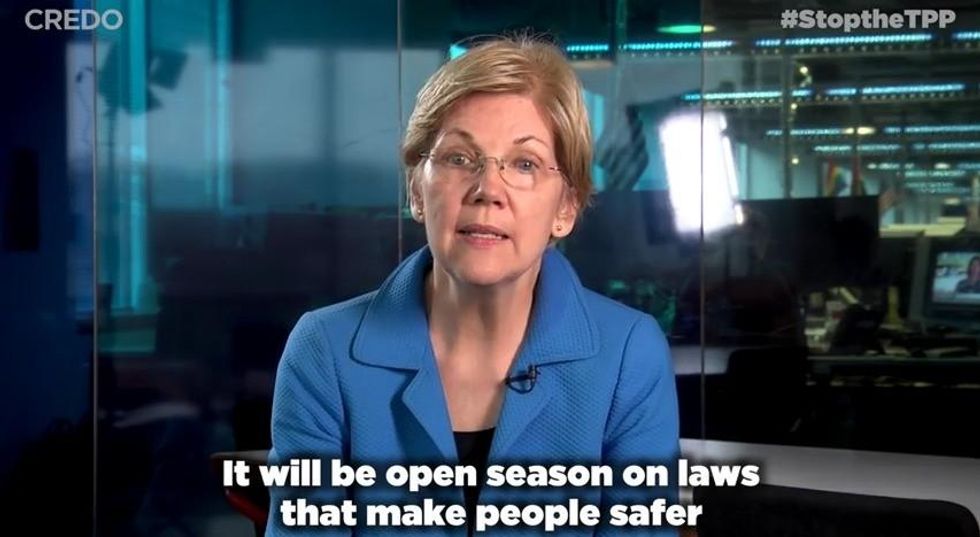
Ahead of this weekend's Democratic platform fight, Sen. Elizabeth Warren (D-Mass.) has once again taken aim at the Trans-Pacific Partnership (TPP), skewering the corporate-friendly trade deal she says will allow for "open season on laws that make people safer."
Warren makes the remarks about the 12-nation trade deal, which still needs Congressional approval, to progressive activists in a video released Thursday by social change network CREDO Action.
The deal, Warren says in the video, "isn't about helping American workers set the rules. It's about letting giant corporations rig the rules--on everything from patent protection to food safety standards --all to benefit themselves."
Even in the drafting process industry representatives could exert influence--but there was no voice to represent American workers or consumers, she says. "A rigged process produces a rigged outcome," she says.
One specific provision of the deal drawing Warren's ire (as it has before) is the "wonky-sounding" Investor State Dispute Settlement, or ISDS.
"This is the part that gives a huge boost to big multinational companies when they want to challenge a country's laws they don't like," she says. They do that not through courts but "industry-friendly arbitration panels staffed with corporate lawyers." Faced with potential billions in fines, "some countries will just back down and change their regulations," she says.
"Workers, environmentalists, and human rights advocates don't get the right to use ISDS; only big corporations do. That's a rigged system," she says. Warren cites specific examples of ISDS challenges-- last year when Canadian taxpayers got stuck with a $300 million bill after the country said a company couldn't expand of a quarry off the coast of Nova Scotia, and when Keystone XL company TransCanada used the ISDS provision of NAFTA to seek $15 billion from the U.S. for its rejection of the pipeline.
With ISDS in the TPP, Warren says, "It will be open season on laws that make people safer--but cut into corporate profits."
She concludes by urging activists to continue their fight stop the TPP.
Watch the full 5-minute video of Warren's remarks below:
Mark Weisbrot, co-director of the Center for Economic and Policy Research and president of Just Foreign Policy,also criticizes the trade deal on Thursday, writing at The Hill that the TPP "is strongly disliked by the base of the Democratic Party, as well as by a sizable majority of Democratic voters and the general public. There's an awful lot not to like about this thing." He cites, for example, how the deal "would grant corporations the right to sue governments for all kinds of decisions, laws or regulations that infringe on their profits or potential profits" and "would increase the price of prescription drugs."
Yet the agreement is "at the heart" of President Barack Obama's trade agenda. Democratic presidential hopeful Hillary Clinton was for the deal before she opposed it, while rival Sen. Bernie Sanders (I-Vt.) has opposed the deal from the get-go. Republican presumptive nominee Donald Trump, meanwhile, is opposed to it, and "has made trade a centerpiece of his campaign, a key to his strategy of winning the votes of working people, particularly in the swing industrial states," as Robert Borosage writes at Campaign for American's Future blog.
Despite the widespread party rejection of the deal, specific opposition to it was kept off of the DNC's platform during a drafting session in St. Louis, and Weisbrot argues that even if the full DNC platform committee fails to includes opposition to it when the group convenes in Orlando on July 8th and 9th, "the Sanders team and its many allies and delegates will take the fight to the floor of the Democratic National Convention, which begins in Philadelphia on July 25."
To that end, while Warren's video did not explicitly mention the platform fight, "opponents of the TPP are likely to view the message as encouragement," Alex Seitz-Wald wrote for MSNBC.
"If," Borosage writes, "Democrats are to address rising inequality and rebuild the middle class, they must define a new, far more balanced trade policy."
"If Democrats can't state clearly where they stand in their platform, few voters will believe that they are prepared to take on the corporate lobby to forge a new course," he continues.
Ultimately, Weisbrot argues, "if the Democratic Party is unable to oppose the TPP, it will be because of [Clinton's] decision to keep it from doing so."
Also on Thursday, CREDO will join other major progressive organizations in releasing a petition signed by hundreds of thousands of Americans urging Democratic House Leader Nancy Pelosi to oppose a lame-duck vote on the TPP. The post-election session, they groups say, is the only time when there's hope for congressional consideration of the deal in 2016.
Ahead of this weekend's Democratic platform fight, Sen. Elizabeth Warren (D-Mass.) has once again taken aim at the Trans-Pacific Partnership (TPP), skewering the corporate-friendly trade deal she says will allow for "open season on laws that make people safer."
Warren makes the remarks about the 12-nation trade deal, which still needs Congressional approval, to progressive activists in a video released Thursday by social change network CREDO Action.
The deal, Warren says in the video, "isn't about helping American workers set the rules. It's about letting giant corporations rig the rules--on everything from patent protection to food safety standards --all to benefit themselves."
Even in the drafting process industry representatives could exert influence--but there was no voice to represent American workers or consumers, she says. "A rigged process produces a rigged outcome," she says.
One specific provision of the deal drawing Warren's ire (as it has before) is the "wonky-sounding" Investor State Dispute Settlement, or ISDS.
"This is the part that gives a huge boost to big multinational companies when they want to challenge a country's laws they don't like," she says. They do that not through courts but "industry-friendly arbitration panels staffed with corporate lawyers." Faced with potential billions in fines, "some countries will just back down and change their regulations," she says.
"Workers, environmentalists, and human rights advocates don't get the right to use ISDS; only big corporations do. That's a rigged system," she says. Warren cites specific examples of ISDS challenges-- last year when Canadian taxpayers got stuck with a $300 million bill after the country said a company couldn't expand of a quarry off the coast of Nova Scotia, and when Keystone XL company TransCanada used the ISDS provision of NAFTA to seek $15 billion from the U.S. for its rejection of the pipeline.
With ISDS in the TPP, Warren says, "It will be open season on laws that make people safer--but cut into corporate profits."
She concludes by urging activists to continue their fight stop the TPP.
Watch the full 5-minute video of Warren's remarks below:
Mark Weisbrot, co-director of the Center for Economic and Policy Research and president of Just Foreign Policy,also criticizes the trade deal on Thursday, writing at The Hill that the TPP "is strongly disliked by the base of the Democratic Party, as well as by a sizable majority of Democratic voters and the general public. There's an awful lot not to like about this thing." He cites, for example, how the deal "would grant corporations the right to sue governments for all kinds of decisions, laws or regulations that infringe on their profits or potential profits" and "would increase the price of prescription drugs."
Yet the agreement is "at the heart" of President Barack Obama's trade agenda. Democratic presidential hopeful Hillary Clinton was for the deal before she opposed it, while rival Sen. Bernie Sanders (I-Vt.) has opposed the deal from the get-go. Republican presumptive nominee Donald Trump, meanwhile, is opposed to it, and "has made trade a centerpiece of his campaign, a key to his strategy of winning the votes of working people, particularly in the swing industrial states," as Robert Borosage writes at Campaign for American's Future blog.
Despite the widespread party rejection of the deal, specific opposition to it was kept off of the DNC's platform during a drafting session in St. Louis, and Weisbrot argues that even if the full DNC platform committee fails to includes opposition to it when the group convenes in Orlando on July 8th and 9th, "the Sanders team and its many allies and delegates will take the fight to the floor of the Democratic National Convention, which begins in Philadelphia on July 25."
To that end, while Warren's video did not explicitly mention the platform fight, "opponents of the TPP are likely to view the message as encouragement," Alex Seitz-Wald wrote for MSNBC.
"If," Borosage writes, "Democrats are to address rising inequality and rebuild the middle class, they must define a new, far more balanced trade policy."
"If Democrats can't state clearly where they stand in their platform, few voters will believe that they are prepared to take on the corporate lobby to forge a new course," he continues.
Ultimately, Weisbrot argues, "if the Democratic Party is unable to oppose the TPP, it will be because of [Clinton's] decision to keep it from doing so."
Also on Thursday, CREDO will join other major progressive organizations in releasing a petition signed by hundreds of thousands of Americans urging Democratic House Leader Nancy Pelosi to oppose a lame-duck vote on the TPP. The post-election session, they groups say, is the only time when there's hope for congressional consideration of the deal in 2016.
Ahead of this weekend's Democratic platform fight, Sen. Elizabeth Warren (D-Mass.) has once again taken aim at the Trans-Pacific Partnership (TPP), skewering the corporate-friendly trade deal she says will allow for "open season on laws that make people safer."
Warren makes the remarks about the 12-nation trade deal, which still needs Congressional approval, to progressive activists in a video released Thursday by social change network CREDO Action.
The deal, Warren says in the video, "isn't about helping American workers set the rules. It's about letting giant corporations rig the rules--on everything from patent protection to food safety standards --all to benefit themselves."
Even in the drafting process industry representatives could exert influence--but there was no voice to represent American workers or consumers, she says. "A rigged process produces a rigged outcome," she says.
One specific provision of the deal drawing Warren's ire (as it has before) is the "wonky-sounding" Investor State Dispute Settlement, or ISDS.
"This is the part that gives a huge boost to big multinational companies when they want to challenge a country's laws they don't like," she says. They do that not through courts but "industry-friendly arbitration panels staffed with corporate lawyers." Faced with potential billions in fines, "some countries will just back down and change their regulations," she says.
"Workers, environmentalists, and human rights advocates don't get the right to use ISDS; only big corporations do. That's a rigged system," she says. Warren cites specific examples of ISDS challenges-- last year when Canadian taxpayers got stuck with a $300 million bill after the country said a company couldn't expand of a quarry off the coast of Nova Scotia, and when Keystone XL company TransCanada used the ISDS provision of NAFTA to seek $15 billion from the U.S. for its rejection of the pipeline.
With ISDS in the TPP, Warren says, "It will be open season on laws that make people safer--but cut into corporate profits."
She concludes by urging activists to continue their fight stop the TPP.
Watch the full 5-minute video of Warren's remarks below:
Mark Weisbrot, co-director of the Center for Economic and Policy Research and president of Just Foreign Policy,also criticizes the trade deal on Thursday, writing at The Hill that the TPP "is strongly disliked by the base of the Democratic Party, as well as by a sizable majority of Democratic voters and the general public. There's an awful lot not to like about this thing." He cites, for example, how the deal "would grant corporations the right to sue governments for all kinds of decisions, laws or regulations that infringe on their profits or potential profits" and "would increase the price of prescription drugs."
Yet the agreement is "at the heart" of President Barack Obama's trade agenda. Democratic presidential hopeful Hillary Clinton was for the deal before she opposed it, while rival Sen. Bernie Sanders (I-Vt.) has opposed the deal from the get-go. Republican presumptive nominee Donald Trump, meanwhile, is opposed to it, and "has made trade a centerpiece of his campaign, a key to his strategy of winning the votes of working people, particularly in the swing industrial states," as Robert Borosage writes at Campaign for American's Future blog.
Despite the widespread party rejection of the deal, specific opposition to it was kept off of the DNC's platform during a drafting session in St. Louis, and Weisbrot argues that even if the full DNC platform committee fails to includes opposition to it when the group convenes in Orlando on July 8th and 9th, "the Sanders team and its many allies and delegates will take the fight to the floor of the Democratic National Convention, which begins in Philadelphia on July 25."
To that end, while Warren's video did not explicitly mention the platform fight, "opponents of the TPP are likely to view the message as encouragement," Alex Seitz-Wald wrote for MSNBC.
"If," Borosage writes, "Democrats are to address rising inequality and rebuild the middle class, they must define a new, far more balanced trade policy."
"If Democrats can't state clearly where they stand in their platform, few voters will believe that they are prepared to take on the corporate lobby to forge a new course," he continues.
Ultimately, Weisbrot argues, "if the Democratic Party is unable to oppose the TPP, it will be because of [Clinton's] decision to keep it from doing so."
Also on Thursday, CREDO will join other major progressive organizations in releasing a petition signed by hundreds of thousands of Americans urging Democratic House Leader Nancy Pelosi to oppose a lame-duck vote on the TPP. The post-election session, they groups say, is the only time when there's hope for congressional consideration of the deal in 2016.

