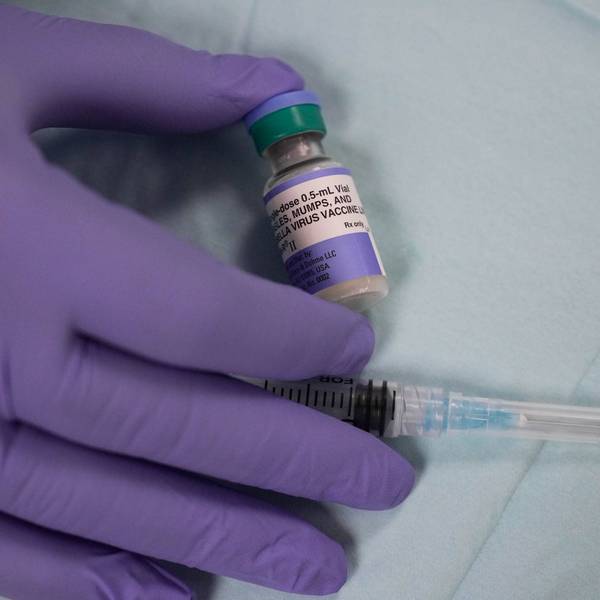

A coalition of healthcare advocacy community organizations gathered outside Pfizer Worldwide Headquarters in Manhattan on March 11, 2021. (Photo: Erik McGregor/LightRocket via Getty Images)
A Vaccine Summit: Taking the Pandemic Seriously
This would mean suspending intellectual property claims over these vaccines.
You might think that, after a year in which have seen millions of deaths and tens of millions of infections, and trillions of dollars in economic losses, our leaders would take the pandemic seriously. But apparently, that is too much to ask.
To my view, taking the pandemic seriously means doing everything we can to get the whole world vaccinated as quickly as possible. This is not just an issue of being concerned for the poor people in the developing world, who are being left behind in the vaccination race, it is a recognition of the reality that viruses mutate.
"Getting the world vaccinated is not about some feel-good gestures, like a few billion dollars for COVAX, the Bill Gates-inspired initiative to make vaccines available in developing countries. It means pulling out all the stops to produce and distribute billions of vaccines as quickly as possible."
We already know about several mutations that are more contagious than the original coronavirus and are at least somewhat more resistant to some of the vaccines that have been developed. If the pandemic is allowed to spread largely unchecked through the developing world for another year or two, then it is virtually certain that we will see many more mutations. Some of these may be even more contagious and deadly, and most importantly, more vaccine-resistant.
The developers of the mRNA vaccines are confident that if this happens, they can quickly tweak their vaccines to make them effective against whatever new mutations develop. This should give us little comfort. Do we want to go through another round of infections, deaths, and lockdowns as we wait for hundreds of millions of the new vaccines to be manufactured and distributed?
Getting the world vaccinated is not about some feel-good gestures, like a few billion dollars for COVAX, the Bill Gates-inspired initiative to make vaccines available in developing countries. It means pulling out all the stops to produce and distribute billions of vaccines as quickly as possible.
To do this, we need the cooperation of the whole world and the elimination of all the barriers to the production and distribution of vaccines. My model here is the bad science fiction movies of the 1950s. When the world was facing an alien invasion, the president of the United States would always call his counterpart in the Soviet Union and agree to a common effort to save humanity. We need to do the same now.
To my view, this means a vaccine summit, which would include Russia and China. We need to produce and distribute vaccines around the world as quickly as possible. That means using every vaccine that has been shown to be safe and effective. Russia has at least one at this point and China has four. Both countries are working on developing more vaccines, as are India, Iran, and Cuba. As soon as a vaccine is shown to meet world standards, we should be producing as much of it as possible and distributing it as quickly as possible.
This will require more transparency of clinical trial results, an area where China's vaccine manufacturers have failed badly and even U.S.-European manufacturers have been far from perfect. We need to know how effective each vaccine is against each variant and have a clear understanding of possible side effects.
I've heard people assert that China will never be open about its results. That could be true, but why not test the claim? There is a lot at stake here.
We also need transparency about production processes so that the technology to manufacture vaccines is freely available for anyone who can use it. The pharmaceutical industry group has been anxious to assert that there is no possible way to increase the production of their vaccines because of inherent limitations in productive capacities. This claim is contradicted by the fact that Pfizer announced the discovery of production efficiencies in early February, that will allow it to nearly double its output. Unless we believe that Pfizer's engineers are the only people in the world who can develop ways to improve its production process, making the knowledge open will lead to further innovations that will allow for more vaccines to be manufactured.
This would mean suspending intellectual property claims over these vaccines. From a moral standpoint, this should not be a tough call since governments paid for so much of the development costs. In the United States, Section 1498 of the commercial code provides legal authority.
We also have the issue that much of the manufacturing expertise is held as an industrial secret by Pfizer, Moderna, and other drug companies. We can buy this expertise, but if these companies choose not to be willing sellers, we can simply go around them. Large payments to their engineers (e.g. $1 million a month) should be able to convince most of them to share their knowledge with the world. The government can also commit to covering their legal liability from lawsuits by their former employers.
These may sound like extreme measures, but what are we going to do if a new and more deadly vaccine-resistant strain develops in Zambia or Burma? I don't want to hear another chorus of "who could have known?" from our intellectuals who missed another huge one.
Let's get it right this time, even if it means having to do things a little differently. Our leaders are not forced to take a vow of incompetence.
We are at a crossroads
This country and this world are at a monumental crossroads. In a few short weeks, US voters will have an opportunity to beat back the forces of fascism and confront the billionaires who are rigging the economy, our media system, and our democracy, making it increasingly impossible for ordinary people to get by. We’re not just talking about the election. We’re talking about what must be done once these fascist elements are vanquished from power. We need a bolder set of solutions than what either major party has so far been willing to offer and a working-class movement ready to fight like hell for it. Trump didn't emerge from nowhere. The conditions that fueled MAGA authoritarianism were created by decades of radical neoliberal economic policies and a corrupt political system dominated by corporate interests. They slashed taxes on the super-rich, promising that the benefits would trickle down. They said giveaways to the corporate titans would make life more affordable for the rest of us. It was all bullshit. And when a bitter, betrayed populace searches for someone to blame, right-wing demagogues have little trouble finding scapegoats. People know when they're being lied to, but you won't hear any of this from the corporate media. Only independent journalism—powered and funded by people who believe in building a better world—can deliver truly trustworthy daily news. Our Fall Campaign is underway, and we need your help. To power our newsroom through the rest of the year, we need to raise $125,000 by midnight on October 31. So if you share our vision, please contribute whatever you can to sustain our work. |
You might think that, after a year in which have seen millions of deaths and tens of millions of infections, and trillions of dollars in economic losses, our leaders would take the pandemic seriously. But apparently, that is too much to ask.
To my view, taking the pandemic seriously means doing everything we can to get the whole world vaccinated as quickly as possible. This is not just an issue of being concerned for the poor people in the developing world, who are being left behind in the vaccination race, it is a recognition of the reality that viruses mutate.
"Getting the world vaccinated is not about some feel-good gestures, like a few billion dollars for COVAX, the Bill Gates-inspired initiative to make vaccines available in developing countries. It means pulling out all the stops to produce and distribute billions of vaccines as quickly as possible."
We already know about several mutations that are more contagious than the original coronavirus and are at least somewhat more resistant to some of the vaccines that have been developed. If the pandemic is allowed to spread largely unchecked through the developing world for another year or two, then it is virtually certain that we will see many more mutations. Some of these may be even more contagious and deadly, and most importantly, more vaccine-resistant.
The developers of the mRNA vaccines are confident that if this happens, they can quickly tweak their vaccines to make them effective against whatever new mutations develop. This should give us little comfort. Do we want to go through another round of infections, deaths, and lockdowns as we wait for hundreds of millions of the new vaccines to be manufactured and distributed?
Getting the world vaccinated is not about some feel-good gestures, like a few billion dollars for COVAX, the Bill Gates-inspired initiative to make vaccines available in developing countries. It means pulling out all the stops to produce and distribute billions of vaccines as quickly as possible.
To do this, we need the cooperation of the whole world and the elimination of all the barriers to the production and distribution of vaccines. My model here is the bad science fiction movies of the 1950s. When the world was facing an alien invasion, the president of the United States would always call his counterpart in the Soviet Union and agree to a common effort to save humanity. We need to do the same now.
To my view, this means a vaccine summit, which would include Russia and China. We need to produce and distribute vaccines around the world as quickly as possible. That means using every vaccine that has been shown to be safe and effective. Russia has at least one at this point and China has four. Both countries are working on developing more vaccines, as are India, Iran, and Cuba. As soon as a vaccine is shown to meet world standards, we should be producing as much of it as possible and distributing it as quickly as possible.
This will require more transparency of clinical trial results, an area where China's vaccine manufacturers have failed badly and even U.S.-European manufacturers have been far from perfect. We need to know how effective each vaccine is against each variant and have a clear understanding of possible side effects.
I've heard people assert that China will never be open about its results. That could be true, but why not test the claim? There is a lot at stake here.
We also need transparency about production processes so that the technology to manufacture vaccines is freely available for anyone who can use it. The pharmaceutical industry group has been anxious to assert that there is no possible way to increase the production of their vaccines because of inherent limitations in productive capacities. This claim is contradicted by the fact that Pfizer announced the discovery of production efficiencies in early February, that will allow it to nearly double its output. Unless we believe that Pfizer's engineers are the only people in the world who can develop ways to improve its production process, making the knowledge open will lead to further innovations that will allow for more vaccines to be manufactured.
This would mean suspending intellectual property claims over these vaccines. From a moral standpoint, this should not be a tough call since governments paid for so much of the development costs. In the United States, Section 1498 of the commercial code provides legal authority.
We also have the issue that much of the manufacturing expertise is held as an industrial secret by Pfizer, Moderna, and other drug companies. We can buy this expertise, but if these companies choose not to be willing sellers, we can simply go around them. Large payments to their engineers (e.g. $1 million a month) should be able to convince most of them to share their knowledge with the world. The government can also commit to covering their legal liability from lawsuits by their former employers.
These may sound like extreme measures, but what are we going to do if a new and more deadly vaccine-resistant strain develops in Zambia or Burma? I don't want to hear another chorus of "who could have known?" from our intellectuals who missed another huge one.
Let's get it right this time, even if it means having to do things a little differently. Our leaders are not forced to take a vow of incompetence.