
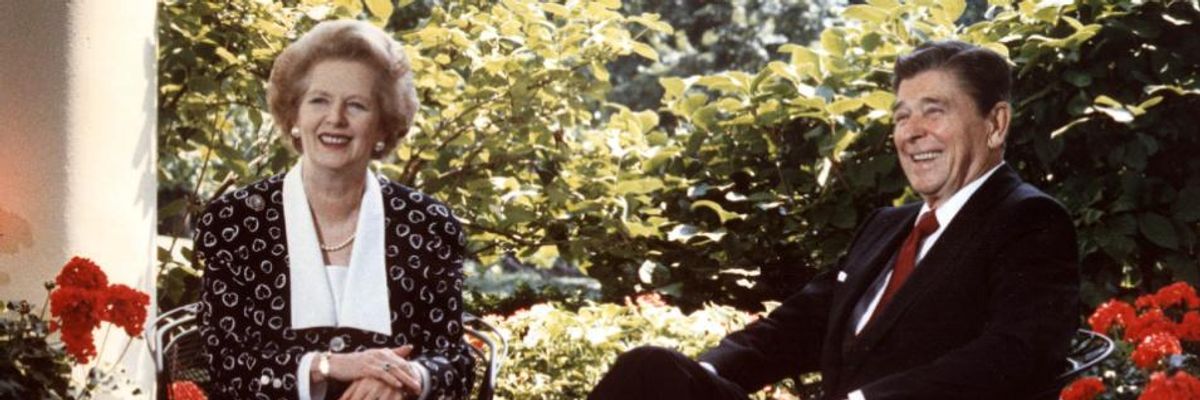
Former U.S. President Ronald Reagan and former British Prime Minister Margaret Thatcher sit on the patio outside the Oval Office on July 17, 1987 in Washington, D.C. (Photo: Mike Sargent/AFP via Getty Images)
Truth Remains Under Siege As Long As Economists Promote Discredited Policies That Hurt People and Gave Rise to Trumpism
In the natural sciences, strictly observed protocols ensure that empirically unsupported theories are rejected in light of evidence. The authority of an economic hypothesis, however, is bolstered by a peer-review process that—far from being scientific—is a value-laden power struggle.
Former U.S. President Donald Trump's opponents call him a liar. But Trump is far worse than a liar. Many politicians lie to cover up inconvenient truths. But Trump can punctuate long sequences of eye-watering mendacity with verities that no other president would ever admit to, from dismissing the dominant view of globalization as unambiguously beneficial to acknowledging that, yes, he tried to defund the United States Postal Service to make it harder for Democrats to vote.
To determine whether we can expect an across-the-board truth revival under President Joe Biden, we need to recall how our societies discern truth in the first place.
Scientists have good reason to celebrate Trump's departure, judging by their evident relief that they can now present epidemiological data from the White House podium without fear of retribution. But to determine whether we can expect an across-the-board truth revival under President Joe Biden, we need to recall how our societies discern truth in the first place.
Liberals love the market analogy. Like gadgets, opinions are floated in the great marketplace of ideas, where a decentralized process, involving consumers and producers of views and news, evaluates them. True opinions outcompete the false.
Unfortunately, the marketplace of ideas is itself a lie. Unlike gadgets or strawberries, the utility of ideas cannot be judged at the individual level. The truth of Darwinism, Einstein's special relativity, or Keynes's point that monetary policy stops working once interest rates hit zero, is not ascertainable by the average Jill or Jack on the basis of personal experience. That is why we rely on top-heavy, inherently undemocratic institutions to test these theories on our behalf.
Universities and scientific associations assume the task of filtering out falsity. In contrast to the market analogy, they operate as a centrally planned league organizing the hierarchical peer-review process with a view to falsifying propositions dispassionately.
Every scientist has a motive to see their pet theory survive this process, but at least in the natural sciences, strictly observed protocols ensure that empirically unsupported theories dissolve in the light of evidence. The top-heavy, impersonal scientific process liberated our ancestors from ignorance and, together with commodification, brought down the mother of all top-down systems: feudalism.
Trump is more dangerous than a mere liar because he found a way to exploit the economic doppelganger of science. Behind every government policy that affects us lurks some economic hypothesis whose authority is bolstered by a peer-review process that the naked eye can mistake for the scientific process. Economics even confers its own Nobel Prize. But it is nothing like the real McCoy, which makes it Trump's great, if unwitting, ally.
Consider the three pillars of any popular conspiracy theory. It provides adherents with the giddy feeling that they possess superior knowledge. It empowers them to expose experts' selfish reasons for propagating untruths. And, lastly, it enlists them in a cause that is greater than themselves against an enemy who will stop at nothing to prevent truth from shining through.
Lest we forget, these are the same pillars that supported the scientific revolution. What sets science apart is the process of falsification. Conspiracy theorists do not fear empirical evidence, because they can explain it away or incorporate it into the theory itself. In contrast, empirical evidence helps science dismiss untruth, owing to nature's indifference to our theories about it. The weather will do what it will, regardless of a meteorologist's predictions, so when the meteorologist's predictions are wrong, her model must be wrong.
For decades before his election, countless disempowered people had been listening to economic experts tell them that the policies wrecking their lives survived the scientific falsification process. It was a monstrous lie that allowed Trump to weaponize their despair against the "establishment"--and also against a scientific ethos tainted by its association with economics.
Have you wondered how two Nobel laureate economists, sometimes sharing the same year's prize, can consider each other charlatans? This would never happen among Nobel laureate physicists or biologists. The reason it happens among economists is that markets and societies are nothing like the weather. Unlike in meteorology, if a venerable financial analyst predicts a sharp drop in the stock exchange, that drop will happen, even if the analyst was drunk when he made the prediction.
This is why neither empirical success nor failure causes an economic theory ever to be dismissed. Like conspiracy theorists and theologians, economists of different schools--Keynesians, monetarists, and Marxists, for example--can explain every possible observation within the confines of their particular paradigm. And, like religions, the prevailing creed results from power struggles between groups hiding their interests behind different dogmas.
Herein lies Trump's opening. For decades before his election, countless disempowered people had been listening to economic experts tell them that the policies wrecking their lives survived the scientific falsification process. It was a monstrous lie that allowed Trump to weaponize their despair against the "establishment"--and also against a scientific ethos tainted by its association with economics.
Trump is out, thankfully. But the view of economics that gave Trump his political toehold remains entrenched, its influence even greater under President Joe Biden. The new administration brims with the same experts who promoted the false prophecies that reinforced the unequal, exploitative, irrational social and economic order that begat Trumpism.
Consider their invention of the mystical notion of "natural" unemployment to explain away the failure of their theory that lowering real wages boosts employment. Or recall how, when the deregulation they promoted caused the financial crisis, they blamed the state's overreach in the mortgage business, while pressing governments to bail out their deregulated paymasters.
Normalcy is back at the White House. Biden will try not to lie, resorting when he must to being economical with the truth. But he will also never reveal crucial truths like those Trump occasionally let slip. Truth will thus remain under siege from the experts serving the new administration and from Trumpism--the movement midwifed by the toxic policies these experts' fake economic truths supported.
We are at a crossroads
This country and this world are at a monumental crossroads. In a few short weeks, US voters will have an opportunity to beat back the forces of fascism and confront the billionaires who are rigging the economy, our media system, and our democracy, making it increasingly impossible for ordinary people to get by. We’re not just talking about the election. We’re talking about what must be done once these fascist elements are vanquished from power. We need a bolder set of solutions than what either major party has so far been willing to offer and a working-class movement ready to fight like hell for it. Trump didn't emerge from nowhere. The conditions that fueled MAGA authoritarianism were created by decades of radical neoliberal economic policies and a corrupt political system dominated by corporate interests. They slashed taxes on the super-rich, promising that the benefits would trickle down. They said giveaways to the corporate titans would make life more affordable for the rest of us. It was all bullshit. And when a bitter, betrayed populace searches for someone to blame, right-wing demagogues have little trouble finding scapegoats. People know when they're being lied to, but you won't hear any of this from the corporate media. Only independent journalism—powered and funded by people who believe in building a better world—can deliver truly trustworthy daily news. Our Fall Campaign is underway, and we need your help. To power our newsroom through the rest of the year, we need to raise $125,000 by midnight on October 31. So if you share our vision, please contribute whatever you can to sustain our work. |
Former U.S. President Donald Trump's opponents call him a liar. But Trump is far worse than a liar. Many politicians lie to cover up inconvenient truths. But Trump can punctuate long sequences of eye-watering mendacity with verities that no other president would ever admit to, from dismissing the dominant view of globalization as unambiguously beneficial to acknowledging that, yes, he tried to defund the United States Postal Service to make it harder for Democrats to vote.
To determine whether we can expect an across-the-board truth revival under President Joe Biden, we need to recall how our societies discern truth in the first place.
Scientists have good reason to celebrate Trump's departure, judging by their evident relief that they can now present epidemiological data from the White House podium without fear of retribution. But to determine whether we can expect an across-the-board truth revival under President Joe Biden, we need to recall how our societies discern truth in the first place.
Liberals love the market analogy. Like gadgets, opinions are floated in the great marketplace of ideas, where a decentralized process, involving consumers and producers of views and news, evaluates them. True opinions outcompete the false.
Unfortunately, the marketplace of ideas is itself a lie. Unlike gadgets or strawberries, the utility of ideas cannot be judged at the individual level. The truth of Darwinism, Einstein's special relativity, or Keynes's point that monetary policy stops working once interest rates hit zero, is not ascertainable by the average Jill or Jack on the basis of personal experience. That is why we rely on top-heavy, inherently undemocratic institutions to test these theories on our behalf.
Universities and scientific associations assume the task of filtering out falsity. In contrast to the market analogy, they operate as a centrally planned league organizing the hierarchical peer-review process with a view to falsifying propositions dispassionately.
Every scientist has a motive to see their pet theory survive this process, but at least in the natural sciences, strictly observed protocols ensure that empirically unsupported theories dissolve in the light of evidence. The top-heavy, impersonal scientific process liberated our ancestors from ignorance and, together with commodification, brought down the mother of all top-down systems: feudalism.
Trump is more dangerous than a mere liar because he found a way to exploit the economic doppelganger of science. Behind every government policy that affects us lurks some economic hypothesis whose authority is bolstered by a peer-review process that the naked eye can mistake for the scientific process. Economics even confers its own Nobel Prize. But it is nothing like the real McCoy, which makes it Trump's great, if unwitting, ally.
Consider the three pillars of any popular conspiracy theory. It provides adherents with the giddy feeling that they possess superior knowledge. It empowers them to expose experts' selfish reasons for propagating untruths. And, lastly, it enlists them in a cause that is greater than themselves against an enemy who will stop at nothing to prevent truth from shining through.
Lest we forget, these are the same pillars that supported the scientific revolution. What sets science apart is the process of falsification. Conspiracy theorists do not fear empirical evidence, because they can explain it away or incorporate it into the theory itself. In contrast, empirical evidence helps science dismiss untruth, owing to nature's indifference to our theories about it. The weather will do what it will, regardless of a meteorologist's predictions, so when the meteorologist's predictions are wrong, her model must be wrong.
For decades before his election, countless disempowered people had been listening to economic experts tell them that the policies wrecking their lives survived the scientific falsification process. It was a monstrous lie that allowed Trump to weaponize their despair against the "establishment"--and also against a scientific ethos tainted by its association with economics.
Have you wondered how two Nobel laureate economists, sometimes sharing the same year's prize, can consider each other charlatans? This would never happen among Nobel laureate physicists or biologists. The reason it happens among economists is that markets and societies are nothing like the weather. Unlike in meteorology, if a venerable financial analyst predicts a sharp drop in the stock exchange, that drop will happen, even if the analyst was drunk when he made the prediction.
This is why neither empirical success nor failure causes an economic theory ever to be dismissed. Like conspiracy theorists and theologians, economists of different schools--Keynesians, monetarists, and Marxists, for example--can explain every possible observation within the confines of their particular paradigm. And, like religions, the prevailing creed results from power struggles between groups hiding their interests behind different dogmas.
Herein lies Trump's opening. For decades before his election, countless disempowered people had been listening to economic experts tell them that the policies wrecking their lives survived the scientific falsification process. It was a monstrous lie that allowed Trump to weaponize their despair against the "establishment"--and also against a scientific ethos tainted by its association with economics.
Trump is out, thankfully. But the view of economics that gave Trump his political toehold remains entrenched, its influence even greater under President Joe Biden. The new administration brims with the same experts who promoted the false prophecies that reinforced the unequal, exploitative, irrational social and economic order that begat Trumpism.
Consider their invention of the mystical notion of "natural" unemployment to explain away the failure of their theory that lowering real wages boosts employment. Or recall how, when the deregulation they promoted caused the financial crisis, they blamed the state's overreach in the mortgage business, while pressing governments to bail out their deregulated paymasters.
Normalcy is back at the White House. Biden will try not to lie, resorting when he must to being economical with the truth. But he will also never reveal crucial truths like those Trump occasionally let slip. Truth will thus remain under siege from the experts serving the new administration and from Trumpism--the movement midwifed by the toxic policies these experts' fake economic truths supported.