SUBSCRIBE TO OUR FREE NEWSLETTER
Daily news & progressive opinion—funded by the people, not the corporations—delivered straight to your inbox.
5
#000000
#FFFFFF
To donate by check, phone, or other method, see our More Ways to Give page.
Daily news & progressive opinion—funded by the people, not the corporations—delivered straight to your inbox.
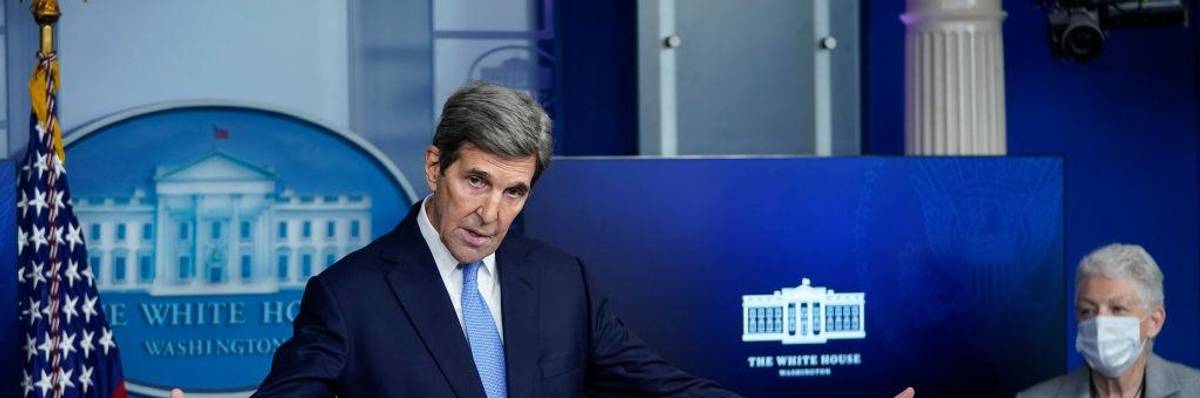
Special Presidential Envoy for Climate John Kerry and National Climate Advisor Gina McCarthy answer questions during a press briefing at the White House on January 27, 2021 in Washington, DC. Kerry and McCarthy took questions from reporters about the Biden administration's plans and agenda on climate change issues. (Photo by Drew Angerer/Getty Images)
This article first appeared on the website The American Prospect.
On the same day he was inaugurated, along with signing a slew of executive orders, President Biden rejoined the Paris climate agreement. The move was celebrated as showing Biden's commitment to addressing the climate crisis. As he promised in his campaign, Biden is prioritizing four "converging crises": COVID, economic crisis, climate crisis, and racial justice. This policy shift is long overdue and welcome.
John Kerry--whom Biden appointed special presidential envoy for climate, the first-ever climate-focused appointment to the National Security Council--responded early the next day with a statement at a meeting of business leaders at the G20. "All nations must raise ambition together--or we will all fail, together," Kerry said. Recognizing that no single country holds the key to reducing global greenhouse gas emissions, and thus the need for international cooperation, is key to ratcheting down greenhouse gas emissions, which encompass four main types including carbon dioxide (CO2) emissions, and to solving the climate crisis.
Kerry said that all countries must also approach the climate crisis with some measure of humility. Acknowledging the U.S. history of dithering, he stated: "Humility because we know that the federal government of the United States, until yesterday, walked away from the table for four wasted years when we could've been helping to meet the challenge."
Yet he continued: "Humility also in knowing that for all our industrial capacity, the United States is responsible for only 15% of global emissions" (emphasis added).
For decades, the U.S. has been deflecting responsibility for its role in the warming of the planet, and drawing out the timeline.
Let's be clear about one point well in advance of the U.N. climate conference, scheduled for Glasgow at the end of 2021: The U.S. must lead by example. For decades, the U.S. has been deflecting responsibility for its role in the warming of the planet, and drawing out the timeline. As youth delegate Anjali Appadurai put it at the U.N. climate conference in 2011: "You've been negotiating all my life. Get it done!"
To that end, two issues and two changes related to them are key from the outset if the U.S. is to show true leadership and address the climate crisis at the U.N.
First issue: It's time to end the dynamic where the U.S. will not move unless China does. In a dangerous game of chicken that only gambles away the future of our planet and all life on it, the U.S. to date has not set ambitious targets, typically arguing that China must bear its own fair burden.
Year in, year out, the headlines covering the U.N. climate conference typically focus on the U.S.-China standoff. To be sure, they are the world's two biggest CO2 emitters: China at 28 percent, followed by the U.S. at 15 percent (India at 7 percent and Russia at 5 percent come next).
But if one attends the conference, one hears individual nation-states and the clusters to which they belong (in the U.N.'s parlance, the African Group, the Alliance of Small Island States, the Least Developed Countries, the Small Island Developing States, etc.) stand up one by one and describe the situation in their home nations. The conference typically takes place on the heels of cyclone, hurricane, and typhoon seasons, so there is usually a lot of devastating news.
Despite the fact that many nations have contributed negligible amounts of CO2 emissions, they have already been suffering the impacts of the climate crisis severely and disproportionately. According to the Intergovernmental Panel on Climate Change, Pacific Island nations are responsible for 0.03 percent of global emissions, and figures for CO2 emissions of island nations in the Caribbean and the Indian Ocean are similar. Yet, despite lacking resources, often related to the legacy of colonialism and modern-day imperialism, these impacted nations have been taking action.
The U.S., meanwhile, looks at China. This must stop.
Humility does not mean that the U.S. should point the finger elsewhere because it is merely the second-most responsible. And of course, "second-most" only refers to currently, not historically. Humility should mean that the U.S. takes a different tack. It means the U.S. should lead by example.
First solution: How about the U.S. cuts its emissions, as the European Union is proposing to do, aiming to be climate-neutral by 2050.
Humility does not mean that the U.S. should point the finger elsewhere because it is merely the second-most responsible.
Second issue: How about the U.S. stops fudging the numbers. Before your eyes glaze over, let me explain the math briefly. The U.S. uses the year 2005 as a baseline by which to judge the country's reduction of greenhouse gas emissions (GHGs). By 2005, the U.S. was already producing far higher GHGs than it was under the original benchmark of 1990. Long story short, the 2005 baseline means the United States' 26 to 28 percent reduction by 2025 amounts to a mere 10 to 17 percent reduction based on 1990 levels, which most countries use. That's only between one-half and one-quarter of the EU's Paris Agreement pledge of a 40 percent reduction by 2030 based on 1990 levels.
Second solution: Let's stop fudging the numbers. Instead of 2005, the U.S. must use 1990 as a baseline for greenhouse gas emissions reductions.
There's a great deal of enthusiasm in the air right now about the Biden administration with regard to his climate team. Of course, there is already criticism with regard to some decisions and appointments. Skepticism always abounds. But if the Biden administration and Kerry as his envoy for climate truly plan to address the climate crisis, the U.S. needs to take ambitious action, including at the U.N. climate conference, or Conference of the Parties (COP).
"At the COP in November," Kerry stated, "[f]ailure is not an option. And that's why ambition is so important."
True enough. So the U.S. should lead by example and take the first step.
This country and this world are at a monumental crossroads. US voters have an opportunity to beat back the forces of fascism and confront the billionaires who are rigging the economy, our media system, and our democracy, making it increasingly impossible for ordinary people to get by. We’re not just talking about the election. We’re talking about what must be done once these fascist elements are vanquished from power. We need a bolder set of solutions than what either major party has so far been willing to offer and a working-class movement ready to fight like hell for it. Trump didn't emerge from nowhere. The conditions that fueled MAGA authoritarianism were created by decades of radical neoliberal economic policies and a corrupt political system dominated by corporate interests. They slashed taxes on the super-rich, promising that the benefits would trickle down. They said giveaways to the corporate titans would make life more affordable for the rest of us. It was all bullshit. And when a bitter, betrayed populace searches for someone to blame, right-wing demagogues have little trouble finding scapegoats. People know when they're being lied to, but you won't hear any of this from the corporate media. Only independent journalism—powered and funded by people who believe in building a better world—can deliver truly trustworthy daily news. If you share our vision, please contribute whatever you can to sustain our work. |
Tina Gerhardt is an environmental journalist who covers international climate change negotiations, domestic and state energy policy and sea level rise. Her writing has been published in Common Dreams, Grist, The Nation, The Progressive, Sierra Magazine, and Washington Monthly. Her latest book is Sea Change: An Atlas of Islands in a Rising Ocean (University of California Press, 2023).
This article first appeared on the website The American Prospect.
On the same day he was inaugurated, along with signing a slew of executive orders, President Biden rejoined the Paris climate agreement. The move was celebrated as showing Biden's commitment to addressing the climate crisis. As he promised in his campaign, Biden is prioritizing four "converging crises": COVID, economic crisis, climate crisis, and racial justice. This policy shift is long overdue and welcome.
John Kerry--whom Biden appointed special presidential envoy for climate, the first-ever climate-focused appointment to the National Security Council--responded early the next day with a statement at a meeting of business leaders at the G20. "All nations must raise ambition together--or we will all fail, together," Kerry said. Recognizing that no single country holds the key to reducing global greenhouse gas emissions, and thus the need for international cooperation, is key to ratcheting down greenhouse gas emissions, which encompass four main types including carbon dioxide (CO2) emissions, and to solving the climate crisis.
Kerry said that all countries must also approach the climate crisis with some measure of humility. Acknowledging the U.S. history of dithering, he stated: "Humility because we know that the federal government of the United States, until yesterday, walked away from the table for four wasted years when we could've been helping to meet the challenge."
Yet he continued: "Humility also in knowing that for all our industrial capacity, the United States is responsible for only 15% of global emissions" (emphasis added).
For decades, the U.S. has been deflecting responsibility for its role in the warming of the planet, and drawing out the timeline.
Let's be clear about one point well in advance of the U.N. climate conference, scheduled for Glasgow at the end of 2021: The U.S. must lead by example. For decades, the U.S. has been deflecting responsibility for its role in the warming of the planet, and drawing out the timeline. As youth delegate Anjali Appadurai put it at the U.N. climate conference in 2011: "You've been negotiating all my life. Get it done!"
To that end, two issues and two changes related to them are key from the outset if the U.S. is to show true leadership and address the climate crisis at the U.N.
First issue: It's time to end the dynamic where the U.S. will not move unless China does. In a dangerous game of chicken that only gambles away the future of our planet and all life on it, the U.S. to date has not set ambitious targets, typically arguing that China must bear its own fair burden.
Year in, year out, the headlines covering the U.N. climate conference typically focus on the U.S.-China standoff. To be sure, they are the world's two biggest CO2 emitters: China at 28 percent, followed by the U.S. at 15 percent (India at 7 percent and Russia at 5 percent come next).
But if one attends the conference, one hears individual nation-states and the clusters to which they belong (in the U.N.'s parlance, the African Group, the Alliance of Small Island States, the Least Developed Countries, the Small Island Developing States, etc.) stand up one by one and describe the situation in their home nations. The conference typically takes place on the heels of cyclone, hurricane, and typhoon seasons, so there is usually a lot of devastating news.
Despite the fact that many nations have contributed negligible amounts of CO2 emissions, they have already been suffering the impacts of the climate crisis severely and disproportionately. According to the Intergovernmental Panel on Climate Change, Pacific Island nations are responsible for 0.03 percent of global emissions, and figures for CO2 emissions of island nations in the Caribbean and the Indian Ocean are similar. Yet, despite lacking resources, often related to the legacy of colonialism and modern-day imperialism, these impacted nations have been taking action.
The U.S., meanwhile, looks at China. This must stop.
Humility does not mean that the U.S. should point the finger elsewhere because it is merely the second-most responsible. And of course, "second-most" only refers to currently, not historically. Humility should mean that the U.S. takes a different tack. It means the U.S. should lead by example.
First solution: How about the U.S. cuts its emissions, as the European Union is proposing to do, aiming to be climate-neutral by 2050.
Humility does not mean that the U.S. should point the finger elsewhere because it is merely the second-most responsible.
Second issue: How about the U.S. stops fudging the numbers. Before your eyes glaze over, let me explain the math briefly. The U.S. uses the year 2005 as a baseline by which to judge the country's reduction of greenhouse gas emissions (GHGs). By 2005, the U.S. was already producing far higher GHGs than it was under the original benchmark of 1990. Long story short, the 2005 baseline means the United States' 26 to 28 percent reduction by 2025 amounts to a mere 10 to 17 percent reduction based on 1990 levels, which most countries use. That's only between one-half and one-quarter of the EU's Paris Agreement pledge of a 40 percent reduction by 2030 based on 1990 levels.
Second solution: Let's stop fudging the numbers. Instead of 2005, the U.S. must use 1990 as a baseline for greenhouse gas emissions reductions.
There's a great deal of enthusiasm in the air right now about the Biden administration with regard to his climate team. Of course, there is already criticism with regard to some decisions and appointments. Skepticism always abounds. But if the Biden administration and Kerry as his envoy for climate truly plan to address the climate crisis, the U.S. needs to take ambitious action, including at the U.N. climate conference, or Conference of the Parties (COP).
"At the COP in November," Kerry stated, "[f]ailure is not an option. And that's why ambition is so important."
True enough. So the U.S. should lead by example and take the first step.