SUBSCRIBE TO OUR FREE NEWSLETTER
Daily news & progressive opinion—funded by the people, not the corporations—delivered straight to your inbox.
5
#000000
#FFFFFF
To donate by check, phone, or other method, see our More Ways to Give page.
Daily news & progressive opinion—funded by the people, not the corporations—delivered straight to your inbox.
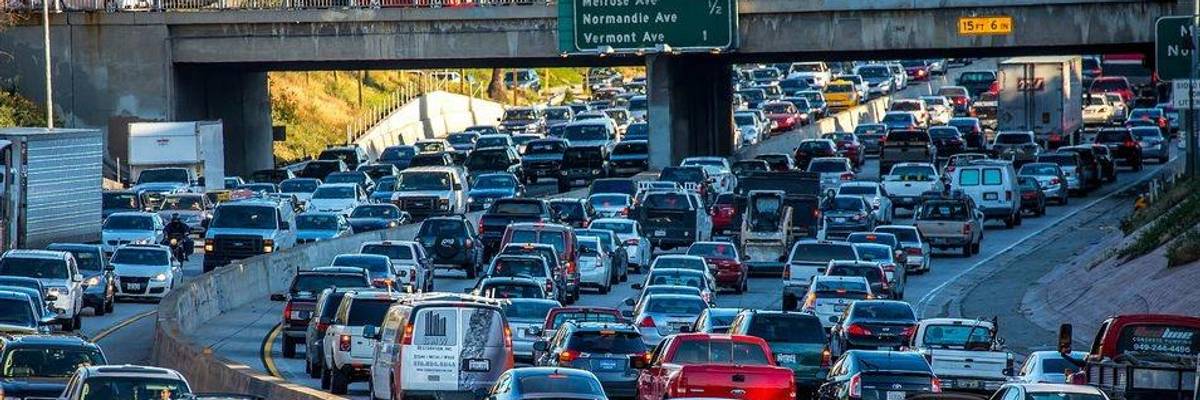
Biden promises a New Day from Trumpism. Let's see if he and his team can provide America with a New Day of Public Safety from callous corporatism on the nation's roadways. (Photo: Eric Demarcq/flickr/cc)
Today the New York Times rediscovered its previous auto safety news beat that blossomed in the 1960s after my book, Unsafe at Any Speed (1965) caused an uproar in Detroit. Reporter Christopher Jensen told New York Times readers about a new report by a coalition of six automotive safety groups demanding that the new Biden Administration recharge the moribund, industry-dominated National Highway Traffic Safety Administration (NHTSA) with strong leadership, adequate budget, and long-overdue, proven vehicle safety standards.
Since its creation by Congress in 1966, NHTSA has had some bright moments which made motor vehicles more crash-worthy and operationally safer, with less pollution and more fuel efficiency. Since then, over four million lives have been saved and many more injuries prevented. Property damage was diminished and insurance premiums were lower than they would have been had the "wild west" non-regulation, "style over safety" manias been allowed to continue. Laissez-faire runs amok.
In recent decades, however, under both Democratic and Republican Administrations, NHTSA was degraded into more of a sporadic, meek consultant to the auto giants, instead of a strong law enforcement agency. Its Administrators wafted sleepily in their few years at the helm and then retired to lucrative positions in the industry they failed to regulate.
To the extent that NHTSA did anything significant, it was due to a small band of gritty citizen safety advocates such as Joan Claybrook, the prime author of this report, Clarence Ditlow of the Center for Auto Safety, and the insurance-industry-funded Advocates for Highway and Auto Safety led until recently by Jackie Gillan and now Cathy Chase. These advocates used the tools of litigation and lobbying to protect all of us, receiving little recognition for their unsung and life-saving endeavors.
Alas for the most part, at NHTSA, the routine was official inaction, not considered "news" by the mass media. Standards not issued nor strengthened, recalls not ordered, penalties not applied, data not compiled by make and model, safety research vehicles not funded and chronic secrecy by the auto companies and government not qualifying as "newsworthy." A few high-profile auto defect scandals, often exposed when manufacturers were sued by tort lawyers, were widely reported, but the news coverage rarely included NHTSA's inaction and institutional abandonment by Congress and the White House.
The revival of the federal government's motor vehicle safety/pollution/fuel efficiency missions must start with Congressional hearings for updated, stronger laws, including criminal penalties for refusal by auto companies to recall defective or noncompliant vehicles, legislatively mandated safety advances, and more capacity and funding for NHTSA's tiny budget, now far less than what is spent on military bands!
With distracted driving and ever more vehicles on more crowded highways, fatalities (including pedestrian casualties) started to increase pre-Covid.
The media, on its part, should not be distracted by the hype around a premature autonomous vehicle and super smart highways. Every day, people are dying in the old-fashioned ways that could be prevented by long-ready, better-handling and crash-protective vehicles.
Imagine the benefits of safer vehicles with far more environmentally benign engines and adequate funding for cost-effective public investment in new forms of public transit and upgrading existing mass transit. Getting around on the ground should include many diverse forms of arriving at one's destination in a timely, safe, and environmentally preferable manner.
The Claybrook report titled, Safer Vehicles and Highways: 4.2 million U.S. Lives Spared Since 1966, is very specific about what needs to be done. New technical talent is needed at NHTSA in this era of electric cars, autonomous safety assists, and the computerization of motor vehicles vulnerable to hacking.
A tougher position on recalls is essential. "Automakers continue efforts to minimize expensive recall costs by delaying the recall, narrowing the scope of a recall, or denying the defect," declares the report.
Moreover, many of the safety features and performance levels in your vehicle have not been updated for years in practical, cost-effective ways long urged by the more innovative automotive suppliers. These include child safety safeguards.
It is time for the Biden people, under the new Secretary of Transportation, Pete Buttigieg, to catch up and end the soporific record of their predecessors, including that of those from the Obama/Biden Administration. (See: Jerry Cox Steven Bradbury and Why 30 Million Takata Airbags Are Not being Recalled).
The French have a saying "the more things change the more they remain the same." That applies to the auto company executive-suite culture. In their comfortable atriums, they arrange for deniability while they press for immunity from criminal and tort laws. They still preside over obscure financing and advertising deceptions. They still dangle before buyers of their less expensive vehicles, over-priced options for long-amortized safety improvements that are standard equipment on higher-priced vehicles so as to pressure them to upgrade.
They still instruct their lobbyists to go to Congress with one message "NO, NO, NO" to long-delayed improvements for motorists to reduce the casualty toll on the highway and the various economic costs associated with such stagnant corporate stubbornness.
Biden promises a New Day from Trumpism. Let's see if he and his team can provide America with a New Day of Public Safety from callous corporatism on the nation's roadways.
Dear Common Dreams reader, It’s been nearly 30 years since I co-founded Common Dreams with my late wife, Lina Newhouser. We had the radical notion that journalism should serve the public good, not corporate profits. It was clear to us from the outset what it would take to build such a project. No paid advertisements. No corporate sponsors. No millionaire publisher telling us what to think or do. Many people said we wouldn't last a year, but we proved those doubters wrong. Together with a tremendous team of journalists and dedicated staff, we built an independent media outlet free from the constraints of profits and corporate control. Our mission has always been simple: To inform. To inspire. To ignite change for the common good. Building Common Dreams was not easy. Our survival was never guaranteed. When you take on the most powerful forces—Wall Street greed, fossil fuel industry destruction, Big Tech lobbyists, and uber-rich oligarchs who have spent billions upon billions rigging the economy and democracy in their favor—the only bulwark you have is supporters who believe in your work. But here’s the urgent message from me today. It's never been this bad out there. And it's never been this hard to keep us going. At the very moment Common Dreams is most needed, the threats we face are intensifying. We need your support now more than ever. We don't accept corporate advertising and never will. We don't have a paywall because we don't think people should be blocked from critical news based on their ability to pay. Everything we do is funded by the donations of readers like you. When everyone does the little they can afford, we are strong. But if that support retreats or dries up, so do we. Will you donate now to make sure Common Dreams not only survives but thrives? —Craig Brown, Co-founder |
Today the New York Times rediscovered its previous auto safety news beat that blossomed in the 1960s after my book, Unsafe at Any Speed (1965) caused an uproar in Detroit. Reporter Christopher Jensen told New York Times readers about a new report by a coalition of six automotive safety groups demanding that the new Biden Administration recharge the moribund, industry-dominated National Highway Traffic Safety Administration (NHTSA) with strong leadership, adequate budget, and long-overdue, proven vehicle safety standards.
Since its creation by Congress in 1966, NHTSA has had some bright moments which made motor vehicles more crash-worthy and operationally safer, with less pollution and more fuel efficiency. Since then, over four million lives have been saved and many more injuries prevented. Property damage was diminished and insurance premiums were lower than they would have been had the "wild west" non-regulation, "style over safety" manias been allowed to continue. Laissez-faire runs amok.
In recent decades, however, under both Democratic and Republican Administrations, NHTSA was degraded into more of a sporadic, meek consultant to the auto giants, instead of a strong law enforcement agency. Its Administrators wafted sleepily in their few years at the helm and then retired to lucrative positions in the industry they failed to regulate.
To the extent that NHTSA did anything significant, it was due to a small band of gritty citizen safety advocates such as Joan Claybrook, the prime author of this report, Clarence Ditlow of the Center for Auto Safety, and the insurance-industry-funded Advocates for Highway and Auto Safety led until recently by Jackie Gillan and now Cathy Chase. These advocates used the tools of litigation and lobbying to protect all of us, receiving little recognition for their unsung and life-saving endeavors.
Alas for the most part, at NHTSA, the routine was official inaction, not considered "news" by the mass media. Standards not issued nor strengthened, recalls not ordered, penalties not applied, data not compiled by make and model, safety research vehicles not funded and chronic secrecy by the auto companies and government not qualifying as "newsworthy." A few high-profile auto defect scandals, often exposed when manufacturers were sued by tort lawyers, were widely reported, but the news coverage rarely included NHTSA's inaction and institutional abandonment by Congress and the White House.
The revival of the federal government's motor vehicle safety/pollution/fuel efficiency missions must start with Congressional hearings for updated, stronger laws, including criminal penalties for refusal by auto companies to recall defective or noncompliant vehicles, legislatively mandated safety advances, and more capacity and funding for NHTSA's tiny budget, now far less than what is spent on military bands!
With distracted driving and ever more vehicles on more crowded highways, fatalities (including pedestrian casualties) started to increase pre-Covid.
The media, on its part, should not be distracted by the hype around a premature autonomous vehicle and super smart highways. Every day, people are dying in the old-fashioned ways that could be prevented by long-ready, better-handling and crash-protective vehicles.
Imagine the benefits of safer vehicles with far more environmentally benign engines and adequate funding for cost-effective public investment in new forms of public transit and upgrading existing mass transit. Getting around on the ground should include many diverse forms of arriving at one's destination in a timely, safe, and environmentally preferable manner.
The Claybrook report titled, Safer Vehicles and Highways: 4.2 million U.S. Lives Spared Since 1966, is very specific about what needs to be done. New technical talent is needed at NHTSA in this era of electric cars, autonomous safety assists, and the computerization of motor vehicles vulnerable to hacking.
A tougher position on recalls is essential. "Automakers continue efforts to minimize expensive recall costs by delaying the recall, narrowing the scope of a recall, or denying the defect," declares the report.
Moreover, many of the safety features and performance levels in your vehicle have not been updated for years in practical, cost-effective ways long urged by the more innovative automotive suppliers. These include child safety safeguards.
It is time for the Biden people, under the new Secretary of Transportation, Pete Buttigieg, to catch up and end the soporific record of their predecessors, including that of those from the Obama/Biden Administration. (See: Jerry Cox Steven Bradbury and Why 30 Million Takata Airbags Are Not being Recalled).
The French have a saying "the more things change the more they remain the same." That applies to the auto company executive-suite culture. In their comfortable atriums, they arrange for deniability while they press for immunity from criminal and tort laws. They still preside over obscure financing and advertising deceptions. They still dangle before buyers of their less expensive vehicles, over-priced options for long-amortized safety improvements that are standard equipment on higher-priced vehicles so as to pressure them to upgrade.
They still instruct their lobbyists to go to Congress with one message "NO, NO, NO" to long-delayed improvements for motorists to reduce the casualty toll on the highway and the various economic costs associated with such stagnant corporate stubbornness.
Biden promises a New Day from Trumpism. Let's see if he and his team can provide America with a New Day of Public Safety from callous corporatism on the nation's roadways.
Today the New York Times rediscovered its previous auto safety news beat that blossomed in the 1960s after my book, Unsafe at Any Speed (1965) caused an uproar in Detroit. Reporter Christopher Jensen told New York Times readers about a new report by a coalition of six automotive safety groups demanding that the new Biden Administration recharge the moribund, industry-dominated National Highway Traffic Safety Administration (NHTSA) with strong leadership, adequate budget, and long-overdue, proven vehicle safety standards.
Since its creation by Congress in 1966, NHTSA has had some bright moments which made motor vehicles more crash-worthy and operationally safer, with less pollution and more fuel efficiency. Since then, over four million lives have been saved and many more injuries prevented. Property damage was diminished and insurance premiums were lower than they would have been had the "wild west" non-regulation, "style over safety" manias been allowed to continue. Laissez-faire runs amok.
In recent decades, however, under both Democratic and Republican Administrations, NHTSA was degraded into more of a sporadic, meek consultant to the auto giants, instead of a strong law enforcement agency. Its Administrators wafted sleepily in their few years at the helm and then retired to lucrative positions in the industry they failed to regulate.
To the extent that NHTSA did anything significant, it was due to a small band of gritty citizen safety advocates such as Joan Claybrook, the prime author of this report, Clarence Ditlow of the Center for Auto Safety, and the insurance-industry-funded Advocates for Highway and Auto Safety led until recently by Jackie Gillan and now Cathy Chase. These advocates used the tools of litigation and lobbying to protect all of us, receiving little recognition for their unsung and life-saving endeavors.
Alas for the most part, at NHTSA, the routine was official inaction, not considered "news" by the mass media. Standards not issued nor strengthened, recalls not ordered, penalties not applied, data not compiled by make and model, safety research vehicles not funded and chronic secrecy by the auto companies and government not qualifying as "newsworthy." A few high-profile auto defect scandals, often exposed when manufacturers were sued by tort lawyers, were widely reported, but the news coverage rarely included NHTSA's inaction and institutional abandonment by Congress and the White House.
The revival of the federal government's motor vehicle safety/pollution/fuel efficiency missions must start with Congressional hearings for updated, stronger laws, including criminal penalties for refusal by auto companies to recall defective or noncompliant vehicles, legislatively mandated safety advances, and more capacity and funding for NHTSA's tiny budget, now far less than what is spent on military bands!
With distracted driving and ever more vehicles on more crowded highways, fatalities (including pedestrian casualties) started to increase pre-Covid.
The media, on its part, should not be distracted by the hype around a premature autonomous vehicle and super smart highways. Every day, people are dying in the old-fashioned ways that could be prevented by long-ready, better-handling and crash-protective vehicles.
Imagine the benefits of safer vehicles with far more environmentally benign engines and adequate funding for cost-effective public investment in new forms of public transit and upgrading existing mass transit. Getting around on the ground should include many diverse forms of arriving at one's destination in a timely, safe, and environmentally preferable manner.
The Claybrook report titled, Safer Vehicles and Highways: 4.2 million U.S. Lives Spared Since 1966, is very specific about what needs to be done. New technical talent is needed at NHTSA in this era of electric cars, autonomous safety assists, and the computerization of motor vehicles vulnerable to hacking.
A tougher position on recalls is essential. "Automakers continue efforts to minimize expensive recall costs by delaying the recall, narrowing the scope of a recall, or denying the defect," declares the report.
Moreover, many of the safety features and performance levels in your vehicle have not been updated for years in practical, cost-effective ways long urged by the more innovative automotive suppliers. These include child safety safeguards.
It is time for the Biden people, under the new Secretary of Transportation, Pete Buttigieg, to catch up and end the soporific record of their predecessors, including that of those from the Obama/Biden Administration. (See: Jerry Cox Steven Bradbury and Why 30 Million Takata Airbags Are Not being Recalled).
The French have a saying "the more things change the more they remain the same." That applies to the auto company executive-suite culture. In their comfortable atriums, they arrange for deniability while they press for immunity from criminal and tort laws. They still preside over obscure financing and advertising deceptions. They still dangle before buyers of their less expensive vehicles, over-priced options for long-amortized safety improvements that are standard equipment on higher-priced vehicles so as to pressure them to upgrade.
They still instruct their lobbyists to go to Congress with one message "NO, NO, NO" to long-delayed improvements for motorists to reduce the casualty toll on the highway and the various economic costs associated with such stagnant corporate stubbornness.
Biden promises a New Day from Trumpism. Let's see if he and his team can provide America with a New Day of Public Safety from callous corporatism on the nation's roadways.