SUBSCRIBE TO OUR FREE NEWSLETTER
Daily news & progressive opinion—funded by the people, not the corporations—delivered straight to your inbox.
5
#000000
#FFFFFF
To donate by check, phone, or other method, see our More Ways to Give page.
Daily news & progressive opinion—funded by the people, not the corporations—delivered straight to your inbox.
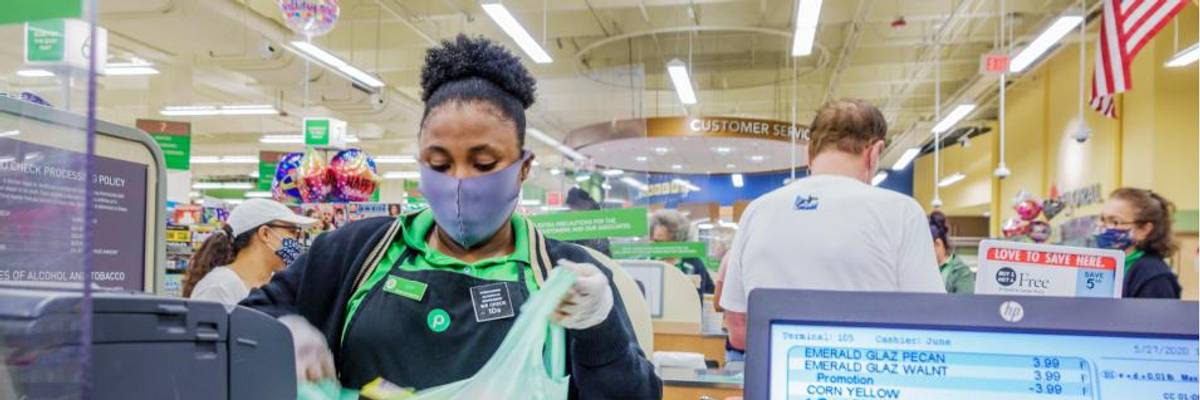
A Publix supermarket cashier bags groceries on May 27, 2020 in Miami. (Photo: Jeffrey Greenberg/Education Images/Universal Images Group via Getty Images)
During the pandemic, essential workers have become public heroes. These frontline workers include tens of millions of retail employees, from those who stock our grocery shelves to those filling orders for Amazon.
With so many people seeing firsthand how low-wage workers make our society function, we have a once-in-a-lifetime opportunity to transform our society so that everyone can earn quality pay and benefits.
But beyond symbolic displays of gratitude, essential retail workers have not yet seen this transformation.
At Walmart, the largest private employer in the country, workers are still not receiving adequate hazard pay, safety protections, or paid leave. The company remains the top employer of workers who are forced to rely on food stamps and other aid.
Think about what corporate America would look like if workers actually had a seat at the table. Corporations would prioritize investments in their workers instead of padding their CEOs' pockets.
At Amazon, employees still face rigid limits on bathroom breaks and other policies that compromise their health and safety in the midst of a pandemic. At least 20,000 Amazon employees have tested positive for Covid-19.
These issues are deeply personal to me.
For four years, I worked at my local Walmart as a cashier and later as a customer service manager--all while raising my son as a single mother and working on a bachelor's degree. I started out making only $7.78 an hour and was never able to get a full-time position, let alone a stable schedule.
I understand the stresses faced by retail workers at our country's largest employers, including struggling to pay bills and not being able to care for a sick child because of unpredictable hours and low wages.
Despite the challenges of the job, I got my degree in social work and now support retail workers across the country as an organizer for United for Respect. This national organization of working people fights for bold policies that would improve lives, particularly those in the retail industry.
One of our priority goals is an Essential Workers Bill of Rights, which would guarantee improved health and safety protections, universal health care, increased pay and paid leave, and whistleblower protection.
Workers also need a real voice in policy matters that affect our lives, from union organizing rights to personal protective equipment. So we're pushing to get worker representation on corporate boards.
Without these rights, corporate executives and politicians will continue to put their interests before those of essential workers and their families. And retail workers, especially Black women like me, will continue to live in poverty while working for some of the largest and wealthiest employers in the world.
During the pandemic, the wealth of Amazon CEO Jeff Bezos and Walmart's Walton family has skyrocketed to record levels, according to a new report by Bargaining for the Common Good, the Institute for Policy Studies, and United for Respect. The contrast between this wealth and the struggles essential workers face is shameful.
If this nation wants a real conversation about dignity for people like me and the people I organize, then we have to embrace bold solutions. And we can start with an Essential Workers Bill of Rights and a voice for workers in decision making.
Think about what corporate America would look like if workers actually had a seat at the table. Corporations would prioritize investments in their workers instead of padding their CEOs' pockets. The millions of retail workers who now have to rely on food stamps and other public assistance could provide for their families.
Let's push toward this dream by expanding opportunities for the working people who are critical to the health and security of our nation--today, during the pandemic, and beyond.
This op-ed was adapted from testimony given to the Poor People's Campaign.
Dear Common Dreams reader, It’s been nearly 30 years since I co-founded Common Dreams with my late wife, Lina Newhouser. We had the radical notion that journalism should serve the public good, not corporate profits. It was clear to us from the outset what it would take to build such a project. No paid advertisements. No corporate sponsors. No millionaire publisher telling us what to think or do. Many people said we wouldn't last a year, but we proved those doubters wrong. Together with a tremendous team of journalists and dedicated staff, we built an independent media outlet free from the constraints of profits and corporate control. Our mission has always been simple: To inform. To inspire. To ignite change for the common good. Building Common Dreams was not easy. Our survival was never guaranteed. When you take on the most powerful forces—Wall Street greed, fossil fuel industry destruction, Big Tech lobbyists, and uber-rich oligarchs who have spent billions upon billions rigging the economy and democracy in their favor—the only bulwark you have is supporters who believe in your work. But here’s the urgent message from me today. It's never been this bad out there. And it's never been this hard to keep us going. At the very moment Common Dreams is most needed, the threats we face are intensifying. We need your support now more than ever. We don't accept corporate advertising and never will. We don't have a paywall because we don't think people should be blocked from critical news based on their ability to pay. Everything we do is funded by the donations of readers like you. When everyone does the little they can afford, we are strong. But if that support retreats or dries up, so do we. Will you donate now to make sure Common Dreams not only survives but thrives? —Craig Brown, Co-founder |
During the pandemic, essential workers have become public heroes. These frontline workers include tens of millions of retail employees, from those who stock our grocery shelves to those filling orders for Amazon.
With so many people seeing firsthand how low-wage workers make our society function, we have a once-in-a-lifetime opportunity to transform our society so that everyone can earn quality pay and benefits.
But beyond symbolic displays of gratitude, essential retail workers have not yet seen this transformation.
At Walmart, the largest private employer in the country, workers are still not receiving adequate hazard pay, safety protections, or paid leave. The company remains the top employer of workers who are forced to rely on food stamps and other aid.
Think about what corporate America would look like if workers actually had a seat at the table. Corporations would prioritize investments in their workers instead of padding their CEOs' pockets.
At Amazon, employees still face rigid limits on bathroom breaks and other policies that compromise their health and safety in the midst of a pandemic. At least 20,000 Amazon employees have tested positive for Covid-19.
These issues are deeply personal to me.
For four years, I worked at my local Walmart as a cashier and later as a customer service manager--all while raising my son as a single mother and working on a bachelor's degree. I started out making only $7.78 an hour and was never able to get a full-time position, let alone a stable schedule.
I understand the stresses faced by retail workers at our country's largest employers, including struggling to pay bills and not being able to care for a sick child because of unpredictable hours and low wages.
Despite the challenges of the job, I got my degree in social work and now support retail workers across the country as an organizer for United for Respect. This national organization of working people fights for bold policies that would improve lives, particularly those in the retail industry.
One of our priority goals is an Essential Workers Bill of Rights, which would guarantee improved health and safety protections, universal health care, increased pay and paid leave, and whistleblower protection.
Workers also need a real voice in policy matters that affect our lives, from union organizing rights to personal protective equipment. So we're pushing to get worker representation on corporate boards.
Without these rights, corporate executives and politicians will continue to put their interests before those of essential workers and their families. And retail workers, especially Black women like me, will continue to live in poverty while working for some of the largest and wealthiest employers in the world.
During the pandemic, the wealth of Amazon CEO Jeff Bezos and Walmart's Walton family has skyrocketed to record levels, according to a new report by Bargaining for the Common Good, the Institute for Policy Studies, and United for Respect. The contrast between this wealth and the struggles essential workers face is shameful.
If this nation wants a real conversation about dignity for people like me and the people I organize, then we have to embrace bold solutions. And we can start with an Essential Workers Bill of Rights and a voice for workers in decision making.
Think about what corporate America would look like if workers actually had a seat at the table. Corporations would prioritize investments in their workers instead of padding their CEOs' pockets. The millions of retail workers who now have to rely on food stamps and other public assistance could provide for their families.
Let's push toward this dream by expanding opportunities for the working people who are critical to the health and security of our nation--today, during the pandemic, and beyond.
This op-ed was adapted from testimony given to the Poor People's Campaign.
During the pandemic, essential workers have become public heroes. These frontline workers include tens of millions of retail employees, from those who stock our grocery shelves to those filling orders for Amazon.
With so many people seeing firsthand how low-wage workers make our society function, we have a once-in-a-lifetime opportunity to transform our society so that everyone can earn quality pay and benefits.
But beyond symbolic displays of gratitude, essential retail workers have not yet seen this transformation.
At Walmart, the largest private employer in the country, workers are still not receiving adequate hazard pay, safety protections, or paid leave. The company remains the top employer of workers who are forced to rely on food stamps and other aid.
Think about what corporate America would look like if workers actually had a seat at the table. Corporations would prioritize investments in their workers instead of padding their CEOs' pockets.
At Amazon, employees still face rigid limits on bathroom breaks and other policies that compromise their health and safety in the midst of a pandemic. At least 20,000 Amazon employees have tested positive for Covid-19.
These issues are deeply personal to me.
For four years, I worked at my local Walmart as a cashier and later as a customer service manager--all while raising my son as a single mother and working on a bachelor's degree. I started out making only $7.78 an hour and was never able to get a full-time position, let alone a stable schedule.
I understand the stresses faced by retail workers at our country's largest employers, including struggling to pay bills and not being able to care for a sick child because of unpredictable hours and low wages.
Despite the challenges of the job, I got my degree in social work and now support retail workers across the country as an organizer for United for Respect. This national organization of working people fights for bold policies that would improve lives, particularly those in the retail industry.
One of our priority goals is an Essential Workers Bill of Rights, which would guarantee improved health and safety protections, universal health care, increased pay and paid leave, and whistleblower protection.
Workers also need a real voice in policy matters that affect our lives, from union organizing rights to personal protective equipment. So we're pushing to get worker representation on corporate boards.
Without these rights, corporate executives and politicians will continue to put their interests before those of essential workers and their families. And retail workers, especially Black women like me, will continue to live in poverty while working for some of the largest and wealthiest employers in the world.
During the pandemic, the wealth of Amazon CEO Jeff Bezos and Walmart's Walton family has skyrocketed to record levels, according to a new report by Bargaining for the Common Good, the Institute for Policy Studies, and United for Respect. The contrast between this wealth and the struggles essential workers face is shameful.
If this nation wants a real conversation about dignity for people like me and the people I organize, then we have to embrace bold solutions. And we can start with an Essential Workers Bill of Rights and a voice for workers in decision making.
Think about what corporate America would look like if workers actually had a seat at the table. Corporations would prioritize investments in their workers instead of padding their CEOs' pockets. The millions of retail workers who now have to rely on food stamps and other public assistance could provide for their families.
Let's push toward this dream by expanding opportunities for the working people who are critical to the health and security of our nation--today, during the pandemic, and beyond.
This op-ed was adapted from testimony given to the Poor People's Campaign.