
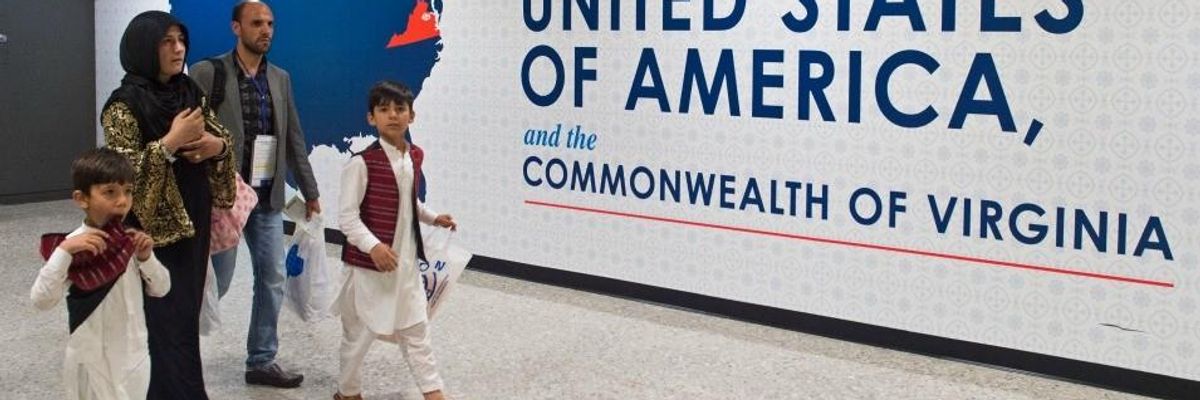
International travelers leave the Customs and Immigration area of Dulles International Airport (IAD) June 29, 2017, outside Washington, D.C., in Dulles, Virginia. (Photo: Paul J. Richards/AFP/Getty Images)
Despite Trump Reversal on Visas, Struggles of International Students Haven't Ended
If the violence or discrimination doesn't seem as spectacular as the recent ICE directive to the U.S. liberal taste, it too often gets normalized and remains ignored.
In an unprecedently swift immigration policy reversal, the Trump administration was forced to rescind the policy that barred international students taking online-only classes from staying in the United States. As a former international student and an immigrant faculty of color at a U.S. university, I feel grateful from my heart to all students, faculty, staff, universities, lawyers, politicians, media, and other organizations and community members who came together, recognized the unique contribution of international students to the U.S. economy and society, and extended their unwavering support. However, I can't give up the discomforting realization that international students, and immigrants in general, tend to get overwhelming support from liberal, progressive voices only when there is spectacular violence happening against them within the geographical boundary of the United States.
If the violence or discrimination doesn't seem as spectacular as the recent ICE directive to the U.S. liberal taste, it too often gets normalized and remains ignored. I am specifically thinking about the highly problematic and institutionally xenophobic U.S. visa application process for international students as well as other immigrants and tourists, which is not a widely addressed topic in progressive, liberal circles in the United States. I have heard so many anecdotes of sexist, racist, and classist responses from consular officers at the Dhaka U.S. embassy from my friends and acquaintances in Bangladesh that these stories don't surprise me anymore. Section 214(b) is a dreaded phrase for many international students, especially for the ones from the Muslim majority countries and the Global South. According to this section of the Immigration and Nationality Act, which--by the way--has no appeal process, the visa officer should presume the "immigrant intent" of the applicant. The immigrant intent basically holds all visa applicants "guilty until proven innocent" as the visa officer is required to assume that the applicant will come to the United and not return to their country of origin unless they can sufficiently demonstrate "strong ties" to their home country.
The interpretation of "strong ties" is often manifested in very gendered, racialized, and classed ways. For example, a friend from Bangladesh--who doesn't want to disclose her identity for obvious reasons--wanted to visit her sisters studying in the United States during her summer break. Her tourist visa application was rejected despite submitting proofs of adequate funds and verification of enrollment at a Bangladeshi university, which was supposed to demonstrate that she would return to Dhaka for continuing her undergraduate studies after her visit. When my brown, Muslim, female friend asked the white male visa officer why her application was rejected, the visa officer replied, "an unmarried student doesn't have sufficient ties to the home country." Based on this statement, does it mean that a Bangladeshi young brown Muslim undergraduate female student must be married to prove her ties to her home country? Where does it leave millions of young Bangladeshi women who are defying hegemonic gendered norms, practices, and expectations every day? In this specific case, it seems like not fitting into the U.S. imperial, hetero-patriarchal imagination of a brown Muslim woman in the Global South made my friend ineligible for a U.S. visa.
Although consular officers may want to establish that they are not racist and they just enforce the law, the very way they interpret the law is likely to be influenced by their individual sexist, racist, classist biases as well as the historically racist and xenophobic institutional policies. The institutional policies are often full of contradictions. The Trump administration, on the one hand, instructed all U.S. embassies to broadly increase scrutiny of applicants to determine if they pose national security risks. On the other hand, each visa officer was instructed to interview no more than 120 visa applicants each day. This instruction allocates five minutes per interview, making it humanly impossible to give each visa applicant a fair review--let alone adequately assessing security threats! This explains why another of my Bangladeshi friend, who applied for an F-1 visa in 2018 and spent a huge amount of time and energy in compiling almost one hundred pages of supporting documents demonstrating proof of assets, proof of admission, proof of scholarship from her U.S. school, and travel history, was rejected right away. The visa officer made the decision instantly without taking a single look at the supporting documents. It costs $160 and months of planning to put together an application package. International students don't deserve to have their dreams shattered by ill-conceived institutional policies and arbitrary decision-making of visa officers who are given God-like power.
Can we expect U.S. based human rights advocates to address the profoundly problematic U.S. visa application process affecting the lives of millions of international students as well as other migrants?
We are at a crossroads
This country and this world are at a monumental crossroads. In a few short weeks, US voters will have an opportunity to beat back the forces of fascism and confront the billionaires who are rigging the economy, our media system, and our democracy, making it increasingly impossible for ordinary people to get by. We’re not just talking about the election. We’re talking about what must be done once these fascist elements are vanquished from power. We need a bolder set of solutions than what either major party has so far been willing to offer and a working-class movement ready to fight like hell for it. Trump didn't emerge from nowhere. The conditions that fueled MAGA authoritarianism were created by decades of radical neoliberal economic policies and a corrupt political system dominated by corporate interests. They slashed taxes on the super-rich, promising that the benefits would trickle down. They said giveaways to the corporate titans would make life more affordable for the rest of us. It was all bullshit. And when a bitter, betrayed populace searches for someone to blame, right-wing demagogues have little trouble finding scapegoats. People know when they're being lied to, but you won't hear any of this from the corporate media. Only independent journalism—powered and funded by people who believe in building a better world—can deliver truly trustworthy daily news. Our Fall Campaign is underway, and we need your help. To power our newsroom through the rest of the year, we need to raise $125,000 by midnight on October 31. So if you share our vision, please contribute whatever you can to sustain our work. |
In an unprecedently swift immigration policy reversal, the Trump administration was forced to rescind the policy that barred international students taking online-only classes from staying in the United States. As a former international student and an immigrant faculty of color at a U.S. university, I feel grateful from my heart to all students, faculty, staff, universities, lawyers, politicians, media, and other organizations and community members who came together, recognized the unique contribution of international students to the U.S. economy and society, and extended their unwavering support. However, I can't give up the discomforting realization that international students, and immigrants in general, tend to get overwhelming support from liberal, progressive voices only when there is spectacular violence happening against them within the geographical boundary of the United States.
If the violence or discrimination doesn't seem as spectacular as the recent ICE directive to the U.S. liberal taste, it too often gets normalized and remains ignored. I am specifically thinking about the highly problematic and institutionally xenophobic U.S. visa application process for international students as well as other immigrants and tourists, which is not a widely addressed topic in progressive, liberal circles in the United States. I have heard so many anecdotes of sexist, racist, and classist responses from consular officers at the Dhaka U.S. embassy from my friends and acquaintances in Bangladesh that these stories don't surprise me anymore. Section 214(b) is a dreaded phrase for many international students, especially for the ones from the Muslim majority countries and the Global South. According to this section of the Immigration and Nationality Act, which--by the way--has no appeal process, the visa officer should presume the "immigrant intent" of the applicant. The immigrant intent basically holds all visa applicants "guilty until proven innocent" as the visa officer is required to assume that the applicant will come to the United and not return to their country of origin unless they can sufficiently demonstrate "strong ties" to their home country.
The interpretation of "strong ties" is often manifested in very gendered, racialized, and classed ways. For example, a friend from Bangladesh--who doesn't want to disclose her identity for obvious reasons--wanted to visit her sisters studying in the United States during her summer break. Her tourist visa application was rejected despite submitting proofs of adequate funds and verification of enrollment at a Bangladeshi university, which was supposed to demonstrate that she would return to Dhaka for continuing her undergraduate studies after her visit. When my brown, Muslim, female friend asked the white male visa officer why her application was rejected, the visa officer replied, "an unmarried student doesn't have sufficient ties to the home country." Based on this statement, does it mean that a Bangladeshi young brown Muslim undergraduate female student must be married to prove her ties to her home country? Where does it leave millions of young Bangladeshi women who are defying hegemonic gendered norms, practices, and expectations every day? In this specific case, it seems like not fitting into the U.S. imperial, hetero-patriarchal imagination of a brown Muslim woman in the Global South made my friend ineligible for a U.S. visa.
Although consular officers may want to establish that they are not racist and they just enforce the law, the very way they interpret the law is likely to be influenced by their individual sexist, racist, classist biases as well as the historically racist and xenophobic institutional policies. The institutional policies are often full of contradictions. The Trump administration, on the one hand, instructed all U.S. embassies to broadly increase scrutiny of applicants to determine if they pose national security risks. On the other hand, each visa officer was instructed to interview no more than 120 visa applicants each day. This instruction allocates five minutes per interview, making it humanly impossible to give each visa applicant a fair review--let alone adequately assessing security threats! This explains why another of my Bangladeshi friend, who applied for an F-1 visa in 2018 and spent a huge amount of time and energy in compiling almost one hundred pages of supporting documents demonstrating proof of assets, proof of admission, proof of scholarship from her U.S. school, and travel history, was rejected right away. The visa officer made the decision instantly without taking a single look at the supporting documents. It costs $160 and months of planning to put together an application package. International students don't deserve to have their dreams shattered by ill-conceived institutional policies and arbitrary decision-making of visa officers who are given God-like power.
Can we expect U.S. based human rights advocates to address the profoundly problematic U.S. visa application process affecting the lives of millions of international students as well as other migrants?