SUBSCRIBE TO OUR FREE NEWSLETTER
Daily news & progressive opinion—funded by the people, not the corporations—delivered straight to your inbox.
5
#000000
#FFFFFF
To donate by check, phone, or other method, see our More Ways to Give page.
Daily news & progressive opinion—funded by the people, not the corporations—delivered straight to your inbox.
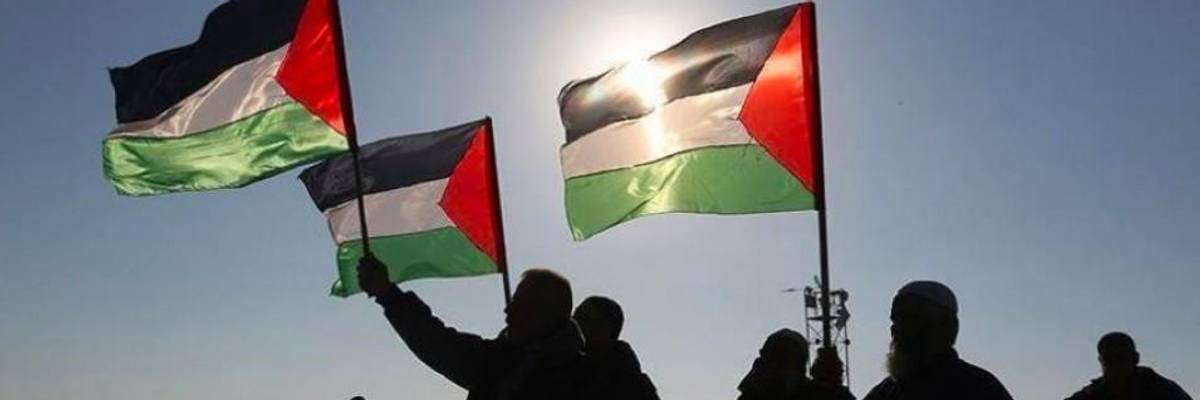
Peace is not something the victims of occupation, displacement and oppression can initiate. (Photo: Screen shot /Twitter)
Donald Trump's "Middle East plan" has fully adopted the Israeli agenda and ignores the fundamental problem that has continued for more than 70 years.
Palestinians are not striving to improve the conditions of their imprisonment, we want the return of our refugees and the end of the occupation.
As it is, Palestinians are trapped, with very little freedom of movement and no voice to tell our side of the story. That is not going to change with this "deal", especially when the international community turns a blind eye to the reality on the ground for ordinary people.
I feel the isolation that Palestinians are subjected to most painfully when I travel. What I love most about travelling is the freedom of movement; being able to get in a car, listen to music and just set off.
But, more than 70 years after the Universal Declaration of Human Rights stipulated the right to freedom of movement, this is not something most Palestinians can contemplate.
People around the world, who may not even know they have this defined right, exercise it on a daily basis. But for those living in the Palestinian territories--essentially a detention camp surrounded by fences, walls and military towers--to try is to risk your life.
In Gaza and the West Bank, a person's ability to travel is conditional upon obtaining a permit from the Israeli government and then going on a waiting list administered by Gaza's Ministry of the Interior. As a result, the vast majority of Gazans have not left the Strip since the Israeli blockade began in 2007. The decision to travel is usually made only in cases of extreme need, such as for urgent medical treatment.
A few months ago, I received an invitation from NOVACT, the International Institute for Nonviolent Action, which is based in Spain, to take part in a speaking tour, in conjunction with a number of other civil organisations, about the situation in Gaza. I was asked to give talks in Belgium, Germany, Spain, the Czech Republic, Italy, Finland, the Netherlands, France and Slovenia. This invitation was the reason I was granted a Schengen visa and as soon as I got it, I registered my name on the travel waiting list in Gaza.
I waited for two months.
The conversations I had with my European colleagues during this time perfectly summed up the differences in our experiences and expectations.
They needed to schedule my activities.
"On what day?" they would ask.
"I cannot say," I would reply. "It is not in my control."
"Ok, so in which week?" they would respond.
"I don't know that, either," I would tell them. "Plans can only be made when I have actually left Gaza."
"So in which month will that be?"
"Maybe in December, maybe January. When I am able to travel, I will let you know."
When I eventually got permission to travel, the experience was one of joy tinged with sorrow that others from my country could not enjoy this simple right.
On the road from Germany to the Czech Republic, and later from the Czech Republic to Austria, I saw no borders to tell me that I was entering a new country. The only thing that informed me was the welcome message I received from my telecom provider on my mobile phone.
I could pass through European airports without registration, waiting lists or lengthy interrogations; I could disembark from a plane and head to the exit gate without being stopped by a security officer. It was a shock.
Dozens of activists I met in Europe told me they had visited Palestine. The thought that they had roamed our cities, learned about our culture, tasted our food and felt the warmth of our sun, always made me feel good. "Did you visit Gaza?" I would ask them. "No, only the West Bank," they would invariably reply, "Israel would not give us permission to visit Gaza."
Not only are Gazans locked in, but others are locked out. And this isolation is killing us and our story. When people do not know us, when they do not see our reality, the chances of them standing in solidarity with us are diminished.
During my tour of Europe, I saw first-hand what it means when Palestinians in Gaza cannot tell their story. I was repeatedly asked by people who knew nothing of the long history of Jews being an important part of the fabric of Arab society, why Arabs were so hostile to Jews.
I was probed about the role of Hamas in the Great March of Return - peaceful Friday protests by Palestinians--and whether this was the reason the Israeli army had used excessive force against the demonstrators. I replied that, according to the OCHA, 213 Palestinians had been killed since the demonstrations began in March 2018 and more than 36,000 injured, many of whom have been left with permanent disabilities. In contrast, no Israelis had died.
I was asked why we did not just make peace with the Israelis. But peace is not something the victims of occupation, displacement and oppression can initiate, I replied.
Now, as Trump's new Middle East plan silences the voices of Palestinians, our stories, our realities, more than ever, Europe has a decision to make.
The EU has for years expressed its "deep concerns" over Israel's targeted killings and illegal settlements. But pro-Palestinian activists increasingly face censure and restrictions in European countries.
Last May, Germany passed a symbolic resolution designating the Boycott, Divestment, Sanctions (BDS) movement as anti-Semitic--even though the movement's demands are based on international law and the methods it uses are peaceful.
In December, the French parliament passed a resolution that labelled anti-Zionism a form of anti-Semitism.
Europe today faces a real test: Will it value the principles of freedom of opinion, expression and movement and the international law that underpins these--or will it help in the continued silencing and stifling of Palestinians?
If Europe and the international community get behind Trump's Middle East plan--a plan in which the Palestinians have no say--the answer will be clear.
Dear Common Dreams reader, It’s been nearly 30 years since I co-founded Common Dreams with my late wife, Lina Newhouser. We had the radical notion that journalism should serve the public good, not corporate profits. It was clear to us from the outset what it would take to build such a project. No paid advertisements. No corporate sponsors. No millionaire publisher telling us what to think or do. Many people said we wouldn't last a year, but we proved those doubters wrong. Together with a tremendous team of journalists and dedicated staff, we built an independent media outlet free from the constraints of profits and corporate control. Our mission has always been simple: To inform. To inspire. To ignite change for the common good. Building Common Dreams was not easy. Our survival was never guaranteed. When you take on the most powerful forces—Wall Street greed, fossil fuel industry destruction, Big Tech lobbyists, and uber-rich oligarchs who have spent billions upon billions rigging the economy and democracy in their favor—the only bulwark you have is supporters who believe in your work. But here’s the urgent message from me today. It's never been this bad out there. And it's never been this hard to keep us going. At the very moment Common Dreams is most needed, the threats we face are intensifying. We need your support now more than ever. We don't accept corporate advertising and never will. We don't have a paywall because we don't think people should be blocked from critical news based on their ability to pay. Everything we do is funded by the donations of readers like you. When everyone does the little they can afford, we are strong. But if that support retreats or dries up, so do we. Will you donate now to make sure Common Dreams not only survives but thrives? —Craig Brown, Co-founder |
Donald Trump's "Middle East plan" has fully adopted the Israeli agenda and ignores the fundamental problem that has continued for more than 70 years.
Palestinians are not striving to improve the conditions of their imprisonment, we want the return of our refugees and the end of the occupation.
As it is, Palestinians are trapped, with very little freedom of movement and no voice to tell our side of the story. That is not going to change with this "deal", especially when the international community turns a blind eye to the reality on the ground for ordinary people.
I feel the isolation that Palestinians are subjected to most painfully when I travel. What I love most about travelling is the freedom of movement; being able to get in a car, listen to music and just set off.
But, more than 70 years after the Universal Declaration of Human Rights stipulated the right to freedom of movement, this is not something most Palestinians can contemplate.
People around the world, who may not even know they have this defined right, exercise it on a daily basis. But for those living in the Palestinian territories--essentially a detention camp surrounded by fences, walls and military towers--to try is to risk your life.
In Gaza and the West Bank, a person's ability to travel is conditional upon obtaining a permit from the Israeli government and then going on a waiting list administered by Gaza's Ministry of the Interior. As a result, the vast majority of Gazans have not left the Strip since the Israeli blockade began in 2007. The decision to travel is usually made only in cases of extreme need, such as for urgent medical treatment.
A few months ago, I received an invitation from NOVACT, the International Institute for Nonviolent Action, which is based in Spain, to take part in a speaking tour, in conjunction with a number of other civil organisations, about the situation in Gaza. I was asked to give talks in Belgium, Germany, Spain, the Czech Republic, Italy, Finland, the Netherlands, France and Slovenia. This invitation was the reason I was granted a Schengen visa and as soon as I got it, I registered my name on the travel waiting list in Gaza.
I waited for two months.
The conversations I had with my European colleagues during this time perfectly summed up the differences in our experiences and expectations.
They needed to schedule my activities.
"On what day?" they would ask.
"I cannot say," I would reply. "It is not in my control."
"Ok, so in which week?" they would respond.
"I don't know that, either," I would tell them. "Plans can only be made when I have actually left Gaza."
"So in which month will that be?"
"Maybe in December, maybe January. When I am able to travel, I will let you know."
When I eventually got permission to travel, the experience was one of joy tinged with sorrow that others from my country could not enjoy this simple right.
On the road from Germany to the Czech Republic, and later from the Czech Republic to Austria, I saw no borders to tell me that I was entering a new country. The only thing that informed me was the welcome message I received from my telecom provider on my mobile phone.
I could pass through European airports without registration, waiting lists or lengthy interrogations; I could disembark from a plane and head to the exit gate without being stopped by a security officer. It was a shock.
Dozens of activists I met in Europe told me they had visited Palestine. The thought that they had roamed our cities, learned about our culture, tasted our food and felt the warmth of our sun, always made me feel good. "Did you visit Gaza?" I would ask them. "No, only the West Bank," they would invariably reply, "Israel would not give us permission to visit Gaza."
Not only are Gazans locked in, but others are locked out. And this isolation is killing us and our story. When people do not know us, when they do not see our reality, the chances of them standing in solidarity with us are diminished.
During my tour of Europe, I saw first-hand what it means when Palestinians in Gaza cannot tell their story. I was repeatedly asked by people who knew nothing of the long history of Jews being an important part of the fabric of Arab society, why Arabs were so hostile to Jews.
I was probed about the role of Hamas in the Great March of Return - peaceful Friday protests by Palestinians--and whether this was the reason the Israeli army had used excessive force against the demonstrators. I replied that, according to the OCHA, 213 Palestinians had been killed since the demonstrations began in March 2018 and more than 36,000 injured, many of whom have been left with permanent disabilities. In contrast, no Israelis had died.
I was asked why we did not just make peace with the Israelis. But peace is not something the victims of occupation, displacement and oppression can initiate, I replied.
Now, as Trump's new Middle East plan silences the voices of Palestinians, our stories, our realities, more than ever, Europe has a decision to make.
The EU has for years expressed its "deep concerns" over Israel's targeted killings and illegal settlements. But pro-Palestinian activists increasingly face censure and restrictions in European countries.
Last May, Germany passed a symbolic resolution designating the Boycott, Divestment, Sanctions (BDS) movement as anti-Semitic--even though the movement's demands are based on international law and the methods it uses are peaceful.
In December, the French parliament passed a resolution that labelled anti-Zionism a form of anti-Semitism.
Europe today faces a real test: Will it value the principles of freedom of opinion, expression and movement and the international law that underpins these--or will it help in the continued silencing and stifling of Palestinians?
If Europe and the international community get behind Trump's Middle East plan--a plan in which the Palestinians have no say--the answer will be clear.
Donald Trump's "Middle East plan" has fully adopted the Israeli agenda and ignores the fundamental problem that has continued for more than 70 years.
Palestinians are not striving to improve the conditions of their imprisonment, we want the return of our refugees and the end of the occupation.
As it is, Palestinians are trapped, with very little freedom of movement and no voice to tell our side of the story. That is not going to change with this "deal", especially when the international community turns a blind eye to the reality on the ground for ordinary people.
I feel the isolation that Palestinians are subjected to most painfully when I travel. What I love most about travelling is the freedom of movement; being able to get in a car, listen to music and just set off.
But, more than 70 years after the Universal Declaration of Human Rights stipulated the right to freedom of movement, this is not something most Palestinians can contemplate.
People around the world, who may not even know they have this defined right, exercise it on a daily basis. But for those living in the Palestinian territories--essentially a detention camp surrounded by fences, walls and military towers--to try is to risk your life.
In Gaza and the West Bank, a person's ability to travel is conditional upon obtaining a permit from the Israeli government and then going on a waiting list administered by Gaza's Ministry of the Interior. As a result, the vast majority of Gazans have not left the Strip since the Israeli blockade began in 2007. The decision to travel is usually made only in cases of extreme need, such as for urgent medical treatment.
A few months ago, I received an invitation from NOVACT, the International Institute for Nonviolent Action, which is based in Spain, to take part in a speaking tour, in conjunction with a number of other civil organisations, about the situation in Gaza. I was asked to give talks in Belgium, Germany, Spain, the Czech Republic, Italy, Finland, the Netherlands, France and Slovenia. This invitation was the reason I was granted a Schengen visa and as soon as I got it, I registered my name on the travel waiting list in Gaza.
I waited for two months.
The conversations I had with my European colleagues during this time perfectly summed up the differences in our experiences and expectations.
They needed to schedule my activities.
"On what day?" they would ask.
"I cannot say," I would reply. "It is not in my control."
"Ok, so in which week?" they would respond.
"I don't know that, either," I would tell them. "Plans can only be made when I have actually left Gaza."
"So in which month will that be?"
"Maybe in December, maybe January. When I am able to travel, I will let you know."
When I eventually got permission to travel, the experience was one of joy tinged with sorrow that others from my country could not enjoy this simple right.
On the road from Germany to the Czech Republic, and later from the Czech Republic to Austria, I saw no borders to tell me that I was entering a new country. The only thing that informed me was the welcome message I received from my telecom provider on my mobile phone.
I could pass through European airports without registration, waiting lists or lengthy interrogations; I could disembark from a plane and head to the exit gate without being stopped by a security officer. It was a shock.
Dozens of activists I met in Europe told me they had visited Palestine. The thought that they had roamed our cities, learned about our culture, tasted our food and felt the warmth of our sun, always made me feel good. "Did you visit Gaza?" I would ask them. "No, only the West Bank," they would invariably reply, "Israel would not give us permission to visit Gaza."
Not only are Gazans locked in, but others are locked out. And this isolation is killing us and our story. When people do not know us, when they do not see our reality, the chances of them standing in solidarity with us are diminished.
During my tour of Europe, I saw first-hand what it means when Palestinians in Gaza cannot tell their story. I was repeatedly asked by people who knew nothing of the long history of Jews being an important part of the fabric of Arab society, why Arabs were so hostile to Jews.
I was probed about the role of Hamas in the Great March of Return - peaceful Friday protests by Palestinians--and whether this was the reason the Israeli army had used excessive force against the demonstrators. I replied that, according to the OCHA, 213 Palestinians had been killed since the demonstrations began in March 2018 and more than 36,000 injured, many of whom have been left with permanent disabilities. In contrast, no Israelis had died.
I was asked why we did not just make peace with the Israelis. But peace is not something the victims of occupation, displacement and oppression can initiate, I replied.
Now, as Trump's new Middle East plan silences the voices of Palestinians, our stories, our realities, more than ever, Europe has a decision to make.
The EU has for years expressed its "deep concerns" over Israel's targeted killings and illegal settlements. But pro-Palestinian activists increasingly face censure and restrictions in European countries.
Last May, Germany passed a symbolic resolution designating the Boycott, Divestment, Sanctions (BDS) movement as anti-Semitic--even though the movement's demands are based on international law and the methods it uses are peaceful.
In December, the French parliament passed a resolution that labelled anti-Zionism a form of anti-Semitism.
Europe today faces a real test: Will it value the principles of freedom of opinion, expression and movement and the international law that underpins these--or will it help in the continued silencing and stifling of Palestinians?
If Europe and the international community get behind Trump's Middle East plan--a plan in which the Palestinians have no say--the answer will be clear.