SUBSCRIBE TO OUR FREE NEWSLETTER
Daily news & progressive opinion—funded by the people, not the corporations—delivered straight to your inbox.
5
#000000
#FFFFFF
To donate by check, phone, or other method, see our More Ways to Give page.
Daily news & progressive opinion—funded by the people, not the corporations—delivered straight to your inbox.
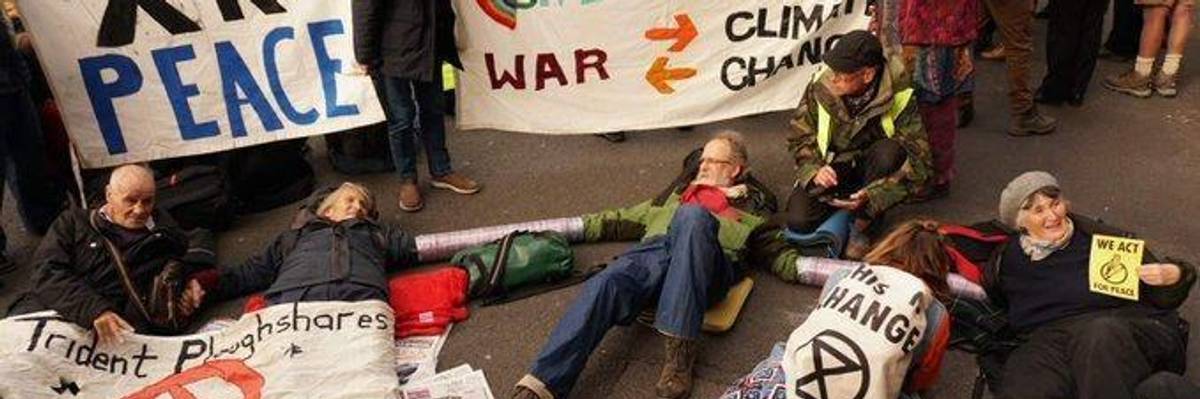
Gandhi said we must become the change we want to see. (Photo: Brian Larkin)
One day in October four of us, all grandparents blocked the road around Trafalgar Square as part of Extinction Rebellion. Here's why I was there.
I am a seasoned activist. But I initially held back on getting involved with Extinction Rebellion, doubting whether the demand for net zero by 2025 was achievable, whether a Citizens Assembly is the best way to resolve the crisis-skeptical of the seemingly alarmist rhetoric from parts of XR, that we were all going to die.
Of course, I'd read the IPCC report that said we had twelve years to avert the worst consequences of greenhouse gas emissions. I'd read about the ice caps and permafrost melting. I was aware of the increasing extinction of species.
Like a juggernaut, we move with certainty towards destruction. And there is no sign of turning this around.
But I felt I was doing what I could. I tried to live simply, recycling, growing a lot of our own food, becoming the change. And there were lots of people campaigning about the climate crisis. My focus was on peace and disarmament, and there aren't enough people working on that these days. Then, another study. Birds across N America have declined in numbers, 65% since 1970. I was ten years old in 1970, about the age my grandson is now. In my yard there was a big plane tree. I used to climb to the top of that tree and look out across the Delaware River valley. You could see for miles.
One day I was raking leaves when a flock of starlings flew overhead. The noise of their chatter and rustle of wingbeats filled the air. They filled the sky, as far as you could see. They went on and on. It seemed like forever. I was in the presence of something far greater than myself, the earth, life itself.
When I read that report about the loss of half the birds in North America I was back there looking up at that flock of starlings and knew, I had to join a movement, no matter how imperfect, to resist this destruction. And as I lay in the road, looking up at that London plane tree, I again remembered those birds. If my grandson climbed that tree only one-third of those starlings would fly over. How many birds will there be when his grandson is ten?
The school strikers are right. We've failed them. We knew this was happening. We knew about the greenhouse effect in the 80's. We knew in the 90s that rainforest was being destroyed to produce beef for US fast-food chains. I knew it. When I worked briefly for Greenpeace I used to put on the voice of Dr. Seuss's Lorax saying "I speak for the trees, and we're saying stop cutting down the rainforest."
Gandhi said we must become the change we want to see.
Personal change has to be part of the solution. We need to drastically reduce consumption. Less meat, fewer new clothes, fewer cars, fewer flights. But, with the ice caps melting, with permanent drought in the southern hemisphere, with coral reefs dying personal change will not turn this around fast enough. Governments must act quickly. But they're not going to do that unless we force them.
During the Cold War many of us believed humanity was on the brink of nuclear war. Armageddon could happen any time. I thought of this as "Geocide." With that sense of urgency, I took part in many resistance actions and did time in jail. Nuclear weapons remain the twin existential threat to humanity and the planet. If only a handful are used it will cause nuclear winter, famine and the death of billions of people.
But my daughter recently helped me to see that geocide is already happening. The collective impact of human activity is already, and at an ever increasing pace, destroying life on earth. Like a juggernaut, we move with certainty towards destruction. And there is no sign of turning this around.
According to the 2019 Emissions Gap Report "to limit global temperature rise to 1.5degC, emissions must drop to 25 gigatons by 2030. Based on today's commitments, emissions are on track to reach 56 Gt CO2e by 2030, over twice what they should be". At COP 2020 in Glasgow governments must make commitments to cut emissions by 7.6% emissions every year we CAN limit global warming to 1.5degC. As the host nation the UK government has the opportunity to lead on this. We need to push the government to do that this year.
Dear Common Dreams reader, It’s been nearly 30 years since I co-founded Common Dreams with my late wife, Lina Newhouser. We had the radical notion that journalism should serve the public good, not corporate profits. It was clear to us from the outset what it would take to build such a project. No paid advertisements. No corporate sponsors. No millionaire publisher telling us what to think or do. Many people said we wouldn't last a year, but we proved those doubters wrong. Together with a tremendous team of journalists and dedicated staff, we built an independent media outlet free from the constraints of profits and corporate control. Our mission has always been simple: To inform. To inspire. To ignite change for the common good. Building Common Dreams was not easy. Our survival was never guaranteed. When you take on the most powerful forces—Wall Street greed, fossil fuel industry destruction, Big Tech lobbyists, and uber-rich oligarchs who have spent billions upon billions rigging the economy and democracy in their favor—the only bulwark you have is supporters who believe in your work. But here’s the urgent message from me today. It's never been this bad out there. And it's never been this hard to keep us going. At the very moment Common Dreams is most needed, the threats we face are intensifying. We need your support now more than ever. We don't accept corporate advertising and never will. We don't have a paywall because we don't think people should be blocked from critical news based on their ability to pay. Everything we do is funded by the donations of readers like you. When everyone does the little they can afford, we are strong. But if that support retreats or dries up, so do we. Will you donate now to make sure Common Dreams not only survives but thrives? —Craig Brown, Co-founder |
One day in October four of us, all grandparents blocked the road around Trafalgar Square as part of Extinction Rebellion. Here's why I was there.
I am a seasoned activist. But I initially held back on getting involved with Extinction Rebellion, doubting whether the demand for net zero by 2025 was achievable, whether a Citizens Assembly is the best way to resolve the crisis-skeptical of the seemingly alarmist rhetoric from parts of XR, that we were all going to die.
Of course, I'd read the IPCC report that said we had twelve years to avert the worst consequences of greenhouse gas emissions. I'd read about the ice caps and permafrost melting. I was aware of the increasing extinction of species.
Like a juggernaut, we move with certainty towards destruction. And there is no sign of turning this around.
But I felt I was doing what I could. I tried to live simply, recycling, growing a lot of our own food, becoming the change. And there were lots of people campaigning about the climate crisis. My focus was on peace and disarmament, and there aren't enough people working on that these days. Then, another study. Birds across N America have declined in numbers, 65% since 1970. I was ten years old in 1970, about the age my grandson is now. In my yard there was a big plane tree. I used to climb to the top of that tree and look out across the Delaware River valley. You could see for miles.
One day I was raking leaves when a flock of starlings flew overhead. The noise of their chatter and rustle of wingbeats filled the air. They filled the sky, as far as you could see. They went on and on. It seemed like forever. I was in the presence of something far greater than myself, the earth, life itself.
When I read that report about the loss of half the birds in North America I was back there looking up at that flock of starlings and knew, I had to join a movement, no matter how imperfect, to resist this destruction. And as I lay in the road, looking up at that London plane tree, I again remembered those birds. If my grandson climbed that tree only one-third of those starlings would fly over. How many birds will there be when his grandson is ten?
The school strikers are right. We've failed them. We knew this was happening. We knew about the greenhouse effect in the 80's. We knew in the 90s that rainforest was being destroyed to produce beef for US fast-food chains. I knew it. When I worked briefly for Greenpeace I used to put on the voice of Dr. Seuss's Lorax saying "I speak for the trees, and we're saying stop cutting down the rainforest."
Gandhi said we must become the change we want to see.
Personal change has to be part of the solution. We need to drastically reduce consumption. Less meat, fewer new clothes, fewer cars, fewer flights. But, with the ice caps melting, with permanent drought in the southern hemisphere, with coral reefs dying personal change will not turn this around fast enough. Governments must act quickly. But they're not going to do that unless we force them.
During the Cold War many of us believed humanity was on the brink of nuclear war. Armageddon could happen any time. I thought of this as "Geocide." With that sense of urgency, I took part in many resistance actions and did time in jail. Nuclear weapons remain the twin existential threat to humanity and the planet. If only a handful are used it will cause nuclear winter, famine and the death of billions of people.
But my daughter recently helped me to see that geocide is already happening. The collective impact of human activity is already, and at an ever increasing pace, destroying life on earth. Like a juggernaut, we move with certainty towards destruction. And there is no sign of turning this around.
According to the 2019 Emissions Gap Report "to limit global temperature rise to 1.5degC, emissions must drop to 25 gigatons by 2030. Based on today's commitments, emissions are on track to reach 56 Gt CO2e by 2030, over twice what they should be". At COP 2020 in Glasgow governments must make commitments to cut emissions by 7.6% emissions every year we CAN limit global warming to 1.5degC. As the host nation the UK government has the opportunity to lead on this. We need to push the government to do that this year.
One day in October four of us, all grandparents blocked the road around Trafalgar Square as part of Extinction Rebellion. Here's why I was there.
I am a seasoned activist. But I initially held back on getting involved with Extinction Rebellion, doubting whether the demand for net zero by 2025 was achievable, whether a Citizens Assembly is the best way to resolve the crisis-skeptical of the seemingly alarmist rhetoric from parts of XR, that we were all going to die.
Of course, I'd read the IPCC report that said we had twelve years to avert the worst consequences of greenhouse gas emissions. I'd read about the ice caps and permafrost melting. I was aware of the increasing extinction of species.
Like a juggernaut, we move with certainty towards destruction. And there is no sign of turning this around.
But I felt I was doing what I could. I tried to live simply, recycling, growing a lot of our own food, becoming the change. And there were lots of people campaigning about the climate crisis. My focus was on peace and disarmament, and there aren't enough people working on that these days. Then, another study. Birds across N America have declined in numbers, 65% since 1970. I was ten years old in 1970, about the age my grandson is now. In my yard there was a big plane tree. I used to climb to the top of that tree and look out across the Delaware River valley. You could see for miles.
One day I was raking leaves when a flock of starlings flew overhead. The noise of their chatter and rustle of wingbeats filled the air. They filled the sky, as far as you could see. They went on and on. It seemed like forever. I was in the presence of something far greater than myself, the earth, life itself.
When I read that report about the loss of half the birds in North America I was back there looking up at that flock of starlings and knew, I had to join a movement, no matter how imperfect, to resist this destruction. And as I lay in the road, looking up at that London plane tree, I again remembered those birds. If my grandson climbed that tree only one-third of those starlings would fly over. How many birds will there be when his grandson is ten?
The school strikers are right. We've failed them. We knew this was happening. We knew about the greenhouse effect in the 80's. We knew in the 90s that rainforest was being destroyed to produce beef for US fast-food chains. I knew it. When I worked briefly for Greenpeace I used to put on the voice of Dr. Seuss's Lorax saying "I speak for the trees, and we're saying stop cutting down the rainforest."
Gandhi said we must become the change we want to see.
Personal change has to be part of the solution. We need to drastically reduce consumption. Less meat, fewer new clothes, fewer cars, fewer flights. But, with the ice caps melting, with permanent drought in the southern hemisphere, with coral reefs dying personal change will not turn this around fast enough. Governments must act quickly. But they're not going to do that unless we force them.
During the Cold War many of us believed humanity was on the brink of nuclear war. Armageddon could happen any time. I thought of this as "Geocide." With that sense of urgency, I took part in many resistance actions and did time in jail. Nuclear weapons remain the twin existential threat to humanity and the planet. If only a handful are used it will cause nuclear winter, famine and the death of billions of people.
But my daughter recently helped me to see that geocide is already happening. The collective impact of human activity is already, and at an ever increasing pace, destroying life on earth. Like a juggernaut, we move with certainty towards destruction. And there is no sign of turning this around.
According to the 2019 Emissions Gap Report "to limit global temperature rise to 1.5degC, emissions must drop to 25 gigatons by 2030. Based on today's commitments, emissions are on track to reach 56 Gt CO2e by 2030, over twice what they should be". At COP 2020 in Glasgow governments must make commitments to cut emissions by 7.6% emissions every year we CAN limit global warming to 1.5degC. As the host nation the UK government has the opportunity to lead on this. We need to push the government to do that this year.