
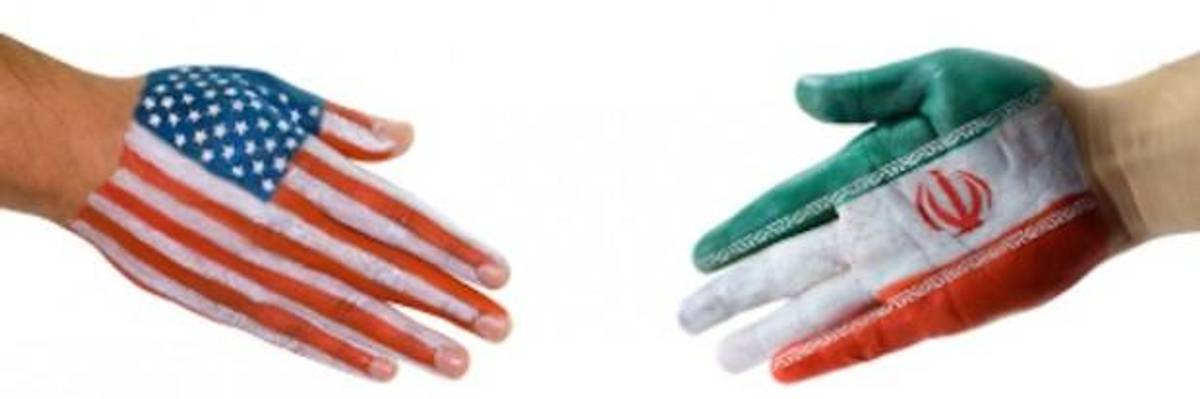
The letter outlines a series of eight bold but practical recommendations to the U.S., Iran, and Europe that could widen the path to diplomacy that has narrowed considerably since the U.S. initiated a tit-for-tat ratcheting up of tensions with Iran. (Photo: LobeLog)
Expert Letter on Deescalating with Iran
There remains a narrow path for the U.S. and Iran to avoid military conflict and resolve ongoing disputes through negotiations.
Editor's note: The National Iranian-American Council has released a letter, signed by 30 foreign policy practitioners, calling on the U.S., Europe, and Iran to take steps to reduce tensions in the Persian Gulf.
July 30, 2019
As foreign-policy practitioners with decades of collective experience in national security and diplomacy, we write to warn that U.S.-Iran tensions have entered a dangerous new phase that has put us on the brink of a disastrous and avoidable war. The administration's decision to violate the Iran nuclear agreement in pursuit of a so-called maximum pressure strategy is damaging the accord and U.S. interests in ways that could be difficult to reverse. There remains a narrow path for the U.S. and Iran to avoid military conflict and resolve ongoing disputes through negotiations. Doing so, however, will require bold action and constructive steps from all sides, as outlined below.
The U.S. Should Suspend Recent Sanctions to Provide Space for Diplomacy
- The U.S. should suspend sanctions imposed after its withdrawal from the nuclear accord with Iran in May 2018 to provide space for de-escalation and assurance that it is serious about pursuing and adhering to a negotiated solution.
Iran Should Return to Full Compliance with the Nuclear Accord
- Iran's recent decision to cease adherence with aspects of the July 2015 nuclear deal in response to U.S. sanctions feeds into a counterproductive escalatory cycle and could lead to an irreversible collapse of the agreement. Iran should welcome the suspension of U.S. sanctions by returning to full compliance with the nuclear deal.
The U.S. and Iran Should Pursue a Prisoner Swap
- Iran has unjustly imprisoned at least five American citizens and dual nationals. According to publicized reports, at least a dozen Iranians are in custody in the U.S. on sanctions violation charges. Iran has publicly and privately offered to arrange a swap of American and Iranian prisoners held in each country's jails. The Trump administration should pursue this overture and view it as the low-hanging fruit for negotiations that can build confidence for broader diplomacy.
Europe Must Take More Serious Steps to Address Challenges in Meeting Its Sanctions Relief Obligations
- Due to U.S. extraterritorial sanctions, Europe has not been able to satisfy its obligations under the nuclear deal to ensure legitimate trade with Iran. To its credit, Europe's development of a special financial mechanism to facilitate legitimate trade with Iran, known as INSTEX, is a constructive first step forward. Europe must now urgently take all necessary actions to ensure INSTEX is utilized to enable the trade and economic benefits promised under the nuclear deal.
The U.S. and Iran Must Reestablish Communication Channels
- The U.S. and Iran should reestablish a permanent and direct communication channel to de-escalate crises, such as the downing of the U.S. drone and the oil tanker attacks in the Gulf of Oman. Absent a dedicated channel for deconfliction and deescalation, as existed under the previous administration, the chances of disaster remain far too high.
The U.S. Should Appoint a Credible and Empowered Iran Envoy
- To signal U.S. seriousness about negotiations and to facilitate the process, a new Iran envoy with the ear of the President and experience in diplomatically engaging Iran is needed. As long as John Bolton and Mike Pompeo are viewed as leading the administration's Iran policy, concerns that the U.S. seeks regime change and military action - and is not serious about a negotiated solution - will undermine any hopes for talks.
Pursue an Agreement to Avoid Confrontations in the Persian Gulf
- The U.S. and Iran came dangerously close to war following several incidents in the Persian Gulf and unverified accusations leveled by both sides. To avoid similar confrontations in the future, the two sides should negotiate an "incidents at sea" agreement to avoid collisions between their naval and air forces operating in close proximity.
U.S. Congress Should Pass Legislation to Prevent War
- Congress was not consulted when President Trump came just a few minutes away from attacking Iran, which could have dragged the U.S. into a major regional conflict far more damaging than the Iraq war. Congress must assert its war-powers authority and uphold its constitutional duty as a coequal branch of government by passing legislation to ensure the administration cannot start an illegal and disastrous war with Iran.
Signatories:
Jamal Abdi, President, National Iranian Amerian Council
Arshin Adib-Moghaddam, Professor in Global Thought and Comparative Philosophies at SOAS, University of London and Fellow of Hughes Hall, University of Cambridge
Sanam Naraghi Anderlini, Founder and CEO, International Civil Society Action Network (ICAN)
Andrew Bacevich, Co-founder, Quincy Institute for Responsible Statecraft
Juan Cole, Richard P. Mitchell Collegiate Professor of History at the University of Michigan
Michael C. Desch, Packey J. Dee Professor of International Relations, University of Notre Dame
Dina Esfandiary, Fellow, International Security Program, Belfer Center for Science and Security Studies, Harvard University; Fellow, The Century Foundation
John L. Esposito, Professor of Religion & International Affairs and Islamic Studies at Georgetown University
Farideh Farhi, Affiliate Graduate Faculty of Political Science, University of Hawai'i at Manoa
Nancy W. Gallagher, Director, Center for International and Security Studies at Maryland and Research Professor of Public Policy, University of Maryland
Mark Gasiorowski, Professor, Department of Political Science, Tulane University
Kevan Harris, Assistant Professor of Sociology studying development and social change in the global South, UCLA
Rula Jebreal, Professor, American University of Rome
Peter Jenkins, Former UK Ambassador to the IAEA
Bijan Khajehpour, Managing partner at Vienna-based Eurasian Nexus Partners, a strategy consulting firm focused on the Eurasian region
Lawrence Korb, Senior Fellow at the Center for American Progress, former Assistant Secretary of Defense (1981-1985)
Peter Kuznick, Professor of History and Director, Nuclear Studies Institute, American University
Joshua Landis, Sandra Mackey Professor of Middle East Studies and Director of the Center for Middle East Studies at the University of Oklahoma
Daniel Larison, Senior Editor, The American Conservative
John J. Mearsheimer, R. Wendell Harrison Distinguished Service Professor of Political Science, University of Chicago
Francois Nicoullaud, Former French Ambassador to Iran
Rouzbeh Parsi, Visiting Research Scholar, Sharmin and Bijan Mossavar-Rahmani Center for Iran and Persian Gulf Studies, Princeton University; Head of the Middle East and North Africa Programme at the Swedish Institute of International Affairs-Stockholm; Senior Lecturer, Human Rights Studies, Lund University
Trita Parsi, Co-founder, Quincy Institute for Responsible Statecraft; Adjunct Associate Professor, Georgetown University
Thomas R. Pickering, former Under Secretary of State and Ambassador to Russia, India, the United Nations and Israel
Paul Pillar, Nonresident Senior Fellow at the Center for Security Studies at Georgetown University and Nonresident Senior Fellow in Foreign Policy at the Brookings Institution
Edward Price, Director of Policy and Communications, National Security Action; former National Security Council Spokesperson; Former Special Assistant to President Obama for National Security Affairs
Barbara Slavin
John F. Tierney, former Member of Congress and Executive Director of Center for Arms Control and Non-Proliferation and of Council for a Livable World
Stephen Walt, Robert and Renee Belfer Professor of International Affairs, Harvard Kennedy School
Lawrence Wilkerson, Visiting Professor of Government and Public Policy at the College of William & Mary and former chief of staff to Secretary of State Colin Powell
An Urgent Message From Our Co-Founder
Dear Common Dreams reader, It’s been nearly 30 years since I co-founded Common Dreams with my late wife, Lina Newhouser. We had the radical notion that journalism should serve the public good, not corporate profits. It was clear to us from the outset what it would take to build such a project. No paid advertisements. No corporate sponsors. No millionaire publisher telling us what to think or do. Many people said we wouldn't last a year, but we proved those doubters wrong. Together with a tremendous team of journalists and dedicated staff, we built an independent media outlet free from the constraints of profits and corporate control. Our mission has always been simple: To inform. To inspire. To ignite change for the common good. Building Common Dreams was not easy. Our survival was never guaranteed. When you take on the most powerful forces—Wall Street greed, fossil fuel industry destruction, Big Tech lobbyists, and uber-rich oligarchs who have spent billions upon billions rigging the economy and democracy in their favor—the only bulwark you have is supporters who believe in your work. But here’s the urgent message from me today. It's never been this bad out there. And it's never been this hard to keep us going. At the very moment Common Dreams is most needed, the threats we face are intensifying. We need your support now more than ever. We don't accept corporate advertising and never will. We don't have a paywall because we don't think people should be blocked from critical news based on their ability to pay. Everything we do is funded by the donations of readers like you. When everyone does the little they can afford, we are strong. But if that support retreats or dries up, so do we. Will you donate now to make sure Common Dreams not only survives but thrives? —Craig Brown, Co-founder |
Editor's note: The National Iranian-American Council has released a letter, signed by 30 foreign policy practitioners, calling on the U.S., Europe, and Iran to take steps to reduce tensions in the Persian Gulf.
July 30, 2019
As foreign-policy practitioners with decades of collective experience in national security and diplomacy, we write to warn that U.S.-Iran tensions have entered a dangerous new phase that has put us on the brink of a disastrous and avoidable war. The administration's decision to violate the Iran nuclear agreement in pursuit of a so-called maximum pressure strategy is damaging the accord and U.S. interests in ways that could be difficult to reverse. There remains a narrow path for the U.S. and Iran to avoid military conflict and resolve ongoing disputes through negotiations. Doing so, however, will require bold action and constructive steps from all sides, as outlined below.
The U.S. Should Suspend Recent Sanctions to Provide Space for Diplomacy
- The U.S. should suspend sanctions imposed after its withdrawal from the nuclear accord with Iran in May 2018 to provide space for de-escalation and assurance that it is serious about pursuing and adhering to a negotiated solution.
Iran Should Return to Full Compliance with the Nuclear Accord
- Iran's recent decision to cease adherence with aspects of the July 2015 nuclear deal in response to U.S. sanctions feeds into a counterproductive escalatory cycle and could lead to an irreversible collapse of the agreement. Iran should welcome the suspension of U.S. sanctions by returning to full compliance with the nuclear deal.
The U.S. and Iran Should Pursue a Prisoner Swap
- Iran has unjustly imprisoned at least five American citizens and dual nationals. According to publicized reports, at least a dozen Iranians are in custody in the U.S. on sanctions violation charges. Iran has publicly and privately offered to arrange a swap of American and Iranian prisoners held in each country's jails. The Trump administration should pursue this overture and view it as the low-hanging fruit for negotiations that can build confidence for broader diplomacy.
Europe Must Take More Serious Steps to Address Challenges in Meeting Its Sanctions Relief Obligations
- Due to U.S. extraterritorial sanctions, Europe has not been able to satisfy its obligations under the nuclear deal to ensure legitimate trade with Iran. To its credit, Europe's development of a special financial mechanism to facilitate legitimate trade with Iran, known as INSTEX, is a constructive first step forward. Europe must now urgently take all necessary actions to ensure INSTEX is utilized to enable the trade and economic benefits promised under the nuclear deal.
The U.S. and Iran Must Reestablish Communication Channels
- The U.S. and Iran should reestablish a permanent and direct communication channel to de-escalate crises, such as the downing of the U.S. drone and the oil tanker attacks in the Gulf of Oman. Absent a dedicated channel for deconfliction and deescalation, as existed under the previous administration, the chances of disaster remain far too high.
The U.S. Should Appoint a Credible and Empowered Iran Envoy
- To signal U.S. seriousness about negotiations and to facilitate the process, a new Iran envoy with the ear of the President and experience in diplomatically engaging Iran is needed. As long as John Bolton and Mike Pompeo are viewed as leading the administration's Iran policy, concerns that the U.S. seeks regime change and military action - and is not serious about a negotiated solution - will undermine any hopes for talks.
Pursue an Agreement to Avoid Confrontations in the Persian Gulf
- The U.S. and Iran came dangerously close to war following several incidents in the Persian Gulf and unverified accusations leveled by both sides. To avoid similar confrontations in the future, the two sides should negotiate an "incidents at sea" agreement to avoid collisions between their naval and air forces operating in close proximity.
U.S. Congress Should Pass Legislation to Prevent War
- Congress was not consulted when President Trump came just a few minutes away from attacking Iran, which could have dragged the U.S. into a major regional conflict far more damaging than the Iraq war. Congress must assert its war-powers authority and uphold its constitutional duty as a coequal branch of government by passing legislation to ensure the administration cannot start an illegal and disastrous war with Iran.
Signatories:
Jamal Abdi, President, National Iranian Amerian Council
Arshin Adib-Moghaddam, Professor in Global Thought and Comparative Philosophies at SOAS, University of London and Fellow of Hughes Hall, University of Cambridge
Sanam Naraghi Anderlini, Founder and CEO, International Civil Society Action Network (ICAN)
Andrew Bacevich, Co-founder, Quincy Institute for Responsible Statecraft
Juan Cole, Richard P. Mitchell Collegiate Professor of History at the University of Michigan
Michael C. Desch, Packey J. Dee Professor of International Relations, University of Notre Dame
Dina Esfandiary, Fellow, International Security Program, Belfer Center for Science and Security Studies, Harvard University; Fellow, The Century Foundation
John L. Esposito, Professor of Religion & International Affairs and Islamic Studies at Georgetown University
Farideh Farhi, Affiliate Graduate Faculty of Political Science, University of Hawai'i at Manoa
Nancy W. Gallagher, Director, Center for International and Security Studies at Maryland and Research Professor of Public Policy, University of Maryland
Mark Gasiorowski, Professor, Department of Political Science, Tulane University
Kevan Harris, Assistant Professor of Sociology studying development and social change in the global South, UCLA
Rula Jebreal, Professor, American University of Rome
Peter Jenkins, Former UK Ambassador to the IAEA
Bijan Khajehpour, Managing partner at Vienna-based Eurasian Nexus Partners, a strategy consulting firm focused on the Eurasian region
Lawrence Korb, Senior Fellow at the Center for American Progress, former Assistant Secretary of Defense (1981-1985)
Peter Kuznick, Professor of History and Director, Nuclear Studies Institute, American University
Joshua Landis, Sandra Mackey Professor of Middle East Studies and Director of the Center for Middle East Studies at the University of Oklahoma
Daniel Larison, Senior Editor, The American Conservative
John J. Mearsheimer, R. Wendell Harrison Distinguished Service Professor of Political Science, University of Chicago
Francois Nicoullaud, Former French Ambassador to Iran
Rouzbeh Parsi, Visiting Research Scholar, Sharmin and Bijan Mossavar-Rahmani Center for Iran and Persian Gulf Studies, Princeton University; Head of the Middle East and North Africa Programme at the Swedish Institute of International Affairs-Stockholm; Senior Lecturer, Human Rights Studies, Lund University
Trita Parsi, Co-founder, Quincy Institute for Responsible Statecraft; Adjunct Associate Professor, Georgetown University
Thomas R. Pickering, former Under Secretary of State and Ambassador to Russia, India, the United Nations and Israel
Paul Pillar, Nonresident Senior Fellow at the Center for Security Studies at Georgetown University and Nonresident Senior Fellow in Foreign Policy at the Brookings Institution
Edward Price, Director of Policy and Communications, National Security Action; former National Security Council Spokesperson; Former Special Assistant to President Obama for National Security Affairs
Barbara Slavin
John F. Tierney, former Member of Congress and Executive Director of Center for Arms Control and Non-Proliferation and of Council for a Livable World
Stephen Walt, Robert and Renee Belfer Professor of International Affairs, Harvard Kennedy School
Lawrence Wilkerson, Visiting Professor of Government and Public Policy at the College of William & Mary and former chief of staff to Secretary of State Colin Powell
Editor's note: The National Iranian-American Council has released a letter, signed by 30 foreign policy practitioners, calling on the U.S., Europe, and Iran to take steps to reduce tensions in the Persian Gulf.
July 30, 2019
As foreign-policy practitioners with decades of collective experience in national security and diplomacy, we write to warn that U.S.-Iran tensions have entered a dangerous new phase that has put us on the brink of a disastrous and avoidable war. The administration's decision to violate the Iran nuclear agreement in pursuit of a so-called maximum pressure strategy is damaging the accord and U.S. interests in ways that could be difficult to reverse. There remains a narrow path for the U.S. and Iran to avoid military conflict and resolve ongoing disputes through negotiations. Doing so, however, will require bold action and constructive steps from all sides, as outlined below.
The U.S. Should Suspend Recent Sanctions to Provide Space for Diplomacy
- The U.S. should suspend sanctions imposed after its withdrawal from the nuclear accord with Iran in May 2018 to provide space for de-escalation and assurance that it is serious about pursuing and adhering to a negotiated solution.
Iran Should Return to Full Compliance with the Nuclear Accord
- Iran's recent decision to cease adherence with aspects of the July 2015 nuclear deal in response to U.S. sanctions feeds into a counterproductive escalatory cycle and could lead to an irreversible collapse of the agreement. Iran should welcome the suspension of U.S. sanctions by returning to full compliance with the nuclear deal.
The U.S. and Iran Should Pursue a Prisoner Swap
- Iran has unjustly imprisoned at least five American citizens and dual nationals. According to publicized reports, at least a dozen Iranians are in custody in the U.S. on sanctions violation charges. Iran has publicly and privately offered to arrange a swap of American and Iranian prisoners held in each country's jails. The Trump administration should pursue this overture and view it as the low-hanging fruit for negotiations that can build confidence for broader diplomacy.
Europe Must Take More Serious Steps to Address Challenges in Meeting Its Sanctions Relief Obligations
- Due to U.S. extraterritorial sanctions, Europe has not been able to satisfy its obligations under the nuclear deal to ensure legitimate trade with Iran. To its credit, Europe's development of a special financial mechanism to facilitate legitimate trade with Iran, known as INSTEX, is a constructive first step forward. Europe must now urgently take all necessary actions to ensure INSTEX is utilized to enable the trade and economic benefits promised under the nuclear deal.
The U.S. and Iran Must Reestablish Communication Channels
- The U.S. and Iran should reestablish a permanent and direct communication channel to de-escalate crises, such as the downing of the U.S. drone and the oil tanker attacks in the Gulf of Oman. Absent a dedicated channel for deconfliction and deescalation, as existed under the previous administration, the chances of disaster remain far too high.
The U.S. Should Appoint a Credible and Empowered Iran Envoy
- To signal U.S. seriousness about negotiations and to facilitate the process, a new Iran envoy with the ear of the President and experience in diplomatically engaging Iran is needed. As long as John Bolton and Mike Pompeo are viewed as leading the administration's Iran policy, concerns that the U.S. seeks regime change and military action - and is not serious about a negotiated solution - will undermine any hopes for talks.
Pursue an Agreement to Avoid Confrontations in the Persian Gulf
- The U.S. and Iran came dangerously close to war following several incidents in the Persian Gulf and unverified accusations leveled by both sides. To avoid similar confrontations in the future, the two sides should negotiate an "incidents at sea" agreement to avoid collisions between their naval and air forces operating in close proximity.
U.S. Congress Should Pass Legislation to Prevent War
- Congress was not consulted when President Trump came just a few minutes away from attacking Iran, which could have dragged the U.S. into a major regional conflict far more damaging than the Iraq war. Congress must assert its war-powers authority and uphold its constitutional duty as a coequal branch of government by passing legislation to ensure the administration cannot start an illegal and disastrous war with Iran.
Signatories:
Jamal Abdi, President, National Iranian Amerian Council
Arshin Adib-Moghaddam, Professor in Global Thought and Comparative Philosophies at SOAS, University of London and Fellow of Hughes Hall, University of Cambridge
Sanam Naraghi Anderlini, Founder and CEO, International Civil Society Action Network (ICAN)
Andrew Bacevich, Co-founder, Quincy Institute for Responsible Statecraft
Juan Cole, Richard P. Mitchell Collegiate Professor of History at the University of Michigan
Michael C. Desch, Packey J. Dee Professor of International Relations, University of Notre Dame
Dina Esfandiary, Fellow, International Security Program, Belfer Center for Science and Security Studies, Harvard University; Fellow, The Century Foundation
John L. Esposito, Professor of Religion & International Affairs and Islamic Studies at Georgetown University
Farideh Farhi, Affiliate Graduate Faculty of Political Science, University of Hawai'i at Manoa
Nancy W. Gallagher, Director, Center for International and Security Studies at Maryland and Research Professor of Public Policy, University of Maryland
Mark Gasiorowski, Professor, Department of Political Science, Tulane University
Kevan Harris, Assistant Professor of Sociology studying development and social change in the global South, UCLA
Rula Jebreal, Professor, American University of Rome
Peter Jenkins, Former UK Ambassador to the IAEA
Bijan Khajehpour, Managing partner at Vienna-based Eurasian Nexus Partners, a strategy consulting firm focused on the Eurasian region
Lawrence Korb, Senior Fellow at the Center for American Progress, former Assistant Secretary of Defense (1981-1985)
Peter Kuznick, Professor of History and Director, Nuclear Studies Institute, American University
Joshua Landis, Sandra Mackey Professor of Middle East Studies and Director of the Center for Middle East Studies at the University of Oklahoma
Daniel Larison, Senior Editor, The American Conservative
John J. Mearsheimer, R. Wendell Harrison Distinguished Service Professor of Political Science, University of Chicago
Francois Nicoullaud, Former French Ambassador to Iran
Rouzbeh Parsi, Visiting Research Scholar, Sharmin and Bijan Mossavar-Rahmani Center for Iran and Persian Gulf Studies, Princeton University; Head of the Middle East and North Africa Programme at the Swedish Institute of International Affairs-Stockholm; Senior Lecturer, Human Rights Studies, Lund University
Trita Parsi, Co-founder, Quincy Institute for Responsible Statecraft; Adjunct Associate Professor, Georgetown University
Thomas R. Pickering, former Under Secretary of State and Ambassador to Russia, India, the United Nations and Israel
Paul Pillar, Nonresident Senior Fellow at the Center for Security Studies at Georgetown University and Nonresident Senior Fellow in Foreign Policy at the Brookings Institution
Edward Price, Director of Policy and Communications, National Security Action; former National Security Council Spokesperson; Former Special Assistant to President Obama for National Security Affairs
Barbara Slavin
John F. Tierney, former Member of Congress and Executive Director of Center for Arms Control and Non-Proliferation and of Council for a Livable World
Stephen Walt, Robert and Renee Belfer Professor of International Affairs, Harvard Kennedy School
Lawrence Wilkerson, Visiting Professor of Government and Public Policy at the College of William & Mary and former chief of staff to Secretary of State Colin Powell