SUBSCRIBE TO OUR FREE NEWSLETTER
Daily news & progressive opinion—funded by the people, not the corporations—delivered straight to your inbox.
5
#000000
#FFFFFF
To donate by check, phone, or other method, see our More Ways to Give page.
Daily news & progressive opinion—funded by the people, not the corporations—delivered straight to your inbox.
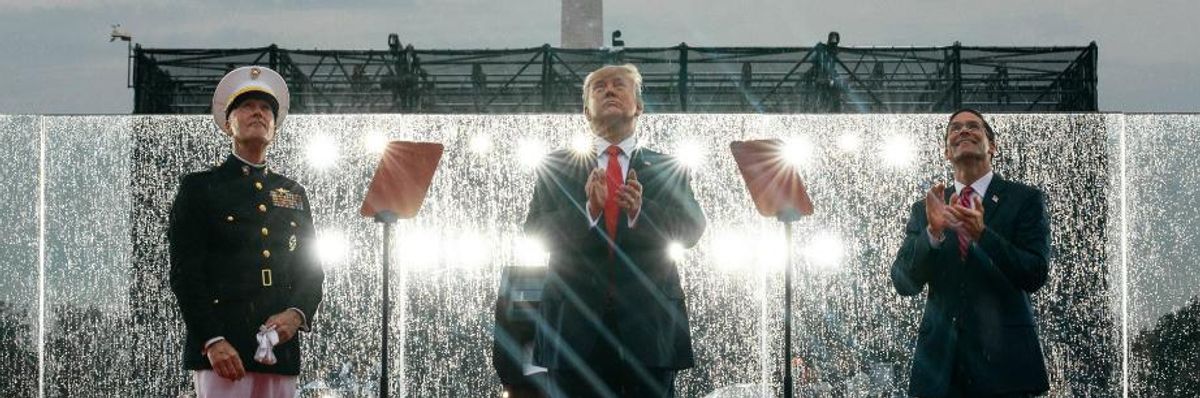
President Donald J. Trump, joined by the Chairman of Joint Chiefs of Staff General Joseph Dunford and Acting Secretary of Defense Mark T. Esper, watches an aircraft flyover during his remarks at the Salute to America event on July 4, 2019 at the Lincoln Memorial in Washington, D.C. (Photo: Andrea Hanks/White House/Flickr)
Suhauna Hussain at the LA Times reviews Trump's fragile grasp of history, from his Revolutionary War airports to his Revolutionary War bombardment of Ft.McHenry (which occurred during 1812).
In the 1980s, K. W. Jeter and others, building on work of Michael Moorcock, developed a new genre of science fiction set in a Victorian age transformed by technology, dubbed "steampunk" by analogy to the also-new genre of cyberpunk inspired by the rise of the internet. In 1990, Bruce Sterling and William Gibson put the genre on the map with their Difference Engine, which imagined what would have happened if Ada Lovelace and Charles Babbage's envisioned computer had actually been built.
Trump is clearly in some ways a major contributor to the steampunk genre of science fiction, having already made Frederick Douglass an immortal sort of like the Highlander, still living and coming up in the world in the 21st century, and having given Andrew Jackson a role in the Civil War. Presumably this creativity has in part to do with some form of dementia, many signs of which--including the slurred speech of a possible micro-stroke--he had earlier displayed.
I suspect, however, that large numbers of Americans anyway cannot distinguish historical eras from one another because they are increasingly poorly educated as a result of a conspiracy of billionaires' lobbying clubs such as ALEC that work to convince state legislatures to slash funds for public education. There is a reason that Trump once crowed that high school dropouts were among his major electoral constituencies: "I love the poorly educated."
Had air power existed in the 1770s and 1780s, my own suspicion is that it would have won the war for the British Empire. In Iraq after WWI, the British faced constant tribal and local rebellions by relatively mobile populations, and the RAF's Arthur Harris dealt with Iraq rebels by following them around from the air and intensively bombing them. The RAF officers even became embarrassed about the "shooting fish in a barrel" aspect of this multi-year brutal colonial air campaign, such that the worried in memos to one another what would happen if the war-weary public in Britain were to find out about it. "Bomber Harris," by the way, went on to play a major role in the use of air power against Germany during WWII, and was behind the firebombing of Dresden, a civilian city with no military importance.
The problem with Trump's scenario, where Washington crossed the Delaware to take the British airbase, is that the British biplanes would have been able to do good aerial surveillance, something the American guerrilla tactics made difficult for the British cavalry (traditionally the arm of the military in charge of surveillance). Seeing Washington's forces coming, the British biplanes could then have dropped small payloads on them and scattered them.
Trump's steampunk daydreams, broadcast as part of his white-nationalist Fascist Fourth of July campaign rally, signal more clearly than ever before the danger he poses to the Republic. The American business classes would prop up a store window mannequin as president if only it would get them the kind of tax cuts they received in February, 2018. The rest of us, however, surely have an interest in having a sane leader. But our equivalent of the Continental Congress, our national legislature, is too pusillanimous to rebel and impeach him. The Revolutionary War was fought against King George III, who himself descended into madness. We got rid of one mad king, only to find ourselves in 2019 saddled by another.
Even if we did take Cornwallis's airbase.
Dear Common Dreams reader, It’s been nearly 30 years since I co-founded Common Dreams with my late wife, Lina Newhouser. We had the radical notion that journalism should serve the public good, not corporate profits. It was clear to us from the outset what it would take to build such a project. No paid advertisements. No corporate sponsors. No millionaire publisher telling us what to think or do. Many people said we wouldn't last a year, but we proved those doubters wrong. Together with a tremendous team of journalists and dedicated staff, we built an independent media outlet free from the constraints of profits and corporate control. Our mission has always been simple: To inform. To inspire. To ignite change for the common good. Building Common Dreams was not easy. Our survival was never guaranteed. When you take on the most powerful forces—Wall Street greed, fossil fuel industry destruction, Big Tech lobbyists, and uber-rich oligarchs who have spent billions upon billions rigging the economy and democracy in their favor—the only bulwark you have is supporters who believe in your work. But here’s the urgent message from me today. It's never been this bad out there. And it's never been this hard to keep us going. At the very moment Common Dreams is most needed, the threats we face are intensifying. We need your support now more than ever. We don't accept corporate advertising and never will. We don't have a paywall because we don't think people should be blocked from critical news based on their ability to pay. Everything we do is funded by the donations of readers like you. When everyone does the little they can afford, we are strong. But if that support retreats or dries up, so do we. Will you donate now to make sure Common Dreams not only survives but thrives? —Craig Brown, Co-founder |
Suhauna Hussain at the LA Times reviews Trump's fragile grasp of history, from his Revolutionary War airports to his Revolutionary War bombardment of Ft.McHenry (which occurred during 1812).
In the 1980s, K. W. Jeter and others, building on work of Michael Moorcock, developed a new genre of science fiction set in a Victorian age transformed by technology, dubbed "steampunk" by analogy to the also-new genre of cyberpunk inspired by the rise of the internet. In 1990, Bruce Sterling and William Gibson put the genre on the map with their Difference Engine, which imagined what would have happened if Ada Lovelace and Charles Babbage's envisioned computer had actually been built.
Trump is clearly in some ways a major contributor to the steampunk genre of science fiction, having already made Frederick Douglass an immortal sort of like the Highlander, still living and coming up in the world in the 21st century, and having given Andrew Jackson a role in the Civil War. Presumably this creativity has in part to do with some form of dementia, many signs of which--including the slurred speech of a possible micro-stroke--he had earlier displayed.
I suspect, however, that large numbers of Americans anyway cannot distinguish historical eras from one another because they are increasingly poorly educated as a result of a conspiracy of billionaires' lobbying clubs such as ALEC that work to convince state legislatures to slash funds for public education. There is a reason that Trump once crowed that high school dropouts were among his major electoral constituencies: "I love the poorly educated."
Had air power existed in the 1770s and 1780s, my own suspicion is that it would have won the war for the British Empire. In Iraq after WWI, the British faced constant tribal and local rebellions by relatively mobile populations, and the RAF's Arthur Harris dealt with Iraq rebels by following them around from the air and intensively bombing them. The RAF officers even became embarrassed about the "shooting fish in a barrel" aspect of this multi-year brutal colonial air campaign, such that the worried in memos to one another what would happen if the war-weary public in Britain were to find out about it. "Bomber Harris," by the way, went on to play a major role in the use of air power against Germany during WWII, and was behind the firebombing of Dresden, a civilian city with no military importance.
The problem with Trump's scenario, where Washington crossed the Delaware to take the British airbase, is that the British biplanes would have been able to do good aerial surveillance, something the American guerrilla tactics made difficult for the British cavalry (traditionally the arm of the military in charge of surveillance). Seeing Washington's forces coming, the British biplanes could then have dropped small payloads on them and scattered them.
Trump's steampunk daydreams, broadcast as part of his white-nationalist Fascist Fourth of July campaign rally, signal more clearly than ever before the danger he poses to the Republic. The American business classes would prop up a store window mannequin as president if only it would get them the kind of tax cuts they received in February, 2018. The rest of us, however, surely have an interest in having a sane leader. But our equivalent of the Continental Congress, our national legislature, is too pusillanimous to rebel and impeach him. The Revolutionary War was fought against King George III, who himself descended into madness. We got rid of one mad king, only to find ourselves in 2019 saddled by another.
Even if we did take Cornwallis's airbase.
Suhauna Hussain at the LA Times reviews Trump's fragile grasp of history, from his Revolutionary War airports to his Revolutionary War bombardment of Ft.McHenry (which occurred during 1812).
In the 1980s, K. W. Jeter and others, building on work of Michael Moorcock, developed a new genre of science fiction set in a Victorian age transformed by technology, dubbed "steampunk" by analogy to the also-new genre of cyberpunk inspired by the rise of the internet. In 1990, Bruce Sterling and William Gibson put the genre on the map with their Difference Engine, which imagined what would have happened if Ada Lovelace and Charles Babbage's envisioned computer had actually been built.
Trump is clearly in some ways a major contributor to the steampunk genre of science fiction, having already made Frederick Douglass an immortal sort of like the Highlander, still living and coming up in the world in the 21st century, and having given Andrew Jackson a role in the Civil War. Presumably this creativity has in part to do with some form of dementia, many signs of which--including the slurred speech of a possible micro-stroke--he had earlier displayed.
I suspect, however, that large numbers of Americans anyway cannot distinguish historical eras from one another because they are increasingly poorly educated as a result of a conspiracy of billionaires' lobbying clubs such as ALEC that work to convince state legislatures to slash funds for public education. There is a reason that Trump once crowed that high school dropouts were among his major electoral constituencies: "I love the poorly educated."
Had air power existed in the 1770s and 1780s, my own suspicion is that it would have won the war for the British Empire. In Iraq after WWI, the British faced constant tribal and local rebellions by relatively mobile populations, and the RAF's Arthur Harris dealt with Iraq rebels by following them around from the air and intensively bombing them. The RAF officers even became embarrassed about the "shooting fish in a barrel" aspect of this multi-year brutal colonial air campaign, such that the worried in memos to one another what would happen if the war-weary public in Britain were to find out about it. "Bomber Harris," by the way, went on to play a major role in the use of air power against Germany during WWII, and was behind the firebombing of Dresden, a civilian city with no military importance.
The problem with Trump's scenario, where Washington crossed the Delaware to take the British airbase, is that the British biplanes would have been able to do good aerial surveillance, something the American guerrilla tactics made difficult for the British cavalry (traditionally the arm of the military in charge of surveillance). Seeing Washington's forces coming, the British biplanes could then have dropped small payloads on them and scattered them.
Trump's steampunk daydreams, broadcast as part of his white-nationalist Fascist Fourth of July campaign rally, signal more clearly than ever before the danger he poses to the Republic. The American business classes would prop up a store window mannequin as president if only it would get them the kind of tax cuts they received in February, 2018. The rest of us, however, surely have an interest in having a sane leader. But our equivalent of the Continental Congress, our national legislature, is too pusillanimous to rebel and impeach him. The Revolutionary War was fought against King George III, who himself descended into madness. We got rid of one mad king, only to find ourselves in 2019 saddled by another.
Even if we did take Cornwallis's airbase.