SUBSCRIBE TO OUR FREE NEWSLETTER
Daily news & progressive opinion—funded by the people, not the corporations—delivered straight to your inbox.
5
#000000
#FFFFFF
To donate by check, phone, or other method, see our More Ways to Give page.
Daily news & progressive opinion—funded by the people, not the corporations—delivered straight to your inbox.
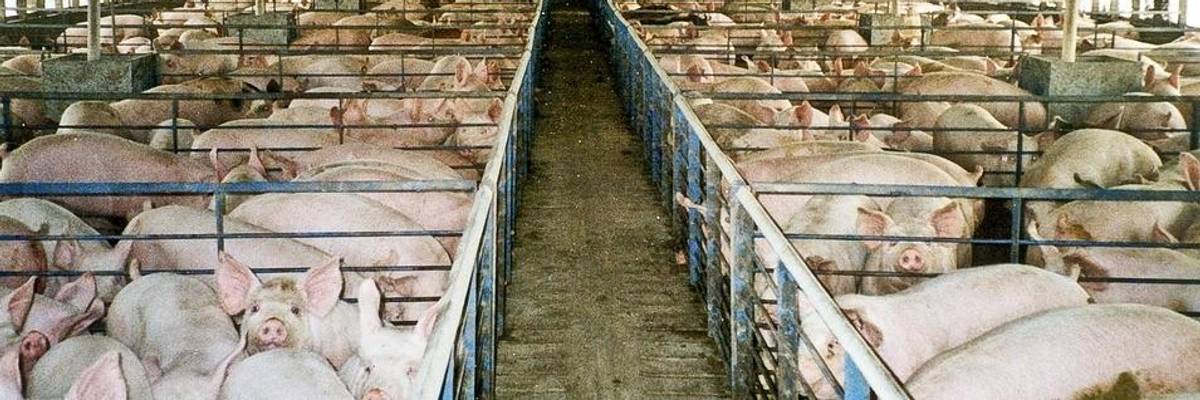
While Big Agriculture with its factory farming model is not too kind as a general rule, the Farm Bill did right by animals in several important respects. (Photo: Farm Sanctuary/flickr/cc)
It is no secret that moving legislation over the finish line in Washington, D.C., has not been easy of late. However, members of Congress did come together to pass the 2018 Farm Bill--a massive public-spending package that funds agriculture, conservation and food policy. It was signed into law by President Trump on December 20, just two days before the government shutdown began. While Big Agriculture with its factory farming model is not too kind as a general rule, the Farm Bill did right by animals in several important respects.
First and foremost, animal advocacy groups and concerned citizens successfully worked to remove an anti-animal provision that Rep. Steve King (R-Iowa) added to the House version of the bill. Of greatest concern to animal advocates was that Representative King's amendment would have nullified thousands of duly enacted laws concerning puppy mills, horse slaughter for human consumption and extreme confinement of farm animals. In its overreach, however, King's measure also threatened to undermine child labor laws and fire-safe cigarettes.
King repeats messages of "pro-states' rights" rhetoric, yet the legislation he introduces year after year threatens those very liberties. Recognizing that Americans care about the humane treatment of animals, Congress wisely opted to reject his dangerous amendment.
The Farm Bill also incorporated legislation addressing pet protection and domestic violence, and the inhumane practice of slaughtering dogs and cats for human consumption, among other things.
The Pet and Women Safety (PAWS) Act will extend current federal domestic violence protections to pets and empower people trapped in domestic violence situations to leave abusive relationships. Currently, only 3 percent of domestic violence shelters provide pet accommodations, which can delay victims from leaving a dangerous environment. Pets can be a source of comfort and support, but tragically, abusers will frequently exploit the emotional bond between a victim and a pet to gain psychological control.
Congress also included elements of The Dog and Cat Meat Trade Prohibition Act in the Farm Bill. Around 30 million dogs and untold numbers of cats are victims of this brutal global industry every year, with animals often snatched off the street or stolen from loving families and subjected to unspeakable abuse only to end as someone's supper. In November, Humane Society International assisted government authorities in a shutdown of the largest dog slaughterhouse in South Korea. This bill will prevent this appalling practice from taking hold in the US, and strengthen the case for ending it worldwide.
There is much more to the Farm Bill, of course, and there are measures in it that give us pause. But in putting the King amendment out to pasture, and in taking up popular measures that had garnered tremendous bipartisan support, Congress has set a standard that we hope will continue in 2019. With the terrible threat of King's measure set aside, and these other priorities made law, Congress should advance a legislative agenda in 2019 that tackles other urgent challenges in humane work, based on the premise that any decent nation is good to the animals in its care.
This article was produced by Earth | Food | Life, a project of the Independent Media Institute, and was originally published by Truthout.
Dear Common Dreams reader, It’s been nearly 30 years since I co-founded Common Dreams with my late wife, Lina Newhouser. We had the radical notion that journalism should serve the public good, not corporate profits. It was clear to us from the outset what it would take to build such a project. No paid advertisements. No corporate sponsors. No millionaire publisher telling us what to think or do. Many people said we wouldn't last a year, but we proved those doubters wrong. Together with a tremendous team of journalists and dedicated staff, we built an independent media outlet free from the constraints of profits and corporate control. Our mission has always been simple: To inform. To inspire. To ignite change for the common good. Building Common Dreams was not easy. Our survival was never guaranteed. When you take on the most powerful forces—Wall Street greed, fossil fuel industry destruction, Big Tech lobbyists, and uber-rich oligarchs who have spent billions upon billions rigging the economy and democracy in their favor—the only bulwark you have is supporters who believe in your work. But here’s the urgent message from me today. It's never been this bad out there. And it's never been this hard to keep us going. At the very moment Common Dreams is most needed, the threats we face are intensifying. We need your support now more than ever. We don't accept corporate advertising and never will. We don't have a paywall because we don't think people should be blocked from critical news based on their ability to pay. Everything we do is funded by the donations of readers like you. When everyone does the little they can afford, we are strong. But if that support retreats or dries up, so do we. Will you donate now to make sure Common Dreams not only survives but thrives? —Craig Brown, Co-founder |
It is no secret that moving legislation over the finish line in Washington, D.C., has not been easy of late. However, members of Congress did come together to pass the 2018 Farm Bill--a massive public-spending package that funds agriculture, conservation and food policy. It was signed into law by President Trump on December 20, just two days before the government shutdown began. While Big Agriculture with its factory farming model is not too kind as a general rule, the Farm Bill did right by animals in several important respects.
First and foremost, animal advocacy groups and concerned citizens successfully worked to remove an anti-animal provision that Rep. Steve King (R-Iowa) added to the House version of the bill. Of greatest concern to animal advocates was that Representative King's amendment would have nullified thousands of duly enacted laws concerning puppy mills, horse slaughter for human consumption and extreme confinement of farm animals. In its overreach, however, King's measure also threatened to undermine child labor laws and fire-safe cigarettes.
King repeats messages of "pro-states' rights" rhetoric, yet the legislation he introduces year after year threatens those very liberties. Recognizing that Americans care about the humane treatment of animals, Congress wisely opted to reject his dangerous amendment.
The Farm Bill also incorporated legislation addressing pet protection and domestic violence, and the inhumane practice of slaughtering dogs and cats for human consumption, among other things.
The Pet and Women Safety (PAWS) Act will extend current federal domestic violence protections to pets and empower people trapped in domestic violence situations to leave abusive relationships. Currently, only 3 percent of domestic violence shelters provide pet accommodations, which can delay victims from leaving a dangerous environment. Pets can be a source of comfort and support, but tragically, abusers will frequently exploit the emotional bond between a victim and a pet to gain psychological control.
Congress also included elements of The Dog and Cat Meat Trade Prohibition Act in the Farm Bill. Around 30 million dogs and untold numbers of cats are victims of this brutal global industry every year, with animals often snatched off the street or stolen from loving families and subjected to unspeakable abuse only to end as someone's supper. In November, Humane Society International assisted government authorities in a shutdown of the largest dog slaughterhouse in South Korea. This bill will prevent this appalling practice from taking hold in the US, and strengthen the case for ending it worldwide.
There is much more to the Farm Bill, of course, and there are measures in it that give us pause. But in putting the King amendment out to pasture, and in taking up popular measures that had garnered tremendous bipartisan support, Congress has set a standard that we hope will continue in 2019. With the terrible threat of King's measure set aside, and these other priorities made law, Congress should advance a legislative agenda in 2019 that tackles other urgent challenges in humane work, based on the premise that any decent nation is good to the animals in its care.
This article was produced by Earth | Food | Life, a project of the Independent Media Institute, and was originally published by Truthout.
It is no secret that moving legislation over the finish line in Washington, D.C., has not been easy of late. However, members of Congress did come together to pass the 2018 Farm Bill--a massive public-spending package that funds agriculture, conservation and food policy. It was signed into law by President Trump on December 20, just two days before the government shutdown began. While Big Agriculture with its factory farming model is not too kind as a general rule, the Farm Bill did right by animals in several important respects.
First and foremost, animal advocacy groups and concerned citizens successfully worked to remove an anti-animal provision that Rep. Steve King (R-Iowa) added to the House version of the bill. Of greatest concern to animal advocates was that Representative King's amendment would have nullified thousands of duly enacted laws concerning puppy mills, horse slaughter for human consumption and extreme confinement of farm animals. In its overreach, however, King's measure also threatened to undermine child labor laws and fire-safe cigarettes.
King repeats messages of "pro-states' rights" rhetoric, yet the legislation he introduces year after year threatens those very liberties. Recognizing that Americans care about the humane treatment of animals, Congress wisely opted to reject his dangerous amendment.
The Farm Bill also incorporated legislation addressing pet protection and domestic violence, and the inhumane practice of slaughtering dogs and cats for human consumption, among other things.
The Pet and Women Safety (PAWS) Act will extend current federal domestic violence protections to pets and empower people trapped in domestic violence situations to leave abusive relationships. Currently, only 3 percent of domestic violence shelters provide pet accommodations, which can delay victims from leaving a dangerous environment. Pets can be a source of comfort and support, but tragically, abusers will frequently exploit the emotional bond between a victim and a pet to gain psychological control.
Congress also included elements of The Dog and Cat Meat Trade Prohibition Act in the Farm Bill. Around 30 million dogs and untold numbers of cats are victims of this brutal global industry every year, with animals often snatched off the street or stolen from loving families and subjected to unspeakable abuse only to end as someone's supper. In November, Humane Society International assisted government authorities in a shutdown of the largest dog slaughterhouse in South Korea. This bill will prevent this appalling practice from taking hold in the US, and strengthen the case for ending it worldwide.
There is much more to the Farm Bill, of course, and there are measures in it that give us pause. But in putting the King amendment out to pasture, and in taking up popular measures that had garnered tremendous bipartisan support, Congress has set a standard that we hope will continue in 2019. With the terrible threat of King's measure set aside, and these other priorities made law, Congress should advance a legislative agenda in 2019 that tackles other urgent challenges in humane work, based on the premise that any decent nation is good to the animals in its care.
This article was produced by Earth | Food | Life, a project of the Independent Media Institute, and was originally published by Truthout.