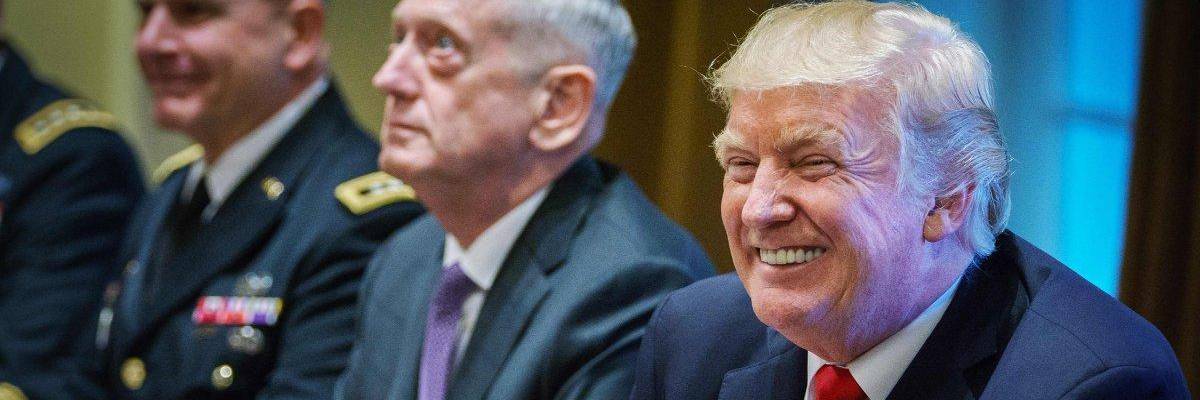
The commander-in-chief is wrong. (MANDEL NGAN/AFP/Getty Images)
Trump's Horrifying Iran Deal Gambit
“We are sleepwalking into an armed conflict.”
President Trump is creating another crisis, and this could be the worst of all. He is planning next week to begin pulling the United States out of the agreement made with the nations of the world to stop Iran's nuclear program. He reportedly will say that the accord, the product of years of exhaustive negotiations that was approved unanimously by the United Nations Security Council in 2015, is not in our national security interest.
Hardly any one agrees with him -- including his Secretary of Defense James Mattis, who told the Senate on Tuesday that the accord is in the national security interest. The entire national security team is with Mattis. At the same hearing, Chairman of the Joints Chiefs Gen. Joseph Dunford said the Iran is complying with the agreement, echoing the unanimous conclusion of our intelligence agencies and repeated reports from the International Atomic Energy Agency that Iran is following all the limits the deal imposed.
Our European allies strongly want America to keep its word, too, and reject the fanciful notion that Trump can somehow get a better deal.
"We don't think it's possible to renegotiate it," Germany's ambassador to the United States Peter Wittig told a Washington audience last week, "and we believe there is no practical peaceful alternative to this deal."
Even Israeli Prime Minister Benjamin Netanyahu's former national security advisor, Uzi Arad, says we ought to keep the deal in place.
"Doing away with the agreement is no real option," he says. "My position is in support of preserving the agreement and strengthening the agreement."
This is the nearly unanimous opinion of America's nuclear security experts, 85 of whom (including me) wrote President Trump last month that the agreement "has dramatically reduced the risk posed by Iran's nuclear program," and the unprecedented verification measures "make it very likely that any possible future effort by Iran to pursue nuclear weapons, even a clandestine program, would be detected promptly."
If Trump pulls out, or tries some bizarre new legislation that puts the agreement in continual, imminent risk of termination, he will instantly create three unnecessary crises.
First, it could very well put America in violation of the deal. This would allow Iran to break free of any restraints on its nuclear program, ending intrusive inspections and allowing it to expand its production of nuclear material tomorrow.
It will simultaneously kill any prospect of new multinational sanctions on Iran. Our allies have told us that if we walk away from this deal, we walk away alone. Iran will win; America will be isolated.
Second, and possibly worse, Trump will deliver a body blow to U.S. credibility, already so tenuous that our closest European allies are talking about going their own way. This will convince many that they can no longer rely on America's word.
Third, and worst of all, with restrictions ended and new sanctions impossible, the only alternative to preventing the rebuilding of Iran's nuclear program will suddenly become military action. Trump -- who claims (inaccurately) he opposed the war in Iraq -- will put us on the path to a new, unnecessary war in the Middle East, even as his impulsive behavior, insults and threats have inflamed the crisis with North Korea.
"We are sleepwalking into an armed conflict," Rep. Gerry Connolly (D-Va.) wrote on Thursday. He blasted the efforts to cherry-pick data to claim Iran was violating the agreement when the administration has presented no such evidence to Congress.
"The hidden scandal of the Iraq War -- the manipulation of intelligence to support a predetermined outcome," he said, "is now an overt political strategy to undermine a multilateral nonproliferation agreement."
He is right. A small group of neoconservative groups in Washington have stroked Trump's ego and fanned his obsessive hatred of former President Obama to convince him that he could and must tear down Obama's signature foreign policy achievement.
They manufacture "violations" no agency can find, invent a "spirit of the deal" than never existed, and imagine an alternative future where Iran caves to new, unilateral American demands -- or we use military force to remove the regime once and for all.
This is not a dream, but a nightmare.
We are at a crossroads
This country and this world are at a monumental crossroads. In a few short weeks, US voters will have an opportunity to beat back the forces of fascism and confront the billionaires who are rigging the economy, our media system, and our democracy, making it increasingly impossible for ordinary people to get by. We’re not just talking about the election. We’re talking about what must be done once these fascist elements are vanquished from power. We need a bolder set of solutions than what either major party has so far been willing to offer and a working-class movement ready to fight like hell for it. Trump didn't emerge from nowhere. The conditions that fueled MAGA authoritarianism were created by decades of radical neoliberal economic policies and a corrupt political system dominated by corporate interests. They slashed taxes on the super-rich, promising that the benefits would trickle down. They said giveaways to the corporate titans would make life more affordable for the rest of us. It was all bullshit. And when a bitter, betrayed populace searches for someone to blame, right-wing demagogues have little trouble finding scapegoats. People know when they're being lied to, but you won't hear any of this from the corporate media. Only independent journalism—powered and funded by people who believe in building a better world—can deliver truly trustworthy daily news. Our Fall Campaign is underway, and we need your help. To power our newsroom through the rest of the year, we need to raise $125,000 by midnight on October 31. So if you share our vision, please contribute whatever you can to sustain our work. |
President Trump is creating another crisis, and this could be the worst of all. He is planning next week to begin pulling the United States out of the agreement made with the nations of the world to stop Iran's nuclear program. He reportedly will say that the accord, the product of years of exhaustive negotiations that was approved unanimously by the United Nations Security Council in 2015, is not in our national security interest.
Hardly any one agrees with him -- including his Secretary of Defense James Mattis, who told the Senate on Tuesday that the accord is in the national security interest. The entire national security team is with Mattis. At the same hearing, Chairman of the Joints Chiefs Gen. Joseph Dunford said the Iran is complying with the agreement, echoing the unanimous conclusion of our intelligence agencies and repeated reports from the International Atomic Energy Agency that Iran is following all the limits the deal imposed.
Our European allies strongly want America to keep its word, too, and reject the fanciful notion that Trump can somehow get a better deal.
"We don't think it's possible to renegotiate it," Germany's ambassador to the United States Peter Wittig told a Washington audience last week, "and we believe there is no practical peaceful alternative to this deal."
Even Israeli Prime Minister Benjamin Netanyahu's former national security advisor, Uzi Arad, says we ought to keep the deal in place.
"Doing away with the agreement is no real option," he says. "My position is in support of preserving the agreement and strengthening the agreement."
This is the nearly unanimous opinion of America's nuclear security experts, 85 of whom (including me) wrote President Trump last month that the agreement "has dramatically reduced the risk posed by Iran's nuclear program," and the unprecedented verification measures "make it very likely that any possible future effort by Iran to pursue nuclear weapons, even a clandestine program, would be detected promptly."
If Trump pulls out, or tries some bizarre new legislation that puts the agreement in continual, imminent risk of termination, he will instantly create three unnecessary crises.
First, it could very well put America in violation of the deal. This would allow Iran to break free of any restraints on its nuclear program, ending intrusive inspections and allowing it to expand its production of nuclear material tomorrow.
It will simultaneously kill any prospect of new multinational sanctions on Iran. Our allies have told us that if we walk away from this deal, we walk away alone. Iran will win; America will be isolated.
Second, and possibly worse, Trump will deliver a body blow to U.S. credibility, already so tenuous that our closest European allies are talking about going their own way. This will convince many that they can no longer rely on America's word.
Third, and worst of all, with restrictions ended and new sanctions impossible, the only alternative to preventing the rebuilding of Iran's nuclear program will suddenly become military action. Trump -- who claims (inaccurately) he opposed the war in Iraq -- will put us on the path to a new, unnecessary war in the Middle East, even as his impulsive behavior, insults and threats have inflamed the crisis with North Korea.
"We are sleepwalking into an armed conflict," Rep. Gerry Connolly (D-Va.) wrote on Thursday. He blasted the efforts to cherry-pick data to claim Iran was violating the agreement when the administration has presented no such evidence to Congress.
"The hidden scandal of the Iraq War -- the manipulation of intelligence to support a predetermined outcome," he said, "is now an overt political strategy to undermine a multilateral nonproliferation agreement."
He is right. A small group of neoconservative groups in Washington have stroked Trump's ego and fanned his obsessive hatred of former President Obama to convince him that he could and must tear down Obama's signature foreign policy achievement.
They manufacture "violations" no agency can find, invent a "spirit of the deal" than never existed, and imagine an alternative future where Iran caves to new, unilateral American demands -- or we use military force to remove the regime once and for all.
This is not a dream, but a nightmare.
President Trump is creating another crisis, and this could be the worst of all. He is planning next week to begin pulling the United States out of the agreement made with the nations of the world to stop Iran's nuclear program. He reportedly will say that the accord, the product of years of exhaustive negotiations that was approved unanimously by the United Nations Security Council in 2015, is not in our national security interest.
Hardly any one agrees with him -- including his Secretary of Defense James Mattis, who told the Senate on Tuesday that the accord is in the national security interest. The entire national security team is with Mattis. At the same hearing, Chairman of the Joints Chiefs Gen. Joseph Dunford said the Iran is complying with the agreement, echoing the unanimous conclusion of our intelligence agencies and repeated reports from the International Atomic Energy Agency that Iran is following all the limits the deal imposed.
Our European allies strongly want America to keep its word, too, and reject the fanciful notion that Trump can somehow get a better deal.
"We don't think it's possible to renegotiate it," Germany's ambassador to the United States Peter Wittig told a Washington audience last week, "and we believe there is no practical peaceful alternative to this deal."
Even Israeli Prime Minister Benjamin Netanyahu's former national security advisor, Uzi Arad, says we ought to keep the deal in place.
"Doing away with the agreement is no real option," he says. "My position is in support of preserving the agreement and strengthening the agreement."
This is the nearly unanimous opinion of America's nuclear security experts, 85 of whom (including me) wrote President Trump last month that the agreement "has dramatically reduced the risk posed by Iran's nuclear program," and the unprecedented verification measures "make it very likely that any possible future effort by Iran to pursue nuclear weapons, even a clandestine program, would be detected promptly."
If Trump pulls out, or tries some bizarre new legislation that puts the agreement in continual, imminent risk of termination, he will instantly create three unnecessary crises.
First, it could very well put America in violation of the deal. This would allow Iran to break free of any restraints on its nuclear program, ending intrusive inspections and allowing it to expand its production of nuclear material tomorrow.
It will simultaneously kill any prospect of new multinational sanctions on Iran. Our allies have told us that if we walk away from this deal, we walk away alone. Iran will win; America will be isolated.
Second, and possibly worse, Trump will deliver a body blow to U.S. credibility, already so tenuous that our closest European allies are talking about going their own way. This will convince many that they can no longer rely on America's word.
Third, and worst of all, with restrictions ended and new sanctions impossible, the only alternative to preventing the rebuilding of Iran's nuclear program will suddenly become military action. Trump -- who claims (inaccurately) he opposed the war in Iraq -- will put us on the path to a new, unnecessary war in the Middle East, even as his impulsive behavior, insults and threats have inflamed the crisis with North Korea.
"We are sleepwalking into an armed conflict," Rep. Gerry Connolly (D-Va.) wrote on Thursday. He blasted the efforts to cherry-pick data to claim Iran was violating the agreement when the administration has presented no such evidence to Congress.
"The hidden scandal of the Iraq War -- the manipulation of intelligence to support a predetermined outcome," he said, "is now an overt political strategy to undermine a multilateral nonproliferation agreement."
He is right. A small group of neoconservative groups in Washington have stroked Trump's ego and fanned his obsessive hatred of former President Obama to convince him that he could and must tear down Obama's signature foreign policy achievement.
They manufacture "violations" no agency can find, invent a "spirit of the deal" than never existed, and imagine an alternative future where Iran caves to new, unilateral American demands -- or we use military force to remove the regime once and for all.
This is not a dream, but a nightmare.