SUBSCRIBE TO OUR FREE NEWSLETTER
Daily news & progressive opinion—funded by the people, not the corporations—delivered straight to your inbox.
5
#000000
#FFFFFF
To donate by check, phone, or other method, see our More Ways to Give page.
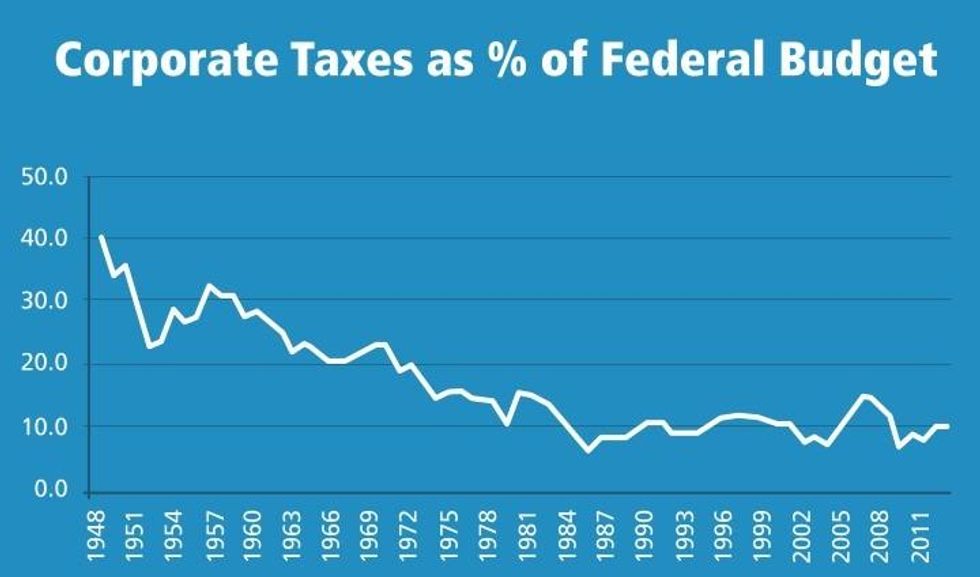
The study, produced by the Center for Effective Government and National People's Action, highlights the damage done by hewing to a central conservative tenet, that "cutting corporate taxes will stimulate job creation and grow the economy." The report shows the aftermath of a lower corporate tax rate on state budgets, and argues that a slight increase in the corporate share of federal revenues would restore cuts to education and public services and add an additional 3.2 million jobs.
With the onset of the Great Recession came budget cuts in the states. While states were buoyed somewhat by the American Reinvestment and Recovery Act, those dollars have stopped flowing, based on the belief that the one shot of stimulus in 2009 would be enough to kickstart our economy. For a few people it was; looking to Wall Street, the stock market has never been healthier. Corporate profits are booming and executives are receiving huge bonuses for the success of their products. Yet 10 million Americans remain jobless. A new Washington political class forced caps and cuts on the budget, but shielded corporate loopholes. This has led to decreased spending in many areas, including education, in the years after the stimulus was enacted.
As federal aid to states declined, many Republican-led states have rolled back taxes, on the theory that doing so would benefit their state's economy and create jobs. One such state, Kansas, has been considered to be a model for business-friendly tax policy, with Governor Sam Brownback receiving an "A" from the Cato Institute on his bold tax cut initiative in 2012. Fast-forward two years and the impact of these cuts can be seen more clearly.
Among these cuts was a tax exemption on corporate profits that are passed directly to individual owners - an extreme measure not done by any other state. According to a report by the Center for Budget and Policy Priorities, the cuts to revenues have acted as a mini-recession for the state of Kansas, and prevented it from moving away from the recession-era cuts to services as quickly as it could have without this tax cut.
As tax cuts for corporations gained more steam, another revenue mechanism had to pick up the slack, and as detailed in the NPA report, taxes on working Americans more than filled in that hole. What that essentially means is hard-working American employees were stuck with the tax bill as corporations were free to use loopholes to their advantage to keep money from government coffers. The report points out the seemingly infinite loop of agreeing to close tax loopholes for a decreased corporate rate, only to introduce new loopholes that must be closed in the future by decreasing the corporate tax rate, of course.
National People's Action and the Center for Effective Government argue that by returning to an Eisenhower-, or even a Nixon-era level of what corporations paid as a percentage of America's bills, corporations could smooth over the scars of the Great Recession and fill in the gaps of lapsed services by increasing tax revenues by $464 billion (Nixon) to $683 billion (Eisenhower).
National People's Action proposes to raise $200 billion in corporate taxes to close the funding gaps created since the recession. They do this by closing three loopholes:
The $200 billion raised through this program would be the salve to losses that occurred in the Great Recession. Under their estimates, a $36 billion-dollar increase would allow America "to refill the 667,000 jobs school teachers, first responders, librarians, highway crews, caretakers of public parks, and other state and city workers lost to budget cuts."
Using the American Society for Civil Engineers' number of $125 billion a year over the next eight years to improve U.S. infrastructure, an estimated additional 2.5 million jobs would be created, and America's waterways, bridges, roads and schools would be updated to modern standards.
It is time to give up on the nonsense of cutting corporate taxes to increase jobs, because we have seen that this is not working. If it did, where are all the jobs? Why are 10 million Americans without work? It clearly isn't working in Kansas. Millions of Americans could be put to work if these proposals were eliminated, and cuts to our state and local budgets would be reversed, allowing for a higher American quality of life. All that is standing in the way is a nonsensical conservative tenet.
The study, produced by the Center for Effective Government and National People's Action, highlights the damage done by hewing to a central conservative tenet, that "cutting corporate taxes will stimulate job creation and grow the economy." The report shows the aftermath of a lower corporate tax rate on state budgets, and argues that a slight increase in the corporate share of federal revenues would restore cuts to education and public services and add an additional 3.2 million jobs.
With the onset of the Great Recession came budget cuts in the states. While states were buoyed somewhat by the American Reinvestment and Recovery Act, those dollars have stopped flowing, based on the belief that the one shot of stimulus in 2009 would be enough to kickstart our economy. For a few people it was; looking to Wall Street, the stock market has never been healthier. Corporate profits are booming and executives are receiving huge bonuses for the success of their products. Yet 10 million Americans remain jobless. A new Washington political class forced caps and cuts on the budget, but shielded corporate loopholes. This has led to decreased spending in many areas, including education, in the years after the stimulus was enacted.
As federal aid to states declined, many Republican-led states have rolled back taxes, on the theory that doing so would benefit their state's economy and create jobs. One such state, Kansas, has been considered to be a model for business-friendly tax policy, with Governor Sam Brownback receiving an "A" from the Cato Institute on his bold tax cut initiative in 2012. Fast-forward two years and the impact of these cuts can be seen more clearly.
Among these cuts was a tax exemption on corporate profits that are passed directly to individual owners - an extreme measure not done by any other state. According to a report by the Center for Budget and Policy Priorities, the cuts to revenues have acted as a mini-recession for the state of Kansas, and prevented it from moving away from the recession-era cuts to services as quickly as it could have without this tax cut.
As tax cuts for corporations gained more steam, another revenue mechanism had to pick up the slack, and as detailed in the NPA report, taxes on working Americans more than filled in that hole. What that essentially means is hard-working American employees were stuck with the tax bill as corporations were free to use loopholes to their advantage to keep money from government coffers. The report points out the seemingly infinite loop of agreeing to close tax loopholes for a decreased corporate rate, only to introduce new loopholes that must be closed in the future by decreasing the corporate tax rate, of course.
National People's Action and the Center for Effective Government argue that by returning to an Eisenhower-, or even a Nixon-era level of what corporations paid as a percentage of America's bills, corporations could smooth over the scars of the Great Recession and fill in the gaps of lapsed services by increasing tax revenues by $464 billion (Nixon) to $683 billion (Eisenhower).
National People's Action proposes to raise $200 billion in corporate taxes to close the funding gaps created since the recession. They do this by closing three loopholes:
The $200 billion raised through this program would be the salve to losses that occurred in the Great Recession. Under their estimates, a $36 billion-dollar increase would allow America "to refill the 667,000 jobs school teachers, first responders, librarians, highway crews, caretakers of public parks, and other state and city workers lost to budget cuts."
Using the American Society for Civil Engineers' number of $125 billion a year over the next eight years to improve U.S. infrastructure, an estimated additional 2.5 million jobs would be created, and America's waterways, bridges, roads and schools would be updated to modern standards.
It is time to give up on the nonsense of cutting corporate taxes to increase jobs, because we have seen that this is not working. If it did, where are all the jobs? Why are 10 million Americans without work? It clearly isn't working in Kansas. Millions of Americans could be put to work if these proposals were eliminated, and cuts to our state and local budgets would be reversed, allowing for a higher American quality of life. All that is standing in the way is a nonsensical conservative tenet.
The study, produced by the Center for Effective Government and National People's Action, highlights the damage done by hewing to a central conservative tenet, that "cutting corporate taxes will stimulate job creation and grow the economy." The report shows the aftermath of a lower corporate tax rate on state budgets, and argues that a slight increase in the corporate share of federal revenues would restore cuts to education and public services and add an additional 3.2 million jobs.
With the onset of the Great Recession came budget cuts in the states. While states were buoyed somewhat by the American Reinvestment and Recovery Act, those dollars have stopped flowing, based on the belief that the one shot of stimulus in 2009 would be enough to kickstart our economy. For a few people it was; looking to Wall Street, the stock market has never been healthier. Corporate profits are booming and executives are receiving huge bonuses for the success of their products. Yet 10 million Americans remain jobless. A new Washington political class forced caps and cuts on the budget, but shielded corporate loopholes. This has led to decreased spending in many areas, including education, in the years after the stimulus was enacted.
As federal aid to states declined, many Republican-led states have rolled back taxes, on the theory that doing so would benefit their state's economy and create jobs. One such state, Kansas, has been considered to be a model for business-friendly tax policy, with Governor Sam Brownback receiving an "A" from the Cato Institute on his bold tax cut initiative in 2012. Fast-forward two years and the impact of these cuts can be seen more clearly.
Among these cuts was a tax exemption on corporate profits that are passed directly to individual owners - an extreme measure not done by any other state. According to a report by the Center for Budget and Policy Priorities, the cuts to revenues have acted as a mini-recession for the state of Kansas, and prevented it from moving away from the recession-era cuts to services as quickly as it could have without this tax cut.
As tax cuts for corporations gained more steam, another revenue mechanism had to pick up the slack, and as detailed in the NPA report, taxes on working Americans more than filled in that hole. What that essentially means is hard-working American employees were stuck with the tax bill as corporations were free to use loopholes to their advantage to keep money from government coffers. The report points out the seemingly infinite loop of agreeing to close tax loopholes for a decreased corporate rate, only to introduce new loopholes that must be closed in the future by decreasing the corporate tax rate, of course.
National People's Action and the Center for Effective Government argue that by returning to an Eisenhower-, or even a Nixon-era level of what corporations paid as a percentage of America's bills, corporations could smooth over the scars of the Great Recession and fill in the gaps of lapsed services by increasing tax revenues by $464 billion (Nixon) to $683 billion (Eisenhower).
National People's Action proposes to raise $200 billion in corporate taxes to close the funding gaps created since the recession. They do this by closing three loopholes:
The $200 billion raised through this program would be the salve to losses that occurred in the Great Recession. Under their estimates, a $36 billion-dollar increase would allow America "to refill the 667,000 jobs school teachers, first responders, librarians, highway crews, caretakers of public parks, and other state and city workers lost to budget cuts."
Using the American Society for Civil Engineers' number of $125 billion a year over the next eight years to improve U.S. infrastructure, an estimated additional 2.5 million jobs would be created, and America's waterways, bridges, roads and schools would be updated to modern standards.
It is time to give up on the nonsense of cutting corporate taxes to increase jobs, because we have seen that this is not working. If it did, where are all the jobs? Why are 10 million Americans without work? It clearly isn't working in Kansas. Millions of Americans could be put to work if these proposals were eliminated, and cuts to our state and local budgets would be reversed, allowing for a higher American quality of life. All that is standing in the way is a nonsensical conservative tenet.