
 Across the United States this week, new mayors and city council members are being sworn in as the leaders of the cities that elected them in November.

Except in Seattle.
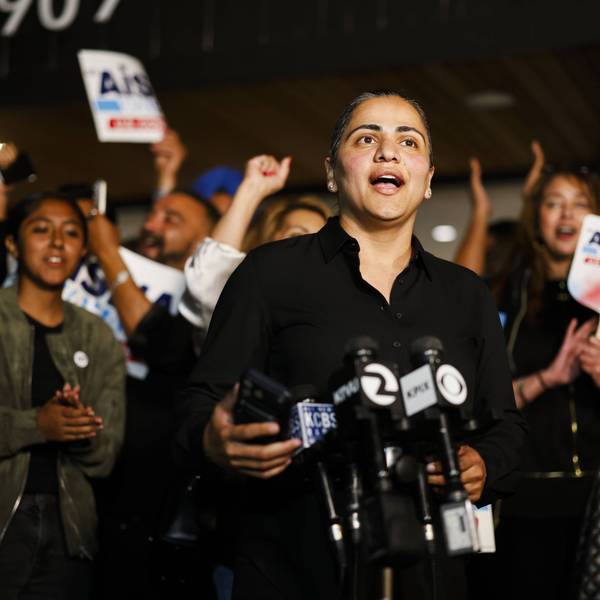
Monday afternoon's inauguration of City Council member Kshama Sawant, arguably the most prominent socialist elected to local office since Bernie Sanders became mayor of Burlington, Vermont, thirty-three years ago, has inspired a striking level of excitement. As officials moved the swearing in for Sawant and Mayor Ed Murray--Seattle's first openly gay mayor--from the city council chambers to the much larger lobby of the city hall, local media predicted "the largest turnout ever for a Seattle inauguration ceremony."
Reporters from around the country and around the world were interviewing Sawant, who in November upset a veteran council member with a campaign that promise to fight for a $15-an-hour minimum wage. They also interviewed other socialists, including Irish parliamentarian Joe Higgins, who was in Seattle to celebrate the event and to tell reporters, "Kshama's election has been a major event internationally. This has been a huge encouragement because the United States is the citadel of world capitalism."
It's a heady circumstance. But Sawant, the community college economics instructor and Occupy Seattle activist who turned to electoral politics as part of a broader commitment to movement building, kept it all in perspective.
"We're going to be focusing on Seattle politics, obviously, because that's going to be our job for the next two years," she explained in an interview before taking her oath. "We will be focusing on city politics: we will be in many ways initiating, in many ways participating in the struggle for $15-an-hour; and other issues like housing and transit. But the media attention gives us the opportunity to show the people that there's nothing unique about Seattle."
Sawant argues that "the social conditions that have meant that people are living in a circumstance of enormous inequality in the wealthiest country in the world" are not distinct to Seattle. At a time when "poverty is skyrocketing, housing is basically unaffordable" and unemployment and under-employment are serious issues in communities across the country, Sawant says it should not be surprising that "nearly 100,000 people voted for a socialist in Seattle."
Because of the strength of the vote she received, and the excitement about her election, Sawant was able to influence Seattle politics even before she took office. Last week, Mayor Murray ordered city administrators to develop plans to pay all municipal employees at least $15 per hour--a move that will lead to wage hikes for at least 600 Seattle workers. And Sawant will be working, on the council and if necessary via a referendum push, to establish a city-wide $15-an-hour base for workers.
She has no doubt the momentum will spread.
"I would say that this is simply the first wave in a storm that is about to be coming to the United States in [the form] of a demand for social change," argues the new council member. "When salon.com named me one of the five political heroes of 2013, my first reaction was: 'Why am I there...?' Why aren't the fast-food workers who went out courageously on one-day strikes all over the nation? They are the real political heroes as far as I am concerned. And it is important to mention them because they are signs that we are heading into a period of political change."
That period of political change has roots, Sawant suggests.
"This didn't come out of nowhere. The conditions have been building up for decades. They have been much worsened because of the recession," she says. "We saw Occupy happening, which broke the silence on inequality. And I don't think we should lose sight of [mass mobilizations of workers in Wisconsin, Ohio and other states].... It shows you that there have been a series of events that tell us people are getting fed up with accepting the status quo and want something different."
Except in Seattle.
Monday afternoon's inauguration of City Council member Kshama Sawant, arguably the most prominent socialist elected to local office since Bernie Sanders became mayor of Burlington, Vermont, thirty-three years ago, has inspired a striking level of excitement. As officials moved the swearing in for Sawant and Mayor Ed Murray--Seattle's first openly gay mayor--from the city council chambers to the much larger lobby of the city hall, local media predicted "the largest turnout ever for a Seattle inauguration ceremony."
Reporters from around the country and around the world were interviewing Sawant, who in November upset a veteran council member with a campaign that promise to fight for a $15-an-hour minimum wage. They also interviewed other socialists, including Irish parliamentarian Joe Higgins, who was in Seattle to celebrate the event and to tell reporters, "Kshama's election has been a major event internationally. This has been a huge encouragement because the United States is the citadel of world capitalism."
It's a heady circumstance. But Sawant, the community college economics instructor and Occupy Seattle activist who turned to electoral politics as part of a broader commitment to movement building, kept it all in perspective.
"We're going to be focusing on Seattle politics, obviously, because that's going to be our job for the next two years," she explained in an interview before taking her oath. "We will be focusing on city politics: we will be in many ways initiating, in many ways participating in the struggle for $15-an-hour; and other issues like housing and transit. But the media attention gives us the opportunity to show the people that there's nothing unique about Seattle."
Sawant argues that "the social conditions that have meant that people are living in a circumstance of enormous inequality in the wealthiest country in the world" are not distinct to Seattle. At a time when "poverty is skyrocketing, housing is basically unaffordable" and unemployment and under-employment are serious issues in communities across the country, Sawant says it should not be surprising that "nearly 100,000 people voted for a socialist in Seattle."
Because of the strength of the vote she received, and the excitement about her election, Sawant was able to influence Seattle politics even before she took office. Last week, Mayor Murray ordered city administrators to develop plans to pay all municipal employees at least $15 per hour--a move that will lead to wage hikes for at least 600 Seattle workers. And Sawant will be working, on the council and if necessary via a referendum push, to establish a city-wide $15-an-hour base for workers.
She has no doubt the momentum will spread.
"I would say that this is simply the first wave in a storm that is about to be coming to the United States in [the form] of a demand for social change," argues the new council member. "When salon.com named me one of the five political heroes of 2013, my first reaction was: 'Why am I there...?' Why aren't the fast-food workers who went out courageously on one-day strikes all over the nation? They are the real political heroes as far as I am concerned. And it is important to mention them because they are signs that we are heading into a period of political change."
That period of political change has roots, Sawant suggests.
"This didn't come out of nowhere. The conditions have been building up for decades. They have been much worsened because of the recession," she says. "We saw Occupy happening, which broke the silence on inequality. And I don't think we should lose sight of [mass mobilizations of workers in Wisconsin, Ohio and other states].... It shows you that there have been a series of events that tell us people are getting fed up with accepting the status quo and want something different."
Except in Seattle.
Monday afternoon's inauguration of City Council member Kshama Sawant, arguably the most prominent socialist elected to local office since Bernie Sanders became mayor of Burlington, Vermont, thirty-three years ago, has inspired a striking level of excitement. As officials moved the swearing in for Sawant and Mayor Ed Murray--Seattle's first openly gay mayor--from the city council chambers to the much larger lobby of the city hall, local media predicted "the largest turnout ever for a Seattle inauguration ceremony."
Reporters from around the country and around the world were interviewing Sawant, who in November upset a veteran council member with a campaign that promise to fight for a $15-an-hour minimum wage. They also interviewed other socialists, including Irish parliamentarian Joe Higgins, who was in Seattle to celebrate the event and to tell reporters, "Kshama's election has been a major event internationally. This has been a huge encouragement because the United States is the citadel of world capitalism."
It's a heady circumstance. But Sawant, the community college economics instructor and Occupy Seattle activist who turned to electoral politics as part of a broader commitment to movement building, kept it all in perspective.
"We're going to be focusing on Seattle politics, obviously, because that's going to be our job for the next two years," she explained in an interview before taking her oath. "We will be focusing on city politics: we will be in many ways initiating, in many ways participating in the struggle for $15-an-hour; and other issues like housing and transit. But the media attention gives us the opportunity to show the people that there's nothing unique about Seattle."
Sawant argues that "the social conditions that have meant that people are living in a circumstance of enormous inequality in the wealthiest country in the world" are not distinct to Seattle. At a time when "poverty is skyrocketing, housing is basically unaffordable" and unemployment and under-employment are serious issues in communities across the country, Sawant says it should not be surprising that "nearly 100,000 people voted for a socialist in Seattle."
Because of the strength of the vote she received, and the excitement about her election, Sawant was able to influence Seattle politics even before she took office. Last week, Mayor Murray ordered city administrators to develop plans to pay all municipal employees at least $15 per hour--a move that will lead to wage hikes for at least 600 Seattle workers. And Sawant will be working, on the council and if necessary via a referendum push, to establish a city-wide $15-an-hour base for workers.
She has no doubt the momentum will spread.
"I would say that this is simply the first wave in a storm that is about to be coming to the United States in [the form] of a demand for social change," argues the new council member. "When salon.com named me one of the five political heroes of 2013, my first reaction was: 'Why am I there...?' Why aren't the fast-food workers who went out courageously on one-day strikes all over the nation? They are the real political heroes as far as I am concerned. And it is important to mention them because they are signs that we are heading into a period of political change."
That period of political change has roots, Sawant suggests.
"This didn't come out of nowhere. The conditions have been building up for decades. They have been much worsened because of the recession," she says. "We saw Occupy happening, which broke the silence on inequality. And I don't think we should lose sight of [mass mobilizations of workers in Wisconsin, Ohio and other states].... It shows you that there have been a series of events that tell us people are getting fed up with accepting the status quo and want something different."